
International Research Journal of Engineering and Technology (IRJET) e-ISSN: 2395-0056
Volume: 11 Issue: 11 | Nov 2024 www.irjet.net p-ISSN: 2395-0072

International Research Journal of Engineering and Technology (IRJET) e-ISSN: 2395-0056
Volume: 11 Issue: 11 | Nov 2024 www.irjet.net p-ISSN: 2395-0072
Shri Narayan Sharma1 , Saiyad Aaliya2 , Rupesh Chandra3 , Ganesh Ram Ratnakar4 , Vikas Chandra5 , Mohini Moitra Bhaduri6
1,2,3_B.TECH Scholar, Chouksey Engineering College , Bilaspur 4,5,6_Assistant Professor , Choukesy Engineering College , Bilaspur Department of Electrical & Electronics Engineering
Abstract A simulation model of an induction motor usingLabVIEWprovidesapowerfulplatformforanalyzing, designing,andtestingmotorcontrolstrategiesinagraphical programmingenvironment.Inductionmotors,widelyused in industrial, automotive, and renewable energy systems, require accurate modeling to optimize performance and efficiency. LabVIEW offers an intuitive interface for developing motor simulations, integrating mathematical models with real-time monitoring and hardware testing capabilities.Thissimulationframeworkenablesthedesign ofadvancedcontrolstrategiessuchasField-OrientedControl (FOC) and Direct Torque Control (DTC), as well as the evaluationofkeymotorparameterslikespeed,torque,and efficiencyundervariousoperatingconditions.
TheuseofLabVIEWextendstoHardware-in-the-Loop(HIL) testing, allowing seamless integration with embedded systems for validating control algorithms and ensuring system reliability. Additionally, it supports fault detection and diagnostics, enabling the simulation of abnormal operating scenarios to enhance motor reliability. Widely adopted in educational and industrial settings, LabVIEWbasedmotorsimulationsprovideanaccessibleplatformfor prototyping, research, and training, bridging theoretical concepts with practical implementation. By offering flexibility, real-time capabilities, and extensive hardware compatibility, LabVIEW proves to be a valuable tool in advancingthedevelopmentandunderstandingofinduction motorsystems.
Key Words: Induction motor, Lab VIEW, simulation
1.INTRODUCTION
Itischallengingtophysicallysimulateaninductionmotor because it is a nonlinear, highly coupled system with a complex connection among its input as well as output variables.Thecomplexityofthemotorsystemofcontrolis increasingaspowerelectronicsandinductionmotorcontrol theoryThedynamicpropertiesofasynchronousinduction motors and its motion-induced modification of different electromagneticlawscanbeshownbycomputersimulation of the induction motor's dynamic process. Simulation programs like Matlab, Protel, and are frequently utilized. There is one significant distinction between and other computerprograms:whileotherprogramsaremadeusing
textlinesofcodeLabVIEWgeneratesapiece ofcodeusing thegraphicalprogramminglanguageG.diagrammaticform. Thesimulationwillbemuchaidedbythedirectmodification of the actual motor characteristics. The initial step in the dynamic analysis approach of an induction motor is to establish the motor's mathematical and physical models [1].Thesecondstepistosolvethemathproblemsofmotion. Lastly, evaluate the findings and make inferences. The inductionmotor'sstateequation,independentofironloss,is inferredunderatwo-phasestationarycoordinatesystemin order to distinguish between the motor's parameters and state.
ThesimulationofinductionmotorsusingLabVIEWhasits roots in the evolution of motor analysis and control methodologies. Initially, motor modeling relied on mathematical equations and analog tools, focusing on steady-stateandtransientperformance.Withtheadventof digital computing in the 1970s, numerical simulations becamemoreaccessible,andlanguageslikeFORTRANand MATLAB gained prominence in motor analysis, enabling more precise modeling of dynamic behaviors. The introductionofLabVIEWin1986revolutionizedsimulation approaches by providing a graphical programming environment that combined ease of use with robust realtimecapabilities.Thisinnovationallowedfortheseamless integrationofhardwareandsoftware,makingitapreferred choiceformotorcontrolsimulations,educationalpurposes, andindustrialapplications.LabVIEWenabledengineersto model and test advanced control strategies, such as fieldorientedanddirecttorquecontrol,whileofferingreal-time monitoringandanalysis.Overtime,itbecameapivotaltool inbothresearchanddevelopment,particularlyinareaslike renewable energy systems and automation, bridging theoreticalconceptswithpracticalimplementation.
1 ControlSystemDesignandTesting:
Developing and testing advanced motor control strategies such as Field-Oriented Control (FOC), Direct Torque Control (DTC), and Scalar (V/f) control.
International Research Journal of Engineering and Technology (IRJET) e-ISSN: 2395-0056
Volume: 11 Issue: 11 | Nov 2024 www.irjet.net p-ISSN: 2395-0072
Fine-tuning control algorithms for optimal performancebeforereal-worlddeployment.
2 Real-TimeSimulationandHardware-in-the-Loop(HIL):
Performing real-time simulations to test motor performanceundervariousoperatingconditions.
IntegratingwithembeddedsystemsforHILtesting, enablingengineerstovalidatedesignswithactual hardware.
3 PerformanceAnalysisandOptimization:
Analyzing key parameters like speed, torque, current, and efficiency under different load conditions.
Optimizingmotordesignsforspecificapplications suchaselectricvehiclesorindustrialdrives.
4 EducationalApplications:
Providingstudentsandresearcherswithahands-on platformtounderstandmotordynamicsandcontrol principles.
Simulating motor behavior for laboratory experimentswithoutneedingexpensivehardware.
5 FaultDetectionandDiagnostics:
Simulating and identifying potential motor faults, such as stator or rotor faults, for condition monitoring.
Developing and testing diagnostic algorithms to improvemotorreliability.
5 RenewableEnergySystems:
Designing and testing induction motors used in wind turbines or other renewable energy applications.
Ensuring efficient energy conversion and motor controlinvariableenvironments.
7 IndustrialAutomation:
Simulatingandcontrollinginductionmotorsusedin manufacturing processes, robotics, and conveyor systems.
Improving precision and reliability in automated systems.
Thedynamicmodelofaninductionmotordescribesits behavior during transient conditions, capturing the interplaybetweenelectricalandmechanicaldynamics. Unlikethesteady-statemodel,it employs the d-qaxis representationtotransformthethree-phasesysteminto two orthogonal axes in a rotating reference frame, simplifyingtheanalysisoftime-varyingelectromagnetic and mechanical interactions. In the analysis of three phases induction motor’s multivariable mathematical model, making the following assumptions[1]. The principleofsuperpositioncanbeusedfortheanalysisof magnetic field and the corresponding the induced electromagneticfields.Motormagneticcircuitislinear, iron heart hysteresis and eddy current losses are negligible. Air-gap magnetic field distribution is sinusoidalinspace,themagneticfieldofhighharmonics isnegligible.Forthethree-phaseinductionmotor,the statorwindingsaresymmetric.Inductanceofstatorand rotor are all linear and independent of the winding currentvalue.
International Research Journal of Engineering and Technology (IRJET) e-ISSN: 2395-0056
Volume: 11 Issue: 11 | Nov 2024 www.irjet.net p-ISSN: 2395-0072
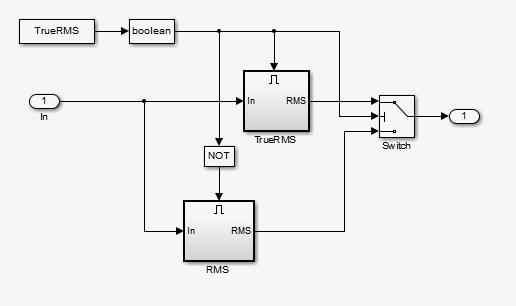
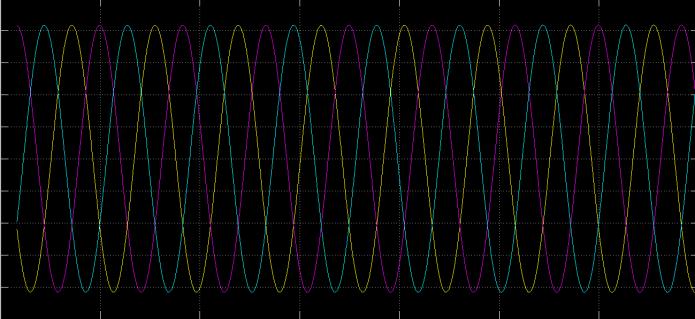
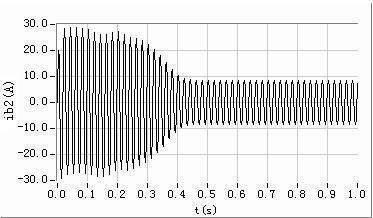
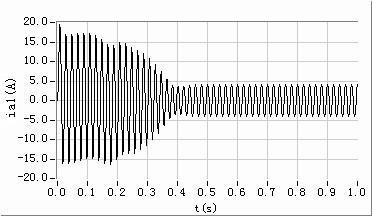
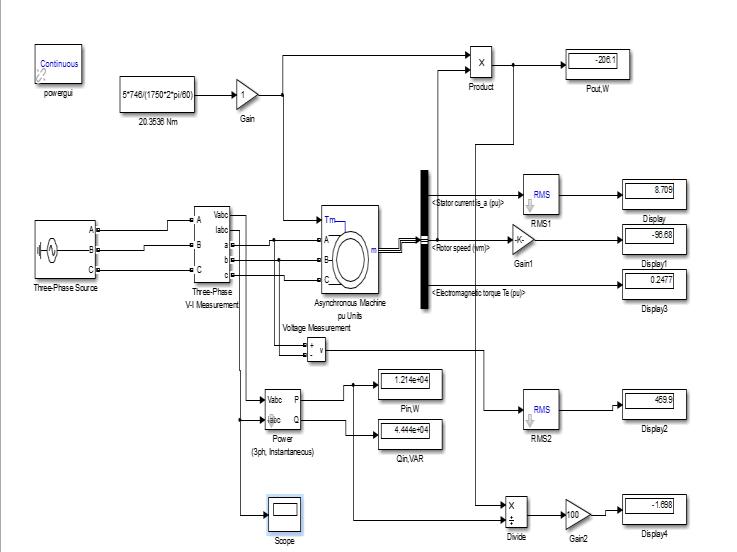
Theexaminationoftheexperimentalfindingsdemonstrates thatthemotormodelcreatedusingLabVIEWiscapableof simulating the motor's operation and performance evaluation. The simulation output can be analyzed using LabVIEW'ssignalprocessingfacilities.Foradditionalmotor development,thisenginemodelmaybefurtherbundledasa sub-VI.Asimpleandefficientwaytocombinetheequivalent circuitsofseveralinductionmotorsintoasinglemotorwas giveninthestudy.Itfollowsthattheoverallpowerfromall of the individual motors equals the power from a single motor. The approach is predicated on the steady-state inductionmotortheory.TheMATLABsoftwarepackageis usedtodothesimulation.Theaggregatemodel'sresultsare contrastedwiththetotaloftheseparateinductionmotors' results. The simulation results show that the combined motor model performs satisfactorily. Comparedtotheearlierworkin[9],themodelprovidedin thisresearchisstraightforwardandsimpletocompute.The computationrequiredtodeterminetheaggregateinduction motor'sparametersisnotdifficultortime-consuming.Asa result,thesuggestedapproachmaybeusefulforsimulating numerous motor workloads in a complicated power system.experimentalinvestigation.Forelectricalsimulation, LabVIEWhasshowntobeaveryusefultool.
[1] E. Levi, “Impact of iron loss on behavior of vector controlledinductionmachines,”IEEETrans.Ind.Appl.,vol. 31,no.6,pp.1287–1296,Nov./Dec.1995.
[2] Yunqiu. Tang, Yihuang. Zhang SNS Yu. Fan, Dynamic Analysis of Alternating Current Machines. Beijing: China MachinePress,2004,ch.1.
[3]Jian.Chen, Mathematical Model and SpeedModulation System of Alternating Current Machines. Beijing: National defenseindustryPress,1991,ch.2.
[4] National Instruments Corporation. Simulation Module UserManual.April2004Edition.PartNumber371013A-01