
International Research Journal of Engineering and Technology (IRJET)
Volume: 11 Issue: 11 | Nov 2024 www.irjet.net
e-ISSN:2395-0056
p-ISSN:2395-0072

International Research Journal of Engineering and Technology (IRJET)
Volume: 11 Issue: 11 | Nov 2024 www.irjet.net
e-ISSN:2395-0056
p-ISSN:2395-0072
Adwait Mandge1, Rohan Fatehchandka2, Kunal Goudani3, Tanaya Shelke4, Prof. Pramila M. Chawan5
11B. Tech Student, Dept of Computer Engineering, and IT, VJTI College, Mumbai, Maharashtra, India
21B. Tech Student, Dept of Computer Engineering, and IT, VJTI College, Mumbai, Maharashtra, India
31B. Tech Student, Dept of Computer Engineering, and IT, VJTI College, Mumbai, Maharashtra, India
41B. Tech Student, Dept of Computer Engineering, and IT, VJTI College, Mumbai, Maharashtra, India
5Associate Professor, Dept of Computer Engineering, and IT, VJTI College, Mumbai, Maharashtra, India
Abstract - Loan default prediction is a critical challenge in the banking sector, where inaccurate assessments can lead to significant financial losses. Recent advances in machine learning, particularly in ensemble methods and deep learning, present valuable opportunities for automating and improving loan default predictions. This paperpresentsa novelWeightedVotingEnsembleapproach by training multiple models Random Forest, XGBoost, and Neural Networks and assigning weights to their predictions based on performance metrics. Neural networks capture complex, high-dimensional patterns, while traditional models like Random Forest and XGBoost handle simpler but crucial features. This hybrid method enhances prediction robustness, optimizing loan default predictions by leveraging the strengths of each model. Additionally, dataimbalanceisaddressedusingSMOTEtoimprovemodel performance.
Key Words: Machine Learning, Deep Learning, Ensemble, LoanDefaultPrediction
1.INTRODUCTION
In today’s financial landscape, loan default is a significant risk that banks and lending institutions constantly face. The challenge of ensuring loan repayment while minimizing default rates is crucial for maintaining profitabilityandoperational stability.Traditionally,credit assessments were performed manually, requiring extensive human intervention and time, which often resulted in inefficiencies and inaccuracies. As the volume of loan applications increased, it became evident that manual methods could no longer meet the needs of modern financial systems, particularly in dealing with largedatasets.
TheprevalenceofMachineLearninghasmadeiteasierfor banks to access advanced technologies that can automate and improve credit risk management. Machine learning models are capable of analyzing data in bulk and identify and recognize structures that are perplexing for humans to detect through manual analysis. By leveraging these models, financial institutions can not only predict loan
defaults with greater precision but also significantly reducetheresourcesrequiredforcreditassessments.
This study aims to examine the potency of several algorithms in predicting loan defaults. Using a dataset sourced from Kaggle, we compare the performance of individual and ensemble models, with a particular focus on addressing the challenge of data imbalance. The objective is to determine which model provides the highest accuracy and reliability for lenders, thereby helpinginmakinginformeddecisionsandlossprevention.
Logistic Regression calculatestheprobabilitythatagiven inputisamemberofaspecificclass.Theoutputisascore in the range [0,1] which is then threshold-based to produceabinaryforecast(yes/no,spam/notspam,etc.).
Naive Bayes is a classification algorithm that supposes that attributes are conditionally independent of the given class label provided,derived from Bayes' Theorem and works well even when this assumption is violated in practice, especially with high-dimensional data. The advantages of this algorithm are its speed, simplicity, and effectiveness, particularly for text classification and large datasets.
Decision Tree is a rule based technique used for classification and regression of data points.. The data points are divided based on feature values,each node represents a test on attributes, and each leaf node represents a final outcome. The algorithm offers ease of interpretation, supports both categorical and numerical data, and does not require data scaling. It is capable of incorporating missing values and provides seamless visualization,providinginsightsintofeatureimportance.
Random Forest learning technique is used to solve various problems of regression and classification problems. It builds several trees during training and aggregates the outcomes to increase prediction accuracy.
International Research Journal of Engineering and Technology (IRJET) e-ISSN:2395-0056
Volume: 11 Issue: 11 | Nov 2024 www.irjet.net p-ISSN:2395-0072
Features are randomly selected at every node(feature bagging), and each tree in the forest is trained on an arbitrary subclass of the data (bootstrapping). Random Forest reduces variation and overfitting and averages the outcomes of these trees, which enhances generalization. The advantages of this algorithm are handling large datasets, reducing overfitting, and maintaining good accuracyeveninthepresenceofmissingdata.
XGBoost (Extreme Gradient Boosting) is a scalable and extremely effective gradient boosting implementation. It constructs decision trees sequentially, aiming to fix the mistakes caused by preceding trees with each new tree. XGBoostusesgradientdescenttominimizetheoverallloss functioninordertooptimizethemodel.Performanceand speed are well-known for XGBoost, particularly with tabular or structured data.The advantages of this algorithm are its speed, scalability, handling of missing data,andregularizationtominimizeoverfitting.
AdaBoost (Adaptive Boosting) is an ensemble learning method that combines weak classifiers, typically decision trees, into a stronger classifier. It ensures that the subsequent classifier focuses more on fixing the errors of the preceding one by assigning larger weights to misclassified examples and smaller weights to correctly classified ones. AdaBoost continues this process until the overall error is minimized.The advantages of this algorithm are its ability to improve weak classifiers and adaptabilitytochallengingdata.
Bagging (Random Forest) is an ensemble technique wheremultiplemodelsaretrainedonarbitrarysubclasses of the data. For classification, majority voting is used for determining the final output and that of regression are averaged. Random Forest is a well-known bagging method. The advantages of this algorithm are the reductionofvarianceandoverfitting,alongwithimproved model robustness.Moreover,baggingenhancespredictive accuracy by allowing each model to correct the errors of others. It also helps in minimizing the influence of noise and outliers present in the dataset. By training on completely randomized shares of data, it introduces diversity among models, making the final model highly resistant to overfitting. This technique is particularly useful when discrepancy is observed in large amounts in the base models, as it effectively stabilizes predictions, providing a more reliable and generalized performance acrossunseendata.
Boosting isanensemblelearningtechniquewheremodels arebuiltsequentiallytocorrecttheerrorsofthepreceding model.Byadjustingtheweightsofweaklearners,boosting helps improve their accuracy. Weak learners are often decision trees.The advantages of this algorithm are its abilitytoreducebias.
Stacking (LR, SVM, NN) uses many base models (e.g., SVM, Neural Networks, and Logistic Regression) to create ameta-modelthatsynthesizestheirpredictions.Eachbase model is trained independently, and the meta-learner combines their outputs to make a final prediction.The advantages of this algorithm are its ability to reduce overfitting and improve the accuracy by using various models.
Neural Networks replicatethecompositionofthehuman brain. Neural networks comprise multiple bands of neurons connected by edges with weights that are updatedduringtraining.Neuralnetworksarewidelyused in deep learning processes as they can interpret occurrences of perplexing repetitive sequences. The advantages of this algorithm are its flexibility, it can interpretinformationfromhugedatasets,anditspotential toreplicatelateralrelationships.
Multi-Layer Perceptron (MLP) is used in deep learning tasks. MLPs consist of multiple layers which are interconnected to each other, every neuron of one layer acts as an input to the neuron in the next layer. MLPs are used in classification, regression, and serve as the foundation for more intrinsic neural networks. Its capability to handle both regression and classification problems, and its role as a foundation for more advanced neuralnetworksisadvantageous
Vijay Kumar, Rachna Narula, and Akanksha Kochhar [1] developed a model to analyze bank credit data for loan approval decisions. Their results showed that K-NN outperformed Logistic Regression, helping businesses reducerisksassociatedwithloandefaults
JinchenLin[2]appliedmachinelearningtoanalyzecredits associated with loans using Kaggle dataset, comparing variousalgorithms.XGBoostshowed thehighestaccuracy, while Logistic Regression performed the worst, highlighting XGBoost's potential to boost profitability for lenders.
Wanjun Wu's[3] study applies Random Forest and XGBoost algorithms to predict loan default cases, achieving high accuracy scores of 0.90657 and 0.90635, respectively. The author has employed feature engineering techniques, including the variance threshold method and Variance Inflation Factor (VIF), to remove irrelevantfeaturesbeforeapplyingthemodels.Theresults show minimal differences in prediction performance between the two algorithms, indicating that both are effectiveforthistask.
International Research Journal of Engineering and Technology (IRJET) e-ISSN:2395-0056
Volume: 11 Issue: 11 | Nov 2024 www.irjet.net p-ISSN:2395-0072
Platur Gashi[4] highlights the effectiveness of various algorithms,includingNeural Networks(NN),NaiveBayes, as well as ensemble methods like Bagging (Random Forest),Boosting(DecisionTrees),andStacking(LR,SVM, NN) in predicting loan defaults. The results reveal that ensemble models outperform individual classifiers, with Boosted Decision Trees achieving maximum accuracy at 84.9% whereas 83.1%. Among individual classifiers, Neural Networks performed the best, reaching an accuracy of 80.3%, while Naive Bayes lagged significantly at 46.5%. These findings underscore the superior predictivepowerofensembleapproachesinthisdomain.
Qingyong Chu, Ping Hu, Xinchang Song, Xu Zhu and Lu Peng[6] utilized algorithms to determine the likelihood that the loan will default. With an accuracy greater than 0.8, LightGBM and XGBoost obtained the best results.
Crucial elements impacting forecasts, like loan length, grade, and credit rating, were explained using the LIME technique.
Author Technique Used Accuracy
Vijay K umar, Ra chna Narula, Akanksha Kochhar [1]
Jinchen Lin[2]
LRandKNN KNN performed betterthanLR
LiliLai[5] XGBoost, AdaBoost. KNN, RF,MLP RF-50.1% AdaBoost100% XGBoost - 71.6% KNN-50.3% MLP-50%
Qingyong Chu,Ping Hu, Xinchang Song,Xu Zh u,Lu Peng[6]
DT, LR, LightGBM, XGBoostLIME Logistic Regression65.55%, Decision Tree-63.17%, XGBoost-80%, LightGBM81.04%
Problem Statement: “To predict loan default using machinelearningtechniques.”
Wanjun Wu[3]
Platur
Random Forest, Logistic Regression,XGBoost,AdaBoost
XGBoost93.26% AdaBoost92.37% RF-92.72%
RandomForest,XGBoost RF - 0.90657, XGBoost0.90635
Gashi[4] LR,DT SVM, NN, NB, BaggingRF, Boosting - DT, Stacking -LR,SVM,NN
LR-76.9% DT-75.3% SVM-75.9% NN-80.3%
Naive Bayes46.5%
Bagging RF83.1% Boosting DT84.9%
Stacking - LR, SVM,NN-73.7%
Problem Elaboration:Forfinancial organizations,loan failureposesa seriousproblemsinceitcanresultinlarge losses and elevated risk. Conventional credit evaluation techniques are frequently ineffective and have trouble identifying subtle trends in borrower behavior, which leads to imprecise forecasts. The volume of loan data has increased due to the growth of digital financial services, necessitating the use of more advanced algorithms to forecast defaults. Loan default prediction can be automated and data-driven with machine learning; nevertheless, choosing the best algorithm can be difficult, especially in cases when the datasets are unbalanced and defaults are few. In order to determine which machine learning model performs best, this study compares the efficacy of several algorithms in forecasting loan defaults. Assistingfinancialinstitutionsinmanagingriskbetterand makingmoreinformedloandecisionsistheaim
Proposed Methodology:
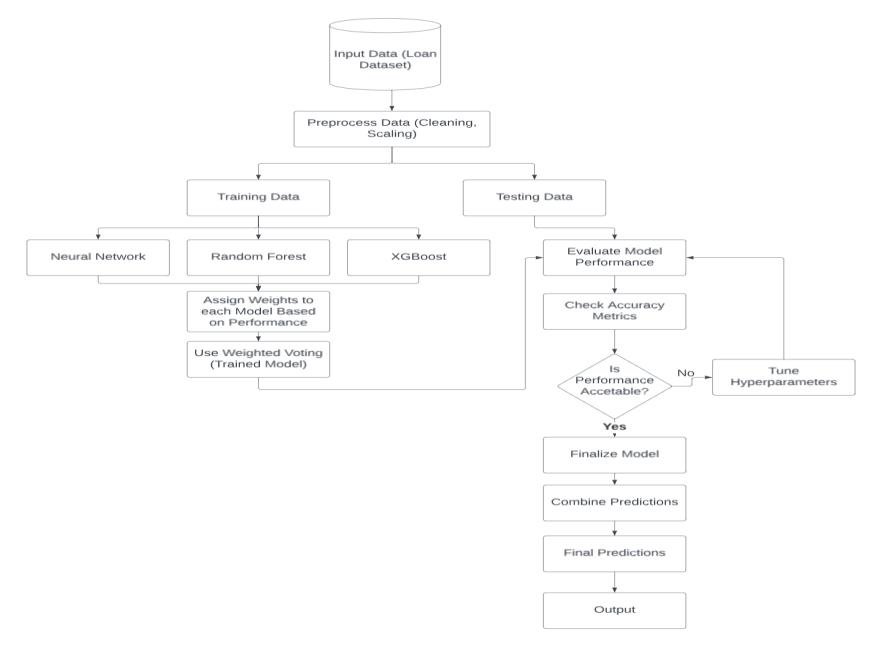
Proposed Method: Weighted Voting Ensemble Model for LoanDefaultPrediction
The Weighted Voting Ensemble model combines the strengths of multiple algorithms to improve the accuracy as well as robustness of loan default predictions. In this approach, individual models are trained on the loan dataset after it has been preprocessed for cleaning and scaling.Eachmodelgeneratesitspredictionsbasedonthe inputfeatures,reflectingitsuniquelearningapproach.The diversity among the models helps capture various patternsinthedata,whichiscrucialforcomplexfinancial datasets that may not be easily understood by a single model.
International Research Journal of Engineering and Technology (IRJET) e-ISSN:2395-0056
Volume: 11 Issue: 11 | Nov 2024 www.irjet.net p-ISSN:2395-0072
Aftergeneratingpredictions,theensemblemethodassigns weightstoeachmodelbasedonmetricssuchasprecision, accuracy and recall that can provide insights into the performanceofthemodel. Thisweightingsystem ensures that better-performing models contribute more significantly to the final prediction. The predictions from eachmodel arethencombinedthrougha weightedvoting mechanism, leading to a consensus prediction that is expected to be more reliable than those generated by individual models. This method harnesses the collective knowledge of different algorithms, ultimately enhancing the ability to predict loan defaults effectively in the financialsector
5. CONCLUSION
In this paper, we explored various machine learning models for loan default prediction and found that ensemble learning methods generally yield high accuracy duetotheirabilitytocombinemultiplemodelpredictions effectively. Building on this insight, we proposed a more complex model, essentially a "double ensemble" approach where we apply ensemble learning on top of individualensemblemodels likeRandomForest,XGBoost, and Neural Networks. By assigning weights to each model’s prediction based on performance, this layered ensemble method further enhances prediction accuracy and robustness, making it a highly reliable tool for loan defaultriskassessment
6. REFERENCES
[1] VijayKumar,RachnaNarula,AkankshaKochhar"Loan Default Prediction using Machine Learning Models" 2024DOI:10.5281/zenodo.8337054
[2] Jinchen Lin "Research on loan default prediction based on logistic regression, randomforest, xgboost and adaboost" 2023 pp DOI: 10.1051/shsconf/202418102008
[3] WanjunWu"MachineLearningApproachestoPredict LoanDefault2022DOI:10.4236/iim.2022.145011
[4] Platur Gashi, “Loan Default Prediction Model” 2023, DOI:10.13140/RG.2.2.22985.01126
[5] Lai,L, “Loandefaultpredictionwithmachinelearning techniques”. In: 2020 International Conference on Computer Communication and Network Security (CCNS).pp.5–9.IEEE(2020)
[6] Xu Zhu, Qingyong Chu,Xinchang Song, Ping Hu,Lu Peng, Explainable prediction of loan default based on machine learning models DOI:10.1016/j.dsm.2023.04.003
[7] LoanDefaultDatasetKaggle-http://bit.ly/3BA9WeX BIOGRAPHIES

Prof. Pramila M. Chawan holds the positionofAssociateProfessorinthe Computer Engineering Department of VJTI, Mumbai. She pursued B.E. (Computer Engineering) and M.E. (Computer Engineering) from VJTI College of Engineering.She has guided 100+ M. Tech. and 150+ B. Tech. projects in her 31 years of profession. In Peer-reviewed International journals, International conferences & Symposiums she has published 181 papers. She has been on the planning committees for six faculty development programs and 29 international conferences. She is consulting editor on 9 scientific research journals. The Society of Innovative Educationalist & Scientific Research Professional, Chennai (SIESRP) awarded her with ‘Innovative & Dedicated Educationalist Award Specialization:ComputerEngineering&I.T.’

Adwait Mandge, B Tech Student, Dept of Computer Engineering and IT, VJTI,Mumbai,Maharashtra,India
International Research Journal of Engineering and Technology (IRJET) e-ISSN:2395-0056
Volume: 11 Issue: 11 | Nov 2024 www.irjet.net p-ISSN:2395-0072



Rohan Fatehchandka, B-Tech Student, Dept. of Computer Engineering and IT, VJTI,Mumbai,Maharashtra,India
Kunal Goudani, B-Tech Student, Dept. of Computer Engineering and IT, VJTI,Mumbai,Maharashtra,India
Tanaya Shelke, B. Tech Student, Dept. of Computer Engineering and IT, VJTI,Mumbai,Maharashtra,India
© 2024, IRJET | Impact Factor value: 8.315 | ISO 9001:2008 Certified