
International Research Journal of Engineering and Technology (IRJET) e-ISSN:2395-0056
Volume: 11 Issue: 11 | Nov 2024 www.irjet.net p-ISSN:2395-0072

International Research Journal of Engineering and Technology (IRJET) e-ISSN:2395-0056
Volume: 11 Issue: 11 | Nov 2024 www.irjet.net p-ISSN:2395-0072
YAKANURI LAKSHMESWARA SURENDRA BABU1 , 2 Mr. B. KRISHNA NAIK, M.tech.
1M. Tech Student, Department of Civil Engineering, MVR College of Engineering and Technology (autonomous) paritala, India.
2Assistant Professor, Department of Civil Engineering, MVR College of Engineering and Technology, (autonomous), paritala, India.
Abstract
Incorporating industrial waste into construction materials is a growing practice to conserve resources and promote sustainability. This study explores ferrochrome slag, a promising but under-characterized by-product in Indian construction, for its potential use in embankment and pavement construction. Laboratory tests were conducted to evaluate its geotechnical and material properties, comparing its performance against other industrial wastes like fly ash and red mud, as well as natural soil. Tests included specific gravity, grain size distribution, compressive strength, shear strength, and durability to assess ferrochrome slag’s viability as a substitute for traditional materials. The study also investigated the stabilization of low-strength residual soil using ferrochrome slag to improve strength and California Bearing Ratio (CBR), making it more suitable for embankments and pavements. Results revealed that ferrochrome slag possesses favorable engineering properties, surpassing fly ash, red mud, and natural soil, with strong potential as a construction material. Ferrochrome slag effectively improves load-bearing capacity and durability when applied to residual soils. This research underscores the value of industrial by-products in construction, reducing waste while fostering sustainable infrastructure development.
Keywords: Ferrochrome Slag, Fly Ash, Red Mud, Residual Soil, Specific Gravity, Grain Size Distribution, Compressive Strength, Shear Strength, California Bearing Ratio, Durability.
Theuseoflargequantitiesofnaturalmaterialsinconstructingroads,embankments,andothercivilengineeringstructures has raised concerns due to the rapid depletion of these resources, necessitating the search for sustainable alternatives (Yadav et al., 2021). Industrialization has led to the accumulation of significant quantities of by-products or industrial waste, posing environmental risks through land, air, and water pollution. Effective management and utilization of industrial by-products have thus become vital for industry sustainability (Kumar et al., 2020). To address these issues, numerousattemptshavebeenmadetoincorporateindustrialwastes suchasflyash,blastfurnaceslag,andredmud intocivilengineeringconstructionprojectsassubstitutesfornaturalresources(SharmaandSingh,2019).
One notable by-product is ferrochrome slag, generated from ferrochrome steel plants, with annual global production estimated at 6.5 to 9.5 million tons, increasing annually by approximately 2.8 to 3% (Kauppi and Peka, 2007). Ferrochromeslagcompositiontypicallyincludes13-39%SiO₂,10-29%MgO,16-43%Al₂O₃,1-6%CaO,6-18%Chromium, and3-11%Iron(Raoetal.,2019).Thisstudycharacterizesferrochromeslag’spropertiesandexplores itspotentialuseas fillmaterialforgeotechnicalstructuressuchasembankments,giventhelimitedresearchonitsapplicationwithinIndian civil engineering (Patel et al., 2022).Although ferrochrome slag remains underutilized globally in civil engineering, this researchaimstoaddressthegapbyevaluatingthematerial’spotentialasanalternativegeotechnicalmaterial.Laboratory tests conducted on local ferrochrome slag provide insights into its physical characteristics, morphology, mineralogy, chemical properties,indexproperties,andshearcharacteristicsforgeotechnical and transportationapplications. Testing followedestablishedstandards,includingIS:2720–1985andSP36(Part1)forgeotechnicalproperties,andIS:2386and MoRTH standards for aggregates in transportation applications (BIS, 1985; MORTH, 2013). Comparative assessments were also conducted with industrial wastes such as red mud, fly ash, and local red soil to evaluate the feasibility of ferrochromeslagasasub-gradematerial(Vijayetal.,2023).
1. To determine the pH and chemical composition of ferrochrome slag to assess its suitability for construction applications.
2.ToevaluatethemineralogyandmorphologyofferrochromeslagthroughSEMandXRDanalyses.
International Research Journal of Engineering and Technology (IRJET) e-ISSN:2395-0056
Volume: 11 Issue: 11 | Nov 2024 www.irjet.net p-ISSN:2395-0072
3.Toanalyzespecificgravity,grading,andcompactionpropertiesofferrochromeslagtoestablishitsuseasanalternative fillmaterial.
4.ToinvestigatetheCBRandinternalfrictionangletoassesstheload-bearingcapacityandstabilityofferrochromeslagin embankments.
5.Toassesstheperformanceofferrochromeslag-stabilizedredsoil,focusingonCBRimprovementandmoisture-density relationships.
6. To conduct strength and durability tests on ferrochrome slag, ensuring compliance with Indian standards for constructionmaterials.
7. To evaluate the impact of blending red soil with ferrochrome slag on permeability and strength, with a view to optimizingembankmentmaterials.
3.1 Ferrochrome Slag (FS)
Ferrochromeproductioninvolves chromateandironoxidesasrawmaterials,withchromiteusedineitherlumpyorfine concentrate forms, often agglomerated for furnace use. Fine concentrates are ground and pelletized in a sintering plant, with the pellets then sintered in a furnace at around 1400°C. Various minerals, including quartzite, bauxite, dolomite, corundum, lime, and olivine, serve as fluxing agents to attain the desired slag composition. Ferrochrome smelting yields bothalloyandslag,withslagproductionvaryingfrom1.1to1.6tonspertonofferrochrome,dependingonfeedmaterials. hasabouttenferrochromeplants.asshownintable1forchemicalcomposition
Constituents|PresentStudy(%byWeight)|(%byWeight)
Table.1 chemical composition ferro chrome slag
3.1.2 Red Mud (RM)
Redmud,collectedfromVijayawada,AndhraPradesh,India,isawasteproductgeneratedduringaluminaextractionfrom bauxite ore. The process involves grinding bauxite with caustic liquor, followed by desilication, digestion at 110–300°C, and classification in thickeners. Aluminates liquor overflows for filtration, while red mud underflow is washed and disposedofinponds.Redmudgeneration,often55-65%ofprocessedbauxite,typicallyresultsin1.2–1.4tons pertonof alumina.Fig.1 showtheredmudsamplescollectedforthestudy.
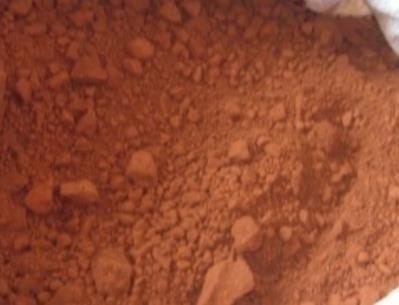
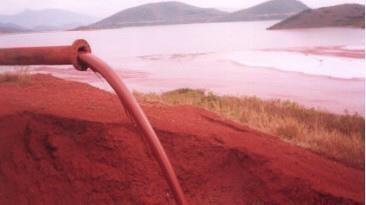
Fig.1.Redmud
Fly ash, a byproduct of coal combustion, is captured before exiting through power plant chimneys. In this study, dry fly ash was collected from the hopper at JSP, Vijayawada, as shown in table.2
Red soil, a fine-grained residual soil, was collected from the college campus and is shown in Figure.2. Not suitable for pavementconstruction,redsoilservesasacomparativesub-gradematerialtoferrochromeslaginthisstudy
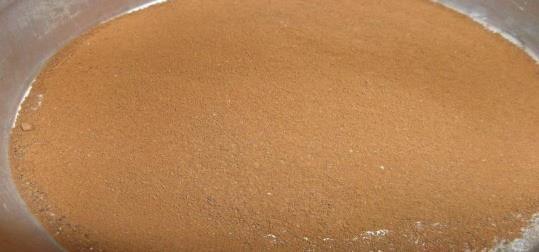
Table.2.Comparison of the Percentage of Chemicals Present in Ferrochrome Slag, Red Mud, Fly Ash, and Red Soil from EDX Analysis
4. Methods
The study employs experimental methods to characterize ferrochrome slag, examining its morphological, chemical, mineralogical,geotechnical,andpavement-relatedpropertiesasfollows:
Thegeotechnicalstudyevaluatesessentialpropertiessuchasparticlesizedistribution,specificgravity,andbulkdensity, conductedinalignmentwithIS:2720andSP:36(Part1),andincludespHmeasurementswithanelectronicpHmeterper SP:36(Part 1).Specific gravityisassessedusing the pycnometermethod,accordingtoIS:2720PartIII Sec 2(1980)for fine-grained materials and IS: 2386 (Part III) (1963) for coarse-grained ferrochrome slag. Particle size is analyzed using the wet sieve method (IS: 2720 Part 4 - 1985), while compaction characteristics (moisture content and dry density) are examined through light and heavy compaction tests (IS: 2720 - 1980). Consistency limits, including liquid limit, plastic limit,andplasticityindex,followIS:2720(Part5)-1985.Soilpermeabilityistestedusingbothfallingandconstanthead parameters(IS:2720Part17-1987),andshearstrengthismeasuredundernormalstressesof0.5,1,and1.5kNthrough directsheartests(IS:2720 Part13 - 1986). California BearingRatio(CBR)testsare performedonunsoakedandsoaked samplesperIS:2720Part16-1961,andUnconfinedCompressiveStrength(UCS)isassessedfollowingIS:2720(Part10) - 1991. Additional assessments for ferrochrome slag include bulk density (loose and compacted) as per IS: 2386 Part 3 (1963),voidratio,shapecharacteristics(flakiness,elongation,angularity)inaccordancewithIS:2386Part1(1963),and soundness testing using sodium sulfate solution as per IS: 2386 Part 5 (1963). Abrasion resistance is evaluated with IS: International Research Journal of Engineering and Technology (IRJET) e-ISSN:2395-0056 Volume: 11 Issue: 11 | Nov 2024 www.irjet.net p-ISSN:2395-0072
International Research Journal of Engineering and Technology (IRJET) e-ISSN:2395-0056
Volume: 11 Issue: 11 | Nov 2024 www.irjet.net p-ISSN:2395-0072
2386 Part 1 - 1963 standards, while aggregate crushing strength adheres to IS: 2386 Part 4 (1963) requirements, with specifiedlimitsforbasecoursesandpavementsurfacelayers.
Samples
IS:2386-1963 (Part3)Specifications
Table.3 The specific gravity of fine and coarse-grained ferrochrome slag, red mud, fly ash, and red soil.


Particlesize(mm)
Fig.3. Grain size analysis of fine and coarse grain ferrochrome slag ,red mud, flyash, red soil
Thegrainsizeanalysisforcoarse-grainedferrochromeslagwasconductedaccordingtoIS:2386-1963(Part1),whilethe analysisforfine-grainedferrochromeslag,redmud,flyash,andredsoilwasperformedusingthesieveanalysismethodas per IS: 2720 (Part 4)-1985. The values of the uniformity coefficient (Cu) and the coefficient of gradation (Cc) for ferrochrome slag, red mud, fly ash, and red soil are provided in fig.3. Additionally, the particle size classifications for ferrochromeslagandredsoil,alongwithotherindustrialwastes(redmudandflyash),aredetailedbasedontheUnified Soil Classification System (USCS) and IS Classification (IS: 1498 – 1970), as presented in Table 4.6 and Table 4.7, respectively.TheCuvaluesforferrochromeslag,redmud,flyash,andredsoilare2.79,1.89,1.50,and3.04,respectively, whiletheCcvaluesare0.95,1.75,1.42,and1.26forferrochromeslag,redmud,flyash,andredsoil,respectively.Hence, theferrochromeslagisclassifiedasapoorlygradedmaterial.
In India, flexible pavements rely heavily on sub-grade soil, which supports the pavement structure. The strength of subgrade soil significantly influences the design of pavement layers, with inadequate conditions leading to issues like wave
International Research Journal of Engineering and Technology (IRJET) e-ISSN:2395-0056
Volume: 11 Issue: 11 | Nov 2024 www.irjet.net p-ISSN:2395-0072
formationandcracking.TheCaliforniaBearingRatio(CBR)testisessentialforassessingsub-gradestrength,determining appropriatepavementthickness.ThischapterexaminesalaboratorystudyofFerrochromeSlag(FS)andFS-stabilizedred soil, evaluating CBR values, compaction, unconfined compressive strength (UCS), consistency limits, and specific gravity forredsoilmixedwithvaryingFSproportions(10%to50%).ResultsshowthataddingFSreducesliquidandplasticlimits ofredsoil.
6.1 California Bearing Ratio (CBR)
Prior to actual implementation, it is essential to confirm that the sub-base material satisfies the California Bearing Ratio (CBR)andotherphysicalspecifications.Specifically,thematerialmustattainadensityofatleast95%ofthemaximumdry densityasdeterminedbythemethodspecifiedinIS:2720(Part8).Experimentalstudieswereconductedonferrochrome slag mixes for granular sub-base (GSB), as well as on red soil blended with varying proportions (10%, 20%, 30%, 40%, 50%)offerrochromeslag.Thesestudiesincludedfour-daysoakedCBRtests,adheringtoIS:2720(Part16)–1986. Figure6.3displaystheLoadvs.SettlementcurveforferrochromeslagmixesforGSB,comparingit withferrochromeslag alone, red soil, and different proportions of red soil mixed with ferrochrome slag after four days of soaking. The CBR valuesforthesematerialsarepresented.Theresultasshowninfig.4

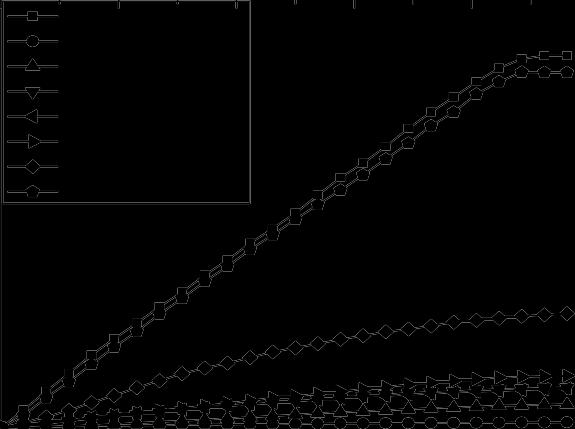

Fig.4.graph re presents the Load vs. Settlement curve for ferrochrome slag mixes for GSB
TheCBRvaluesoftheferrochromeslagmixforgranularsub-base(GSB)arecomparedwiththoseofferrochromeslag,red soil,andvariousproportionsofredsoilblendedwithferrochromeslag(i.e.,10%,20%,30%,40%,and50%).
International Research Journal of Engineering and Technology (IRJET) e-ISSN:2395-0056
Volume: 11 Issue: 11 | Nov 2024 www.irjet.net p-ISSN:2395-0072
Table 4: CBR values of the ferrochrome slag mix for granular sub-base (GSB)
CBR values of the ferrochrome slag mix for granular sub-base (GSB) compared with those of ferrochrome slag, red soil, andvariousproportionsofredsoilblendedwithferrochromeslag(10%,20%,30%,40%,and50%).rubber.
In this study, experimental investigations were conducted on ferrochrome slag, a ferrochrome slag mix for GSB, and red soil, including various proportions (10%, 20%, 30%, 40%, 50%) of red soil mixed with ferrochrome slag. The testing employedaconventionalsaturatedDirectSheartestinaccordancewithIS2720(Part39) -1977.Figure6.4presentsthe comparison of normal stress versus shear strength for the ferrochrome slag mix in GSB, as well as the comparison with pureferrochromeslag,redsoil,andthevariousproportionsofredsoilmixedwith ferrochromeslag.Theresultsinclude cohesionvalues(C)inkPaandtheangleofinternalfriction(φ)indegreesfortheGSBmixwithferrochromeslag,aswell asforeachcompositionofredsoilmixedwithferrochromeslagasresultshowninfig.5 2 4 6 8 10


RS90%+FS10%
RS80%+FS20%
RS70%+FS30%
RS60%+FS40%
RS50% + FS50%FS (forGSB)
NormalStress(kN/m2)
Fig.5 comparison of Normal stress v/s Shear strength of ferrochrome slag mix for GSB and comparison with ferrochrome slag, red soil and different proportion (i.e.10%, 20%, 30%,40%,50%)of red soil with ferrochrome slag
7. CONCLUSION:
Conclusionsdrawnfromthestudyareasfollows:
1. The pH values for coarse- and fine-grained ferrochrome slag are 9.88 and 9.79, respectively, indicating an alkaline natureduetohighMgOcontent.
2.Chemicalanalysisrevealsthepresenceofapproximately56%aluminasilicatecompoundsand23%MgOastheprimary components.
3.SEManalysisshowsthatparticlesareangulartosub angularinshape,withXRDanalysisidentifyingquartz,forsterite, olivine,andspinelaspredominantminerals.
4. Ferrochrome slag exhibits specific gravity values between 3.21 and 3.27. The coefficients of uniformity (Cu) and curvature(Cc)are2.78and0.95,respectively,categorizingitaspoorlygraded.
5. Compaction characteristics indicate that, for light compaction, the optimum moisture content (OMC) is 8.32% with a maximumdrydensity(MDD)of2.18g/cc,andforheavycompaction,theOMCis7.64%withanMDDof2.44g/cc.
6. High MDD values correlate with high specific gravity. When used to stabilize red soil, an increase in ferrochrome slag (FS)contentleadstoreducedOMCandincreasedMDD,comparedtoredsoilalone.
7.FerrochromeslagshowsahighCaliforniaBearingRatio(CBR)valueof34.62,whichissuperiortoredmud(18.1)and redsoil(1.56).
8.TheCBRofredsoilimprovedwiththeadditionofFS,reaching10.1with10%FScontent.
9.Theangleofinternalfrictionforfine-grainedFSismeasuredat37°.
International Research Journal of Engineering and Technology (IRJET) e-ISSN:2395-0056
Volume: 11 Issue: 11 | Nov 2024 www.irjet.net p-ISSN:2395-0072
10.Soundnesstestingoncoarse-grainedslagshowsamaximumlossof2.11%after10cyclesinsodiumsulfate.Thebulk density is 1.785, and water absorption is 0.8%, meeting Indian standards. The impact value is 8.613, crushing value is 21.666,andabrasionvalueis25.84.
11.Blending redsoilwithFSenhancesitsunconfinedcompressive strength,shear strength,andCBR values.FShashigh permeability compared to other materials, whereas red soil has low permeability, limiting its use in embankment applications.BlendingredsoilwithFSreducesthek-value,thoughfurtherleachateanalysisisrecommendedtoassessthe effectsofFSaddition.
1. -BIS,"MethodsofTestforSoils:IS:2720,"BureauofIndianStandards,NewDelhi,1985.
2. -Kauppi,P.,andPeka,K.,"Ferrochromeslagasapotentialresource,"JournalofEnvironmentalManagement, 2007.
3. -Kumar,R.,etal.,"Sustainablemanagementofindustrialwaste,"ConstructionandBuildingMaterials,2020.
4. -MORTH,"SpecificationsforRoadandBridgeWorks,"MinistryofRoadTransportandHighways,NewDelhi, 2013.
5. -Patel,A.,etal.,"UtilizationofFerrochromeSlaginConstruction,"MaterialsToday:Proceedings,2022.
6. -Rao,N.,etal.,"GeotechnicalApplicationsofFerrochromeSlag,"JournalofCivilEngineeringResearch,2019.
7. -Sharma,T.,andSingh,M.,"IndustrialWasteinConstructionProjects,"EnvironmentalResearchJournal,2019.
8. -Vijay,R.,etal.,"Comparativestudyonindustrialwastematerials,"JournalofGeotechnicalandGeo environmentalEngineering,2023.
9. -Yadav,P.,etal.,"AlternativeMaterialsinCivilEngineering,"JournalofSustainableEngineering,2021.
10. 1.Ajay,A.,andRani,D.,“Sustainableuseofferrochromeslagandquarrydustcompositeascement-bound materials,”*GlobalNESTJournal*,2023
11. 2.Balasubramaniam,T.,etal.,“Propertiesofconcreteincorporatingferrochromeslagascoarseaggregates,” *MaterialsToday:Proceedings*,2023.
12. 3.Parikh,V.,etal.,“Geotechnicalperformanceofstabilizedferrochromeslagandsoilmixtures,”*Geotechnical EngineeringJournal*,2023.
13. 4.Sinha,K.,etal.,“Toxicityleachingcharacteristicsofferrochromeslag,”*JournalofHazardousMaterials*,2022.
14. 5.Thakur,P.,etal.,“Impactofindustrialslagoncementitiouspropertiesinroadapplications,”*Constructionand BuildingMaterials*,2022.
15. 6.Yash,S.,andKumari,R.,“Comparativedurabilityanalysisofslag-basedpavementmaterials,”*RoadMaterials andPavementDesign*,2023.
16. Theserecentsourcesshouldprovidefurtherinsightsintoferrochromeslag’senvironmental,geotechnical,and structuralapplications.Letmeknowifyouneedadditionalassistance!