
A Review On Behavior Of Tall Structure Under Blast Loading
Deep Modi1 , Kishan Pala2 , Aakash Suthar3
1M.Tech Student, L.J. University, Ahmedabad
2Kishan Pala/3Aakash Suthar, Assistance Professor, structural Engineering Department, L.J. University, Ahmedabad, India.
Abstract - Today's bomb explosion close to a structure can seriously harm both the interior and exterior of the structure. The building may sustain mild, moderate, or significant damage as a result. This study's primary goal is to compare building models and determine how they react to blast loads using ETABS software. In this investigation, an 11-story building is charged with 100 kg and 200 kg of TNT at 20-and 40-meter stands. The formula for blast parameters is IS 49911968.Four more models are examined by putting various structural systems into practice. The models' responses in terms of storey displacement and storey drift are examined in order to identify the model that has the structural component that helps resist blast effects.
Key Words: Dia-Grid Structure, Structural Design, Seismic Load, E-tabs Software.
1.INTRODUCTION
Theinvestigationofblastimpactsonstructureshasbeenthe subjectofformaltechnicalinvestigationformorethansixty years. An explosion caused by a bomb inside or in close proximitytoabuildingcanledtodamagetothebuilding's externalandinternalstructuralframeworks,thecollapseof walls,thefragmentationoflargeareasofwindows,andso forth.Lossoflifeandinjuriestooccupantscanoccurdueto various factors, including direct blast effects, structural collapse,fire,andsmoke.
Traditional structures are generally not designed to withstandblastloads,andbecausethemagnitudesofdesign loadsaresignificantlylowerthanthoseproducedbymost explosions,traditionalstructuresaresusceptibletodamage fromexplosions.Theloadingfromablastanditseffectsona structure are influenced by several factors, including the weightofthecharge, thelocationof the blast(or standoff distance),andthegeometricconfigurationandorientationof the structure (or direction of the blast). The structural response will vary depending on how these factors come together.Therefore,understandingtheimpactofabuilding underblastloadiscrucialforthesafeguardingofastructure.

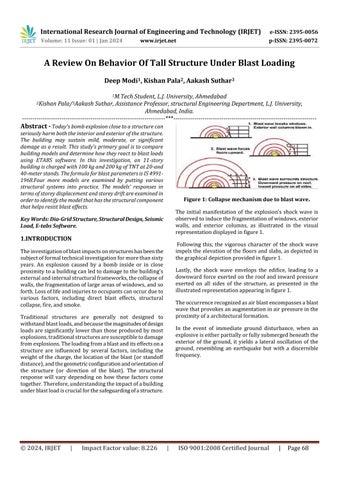
The initial manifestation of the explosion's shock wave is observedtoinducethefragmentationofwindows,exterior walls, and exterior columns, as illustrated in the visual representationdisplayedinfigure1.
Following this, the vigorous character of the shock wave impelstheelevationofthefloorsandslabs,asdepicted in thegraphicaldepictionprovidedinfigure1.
Lastly, the shock wave envelops the edifice, leading to a downward force exerted on the roof andinwardpressure exerted on all sides of the structure, as presented in the illustratedrepresentationappearinginfigure1.
Theoccurrencerecognizedasairblastencompassesablast wavethatprovokesanaugmentationinairpressureinthe proximityofaarchitecturalformation.
In the event of immediate ground disturbance, when an explosiveiseitherpartiallyorfullysubmergedbeneaththe exterior of the ground, it yields a lateral oscillation of the ground, resembling an earthquake but with a discernible frequency.
International Research Journal of Engineering and Technology (IRJET) e-ISSN: 2395-0056 Volume: 11 Issue: 01 | Jan 2024 www.irjet.net p-ISSN: 2395-0072 © 2024, IRJET | Impact Factor value: 8.226 | ISO 9001:2008 Certified Journal | Page68
***
Figure 1: Collapse mechanism due to blast wave.

TheAnabruptincreaseinmagnitudeandreleaseofenergy in an extreme manner, typically accompanied by the production of exceedingly high temperatures and the expulsionofgases,isdefinedasanexplosion.Explosionscan manifest in either the form of deflagration or detonation, contingent upon the rate of combustion during the event. Deflagration occurs as a result of the ignited reaction of thermal conductivity, whereby the subsequent layer of colder material isignited by the hot burning material and subsequently combusted. which entails a supersonic exothermicfrontthatrapidlyacceleratesthroughamedium, ultimately leading to the propagation of a shock front directlyinitspath.
1.2 Objective
Thestudyaimstomodelandanalyzetheimpactof external (air blast) explosions on high-rise buildings. Through analytical and numerical methods.
Theobjectiveistoprovideevidenceofthebehavior exhibitedbytallstructureswhenexposedtoblasts. Theobtainedresultswillbethoroughlyassessedto evaluate the effects of the analysis on high-rise buildings.Additionally
The performance of the Diagrid structure will be analyzed in relation to various parameters, includingstorydrift,storydisplacement,andbase shear.Thefocuswillbeoninvestigating
Theprimaryobjectiveofdesigninganearthquakeresistant structure is to guarantee sufficient ductilitytowithstandlateralloads.
2. Literature Review
[1] Pranali R. Nikure, Dr. Valsson Varghese A review on study and analysis of blast resistance structure IJEDR 2019
Research on the behavior of blast loading has shown that when standoff distance and charge weight drop, blast
pressure increases. Charge weight, standoff distance, and structuralconfigurationareafewexamplesofthesevariables thatinfluencehowstructuresrespondtoblastloads.
Programs like LS-Dyna and AUTODYN have been used to analyzeandquantitativelystudythebehaviorofstructures under blast loading. To increase the blast resistance of reinforcedconcretepanels,theuseofglassfiberreinforced polymer(GFRP)compositesinretrofittinghasbeenstudied. Buildingdesignsthatareresistanttoexplosionshavebeen examined and evaluated using the Analytical Hierarchy Process (AHP) and Delphi approach. AHP is thought to be preciseandeffectiveindecision-making.
Inthisinvestigation,theresponsesofbuildingstoseismicand blast loads can be compared. A twenty-story structure in earthquakezone5,forinstance,mightresponddifferentlyto beinghitwithaspecificquantityofTNTatavariedstandoff distance.Thedesignofblast-resistantstructuresrequiresa deep understanding of blast phenomena, blast load predictionmethods,andthedynamicresponseofstructural elements.
[2] Jiji Madonna, Mrs. Vijaya G, Er. Kirankumar K Analysis of high rise rcc building subjected to blast load IRJET 2016.
The acquired results show that when the standoff distance decreases and the charge weight increases, the systemisconsiderablyimpacted.Thelengthofthestandoff becomesthemostcriticalelementinsafeguardingabuilding since it affects the blast pressure. Examining the graphical representationoftheblastpressureinrelationtothestorey levelmakesitevidentthattheintensityoftheblastpressure decreases as storey height increases. This makes sense becausetheexplosionoccursata lowerstorylevel,where thereismorepressure.
The graphs demonstrate that while storey drift rises with increasingchargeweight,itreduceswithincreasingstandoff. It's also critical to keep in mind that the heavily stressed columns of the first story initially warp and lose their essential capacity to support weight. As a result, the building's geometry collapses along with the columns. Unevenbuildingsareparticularlyvulnerablesincetheyhave thehighestvaluesofinter-storydrift.
[3] Shubham Pathak, VishalKoli, Vishwambhar Khomane, Sakharam Shelke, Aditya Nalawade, Behaviour of RCC Structure Subjected ToBlasting
IJIRSET 2018
Thesystemissignificantlyimpactedbybothanincrease in charge weight and a decrease in standoff distance, according to the results. The length of the standoff, which influences the blast pressure, is the main determinant of
International Research Journal of Engineering and Technology (IRJET) e-ISSN: 2395-0056 Volume: 11 Issue: 01 | Jan 2024 www.irjet.net p-ISSN: 2395-0072 © 2024, IRJET | Impact Factor value: 8.226 | ISO 9001:2008 Certified Journal | Page69
Figure 2: Incident and reflected pressures on building
whether or not a structure is protected. A graphic representation of the blast pressure vs storey level shows thatasstoreyheightrises,theblastpressureintensityfalls becausetheexplosionoccursatlowerstoreylevels,where there is high pressure. The graphs demonstrate how the storeydriftrisesasthechargeweightincreasesandfallsas thestandoffincreases.Moreover,itisseenthatthefirst-floor columns undergo deformation due to elevated pressure, whichcausesanabruptlossofvitalload-bearingability.
Themostvulnerablekindofstructure,withthehighest values of inter-story drift,isan irregular building. The top floorshavelowpressureintensity,thereforetheincreasein standoff distance between the lower and upper floors has littleeffectonthem.Assuch,thestandoffdistancewillaffect thepressureatdifferentfloors.
[4] Bharadwaj Vangipuram,Md.AbdulJabbarSharief,B. Bala Sandeep Behaviour of reinforced concrete Structural members undertheInfulenceofimplicitblast loading IJCIET 2019
Thestructuralcomponentanalysisrevealsthatthecenter ofconventionalmembersexperiencesthemostinertialforce. Nonetheless,blastresistantmemberscanwithstandtheload andstillhavethesameexplosiveimpactbecauseofa20% increase in mass. It has been demonstrated that the member's economic viability is maintained when mass is usedasametaphorforinertialresistance.Furthermore,the supportsoftheconventionalmembersbearthebruntofthe explosionforce.Strainenergygraphsareusedtocalculate the energy expenditure for both conventional and blast resistant members. The results show that blast resistant members have an energy level of 0.85 unit. The stark differencehereshowshowmuchtheconventionalmembers are distorted. Usually,beams suffer bendingmomentsand columnsreceiveaxialstresses.
The results In orderforthemember to withstandboth axialandbendingloads,itiscrucialtomaintainequilibrium. It's interesting to note that typical members exhibit strain energy saturation, which indicates severe deformation.On theotherhand,blast-resistantmembersneversaturate
[5] Shreya Vedpathak, Prof. Ajay Hamane Analysis of blast resistant structure IRJET 2022
The modelling of blastforceincreases andthestandoff distance falls, the study of the four instances shows a considerable increase in storey displacements and storey drifts. The standoff distance and charge weight values determinetheblast'sparametersandeffects.Theanalysisof the modelsshows thatthe inclusion of differentstructural elementssignificantlyaltersstoreydisplacementandstorey drift, resulting in a decrease in these displacements and drifts.whichentailsmakingthecolumnsandbeamslarger, suggests that the construction will be more resistant. However, in some circumstances its application may be
limitedduetothedemandforconsiderablecrosssectionsof columnsandbeams.
[6] Nadi A. Swadi and Hussam K. Risan Comparison of blast load main parameters based on Indian standard RJOAS 2017
The American Standard UFC, the 1968 edition of the IndianStandard(IS4991)didnotdiscriminatebetweenfree airburstsandhemisphericalsurfaceburstsontheground. Thiscouldcertainlyleadtoavarietyofon-groundandon-air explosions with unclear and incorrect designs. In terms of peakpressures,theIndianstandardCodeproducesanotably highnumberatashortstandoffdistancewhentheexplosion closedinonthetargetwithrespecttoUFC.
The research did not recommend employing IS for the constructionofbuildingssubjectedtoblastloadswithshort standoffdistancesbecausetotheimpracticaldesignoutputs. Moreover,theIndianstandardmightnotprovideasufficient descriptionoftheblastloadrequirementsforacloseshort standoffdistance.
3. CONCLUSIONS
Thecomparisonbetweenthecombinedstructure.Several numerical models were developed to investigate how insertinganairlayeroraluminumfoamlayerbetweentwo layersofconcreteandchangingwallthicknesscouldlessen theimpactofblastwavesontheconstructionwalls.
Generally speaking, a reasonable amount of the deflection and impulse of various walls are decreasedwhenconcretewallthicknessincreases.
Itisestablishedthatwhenwallsaremadethicker from20to40cm displacelowersdramaticallyby anaverageof94.25%.Thisisbecausetheincreased thicknessofthewallsincreasestheirintegrityand rigidity.
Increasingthethicknessofthewallsisobservedto reducetheimpulseappliedtothewallsforallfour walls, whether they are reinforced or not. As a result,
The average blast force applied to the walls is lessenedwhenthethicknessofthewallsincreases.
Whileitmayhaveapositiveimpactondamageand fragmentation, wall reinforcement has little effect onthewalls'
REFERENCES
[1] PranaliR.Nikure,Dr.ValssonVarghese,Areviewon study and analysis of blast resistance structure, Volume7Issue2,2019.
International Research Journal of Engineering and Technology (IRJET) e-ISSN: 2395-0056 Volume: 11 Issue: 01 | Jan 2024 www.irjet.net p-ISSN: 2395-0072 © 2024, IRJET | Impact Factor value: 8.226 | ISO 9001:2008 Certified Journal | Page70
[2] JijiMadonna1,Mrs.VijayaGS2,Er.KirankumarK L3,AnalysisofhighriseRCCbuildingsubjectedto blast load, International Research Journal of Engineering and Technology, Volume 3 Issue 8, 2016.
[3] Prof.C.M.Deshmukh,Dr.C.P.Pise,etal.,Behavior of RCC Structural Members for Blast Analysis: A Review,Volume6Issue11,InternationalResearch JournalofEngineeringandTechnology,2016.
[4] Shubham Pathak, Vishal Koli, et al., Behaviour of RCCStructureSubjectedtoBlasting,International Journal of Innovative Research in Science, Engineering and Technology, Volume 7 Issue 5, 2018.
[5] ShreyaVedpathak1,Prof.AjayHamane2,Analysis ofBlastResistantStructure,InternationalResearch Journal of Engineering and Technology (IRJET), 2022.
[6] BharadwajVangipuram,Md.AbdulJabbarSharief, B. Bala Sandeep, Behaviour of reinforcement concretestructuralmembersundertheinfluenceof implicitblastloading,InternationalJournalofCivil Engineering and Technology, Volume 10 Issue 7, 2019.
[7] Mahdi Bitarafana, Sayed Bagher Hosseinib, et al., Role of architectural space in blast resistant buildings,FrontiersofArchitecturalResearch,2012
[8] NadiaA.SwadiandHussamK.Risan,Comparison ofBlastLoadMainParametersBasedonIndianand American Standard, Research Journal of Applied Sciences,EngineeringandTechnology,2017
[9] EidBadshah,AmjadNaseer,etal.,ReviewofBlast LoadingModels,MasonryResponseandMitigation, Volume 2017, 2017 Investigation of structural behaviourforR.C.Framesubjectedtoblastloading civilengineering,mitsoe,mitadt,Pune70/70
[10]Y.E.Ibrahim,M.Almustafa,Mitigationofblastload riskonreinforcedconcretestructuresconsidering different designs alternatives, Archives of Civil engineering,VolumeLXVIIssue3,2020
[11] Ahmed K. Taha, M.S. Zahran, ZhengguoGao, Mitigation of the blast load effects on a building structure using newly composite structural configurations,DefenceTechnology,2020
International Research Journal of Engineering and Technology (IRJET) e-ISSN: 2395-0056 Volume: 11 Issue: 01 | Jan 2024 www.irjet.net p-ISSN: 2395-0072 © 2024, IRJET | Impact Factor value: 8.226 | ISO 9001:2008 Certified Journal | Page71