
International Research Journal of Engineering and Technology (IRJET) e-ISSN: 2395-0056
Volume: 11 Issue: 11 | Nov 2024 www.irjet.net p-ISSN: 2395-0072

International Research Journal of Engineering and Technology (IRJET) e-ISSN: 2395-0056
Volume: 11 Issue: 11 | Nov 2024 www.irjet.net p-ISSN: 2395-0072
Kiran Kumar Patibandla1 , Rajesh Daruvuri2 , Pravallika Mannem3
1 Visvesvaraya Technological University (VTU), India
2 Google Inc, USA
3ProBPM,Inc,USA***
Abstract - The use of artificial intelligence (AI) in cloud architectures has significantly increased processing efficiency and scale. However, with the development of complex algorithms and big data as well as surprisingly entered into our machine learning world; workload management becomes a significant issue in AI cloud computing. Existing workload management solutions are rule-based heuristics that may result in underutilization of resources and poor performance. For that, we present an algorithmic comparative approach to easing the burden of workload management for AI-driven cloud architectures. This is in contrast to executing a batch of tasks with different algorithms and comparing performance, cost, etc. We use ML methods to determine the best algorithm for our workload, and then deploy this in a self-contained binary that can switch between algorithms at runtime on an available resource. We validated our scheme with simulations, which demonstrates the capability of superior resource use and diminished completion time in comparison to rule-based schemes. When needed, flexibility and scalability allow you easier control over workloads that are subject to change or allocation. By simplifying AI-driven cloud workload management, the elasticity of their overall approach greatly enhances efficiency and scalability for those organizations looking to run even larger and take advantage of more complex workloads faster Tweet this Share on Facebook.
Key Words: Cloud Architectures, Scalability, Large Datasets, Better Management, Cost-Effectiveness
1.INTRODUCTION
Beforewestart,let'sseewhattwonewtermswhichareintroducedinthisworkconsideredfordevivinginsightsonhowto designtheAI-poweredcloudArchitecturesuchthatworkloadmanagementcanbeeasilystreamlinedvia[1]WhatisWorkload Management?MonitoringandManagementofWorkStreamsOutLookrelatedtoCloudArchitecture:Cloudarchitectureisthe designofanapplicationbuiltontopofacloudprovidersetup.cloudcomputingsupport[2].Nowadays,theemploymentofAI cloudincomputersystemsnotonlymakesworkloadmanagementturnedouttobeevenmorecomplexduetothesignificant setupandfunctionalresourcesneededbyAIalgorithms(Lopezetal.,2018)[3]…)Assuch,itwassuggestedthatcontaining thesedemandsmayrequiremorethantheconventionaldevicesofworkloadmanagement[4].FortherapidlychangingAIdrivencloudarchitectures,thismeansrequiringastraightforwardworkloadmanagementapproach.ItincludestheuseofAI technologiestoautomatethemanagementofcloudworkloads(5).AIuseshistoricaldataandusagepatternstodistributethe workloadamongVMsinthemosteffectiveordersimilartoresourseallocation[6].Thisreduceshumaninterventionandoffers helpfulresourcesacrossthefunctions.TheworkloadinAI-drivencloudarchitecturesandmanagingthemiscriticalforboth effectiveresourceutilizationaswell moreimportantly easeof meetingtheincreaseddemandsfrommodern enterprises. Nevertheless,theeffortstostreamlineworkloadmanagementacrossAI-drivencloudsrequire[7]addressingspecifickey challenges.IfwereferbacktotheAI-drivenworkloadsinadditiontojustgeneral-purpose,anotherchallengeisbookkeeping QoSrequirements.TheproblemwithAImodelsisthattheychewupalotofinfrastructureresourcesintheformofdataand computationalpower.Traditionally,workloadslikethesearedifficulttomanageandoptimizeinanormalcloudenvironment [9]thatneedsspecialhardwareandsoftwareconfiguration.Additionally,thereisthequestionofproperstandardizationfor differentAIworkloads.ResourceRequirements:AgenericworkloadmanagementsystemthatcaterstoalltheAIworkloadsis prettyhardsinceeachAIalgorithmandmodelhasitsveryownresourcerequirements[10].Thismakesitveryhardtopredict whatresourceusageanappwillneed,soyoueitherover-provisionoroversubscribetheresources.Themaincontributionof theresearchhasthefollowing:
NovelAI-basedWorkloadManagement:Theresearchpresentsnoveltechniquesthatallowforefficientworkload management of the new characteristics introduced by bottlenecked cloud-native AI workloads using a hybrid approachcontainingbothtraditionalstaticresourceallocationanddynamic,AI-drivenmethodologies.Belowlet's describeoneofthesecreativewaysusedbycurrentcontainerorchestratorstodomeanresourcedistributionacross workloadswhichincreasestheperformanceandallowscostoptimization.
International Research Journal of Engineering and Technology (IRJET) e-ISSN: 2395-0056
Volume: 11 Issue: 11 | Nov 2024 www.irjet.net p-ISSN: 2395-0072
·Increasedscalabilityandresilience:Theworkloadmanagementtechniquesareshowntoenhancethescalabilityand resilienceofAI-drivencloudarchitecturesbyenablingefficientmappingsystemresourcesforexecutingworkloads using adaptive means based on deep learning. This leads to less resource wastage, lower expense, and better performanceforimportantworkloads.
Real-worlddeployment:Thestudyalsohighlightstherequirementtoshowwhethertheycandeployandevaluate proposedmethodsusingatestcloudsetupofanindustrialpartner,servingasadditionalvalidationthatprovides supportforthemonpracticalsoftwareengineeringtoolaspects.Read=Thisisyourinsightthatthesetechniques (helpyou)grokhoweffectivetheyareandthusmakeiteasiertomovethemintotheirAI-drivencloudarchitectures, therebysavingcompaniesthetime&moneyspentensnaredbydatatransfercosts.
Theremainingpartoftheresearchhasthefollowingchapters.Chapter2describestherecentworksrelatedtotheresearch. Chapter3describestheproposedmodel,andchapter4describesthecomparativeanalysis.Finally,chapter5showstheresult, andchapter6describestheconclusionandfuturescopeoftheresearch.
Abdi,A.,etal.[11]HowItWorks:Distributedsystemsallowyoutogetthemostout ofcloudresourcesbyspreadingjobs betweenmultipleservers,asmentioned.ThisresultsinBetterCapacityUtilizationasitmakessurethattheavailablecapacityis optimallyusedandcostsareminimized.Also,itwillimprovethescalabilityandintegrityofthissystem.Firouzi,F.,etal.[12] TheintegrationofEdge,fog,andCloudfortheAI-drivenInternetofThings(IoT)hasbeeninvestigated.Itrelatestohowthese threecomputinglayersneedtoworkinsynergyandshouldbeintegratedtoprovidetheabilitytoprocessdatamoreefficiently withreal-timeanalytics.Thefeaturessuchasedgedevicesforcollectionandpreprocessingofdata,fognodeswithadditional capabilitiesinprocessingthedatabeforeitsstoringthathappensatahigherlevelcloudservices.Theplayofthisinteraction willleadtosmartdecision-makingandasmoothdataoperationhandovercourseintheIoTecosystem.Khan,M.A.,etal.[13] This is discussed in and refers to Intelligent Data Management using AI a model that automates data management tasks (housekeeping,performancetuning,monitoring)overlargevolumesofdatastoredacrosscloudenvironments.Thisincludes analyzing,predicting,andautocratictaskssuchasstoragereplicationbackuptoincreaseefficiencycostsavings,andtotaldata performance.Kommisettyetal.[14]havehighlightedbigdatasolutionswheretwonewtechnologiesandstrategiesareusedto dealwithdatasize.Thesearethetwowell-developedsolutionsthatenableyoutodowiththetraditionaldatamovement method and build your connectors where a kind of cloud migration moves all our entire datasets from an on-premises environmentintoaCloudthatprovidesthebestsuitablefeatureslikemorescalability,andflexibility.ThiswayofAIdecisionmakingusesartificialintelligencetomakedata-baseddecisions,inreal-timeandthismethodalsobooststheefficiencyand accuracyofmodernenterprises.Tatineni,S.,etal.[15]IntegratingAIwithDevOpswillnotonlygivethefreedomofsmarter infrastructuremanagementbutithasalsobeenreviewedbyearlierstudies16onhowOperatingimperativeshavealready scheduledafutureforboth.AItoolsprogrammaticallymonitorinfrastructure,analyzedatalookforpatterns,andhelpidentify potentialproblems,sometimeseventotheextentofpreventingthemfromcroppingupinthefirstplace.Deploymentsareboth quickerandmorestablewhenthesetwotoolsworktogether,thusresultinginbetterinfrastructureonthewhole.Alnafessah, A.etal.[16]Artificialintelligence(AI)-drivenanomalydetectionhasbeendescribedthatusesmodernalgorithmsandmachine learningtodeterminestrangepatternsorbehaviorsinlargedatasystems;Thisallowsbusinessestoidentifyanomaliesand potentialthreatsinreal-time,therebyhelpingthembeproactiveatpreventingadatabreachorgettingattacked.Giagkos,D.,et al.AworkbyAparnaetal.[17]hasproposedAI-drivenQOs-awareschedulingforServerVideoAnalyticsattheEdgewhichis an intelligent way to schedule and allocate resources in edge devices only for running video analytics tasks efficiently. LeveragingAIalgorithms,itdynamicallyallocatesresourcesdependingonthequalityofservicerequirementsandenables video data processing promptly while providing maximum accuracy. Kokkonen, et, al.[18] The computing continuum representsthedifferentlevelsofautonomousandintelligentcapacitiesthatcurrentandfuture-generationsensingsystems shouldhave.Inoneextreme,simplemachinescannotfunctionwithoutcontinuoushumanintervention. Conversely,more intelligentsystemsontheothersidecanworkindependentlyandfocusondataanalysis+machinelearning.Iriogbe,E.I.et al.[19] Hybrid computing has been promoted as a way to reduce cloud overhead and latency in artificial intelligence applicationsItisaneed-baseddesignthatunitescloudandedgecomputingtoshiftworkloads/dataprocessingfromtheCloud (offloading)closertolocaldevice(s),toincreasereal-timeperformanceaswellcompressnetworkdelays.Thissortofapproach willalsohelpwithsavingresourcesandcostswhendeployingAIapplications.Mills,N.,etal.[20]Thearchitecture(Figure3) discussedinisbasedonthecloudandincreasesefficiency,andaccuracy(interpretabilityofAI),makingpossiblescalabilityto bigdatathankstoaself-structuringapproachbyapplyingalgorithms.Itenablesustodistillkeylearningsfromanarrayofdata sourcesinasimpleandtransparentprocessforaccountability.
International Research Journal of Engineering and Technology (IRJET) e-ISSN: 2395-0056
Volume: 11 Issue: 11 | Nov 2024 www.irjet.net p-ISSN: 2395-0072
AI-DrivenCloudArchitectureisanalternativemodelforcloudinfrastructurethattakesanalgorithmic(orrathersemi)stance liftingwiththehelpofartificialintelligence(AIcandesignreal-timebuildandmanagewholecloudinfrastructure).Enterthis architectural intervention model, which leverages machine learning tech like NLP (auto comment), deep Learning (automated cleanup), and RL(self-improving functions). It uses historical data and real-time monitoring to make better decisionsaccordingtothechangesintheenvironmentovertime.
By evaluating the degree of agreement between the anticipated values and the actual observed values, it is essential for determiningtheprecisionandaccuracyofthemodels’predictions.

Theweightsarethenmovedinthedirectionthattheerrorreducesmost.

Becausegisdifferentiablesowedifferentiateusingthefollowingchainrule.So,thechainruleappliedlikethisallowsusto calculatehowchangesinweightsaffectourerrorfunctionbutexactlywhatdiditdoaboutsteeringtowardshavingoutputwe searchfor?
Itisthefirststepwherewedefinewhatisneededandwhatcloudarchitecturelookslikebynaturallanguageinterface.TheAI thenevaluatesthatdataandgivesyouafewpotentialarchitectures.


Chainrulecanbeusedtogetthederivativeoftheerrorwithrespecttoanyweight.
Theseoptionsareevaluatedusingasetofmetrics,suchascost,performance,andscalability,todeterminethemostsuitable architecture.Afterimplementingthearchitecture,theAIcontinuouslymonitorsitsperformanceandadjuststooptimizeits efficiency.
Thisstepinvolvesreviewingthetitlesandkeywordsofthecollectedstudiestoassesstheirrelevancetotheresearchtopic. (5)



Where represents the relative observed agreement among authors, and the hypothetical probability of chance agreement.
Italsousespredictiveanalyticstoanticipatefuturedemandsandproactivelyscaletheinfrastructureaccordingly.Thishelpsto ensuremaximumresourceutilizationandcost-effectiveness.
International Research Journal of Engineering and Technology (IRJET) e-ISSN: 2395-0056
Volume: 11 Issue: 11 | Nov 2024 www.irjet.net p-ISSN: 2395-0072
Similarly,AI-drivencloudarchitecturesandintelligentsolutionsorchestratedwithacombinationofartificialintelligence(AI) andcloudcomputingmethodsprovidecost-effectivediscreetmechanismsfordealingwithcomplexdata/workflow-related problemsonaLargescale.Thesearchitecturesareconstructedtocatertotheexpandingneedforprocessingandanalysisof real-timedata, aswell asprovidea morecost-effective resilientcloud infrastructure.Fig1 showstheconstructionofthe proposedmodel.
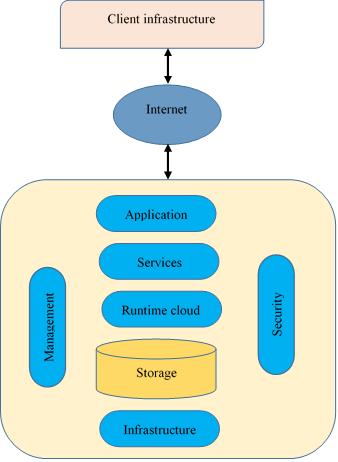
Fig1constructionoftheproposedmodel
AI-drivencloudarchitecturesarecomprisedofanarrayofindividualpiecesthatmakeupacomprehensivewhole,fromdata centersandstoragesystemstonetworkingtoolsandAIframeworks.
TheARmodeldisregardslong-termtrends,butitexcelsincapturinglocalfeaturesofrecentobservationsandis,therefore, moresuitablefortransientdynamicsduringburstscomparedtotheInformer-basedworkloadpredictor.

(6)
Toachievethis,wefirstdesignaSupportVectorRegression(SVR)drivenperformancemodeltoestimatetheresponsetime undergivenworkloadsandinstancereplicas.

(7)Hence,the majorobjectiveoftheworkistoreducemakespanandpowerconsumption.Whenasubtaskmeetsitsdeadline,thenapenalty isissued,whichisgivenby
Thesecomponentsareintegratedandoptimizedtoworktogetherseamlessly,utilizingalgorithmstoautomateandoptimize processes,resultinginimproveddataprocessing,analysis,anddelivery.OneofthemaintechnicalaspectsofAI-drivencloud architecturesisitsuseofAIalgorithmstohandlelargevolumesofdatainrealtime.
International Research Journal of Engineering and Technology (IRJET) e-ISSN: 2395-0056
Volume: 11 Issue: 11 | Nov 2024 www.irjet.net p-ISSN: 2395-0072

Suppose,whenthesubtaskisaccomplishedbeforeitsdeadline,thenthetimeisaddedtothepoints.

Thesealgorithmsaredesignedtoconstantlylearnandadapt,ensuringthesystemconsistentlydeliversaccurateandtimely results.Machinelearninganddeeplearningalgorithmsarecommonlyusedinthesearchitecturestoanalyzedata,identify patterns,andmakedata-drivendecisions.
3.2.Operatingprinciple
Sky-baseddumbminorarchitectures:UtilizeAIalgorithmsforbuildingandcontrollingcloud-computingmodels.Theyenable betterperformance,scalability,andefficiencybyemployingAIalgorithms&automation.Basedonmachinelearningprinciples, they utilize natural language processing and deep learning to optimize cloud operations continuously. Fig 2 shows the operatingprincipleoftheproposedmodel.
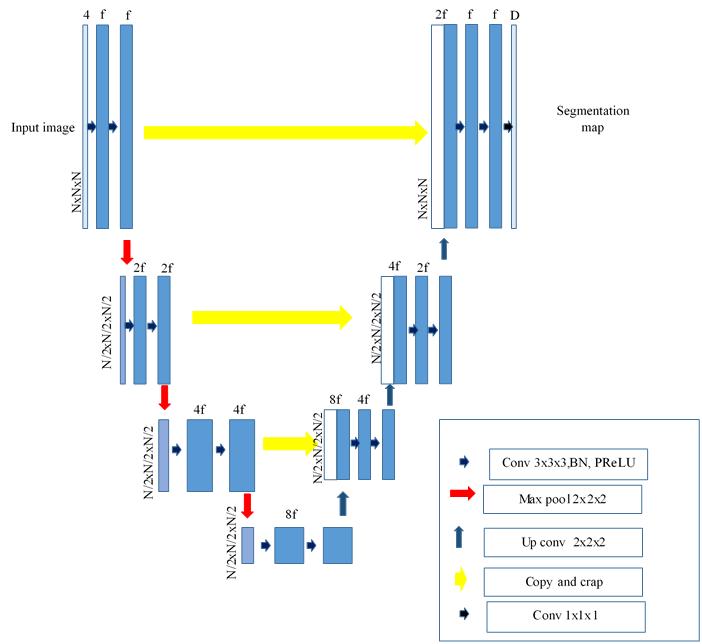
Performance-basedleAI-drivencloudarchitecturesworkinathree-stepprocess:-DataCollection,Analysis,andDecisionmaking.Step1:Inyourfirststepwhereyouwillcollectdatainreal-timewhichcomesfromvarioussourceslikeapplications, servers,andnetworks.Thiscouldincludeanythingfromsystemmetricstohowuserswereinteractingwiththesystems.

Thesubtaskswithgreaterfitnessvalueischosenforexecutionanditsprobabilityisgivenby (10)
International Research Journal of Engineering and Technology (IRJET) e-ISSN: 2395-0056
Volume: 11 Issue: 11 | Nov 2024 www.irjet.net p-ISSN: 2395-0072
Hence, this approach takes care for not violating the precedent constraints and minimizes the make span and power consumption.
Howitworkscollectsincomingdataandrunsthemthroughmachinelearning(AI)algorithmstoinitiatepatternrecognition; anddiscoveranomalies,inconsistencies,orcorrelations.Thesystemdoesthisbypullingintelligentinsightsfromanalysis andthenactingonthemtomakeproactivedecisions.Finally,itusestheseinsightstodetermineandperformcloudoperations to improve them. It can automatically scale up resources based on usage, troubleshoot performance issues, identify & recommendingsavings.
4. Result and Discussion
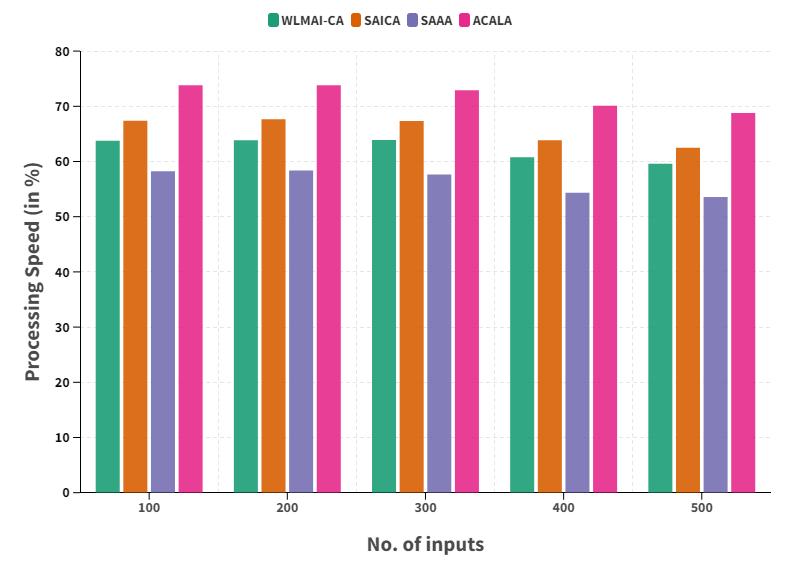
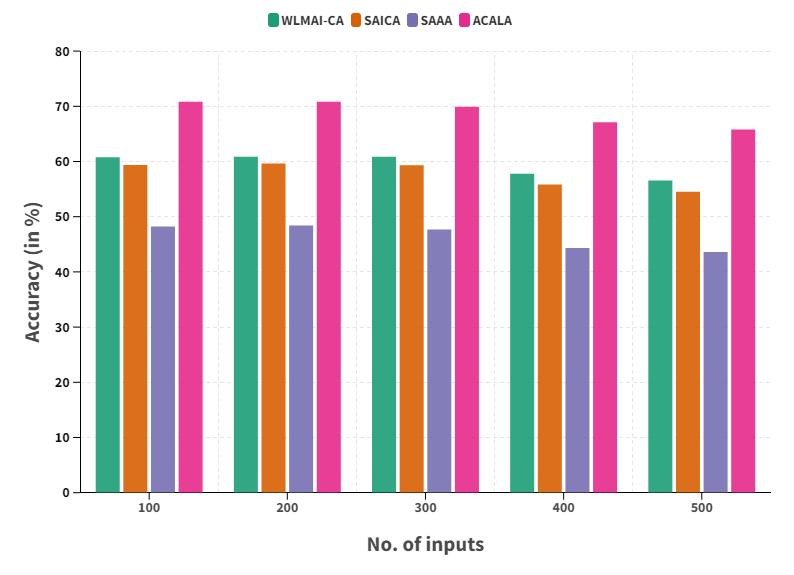
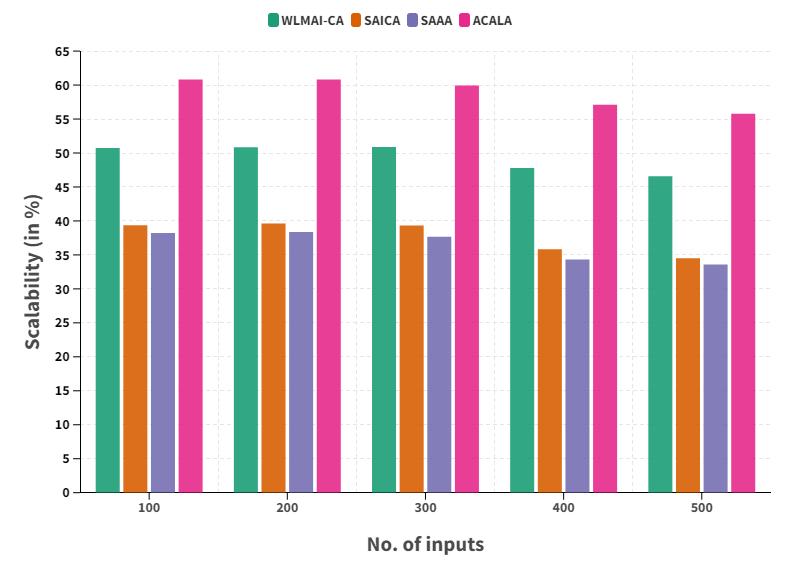
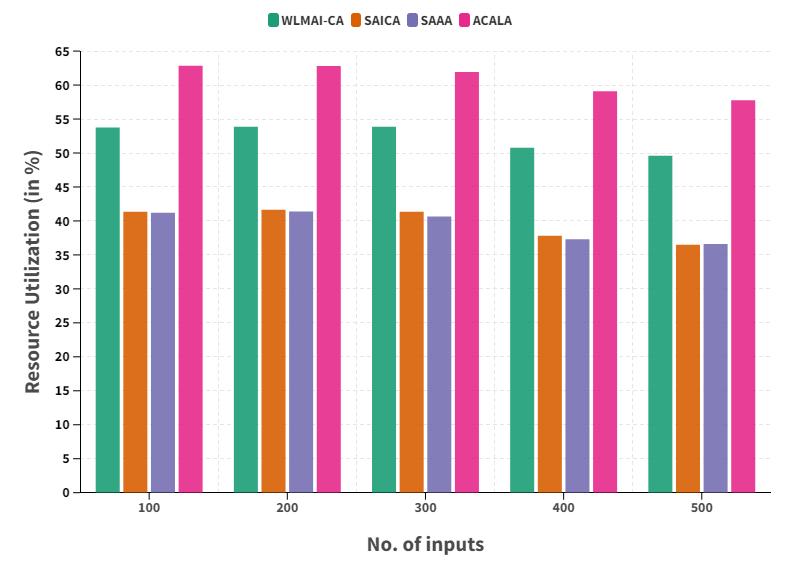
TheproposedmodelACALA(AlgorithmicComparisonforAI-DrivenCloudArchitectures)hasbeencomparedwiththeexisting WLMAI-CA(WorkloadManagementinAI-DrivenCloudArchitectures),SAICA(StreamliningAICloudArchitectures)andSAAA (StreamliningAIArchitectureAlgorithms)
4.1.ProcessingSpeedistheabilitytoprocessandhandleincomingtasks/workloadsatacertainrate.Efficiencyinprocessing tasksiscriticaltomaintainingyourbalancewithAI-drivencloudarchitectures.Fig.3showstheComparisonofProcessing Speed
4.2.AccuracyandReliability:EfficiencytomanageworkloadinAI-drivencloudarchitectures:Thealgorithmsmustbeableto produceaccurateandreliableresults.Thismeansemployingerrorminimizationandhavingreusableperformanceacross disparatetasks.Fig.4showstheComparisonofAccuracy
International Research Journal of Engineering and Technology (IRJET) e-ISSN: 2395-0056
Volume: 11 Issue: 11 | Nov 2024 www.irjet.net p-ISSN: 2395-0072
4.3.Scalability:TheseAI-drivencloudarchitecturesshouldbeabletofacilitateanewoperator-developerworkflowandhandle diverseworkloadswhilescalingupinfinitelyintheirperformancecapabilities.Forthisonemustutilizethealgorithmswhich canlearnandperformwellconcerningworkloadhavingfourproperties.Fig.5showstheComparisonofScalability
International Research Journal of Engineering and Technology (IRJET) e-ISSN: 2395-0056
Volume: 11 Issue: 11 | Nov 2024 www.irjet.net p-ISSN: 2395-0072
4.4.ResourceUtilization:InAI-drivencloudarchitectures,cost-effectiveandsustainableoperationiscruciallydependenton theefficientuseofresources.So,thealgorithmswillhavetofigureouthowwegetallthatdonewithoutoverburdeninganyone systemresourceuntilexhausted.Efficientuseofcomputing,networkbandwidth,andstorage.Fig.6showstheComparisonof ResourceUtilization
5. Conclusion
TherebywehaveconcludedthatAI-drivencloudarchitectureshaverevolutionizedworkloadmanagementinmultiplesectors. Thecomparativealgorithmic integratingform mayset theworkloadmanagement flowof anaggregatorright, whichwill increase efficiency and productivity enough to cut down on cost without any performance decrease. AI algorithms like Predictive analytics and Machine learning which are independent of Human thought provide Automation in workload allocation,resourceoptimisation&decision-making.Allinall,itcomesdowntomakinglifeeasierforhumanmanagershelping thembetterfocustheirtimeandeffortsonmorestrategicbusinesstasks.Inthefuture,asAItechnologyevolvesevenfurther, workload management in cloud architectures is expected to be faster than ever before revolutionizing organizational processing
References
1. Liang,Q.,Hanafy,W.A.,Ali-Eldin,A.,&Shenoy,P.(2023).Model-drivenclusterresourcemanagementforaiworkloads inedgeclouds.ACMTransactionsonAutonomousandAdaptiveSystems,18(1),1-26.
2. Priyadarshini, S., Sawant, T. N., Bhimrao Yadav, G., Premalatha, J., & Pawar, S. R. (2024). Enhancing security and scalabilitybyAI/MLworkloadoptimizationinthecloud.ClusterComputing,1-15.
3. Bidollahkhani,M.,Sharma,A.K.,&Kunkel,J.M.(2024,July).HOSHMAND:AcceleratedAI-DrivenSchedulerEmulating ConventionalTaskDistributionTechniquesforCloudWorkloads.In2024IEEE48thAnnualComputers,Software,and ApplicationsConference(COMPSAC)(pp.2313-2320).IEEE.
4. Tuli,S.,Mirhakimi,F.,Pallewatta,S.,Zawad,S.,Casale,G.,Javadi,B.,...&Jennings,N.R.(2023).AIaugmentedEdgeand Fogcomputing:Trendsandchallenges.JournalofNetworkandComputerApplications,216,103648.
International Research Journal of Engineering and Technology (IRJET) e-ISSN: 2395-0056
Volume: 11 Issue: 11 | Nov 2024 www.irjet.net p-ISSN: 2395-0072
5. Seo,C.,Yoo,D.,&Lee,Y.(2024).EmpoweringSustainableIndustrialandServiceSystemsthroughAI-EnhancedCloud ResourceOptimization.Sustainability,16(12),5095.
6. Singh, V., & Yadav, N. (2023). Optimizing Resource Allocation in Containerized Environments with AI-driven PerformanceEngineering.InternationalJournalofResearchRadicalsinMultidisciplinaryFields,ISSN:2960-043X, 2(2),58-69.
7. Alsadie,D.(2024).AComprehensiveReviewofAITechniquesforResourceManagementinFogComputing:Trends, ChallengesandFutureDirections.IEEEAccess.
8. MURTHY,P.,&BOBBA,S.(2021).AI-PoweredPredictiveScalinginCloudComputing:EnhancingEfficiencythrough Real-TimeWorkloadForecasting.
9. Ghelani,D.(2024).OptimizingResourceAllocation:ArtificialIntelligenceTechniquesforDynamicTaskSchedulingin CloudComputingEnvironments.InternationalJournalofAdvancedEngineeringTechnologiesandInnovations,1(3), 132-156.
10. Singh, A., & Aggarwal, A. (2023). Artificial Intelligence Enabled Microservice Container Orchestration to increase efficiencyandscalabilityforHighVolumeTransactionSysteminCloudEnvironment.JournalofArtificialIntelligence ResearchandApplications,3(2),24-52.
11. Abdi,A.,&Zeebaree,S.R.(2024).EmbracingDistributedSystemsforEfficientCloudResourceManagement:AReview ofTechniquesandMethodologies.IndonesianJournalofComputerScience,13(2).
12. Firouzi,F.,Farahani,B.,&Marinšek,A.(2022).Theconvergenceandinterplayofedge,fog,andcloudintheAI-driven InternetofThings(IoT).InformationSystems,107,101840.
13. Khan,M.A.,&Walia,R.(2024,March).IntelligentData ManagementinCloudUsingAI.In20243rdInternational ConferenceforInnovationinTechnology(INOCON)(pp.1-6).IEEE.
14. Kommisetty, P. D.N. K.(2022).LeadingtheFuture:Big Data Solutions, CloudMigration,andAI-DrivenDecisionMakinginModernEnterprises.EducationalAdministration:TheoryandPractice,28(03),352-364.
15. Tatineni,S.,&Chakilam,N.V.(2024).IntegratingArtificialIntelligencewithDevOpsforIntelligentInfrastructure Management:OptimizingResourceAllocationandPerformanceinCloud-NativeApplications.JournalofBioinformatics andArtificialIntelligence,4(1),109-142.
16. Alnafessah,A.(2022).Artificialintelligencedrivenanomalydetectionforbigdatasystems(Doctoraldissertation, ImperialCollegeLondon).
17. Giagkos, D., Tzenetopoulos, A., Masouros, D., Xydis, S., Catthoor, F., & Soudris, D. (2024). AI-Driven QoS-Aware SchedulingforServerlessVideoAnalyticsattheEdge.Information,15(8),480.
18. Kokkonen, H., Lovén, L., Motlagh, N. H., Kumar, A., Partala, J., Nguyen, T., ... & Riekki, J. (2022). Autonomy and intelligenceinthecomputingcontinuum:Challenges,enablers,andfuturedirectionsfororchestration.arXivpreprint arXiv:2205.01423.
19. Iriogbe,E.I.(2021).ReducingtheCloudOverheadandLatencyforArtificialIntelligenceApplicationsUsingHybrid Computing(Doctoraldissertation,Dublin,NationalCollegeofIreland).
20. Mills,N.,Issadeen,Z.,Matharaarachchi,A.,Bandaragoda,T.,DeSilva,D.,Jennings,A.,&Manic,M.(2024).Acloud-based architecture for explainable Big Data analytics using self-structuring Artificial Intelligence. Discover Artificial Intelligence,4(1),33.
21. Daruvuri,R.,Patibandla,K.,&Mannem,P.(2024).Leveragingunsupervisedlearningforworkloadbalancingand resourceutilizationincloudarchitectures.InternationalResearchJournalofModernizationinEngineering TechnologyandScience,6(10),pp1-8.