
International Research Journal of Engineering and Technology (IRJET) e-ISSN: 2395-0056
Volume: 11 Issue: 11 | Nov 2024 www.irjet.net p-ISSN: 2395-0072

International Research Journal of Engineering and Technology (IRJET) e-ISSN: 2395-0056
Volume: 11 Issue: 11 | Nov 2024 www.irjet.net p-ISSN: 2395-0072
Binu Sudhakaran Pillai1
1Senior Systems Engineer – Systems Engineering, Axyom.Core 15073 Brooks Ln, Frisco, Texas, USA 75035
Abstract - TelecomOperatorshavecommerciallydeployed the5Gtelecommunicationsystems,providing5Gtelecomusers with the latest services, improved customer experience, and variousindustrialopportunitieslikePrivate5G.Therearefew gaps and challenges in 5G services, so various international industrial, academic, and standards organizations have collaborated to research sixth generation (6G) wireless telecommunicationsystems.Muchresearch,whitepapers,and survey papers have been published worldwide, which aim to define6Gintermsofindustrialanduserrequirements,various application scenarios, and future technologies. The International Telecommunication Union for Radio has finalized its vision on 6G and how 6G should function; the related international discussions are still in progress. This paper provides the challenges of 5G and benefits and future vision for 6G, futuristic technical requirements, and telecommunication application scenarios, covering the visualization of 6G. Later, we will discuss the 6G network architecture and its latest technologies. To close with, we will discuss the lessons learned related to 6G networks.
Key Words: 6G (Sixth Generation), mmWave (Millimeter wave),6Gapplicationscenarios,6Gnetworkarchitecture,6G keytechnologies,6Gtrends
1.INTRODUCTION
With the rapid development of Telecommunication applications, communication technologies undergo revolutionary changes every decade. Up till today, the developmentoftelecommunicationsystemshasundergone variousgenerations.Startingthefirstgeneration(1G)analog communication systems to fifth generation (5G) digital communication systems, each generation incorporates higherfrequencies,largerbandwidths,andhigherdatarates. Since 2019, 5G has been commercialized by US Telecom operators,employingsub-6GigaHertzandmillimeterwave (mmWave) bands, with a peak rate of 20 Gigabits per second. From the architecture’s perspective, telecommunication systems have evolved towards more modern antennas, Service advancements, and Advanced multipleaccesstechnologies,asshowninFig.1.
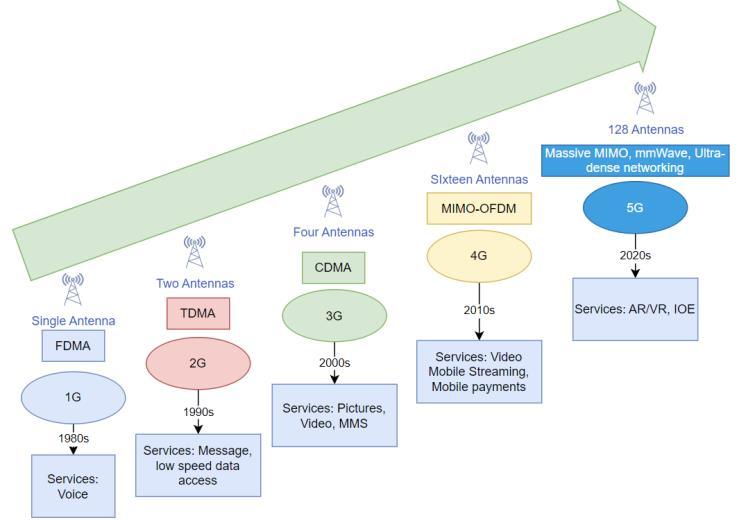
1G-5G: Antennas, multiple access technologies, and services.
Todaythe5GbasestationsexploitmassiveMIMO(Multipleinputmultiple-output)[1],mmWave,andUDN(Ultra-dense networking) technologies [2], supporting up to sixty four transceivers withmoreantenna elements.Commercial 5G basestationproductsusing128antennasaremature,and massiveMIMObasestationswillhaveupto384antennas.In addition, 5G Networks supports augmented reality (AR), InternetofEverything(IoE)andvirtualreality(VR).
Although 5G offers significant improvements over fourth generation(4G)communicationsystems,itstillhasseveral limitations. Currently, there are applications and services requiringbettercommunicationperformancethatisbeyond 5G’scapabilities,suchasglobalcoverage,ultra-highdatarate transmission,ultra-lowlatency,ultra-denseconnection,high precisionpositioning,ultra-reliableandsafeconnection,low powerconsumption,highenergyefficiency(EE),aswellas ubiquitousintelligence.Toaddresstheselimitations,weneed 6G.Ultrahighdatatransmissionrateneedstobesignificantly improvedsothatthepeakdataratecanreachTerabitsper second level, supporting services such as ultra-highdefinitionvideoandtelemedicine.
At low transmission speed, the end-to-end (E2E) latency needstobelessthan1millisecond,whileathighspeed,the latencyshouldreachthemicrosecondlevel.Theconnection densityshouldreach108devices/square-kilometer,meeting
International Research Journal of Engineering and Technology (IRJET) e-ISSN: 2395-0056
Volume: 11 Issue: 11 | Nov 2024 www.irjet.net p-ISSN: 2395-0072
the needs of connecting industrial equipment and dense crowd. Additionally, the positioning accuracy should be improved to achieve an outdoor centimeter level and an indoorsub-centimeterlevelforhigh-precisionpositioning.A seriesofnovelapplications,suchastactileInternet,vehicleto everything (V2X), and wireless data centers, have higher requirements for reliability. Energy consumption is also a vital issue for many applications. Consequently, power consumptionmustbeoptimal,andthenetworkEEneedsto be increased 100-fold moreover, many intelligent applicationspromptcommunicationsystemstohaveahigher intelligencelevel
The evolution of wireless communication systems is an iterativeprocesseverytenyears.Theresearchon6Gisin theearlystageofexploration,andacollectionofcountries and standardization organizations worldwide have announced their plans for 6G research. The Federal Communications Commission (FCC) opened the terahertz (THz) spectrum in the United States for 6G research. It proposed developing 6G based on “mmWave + THz + satellite” in Mar. 2019. In Oct. 2020, the Alliance for Telecommunications Industry Solutions (ATIS) led the formation of the NextG Alliance, a trade organization specializinginmanaging6GdevelopmentinNorthAmerica. The6GSmartNetworksandServicesIndustryAssociation (6G-IA) was set up in Europe to provide next-generation networksandservices.Asaninternationalorganizationfor standardization, the International Telecommunications Union(ITU)releasedtheinitialscheduleof6Gresearchin Feb. 2020. Research and development for the 6G and its corresponding technical propositions will be completed soon.
With continuous application and technical requirements development, the primary application scenarios in the current5Gareexpectedtobehighlyenhancedandexpanded in 6G. Novel application scenarios, such as digital twins, communication, computing, and sensing integration, and distributed AI applications, are also envisaged in 6G. It is necessarytorevolutionizetheentirecommunicationnetwork at the architecture level to enable the network to provide diverse applications and reduce cost and energy consumption.
From 1G to 5G, communication network architecture is developing in the direction of modularization, softwareization, virtualization, and cloudification. Key networkarchitecturesin5Gincludenetworkslicing,network functions virtualization (NFV), software-defined network (SDN),andservice-basedarchitecture(SBA),whichmakethe network more flexible and improve multiple aspects, includingapplicationservicesandcosts.
However,therearestillmanychallengesindeployingthese network architectures in real networks. For the sake of applicationrequirements,technicalrequirements,andcost considerations, the 6G network architecture will integrate novelnetworkarchitecturesandtechnologiesbasedonthe further evolution of the 5G network architecture, moving towardsthefollowingfivedirections:1)3Dmulti-network integrated; 2) Secure and trustworthy; 3) Integration of communications,sensing,andcomputing;4)Green,flexible, andlightweight;5)Nativelyintelligent.
Fig.2summarizesthedevelopmenttrendsofthe6Gnetwork architecture.Inthissection,wewillintroduceeachtrendand thencomprehensivelyfollowthe6Gcommunicationnetwork architecture.
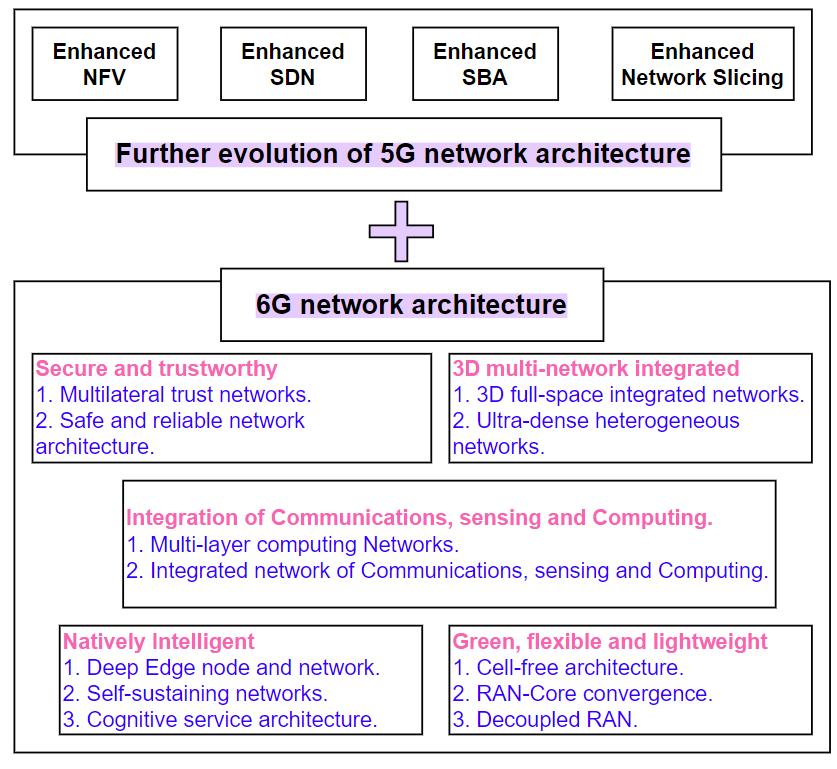
1)3DMulti-NetworkIntegrated:5Gnetworksandprevious generationsofcommunicationnetworkshavemainlyfocused on deploying network access points to connect telecom devicesontheground.However,communicationinremote locations is limited by low wireless coverage. In addition, systems that rely only on terrestrial communication networkshavepoorrobustnessandcannotprovidetimely communication during various disasters. The future Sixth Generationnetworkwillbea3Dfull-spacenetworkdeeply integrated with the ultra-dense terrestrial heterogeneous communicationnetwork.
2)TrustworthinessandSecurity:Itiscriticaltoachievethe requirements of various applications in the 6G communication network, including security and trustworthiness. On the one hand, the fusion of communication technologies with data and industrial operation technologies and the marginalization and
International Research Journal of Engineering and Technology (IRJET) e-ISSN: 2395-0056
Volume: 11 Issue: 11 | Nov 2024 www.irjet.net p-ISSN: 2395-0072
virtualization of facilities will guide a more blurred Sixth Generation network security boundary. Therefore, the traditional existing security model can no longer meet the requirementsofthe6Gsecurityandtrustworthiness[3].On theotherhand,withthechangeofthenetworkarchitecture andtheemergenceofnewservicesandnewterminals,6G networkswillfacenovelsecuritythreats[4],[5],e.g.,thedata privacyissue,securityrisksofmodelsandalgorithms,aswell as software or network vulnerabilities. The new Sixth Generationnetworkarchitecturemustbebasedonamore inclusivemultilateraltrustmodel,consideringsecurityissues at the beginning of the network design to achieve endogenoussecurityandtrustworthiness.
3)IntegrationofCommunications,Computing,andSensing: The 5G network architecture introduced mobile edge computingtoreduceservicelatencyandbackhaulcostsand alleviatetrafficpressure.Thecommunication,computing,and sensingfunctionsinthe6Gerawillbedeeplyintegratedto achieve the vision of complete applications and meet the requirements of lightweight and dynamic computing. Individualnetworknodeswillhavethefunctionsofsensing, datatransmissionandcomputingprovidingsuperiorservices forvarious6Gapplicationscenarios
4) Green, Flexible, and Lightweight: Beyond the flexible networkslicingof5G,thenetworkarchitectureoftheSixth Generation will become flexible, greener, and more lightweight, using cell-free architecture, the RAN Core convergencearchitecture,fullydecoupledRANarchitecture, andotherpromisingtechniques.
5)NativelyIntelligent:The5Gcorenetworkhasaddedthe network data analysisfunction (NWDAF), which improves the network's data collection and analysis capabilities. However, due to limited data sources and a lack of data privacyprotectionandsupportforexternalAIservices,the NWDAFcannotprovidenativeAIsupportforthenetwork. WiththefastdevelopmentofAItechnologies(includingDL [6],reinforcementlearning,andfederatedlearning)andthe enhancement of the comprehensive potential of network nodes,suchastelecommunication,computing,andsensing, TheSixth-GenerationnetworkswillsupportnativeArtificial intelligence,whichhastwodifferentaspects[7],i.e.,AIfor Network(AI4Net)andNetworkforAI(Net4AI).Ontheone hand, novel Artificial Intelligence technologies are used in network planning, system maintenance, and network optimization, enabling self-sufficient operation, selfmaintenance,andself-healingcapabilities.Ontheotherhand, thenetworkwithnativeintelligencewillbeabletoprovide moreintelligentAIapplicationservicesforusers.Currently, more and more research interests are focused on natively intelligent network architecture, such as cognitive service architecture,DEN2(Deepedgenodesandnetworks),SSNs (Self-sustaining networks) and digital twin-based network architecture. These futuristic technologies will help to achievenativelyintelligent6Gnetworks.
Inthissection,theconcepts,applications,developmentsand challenges of these potential 6G key technologies will be discussedasshowninFig3
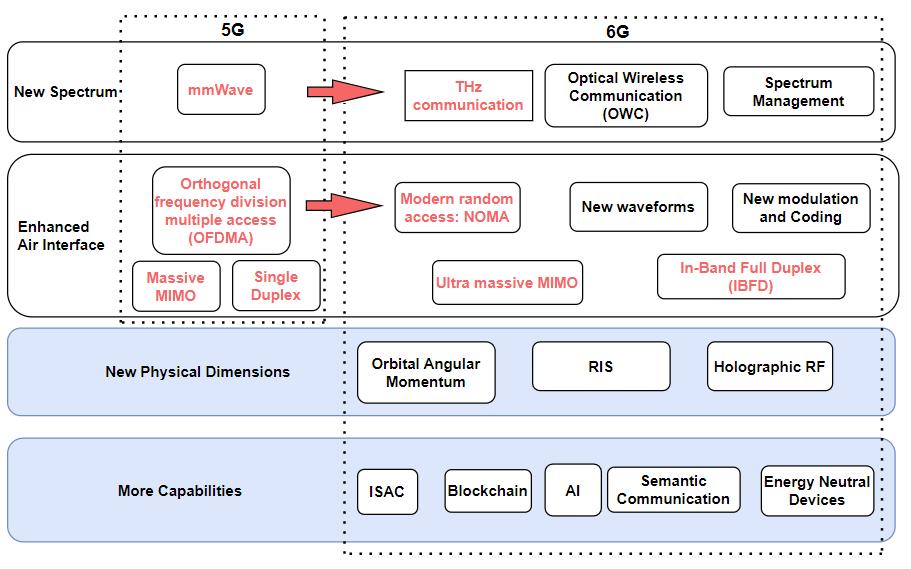
1)NewTHzSpectrum:Therapidgrowthofvideoservices and the emergence of new applications, such as Virtual Reality,AugmentedReality,autonomousdriving,etc,have ledtothedemandforhighdataratetransmissionandlow latencyservices[8].Mostexisting5Gtechnologiesarestuck inthemmWavebandandcanonlyachieveaverageratesof upto1Gbps[9].Facingnon-negligiblespectrumcongestion problems, more than 5G communication systems are requiredtomeettherapidlyincreasingdemandfor6Gdata services.THzisthelastspectrumgapbetweenmmWaveand optical frequency ranges. THz is characterized by high frequency,largebandwidth,highpathloss,severemolecular absorption, abundant diffuse scattering, and extremely narrow beam. Although there is still some distance from practicalapplications,THzisregardedasthemostpromising technology for 6G because of its ability to provide robust supportforultra-highdatarateservices[10].
2)ModulationandNewWaveforms:6Genhancementspose newideasforwaveformdesignandmodulation,andtheyare expectedtoachievedataratesreachingTbps(terabitsper second),enablehigh-densityconnections,offerawiderange of coverage, and facilitate the delivery of more intelligent and secure services. The unique characteristics and requirementsofapplicationscenariosneedtobeconsidered whendevelopingwaveforms,whicharecloselyassociated withtheperformanceofthetelecomsystem.Moreexisting waveformsaredetailedin[11].Inordertoflexiblyadaptto thepossibleapplicationscenariosofthe6Gcommunication system, new waveform designs are expected to provide better performance in a targeted manner. Compared with lowfrequency,thepotentialhigh-frequencyscenariosof6G lead to more challenges, such as significant transmission path loss and the need for efficient high-frequency broadbandpoweramplifiers.In[12],asingle-carriersystem
International Research Journal of Engineering and Technology (IRJET) e-ISSN: 2395-0056
Volume: 11 Issue: 11 | Nov 2024 www.irjet.net p-ISSN: 2395-0072
withalowpeak-to-averagepowerratio(PAPR)wasstudied to address these challenges. For high mobility scenarios, waveforms in the transform domain, such as OTFS (Orthogonaltimefrequencyspace),candescribeinformation suchasdelayandDopplermoreaccurately[13].
3) New Coding: Efficient channel coding technology can improvethecapacity,reliability,andqualityoftheservices in the communication systems. As per Shannon’s theory, error-correctingcodes(ECCs)realizealeapfromalgebraic coding to probabilistic coding, significantly improving communicationsystems'capacity,reliability,andqualityof service [14]. The probabilistic codes approach or even achievetheShannonlimitbyintroducingrandomnessand sparsityincodingandpropagatingsoftmessagesbasedon factor graphs in decoding. Among them, the most representative ECCs are Turbo codes [15], low-density parity-check(LDPC)codes[16],andpolarcodes[17],which are the standard codes for 4G data channels, 5G data channels, and 5G control channels, respectively. Though theirde-factodecodingalgorithmsandimplementationsare different[18],theyareallderivedbasedonBayes’theorem andarecompetitivefor6Gultra-highspeedandultra-low powerconsumptionrequirements.
4) Modern Random Access: Long Term Evolution (LTE) employsOFDMA,and5GNewRadiousesoptimizedOFDMbasedwaveformsandmultipleaccess,whichareorthogonal multipleaccess(OMA)technologies.Theconnectiondensity of 6G communication systems will increase tens of times compared to that of 5G. NOMA is recognized as the most encouraging modern random access technology for 6G, meetingtherequirementsoflowcosts,highdependability, lowlatency,enormousconnectivity,andhighthroughputin the complex and variable scenarios of 6G communication systems[11],[4],[3],[5],[19].
5)NewPhysicalDimensions:Tosurvivewiththeprospering development of massive IoT, Sixth generation communication is expected to achieve a higher data rate usingtheexistingspectrumresources.Inadditiontorelying on traditional air interface technologies, such as multiple antennas, modulation, coding, and duplexing, finding new physical dimensions and transmission carriers to achieve revolutionarybreakthroughscanalsohelp.
6) Reconfigurable Intelligent Surfaces: RIS is a surface composedofmanyprogrammable2Dmeta-materialsofsubwavelengths,eachcapableofdynamically,intelligently,and independently manipulating incident signals to obtain the expectedreflectedsignalortransmissionsignal.Compared withtheradiotransmitterswithtraditionalstructures,RIS technologyiscosteffective,energyefficient,andtrouble-free deployment, which can remarkably increase network transmission rate, amplify signal coverage, and improve energy,frequencyandcostefficiency[3],[20],[21],[22].
7)AI:ArtificialIntelligencehasdevelopedrapidlyandhas overwhelmingadvantagesinthetelecomsector.MLandDL areessentialsubsetsofAIthatcanlearnanddevelopover time. AI technologies have high robustness, adaptive learning ability, and strong understanding and reasoning ability, which equip them with great potential in many elements,especiallyforscenarioswheresignificantamounts of data are available for training. The telecom system will enablemoresignificantthroughput,lowerlatency,agreater numberofconnections,andmoreintelligentservices.
8)Blockchain:Theblockchaintechniquewasfirstproposed for cryptocurrency in 2008. Using distributed databases connected by hash pointers, blockchain has the characteristicsofdecentralization,transparency,anonymity, immutability, traceability, and resiliency. Because of the flatterstructureandmorefrequentdatatransformationin the 6G network, the traditional centralized security authenticationandaccesscontrolmechanismswillnolonger be fully applicable. Blockchain, considered one of the essential technologies for 6G communication systems [3], [20],[5],providesapromisingsolutiontothetrustsecurityrelated issues among distributed and heterogeneous network devices and infrastructures. In the 2018 Mobile WorldCongressAmericas(MWCA),theFCCdrafteditsvision for deploying blockchain in future Sixth Generation networks.In[23],blockchain-RAN(B-RAN)architecturewas proposedforsecureradioaccessinadecentralizedsystem.
TheSixthGenerationNetworkwillpromoteintercontinental telecom services by steering in new telecom application scenarios, bringing fresh telecom experiences, and supportinggrowth.Thispaperhascriticallyappraisedthe recent solutions disseminated in the relevant literature, focusing on the associated developments. This paper has alsodiscussedthevision,trend,andtechnologyforthe6G Network, indicating that 6G will be developed in multiple directions, aiming for global coverage, relying on a vast rangeofspectralbands,attractiveapplications,stimulating all human senses, and hinging on pervasive digital intelligenceandrobustsecurity.Variousresearchdirections have also been analyzed from the perspective of fundamentalresearch,greennetworks,andtheassociated criticaltechnologiesdevelopedforsupportingtheproposed 6Gvision.
[1] L.Lu,G.Y.Li,A.L.Swindlehurst,A.Ashikhmin,andR. Zhang, “An overview of massive MIMO: Benefits and challenges,”IEEEJ.Sel.Top.SignalProcess.,vol.8,no.5, pp.742–758, Oct. 2014. DOI: 10.1109/JSTSP.2014.2317671
International Research Journal of Engineering and Technology (IRJET) e-ISSN: 2395-0056
Volume: 11 Issue: 11 | Nov 2024 www.irjet.net p-ISSN: 2395-0072
[2] M. Kamel, W. Hamouda, and A. Youssef, “Ultra-dense networks:Asurvey,”IEEECommun.SurveysTuts.,vol. 18,no.4,pp.2522–2545,4thQuart.,2016.
[3] “White paper on 6G overall vision and potential key technologies,”IMT-2030(6G)PromotionGroup,White Paper, Jun. 2021. [Online]. Available: http://www.caict.ac.cn/kxyj/qwfb/ztbg/202106/ P020210604552573543918.pdf
[4] “6G: Unbounded, with AI,” UNISOC, Shanghai, China, White Paper, Nov. 2020. [Online]. Available: http://unisocdata.osscnshanghai.aliyuncs.com/other/20201126/202011261 130506G
[5] X.You,C.-X.Wang,J.Huang,X.Gao,Z.Zhang,M.Wang,et al., “Towards 6G wireless communication networks: Vision,enablingtechnologies,andnewparadigmshifts,” Sci.ChinaInf.Sci.,vol.64,no.1,p.110301,Jan.2021., doi:DOI:10.1007/s11432-020-2955-6
[6] C. Zhang, P. Patras, and H. Haddadi, “Deep learning in mobile and wireless networking: A survey,” IEEE Commun.SurveysTuts.,vol.21,no.3,pp.2224–2287, 3rdQuart.,2019
[7] “White paper on 6G network architecture vision and potentialkeytechnologies,”IMT-2030(6G)Promotion Group, White Paper, Jun. 2021. [Online]. Available: https://mp.weixin.qq.com/s/JXqJbVTvbPvJE_Tl5jRXKA
[8] T. S. Rappaport et al., “Wireless communications and applications above 100 GHz: Opportunities and challengesfor6Gandbeyond,”IEEEAccess,vol.7,pp. 78729–78757,2019.
[9] K.M.S.Huq,S.A.Busari,J.Rodriguez,V.Frascolla,W. Bazzi, and D. C. Sicker, “Terahertz-enabled wireless system for beyond-5G ultrafast networks: A brief survey,”IEEENetw.,vol.33,no.4,pp.89–95,Jul.2019.
[10] H.Elayan,O.Amin,B.Shihada,R.M.Shubair,andM.-S. Alouini,“Terahertzband:ThelastpieceofRFspectrum puzzle for communication systems,” IEEE Open J. Commun. Soc., vol. 1, pp.1–32, 2020. DOI: 10.1109/OJCOMS.2019.2953633
[11] W. Tong and P. Zhu, 6G, The Next Horizon: From ConnectedPeopleandThingstoConnectedIntelligence, 1st ed. Cambridge, U.K.: Cambridge Univ. Press, 2021. DOI:10.1017/9781108989817
[12] T.Nitsche,C.Cordeiro,A.Flores,E.Knightly,E.Perahia, and J. Widmer, “IEEE 802.11ad: Directional 60 GHz communication for multi-gigabit-per-second Wi-Fi [invited paper],” IEEE Commun. Mag., vol. 52, no. 12, pp.132–141, Dec. 2014. DOI: 10.1109/MCOM.2014.6979964
[13] Z.Wei,W.Yuan,S.Li,J.Yuan,G.Bharatula,R.Hadani,et al., “Orthogonal time–frequency space modulation: A promising next-generation waveform,” IEEE Wirel. Commun., vol. 28, no. 4, pp.136–144, Aug. 2021. DOI: 10.1109/MWC.001.2000408
[14] D.J.CostelloandG.D.Forney,“Channelcoding:Theroad tochannelcapacity,”Proc.IEEE,vol.95,no.6,pp.1150–1177,Jun.2007.
[15] C. Berrou, A. Glavieux, and P. Thitimajshima, “Near shannon limit error-correcting coding and decoding: Turbo-codes. 1,” in Proc. IEEE ICC, vol. 2. Geneva, Switzerland,1993,pp.1064–1070.
[16] R. Gallager, “Low-density parity-check codes,” IEEE Trans. Inf. Theory, vol. 8, no. 1, pp.21–28, Jan. 1962. DOI:10.1109/TIT.1962.1057683
[17] E. Arıkan, “Channel polarization: A method for constructing capacityachieving codes for symmetric binary-input memoryless channels,” IEEE Trans. Inf. Theory, vol. 55, no. 7, pp.3051–3073, Jul. 2009. DOI: 10.1109/TIT.2009.2021379
[18] S.Shao,etal.,“Surveyofturbo,LDPC,andpolardecoder ASIC implementations,” IEEE Commun. Surveys Tuts., vol. 21, no. 3, pp. 2309–2333, 3rd Quart., 2019 DOI: 10.1109/COMST.2019.2893851
[19] W.Jiang,B.Han,M.A.Habibi,andH.D.Schotten,“The roadtowards6G:Acomprehensivesurvey,”IEEEOpenJ. Commun. Soc., vol. 2, pp.334–366, 2021. DOI: 10.1109/OJCOMS.2021.3057679
[20] M.Z.Chowdhury,M.Shahjalal,S.Ahmed,andY.M.Jang, “6G wireless communication systems: Applications, requirements, technologies, challenges, and research directions,”IEEEOpenJ.Commun.Soc.,vol.1,pp.957–975,2020.DOI:10.1109/OJCOMS.2020.3010270
[21] E. Basar, M. Di Renzo, J. De Rosny, M. Debbah, M.-S. Alouini, and R. Zhang, “Wireless communications through reconfigurable intelligent surfaces,” IEEE Access, vol. 7,116753–116773, 2019. DOI: 10.1109/ACCESS.2019.2935192
[22] Y. Liu, et al., “Reconfigurable intelligent surfaces: Principlesandopportunities,”IEEECommun. Surveys Tuts.,vol.23,no.3,pp.1546–1577,3rdQuart.,2021.
[23] X.Ling,J.Wang,T.Bouchoucha,B.C.Levy,andZ.Ding, “Blockchain radio access network (B-RAN): Towards decentralized secure radio access paradigm,” IEEE Access, vol. 7, pp.9714–9723, Jan. 2019. DOI: 10.1109/ACCESS.2018.2890557
International Research Journal of Engineering and Technology (IRJET) e-ISSN: 2395-0056

Binu Sudhakaran Pillai, a Seasoned Telecom Professional and Solutions Architect, has over 19yearsofexperienceintheCore Telecom and Cloud Virtualization domain.
Binu has been providing subject matter expertise in virtualized 4G/5G mobile packet core solutions. His contributionstotheTelecomandCloudNativeplatformsare noteworthy,andheiswidelyrecognizedasadistinguished researcher. Kindly contact on his LinkedIn page for any questions:https://www.linkedin.com/in/binu-sudhakaranpillai-993089196/
Volume: 11 Issue: 11 | Nov 2024 www.irjet.net p-ISSN: 2395-0072 © 2024, IRJET | Impact Factor value: 8.315 | ISO 9001:2008