

STUDY THE EFFECT OF RESPONSE REDUCTION FACTOR ON RC FRAMED STRUCTURE
Atul B.Pujari1 , Swarupa Nawale2
1 Professor, Department of Civil Engineering, KJEI’s KJ College of Engineering & Management Research, Pune, Maharashtra, India.
2. PG Student, Department of Civil Engineering, KJEI’s KJ College of Engineering & Management Research, Pune, Maharashtra, India.
Abstract: An important consideration in the design of structures is seismic analysis. In seismic design, the strength and ductility of frame members depend on the reduction factor (R). In this plan, different heights of our frame structure in the fourth area conditions were considered. The primary purpose of this study is to calculate the response reduction coefficient values obtained from the RC frame design. The results were interpretedusing nonlinear analysis. ETABS software was used to analyze the nonlinear behavior ofthe samples. Therefore, thisstudyattemptedtoevaluatethe adequacy of the rule-based "R" factor in the seismic evaluation of structural design using nonlinear dynamic analysis (NLD). The results clearly show the effect of structural changes on ductility and strength values. It is distinctly seen that the 'R' value written by the code for a particular type of model indicates that importance should be givento the error andadequate prediction. Inthis we studied the different response reductioncoefficientsareusedtodefine models with different processestoobtainthemosteconomical and stable models. And examining the influence of behavior factor on changes in displacement and drift of structure.
Key Words: dynamic analysis1, extreme strength 2, impact ductility3, seismic response analysis 4.
1. INTRODUCTION
While there are many natural disasters in the world, earthquakes are one of the worst and can have a significantimpactontradeandbusiness.Therefore,in recent years, earthquake engineering has been established as a branch of engineering related to earthquakeprediction.years.Mostseismicdesignrules for buildings consider and assume the nonlinear response of earthquake-exposed objects in terms of seismicintensity.Measuretheseismicforcerequiredin the structure and then develop a design process to ensure the structure can withstand this force. Durabilityisakeyfactorintheseismicdesignofmost structures. The reduced response factor provides an easy-to-understand view and plays a crucial role in seismicdesign. Thenegativeresponse ofthe model is not included in the design process, but its impact is consideredusingareductioncalledthereductionfactor
(R). In seismic design, the seismic coefficient method uses the R factor to reduce the base shear force to obtaintheexternaldesign.Weknowthatactualseismic forcesaregreaterthanthemodelsweredesignedfor. The structure cannot be built according to the importance of the earthquake intensity because the constructioncostswillbetoohigh.Theactualintensity oftheearthquakeisreducedbyafactorcalledRfactor. The method for determining the reduction factor (R) varies from code to code. The value of the reduced responsereductionfactorintheIScodevariesfrom3to 5.IS18932016(PartI)dependsonthetypeofmoment resisting frame (OMRF), specific moment resisting frame(SMRF)andmomentresistingframewithactual mean resistance (IMRF). Most previous work in this field has focused on finding the ductility and super strength components in response to the reduction coefficient.
Responsereductioncoefficient:-
Reactionreductioncoefficient,R,representstheratioof themaximumexternalforcetothelateralforcecarried when the structure is elastic. Last build. In general, responsereductionpointsareexpressedasafunction of various structural parameters such as strength, ductility,dampingandredundancy.

Where "Rs" is the strength coefficient, "Rr" is the hardnesscoefficientand"Rμ"istheductilitycoefficient.
1.1 Strength Factor (Rs):
The strength factor is calculated as the ratio of the maximum base shear force (Vo) obtained from the pushover curve to the base shear force (Vb) of the structure.


International Research Journal of Engineering and Technology (IRJET) e-ISSN: 2395-0056 Volume: 11 Issue: 01 | Jan 2024 www.irjet.net p-ISSN: 2395-0072 © 2024, IRJET | Impact Factor value: 8.226 | ISO 9001:2008 Certified Journal | Page742
***
Where,
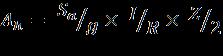
Where,W=totalweightofthebuilding.
R=responsereductionvalue. I=important.
1.2 Coefficient of ductility (Rμ):
Inseismicdesign,theterm"ductility"isusedtoindicate structure's capacity to withstand significant cyclic deformations in the inelastic range without reducing strength.
Coefficient of ductility = maximum elasticity / yield strength

1.3 Redundancy factor (Rr)
The redundancy factor depends on the number of verticallinesinvolvedintheearthquake.Thefactthata part of a sample is removed does not mean that the entiresampleisremoved.Therefore,loaddistribution providesadditional safetyduetotherepetitionofthe structure.Theredundancyfactorisassumedtobe1in thisstudy.
1.4 Damping coefficient (Rxi):
Sincenodamperwasusedinthisresearch,thedamping coefficientwasassumedtobeequalto1.
Ferraioli [1] he studied the behavior factor for RC framed structure of 3,5,7 & 9 Storey height, For investigating he used the relationship between code prescribed value and calculated value of behavior factor.ThomasandTrezos[2]theyattemptedtostudy thebehaviorfactorofvariousbuildingsconsideringthe random character of their characteristic Elnashai, Broderick [3] they selected the response criteria and earthquakegroundmotionsinacompanionstudyand are applied to the evaluation of the actual behavior factorofanumberofmovementregisteringcomposite frame designed to the requirements of the structural eurocodes..Toby,Kottuppill,[4]theystudiedEvaluation ofresponsereductionpointsusingnonlinearanalysis. Parsaci and K Rama [5] this paper has studed the influenceoflocationoflaterialforceregisteringsystem ontheresponsereductionfactorR,ductilityandplastic hinge status at performance point of the RC building. Mondal, Ghosh, Reddy, [6] This paper carried out researchworkfocusingestimationofactualRvaluesfor realistic RC movement registering frame building design and Performance-based analysis of response
mitigation members of ductile RC frames. Ferraioli, Lavino,andMandara[7]theyinvestigatedthebehavior factor i.e. related to the non-linear dynamic response with simplified linear design response of movement registering frames. Han and Jee [8] they performed Seismic Performance ofNormal and Medium Flexural Strength Concrete Columns in Frames. Sunagar and Shivananda [9] This paper carried out studies investigationlateralloadcarryingcapacityofRCframe and analysis of response modification factor for individual frames. Anwaruddin, Akberuddin, ZameeruddinandSaleemuddin[10]thispapercarried out another study on Pushback analysis of mid-rise multi-storey RCC frame with and without vertical irregularitiesusingETabssoftware.IS13920[11]Code of Practice for Ductility Detailing of Reinforced ConcreteStructuresSubjecttoSeismicForces,1993.IS 456[12]“Indianstandardcodeofpracticeforgeneral andreinforcedconcrete.”BureauofIndianStandards, New Delhi, 2000. IS 1893 (Part I) [13] “Standards for seismicdesignofstructures.”
2. ANALYSIS PROCEDURES
By reviewing the previous literature, the effect of the reduction coefficient on the reinforced concrete frame structurewasexamined.
1.Forthestandardmodel,thefloorheightforeachfloorof 5x4m length is 3m. Three models will be created with differentresponsereductioncoefficientsR1R2R3R4R5 dependingonthenumberoflayers.
2.DefinethepropertiesoftheframestructureanduseEtabs software to create the structure. Several types of loadingareconsideredintheanalysis.Forstaticbehavior, deadloadofthebuildingistakenintoconsiderationasper IS875PartIandliveloadasperIS875PartIII.1893:2016 forSeismicLoading,IS456:2000forReinforcedConcrete Structures
3.Thethree-dimensionalreinforcedconcretestructuresof floors G+4, G+8 and G+12 was analyzed using response spectrum analysis in E-tabs software. This evaluation includes the building's floor change, floor interactions, floorintersections,etc.focusesonlearninghowtoanalyze itsstructure.
4.ComparetheanalysisresultsofdifferentresponsesinR1 R2 R3 R4 R5. Cover layer movement, displacement, and shearforcestoshapethebuildingsymmetrically.
3. MODEL FEATURES
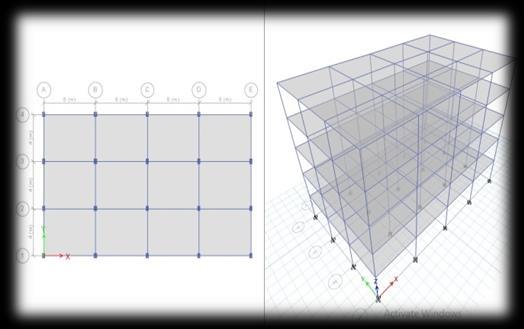
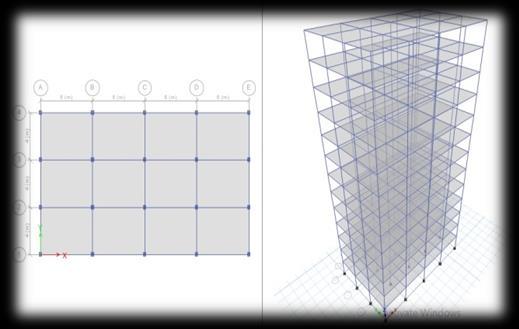
This research considers three RC frames with the same numberofcompartmentsbutdifferentfloors.Four-storey, eight-storey, twelve-storey models are designed for R = 1,2,3,4,5. The height of each floor is 3m, the building's overall width inthe X direction is20m, the baywindow widthis5m,thetotalwidthintheYdirectionis12m,the
International Research Journal of Engineering and Technology (IRJET) e-ISSN: 2395-0056 Volume: 11 Issue: 01 | Jan 2024 www.irjet.net p-ISSN: 2395-0072 © 2024, IRJET | Impact Factor value: 8.226 | ISO 9001:2008 Certified Journal | Page743
totalwidthis4m.M-25qualityconcreteandFe-500quality steelbarsareusedinallmodelsinthisstudy.Forexample, the floor thickness is 150 mm, the wall thickness is 230 mm,andtheheightis3m,theparapetheightis1.2mand thethicknessis230mm.DeadloadisdistributedasperIS 875(Part1)12andliveloadisdistributedasperIS875 (Part 2) 3. Seismic loads are calculated as per IS 1893 2016.AssumedseismicloadzoneIV,intermediateground conditions, OMRF, R = 1.3, SMRF, R = 5, damping 5%, criticalfactor1.

4. RESULTS AND DISCUSSION
In this study, RCC G+4, G+8, G+ 12-storey buildings were analyzed from the response spectrum using reduced response (i.e., from 1 to 5) for magnitude III earthquakes. TheeffectofRonRCCsamplesatheightsG+4,G+8andG+12 wasobtainedthroughthedesignandanalysisofeachmodel in ETABS. Compare soft tissue and response (including displacement,compression,andbasalshear)forR=1toR= 5.
4.1 Dynamic Analysis Method
Table-1 G+4story buildingDisplacementResultsfor differentResponseReductionsFactor.
TABLE: Story Response

Fig.4 G+4storybuildingDisplacementResultsfor differentResponseReductionsfactor
ComparingthedisplacementresultofG+4storybuildingfor response reduction factor 1, 2, 3, 4 & 5. Results indicate variation ofdisplacement is 2.5%,3.05%, 7.85%and38% displacementareincreasedascomparedto5factor.
International Research Journal of Engineering and Technology (IRJET) e-ISSN: 2395-0056 Volume: 11 Issue: 01 | Jan 2024 www.irjet.net p-ISSN: 2395-0072 © 2024, IRJET | Impact Factor value: 8.226 | ISO 9001:2008 Certified Journal | Page744
Fig.-1: G+4STORYBUILDINGMODEL.
Fig.-2: G+8STORYBUILDINGMODEL.
Fig.- 3: G+12STORYBUILDINGMODEL
Story Elevation (m) R=1 R=2 R=3 R=4 R=5 Base 0 0 0 0 0 0 GF 3 12 3.85 2.27 2.23 1.6 1 6 28.01 10 6.2 4.81 4 2 9 44 15 10 7.25 6 3 12 55.75 18.75 12.35 9.4 7.5 4 15 61.03 21.6 13.75 10.7 8.2
TABLE: Story Response


The change in % difference for drift results shows 1.27%, 0.18%,0.12%,0.07%forthevalueofR=1toR=5.
AnalysisofG+4storybuildinginresponsespectrummethod, Story stiffness is 50%, 34%, 25%, 19.67% in different responsereductionfactor.i.e.,1,2,3,4,5.hencestructure showsmaximumstiffnessinresponsefactor1,2.
5. CONCLUSIONS
1.ComparingthedisplacementresultsforG+4,G+8,G+12 story building in different response reductions factor i.e., 1,2,3,4&5resultsindicatethatvariationsofdisplacement areincreasedasresponseReductionsfactordecreases.So, for3to5responsereductionfactorperformanceisbetter.
2. Drift is decreased with proportional to response reductions factor, i.e., 1, 2, 3, 4 & 5 hence structure show linearbehaviorsinresponsereductionsfactor3,4&5.And responsereductionsfactor1&2shownonlinearbehaviors. Hence structure shows satisfactory performance in Responsereductionsfactor3,4&5.
3.Thedisplacementisincreasedascomparedtoheight,but percentage variations are same in all different height of structure.
TABLE: Story Response
4.AnalysisofRCCbuildingwithdifferentresponsereductions factorfordifferentheightstructureG+5,G+7andG+9story, Rfactorisdecreasedwithproportionaltoincreasedheightof structure and response reductions factors 3 & 5 show satisfactoryperformanceinpushoveranalysis.
6. REFERENCES
[1] Massimiliano Ferraioli, “Behavior Factor of Ductile Code- Designed Reinforced Concrete Frames”, Hindawi AdvancesinCivilEngineering,2021.
https://www.hindawi.com/journals/ace/2021/6666687/
International Research Journal of Engineering and Technology (IRJET) e-ISSN: 2395-0056 Volume: 11 Issue: 01 | Jan 2024 www.irjet.net p-ISSN: 2395-0072 © 2024, IRJET | Impact Factor value: 8.226 | ISO 9001:2008 Certified Journal | Page745
Table-2 G+4storybuildingDriftResultsfordifferent ResponseReductionsFactor
Story Elevation (m) R=1 R=2 R=3 R=4 R=5 Base 0 0 0 0 0 0 GF 3 3.9 1.3 0.9 0.68 0.55 1 6 5.7 1.9 1.29 0.98 0.79 2 9 4.9 1.7 1.12 0.85 0.68 3 3 3.8 1.3 0.84 0.64 0.51 4 6 1.9 0.63 0.45 0.33 0.26
Fig.5 G+4storybuildingDriftResultsfordifferent ResponseReductions.
Table-3 G+4storyShearResultsfordifferentResponse ReductionsFactor.
Story Elevation (m) R=1 R=2 R=3 R=4 R=5 Base 0 0 0 0 0 0 GF 3 1500 510 340 255 206.5 1 6 1390 478 310 238 187.5 2 9 1170 388 260 195 152 3 3 790 270 180 135 112 4 6 320 120 78 58 48
Fig.6 G+4storyshearResultsfordifferentResponse Reductions.
[2] G. C. Thomos& C. G. Trezos, “Behavior Factor of RC Structures:AProbabilisticApproach”,TransactionsonThe BuiltEnvironment,Vol81,2005.
https://www.witpress.com/Secure/elibrary/papers/ERES0 5/ERES05068FU.pdf
[3] S. Elnashai, B. M. Broderick, “Seismic Response of Composite Frames II. Calculation Of Behaviors Factors,”EngineeringStructures,Vol.18,No.9,pp.707-723, 1996.https://www.sciencedirect.com/science/article/abs/p ii/014102969500212X.
[4]TiaToby,AjeshK.Kottuppillil, “Evaluation of Response ReductionFactorusingNonlinearAnalysis”, International Journal for Innovative Research in Science & Technology, Vol.2,Issue06,November2015.
https://www.academia.edu/19835669/Evaluation_of_Respo nse_Reduction_Factor_using_Non_Linear_Analysis
[5] Mohammad ParaeiMaram and K Rama Mohana Rao “Effect of Location of Lateral Force Resisting System on Seismic Behavior of RC Building”, InternationalJournalof Engineering Trends and Technology (IJERTT), Volume 4, Issue10,Oct2013.
https://ijettjournal.org/archive/ijett-v4i10p158
[6]Apurba Mondal, Siddhartha Ghosh, G.R. Reddy, “Performance-Based Evaluation of The Response Reduction Factor for Ductile RC Frames” Engineering Structures,Vol. 56,Pp.1808-1819,2013.
https://www.researchgate.net/publication/265642853_Perf ormancebased_evaluation_of_the_response_reduction_factor _for_ductile_RC_frames
[7] Sang W han Han and N.Y. Jee “Seismic Behavior of Column in Ordinary andIntermediateMoment Resisting Concrete Frames”, Elsevier,volume27,Issue6,May2005, 951-962.
https://www.sciencedirect.com/science/article/abs/pii/S0 141029605000611
[8]PrashantSunagarandS.M.Shivananda, “Evaluation of SeismicResponseModificationFactorsforRCCFramesby Non-Linear Analysis”
https://www.scribd.com/document/245582596/Evaluation -of-Seismic-Response-Modification-Factors-for-RCC-Framesby-Non-Linear-Analysis
[9] Mohammad Anwaruddin, Md. Akberuddin, Mohd. ZameeruddinMohdandSaleemuddin “Pushover Analysis of Medium Rise Multi-Story RCC Frame with And Without Vertical Irregularity,” International JournalofEngineering ResearchandApplicationsVol3,Issue5,Oct2013,540-546. https://www.researchgate.net/publication/280095036_Pus hover_Analysis_of_Medium_Rise_MultiStory_RCC_Frame_With_and_Without_Vertical_Irregularity
[10] I S 13920 Ductile detailing of reinforced concrete structuresubjectedtoseismicforcescodeofpractice”,1993. https://law.resource.org/pub/in/bis/S03/is.13920.1993.pd f
[11]IS456“IndianStandardCodeofPracticeforPlainand Reinforced. Concrete,” Bureau of Indian Standards, New Delhi,2000.
https://www.scirp.org/(S(lz5mqp453ed%20snp55rrgjct55) )/reference/referencespapers.aspx?referenceid=1610427
[12] I S 1893 2016 (Part I), “Criteria for Earthquake ResistantDesignofStructures”.
https://law.resource.org/pub/in/bis/S03/is.1893.1.2002.pd f
International Research Journal of Engineering and Technology (IRJET) e-ISSN: 2395-0056 Volume: 11 Issue: 01 | Jan 2024 www.irjet.net p-ISSN: 2395-0072 © 2024, IRJET | Impact Factor value: 8.226 | ISO 9001:2008 Certified Journal | Page746