
International Research Journal of Engineering and Technology (IRJET) e-ISSN:2395-0056
Volume:11Issue:11|Nov2024 www.irjet.net p-ISSN:2395-0072

International Research Journal of Engineering and Technology (IRJET) e-ISSN:2395-0056
Volume:11Issue:11|Nov2024 www.irjet.net p-ISSN:2395-0072
Archana Panpatil1 , Pratiksha Deokar2, Sayali Nerkar3 , Vaishnavi Nikam4, Nikita Mate5
1 Assistant Professor, Dept. of Computer Engineering, GES’s R. H. Sapat College of Engineering, Nashik, Maharashtra, India
2,3,,4,5Student, Dept. of Computer Engineering, GES’s R. H. Sapat College of Engineering, Nashik, Maharashtra, India
Abstract - MediMitra is an innovative application that harnesses advanced deep learning techniquestoprovideusers with a comprehensivehealthcareassistancesolution.Designed to facilitate pill identification, recommend home remedies based on symptoms, and locate nearbypharmacies,thesystem comprises three integral modules. The Pill Identifier allows users to upload pill images for rapid analysis, matching visual features like color, shape, and imprintagainstavast database, offering detailed information on each pill, including its name, uses, and precautions. The Symptoms-Based Home Remedies Recommendation module enables users to input their symptoms, where aConsultationAlgorithmevaluatesthisdata and suggests tailored, non-invasive home remedies alongside lifestyle and dietary recommendations. Finally, the Map Navigator utilizes location-based services to help users easily find nearby pharmacies for prescribed medications. By integrating artificial intelligence with healthcare, MediMitra bridges the gap between immediate health needs and professional medical guidance, empowering users to manage their health proactively and effectively.
Key Words: Pill Identification, Symptom-Based Recommendation, Deep Learning, Pharmacy Locator, HomeRemediesRecommendation.
Medication errors are a serious issue that can have significantconsequencesforpatienthealthandsafety.With the vast variety of pharmaceutical products available, the accurateidentificationofpillshasbecomeacriticaltaskfor bothhealthcareprofessionalsandpatients.Thistaskismade even more challenging by the fact that many pills share similar shapes, colors, and sizes, which makes manual identification difficult and prone to errors [1]. Medication errorscanoccuratmultiplepoints,suchaswhenadoctor prescribesthewrongdrug,apharmacistmakesadispensing error,orapatienttakesmedicationincorrectly.Evenwith the best efforts of healthcare professionals, errors still happen.Problemsmayarisefrommishandlingmedications, suchaswhenanindividualcomesacrossanunknownpillor accidentallyconfusestwomedications[2].Issueslikehardto-readlabelsanddamagedpackagingcanalsocontributeto mistakes. Moreover, self-medication, particularly when buying drugs without professional advice, increases the
likelihood of errors, especially in settings without a pharmacisttoofferguidance.
Whenmedicationerrorscauseharmtoapatient,theyresult inadversedrugevents(ADEs).Importantly,ADEsassociated withmedicationerrorsarepreventable.Researchhasshown that these errors most frequently occur during the prescribing phase (56%) and the administration phase (34%) in hospital settings, where there is often no intermediarytodetectorpreventtheerrorbeforeitreaches thepatient.Factorssuchasthesimilarityindrugappearance or drug names, known as Look-Alike Sound-Alike (LASA) errors, pose a serious risk, particularly at the level of pharmacistsorphysicians.Sucherrorscanputpatientsafety atsignificant risk,emphasizingtheneedforimproved pill identificationsystems.
Whiletraditionalmethodshavelaidthegroundworkforpill identification, recent advancements in deep learning have opened up new possibilities for improving accuracy and performance. Deep learning algorithms, particularly convolutionalneuralnetworks(CNNs),arehighlyeffectivein featureextractionandobjectdetectiontasks,makingthem well-suitedforrobustpillrecognitioneveninuncontrolled environments [3]. Various studies have demonstrated the potential of deep learning models to identify pills from imagescapturedonmobiledevices,offeringavaluabletool for both patients and healthcare professionals. However, ensuringconsistentperformanceacrossdiverseconditions such as varying lighting, backgrounds, and image quality remainsasignificantchallenge.
Thedesign,implementation,andevaluationofMediMitra,a web-based application that leverages CNNs for advanced imageprocessing.Thesystemisdesignedtoautomatically identifypillsbasedontheirvisualcharacteristics,aimingto mitigate the risk of medication errors and streamline the identification process. By using CNNs, MediMitra can accurately process and analyze pill images, extracting key features such as shape, color, and size to make precise identifications. This paper evaluates the performance of MediMitra, discusses the challenges faced in its development, and highlights its potential to significantly reducemedicationerrorsandimprovepatientsafety.
International Research Journal of Engineering and Technology (IRJET) e-ISSN:2395-0056
Volume:11Issue:11|Nov2024 www.irjet.net p-ISSN:2395-0072
SupawadeeSrikamdeeetal.[1],developedamobile-based application to automatically identify pills based on their shapeandcolorusingMask-RCNNforshaperecognitionand K-meansclusteringforcolordetection.Thesystemachieves highaccuracyinpillidentificationunderunconstrainedrealworldconditions.
Po-Tseng Wu et al. [2], propose a system to accurately recognize similar-looking round pills using an AttentionYOLO (AY) model. This model combines the YOLO v3 architecturewithattentionmechanismstoenhancefeature extraction and spatial localization. Trained on 7,063 pill images across four shape types, the AY model achieves 92.28% accuracy. The system helps medical professionals accuratelyidentifyroundpills,reducingmedicationerrors andimprovingpatientcare.
RoyChaomingHsuandPo-ChengSu[3],proposeasystem usingYOLOv4deeplearningtoreducemedicationerrorsby identifying pills and verifying them against QR-encoded prescriptions.RunningonNvidia’sJetsonNano,it enables real-time processing. The system marks a shift from traditional image recognition to advanced techniques like CNNsandYOLOforefficientpilldetection,improvingpatient safety.
AmirRezaAshrafetal.[4],exploretheuseofcode-freedeep learning(CFDL)fordevelopingapillrecognitionmodelto reducemedicationerrorsinclinicalsettings.UsingMicrosoft Azure'sCustomVisionplatform,themodelwastrainedon images of the top 30 most dispensed pills from three hospitals, achieving high precision (98.7%) and recall (95.1%)intests.However,performancevariedondifferent platforms, especially offline mobile devices. The study concludesthatCFDLisafeasibleandcost-effectiveapproach, though challenges remain in real-world clinical use, requiring further research to improve adaptability and imageprocessingtechniques.
MohanWangetal.[5],proposeanovelmodeltoaccurately classify white pills, which are visually challenging to differentiate under visible light. By utilizing multi-band infrared (IR) imaging and enhancing the YOLOv5s model with multimodal fusion techniques, the study achieves higher detection accuracy. The model incorporates six IR channelsandintegratesanauxiliarydetectionbranchand attention mechanisms, resulting in improved feature precision and a notable increase in classification performance.
NileshKumarMauryaetal.[6],proposeasystemthathelps users locate nearby medical stores based on their current location.ThesystemutilizesGPSandmappingtechnologies toprovideuserswithreal-timeinformationabouttheclosest pharmacies and medical stores. The main objective is to
make it easier for individuals to find and access essential medicalsupplies,especiallyinemergencies.
Matiwos Tekalign Wondmagegn et al. [7], developed a system to help patients in developing countries find pharmacies with their prescribed medications. The frameworkusesGPSandGoogleMapstoaddressissueslike distance,drugcost,traveltime,andpharmacyhours.Tested in Mbarara, Uganda, it efficiently identifies nearby pharmacies with the required drugs, improving patient accessandreducingmedicationdelays.
PrajaktaKhairnaretal.[8],presentsasystemthatpredicts diseases and suggests medications based on user-entered symptoms.UsingDecisionTree,RandomForest,andNaive Bayesalgorithms,thesystemfoundNaiveBayesto bethe most accurate, with a 98.12% accuracy rate. Designed to assist users with limited access to healthcare, it provides quickandaccuratemedicationrecommendationsforminor symptomsthroughaneasy-to-useinterface.
BenjaminStark,ConstanzeKnahletal.[9],exploresvarious approaches to medicine recommendation systems in healthcare.Itreviewsexistingsystems,comparingontologybased and machine learning-based solutions, which assist healthcareproviders inselectingappropriatemedications for patients. The paper highlights the need for scalable systems that consider dosage recommendations and emphasizesfutureresearchonintegratinggraphdatabases forbetterscalabilityandperformance.Thestudyconcludes byidentifyinggapsandsuggestingenhancementstoimprove theaccuracyandusabilityofthesesystems.
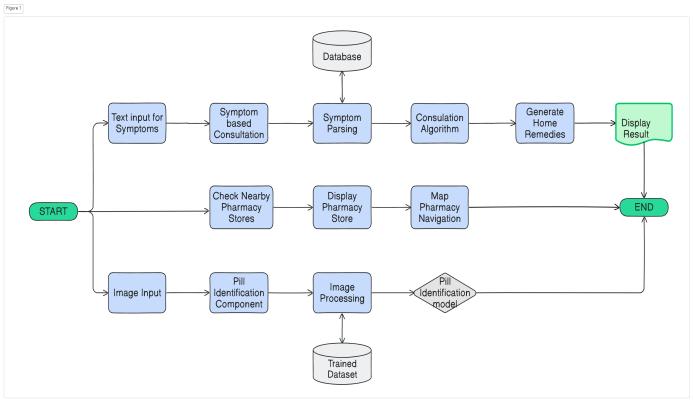
Fig-1:ProposedSystemArchitecture
The MediMitra system offers a comprehensive healthcare solution combining pill identification and symptom-based consultation.ThePillIdentificationfeatureallowsusersto upload images of medication, which are processed using advanced AI models (CNN). These models are trained to recognize pill attributes such as shape, size, and color, ensuringaccurateidentificationtoverifyprescriptionsand prevent medication errors [5]. Alongside this, the Home
International Research Journal of Engineering and Technology (IRJET) e-ISSN:2395-0056
Volume:11Issue:11|Nov2024 www.irjet.net p-ISSN:2395-0072
RemediesModuleprovidesuserswithtailoredadvicebased on their inputted symptoms. Using a symptom parsing algorithm, the system generates home remedies, precautionary measures, diet plans, and workout suggestions for mild conditions. All recommendations are sourcedfromareliablemedicaldatabase,offeringsafeand effective guidance. Moreover, the system integrates with nearby pharmacy services to help users obtain necessary over the counter medications [6]. MediMitra leverages AI anddeeplearningtodeliverauser-friendly,real-timehealth managementsystemthatenhancespatientsafetyandwellbeing.
The system architecture is depicted in Fig .1. where the process flow is divided into two main functionalities: symptom-basedconsultationandpillidentification.
Thesystemarchitectureiscomposedoffivecoremodules: input,preprocessing,identification,symptomanalysis,and recommendation. The input module captures pill images, and the preprocessing module ensures image quality is optimized. A convolutional neural network (CNN) in the identification module is used for pill classification. Additionally,thesystemanalyzesuser-reportedsymptoms to suggest appropriate home remedies. Finally, the recommendation module provides detailed guidance on homeremediesandpharmacylocationswherethemedicine canbeobtained[7].
3.1WORKFLOWFORPILLIDENTIFICATIONMODULE
Step1:Theusercapturesanimageofthepillanduploadsit tothesystem.
Step 2: The system preprocesses the image by adjusting contrast,size,andsharpnessforbetterfeatureextraction.
Step3:ACNNmodelisemployedtoclassifythepillbasedon visualfeatures(color,shape,andimprint).
Step 4: If the user inputs symptoms, the system provides homeremediesthatalignwiththosesymptoms.
Step 5: The system offers pill identification results and relevanthomeremedies,includingdosageinformationand detailsofnearbypharmacies.
3.2 WORKFLOW FOR SYMPTOMS-BASED HOME REMEDIESMODULE
Step1:Userinputssymptomsintothesystem.
Step2:SystemprocessessymptomsusingtheConsultation Algorithm.
Step 3: Algorithm evaluates symptoms and classifies the conditionasnon-critical.
Step4:Systemgenerateshomeremedysuggestionsbasedon thesymptoms.
Step 5: System provides additional lifestyle, diet, and workoutrecommendations.
The MediMitra system is developed using a modular approach, integrating advanced deep learning techniques, symptom-based analysis, and geolocation services. The system is divided into three main modules: Pill Identification, Symptoms-Based Home Remedies Recommendation, and Nearby Pharmacy Locator. Each module works cohesively to provide a comprehensive healthcaresolution.
Data Collection: A dataset of pill images is collected, consisting of various shapes, colors, and imprints from publicmedicalrepositoriesandcustomsources.
Preprocessing: Images are preprocessed to ensure uniformity in size, resolution, and background, applying techniques such as resizing, noise reduction, and normalization.
ModelTraining:AConvolutionalNeuralNetwork(CNN)is employed for feature extraction and classification. The modelistrainedusingthepreprocessedpillimages,where keyfeaturessuchascolor,shape,andimprintsareusedfor classification.
IdentificationProcess:Whenauserinputsanimageofapill, theimageisprocessedandclassifiedusingthetrainedCNN model,matchingitwiththeexistingpilldatabasetoprovide informationonthemedication.
4.2
SymptomInput:Usersprovidesymptomsthroughtextinput orselectionfromapredefinedlist.
ConsultationAlgorithm:Thealgorithmparsesthesymptoms, categorizesthecondition,andevaluatesitsseverity.Ifthe condition is non-critical, the system proceeds to suggest remedies.
Remedies and Suggestions Generation: Based on the evaluatedsymptoms,thesystemgeneratestraditionalhome remedies, lifestyle adjustments, diet plans, and workout recommendations tailored to the user's condition. This is achievedthroughacurateddatabaseofremediesandbest practicesforcommonnon-criticalconditions.
Feedback Mechanism:Users mayprovidefeedback onthe remedieseffectiveness,whichcanbeusedtorefinefuture suggestions.
International Research Journal of Engineering and Technology (IRJET) e-ISSN:2395-0056
Volume:11Issue:11|Nov2024 www.irjet.net p-ISSN:2395-0072
Location Tracking: The module uses the device’s GPS or locationservicestoidentifytheuser'scurrentlocation.
Pharmacy Database: The system accesses a database of pharmacies, including details like location, contact information,andmedicationavailability.
PharmacyRecommendations:Basedontheuser’slocation and the identified medication from the Pill Identification Module,thesystemrecommendsnearbypharmacieswhere therequiredmedicineisavailable.
MediMitraisdesignedtoprovideaccurateresultsacrossall its modules, ensuring user satisfaction through its ease of useandeffectiveness.Thesystemaimstoreducethetime spent on medication management tasks by, improving overall efficiency. It will likely lead to measurable health outcomes, such as fewer medication errors and better adherence to treatment plans. Designed for scalability, MediMitra can adapt to various healthcare settings and is projected to be cost-effective, providing savings for both providers and patients. Overall, these results highlight its potentialtosignificantlyenhancehealthcareexperiences.
This paper presents, MediMitra, an integrated healthcare solution that combines a deep learning-based pill identification system, a personalized home remedies recommendationsystem,andareal-timehealthcarefacility navigation tool. The pill identification module employs a ConvolutionalNeuralNetwork(CNN)developedusingKeras and TensorFlow, trained on a large dataset of labeled pill images.Thisdatasetunderwentpre-processingtonormalize inputdataandenhanceimagefeaturessuchascolor,shape, andimprint.Thehomeremediesrecommendationsystem alignsuser-reportedsymptomswithappropriateremedies, while the map navigator offers GPS-based guidance to nearbyhealthcarefacilities.Byaddressingmedicationsafety, self-care,andhealthcareaccessibility,MediMitraprovidesan integrative approach to health management. Future enhancements will focus on expanding the datasets, and integratingthesystemintobroaderhealthcareplatformsto maximizeitsutilityandimpact.
[1] SupawadeeSrikamdee,UreeratSuksawatchon,Jakkarin Suksawatchon, Worawit Werapan “ClinicYA :An ApplicationForPillIdentificationUsingDeepLearning andK-meansClustering”,ConferenceIEEE,(2023),pp.16.DOI:10.1109/ICSEC56337.2022.10049345
[2] Po-TsengWu,Tzu-YuSun,Jun-ChengLin,Chiun-LiChin, “RoundPillShapeRecognitionSystemBasedonAYDeep LearningModel”,ConferenceIEEE,(2022),pp:1-6. DOI:10.1109/ICCE-Taiwan55306.2022.9869124
[3] Roy Chaoming Hsu, and Po-Cheng Su, "Real-Time Pill IdentificationwithPrescriptionConfirmationUsingDeep Learning on Embedded System," Proceedings of Conference IEEE,vol.x,no.x,pp.216-221,2023, DOI:10.1109/ICUFN57995.2023.10200156
[4] AmirRezaAshraf,AnnaSomogyi-Vega,SaraMerczel,Nora Gyimesi,Andras Fittler “Leveraging code-free deep learning for pill recognition in clinical settings : A multicenter, real-world study of performance across multipleplatform”,ELSEVIER(2024)pp:01-17.
[5] MohanWang,YangJiang,BaohuiXu,MengqiangHuang, Wenjian Kuang, Xiang Li, Harm Tolner , “MCIR-YOLO: White Medication Pill Classification Using Multi-Band InfraredImages”,ConferenceIEEE,(2024),pp:1-13. DOI:10.1109/JPHOT.2024.3426929
[6] NileshkumarMaurya,PratikJadhav,KrishnoprasadDas, Prof.InduAnoop,“MedicalStoreLocator”IRJET,(2020) pp:1-6
[7] Matiwos Tekalign Wondmagegn, Evarist Nabassa, EndashawAmsaluMelesse,EwunateAssayeKassaw,“A Framework for locating prescribed medication at pharmacies”,ResearchSquare(2023)pp:1-16
[8] PrajaktaKhairnar,VamasiAvula,AdityaHargane,Pratik Baisware,“MedicineRecommendSystemUsingMachine Learning”,IJSRSET,(2022)pp:1-4.
[9] Benjamin Stark, Constanze knahl, Mert Aydin, Karim Elish,“ALiteratureReviewonMedicineRecommender Systems”,IJACSA,(2019)pp:1-8. DOI:10.14569/IJACSA.2019.0100802