
International Research Journal of Engineering and Technology (IRJET) e-ISSN:2395-0056
Volume:11Issue:11|Nov2024 www.irjet.net p-ISSN:2395-0072

International Research Journal of Engineering and Technology (IRJET) e-ISSN:2395-0056
Volume:11Issue:11|Nov2024 www.irjet.net p-ISSN:2395-0072
Belnekar Janhavi1 , Dube Anuj Soumendra2 , Kothari Moksha3
1,2,3 Student, Information Technology, Thakur College of Engineering and Technology Mumbai, India ***
Abstract
Anemia, characterized by a deficiency of red blood cells or hemoglobin, remains a global public health concern, particularly in resource-limited regions where access to advanced diagnostic tools is limited. The essence of this work lies in the comprehensive evaluation and analysis of ML models like Convolutional Neural Networks, Logistic Regression, and Gaussian Blur algorithm on publicly available dataset of 710 images of the conjunctiva for pallor analysis. This endeavor aims to furnish the ongoing efforts to improve anemia detection and healthcare access, especially in underserved communities. The implications of this work extend to early intervention and prevention of anemia-related health complications.
Keywords pallor analysis, ML models, healthcare access
This research paper presents a task-critical implementation of Convolutional Neural Networks (CNN), Logistic Regression and Gaussian Blur algorithm in computer vision. CNNs are a core deep learning architecture widely used in computer vision. They are designed to automatically and adaptively learn hierarchical features from data, making them highly effective for tasks such as image classification, object detection, and image segmentation. Deep learning techniques have consistently demonstrated significant progress and efficiency in the field of semantic segmentation.Anemia, moving nearly 33% of the global state, presents a important fitness challenge, particularly with youngsters and pregnant daughters. Iron imperfection stands as a chief cause, contributing to 42% of emptiness cases. The prompt discovery of anemia is criticaltochecktheriskofirrevocableorgandamage.This study intends a creative non-obtrusive approach, utilizing machine intelligence algorithms to resolve images of palms,fingernails,andconjunctiva.Thedeterminedsearch out overcome support limitations guide unoriginal chlorosisdetectionorders.
By combining the power of machine learning, image analysis and mobile technology, we present a viable solution that has the potential to revolutionize anemia screening and diagnosis, particularly in resourceconstrained settings. This research holds the promise of significantly improving health care access and outcomes forindividualsaffectedbyanemiaandoffersarayofhope in the ongoing global battle against this pervasive health problem.
In recent research, computerized algorithms, particularly machinelearning,haveshown highaccuracyin estimating hemoglobin(Hb)levelsanddiagnosingmedicalconditions like anemia # [1]. Various algorithms, including support vector machines (SVM), k-nearest neighbors (k-NN), Bayesian networks, artificial neural networks (ANN), and decision tree classifiers, have been employed for classification.Studiesusingconjunctiva imagesoftheeyes have demonstrated that the choice of algorithm depends on the specific problem domain # [2]. Non-invasive techniquesutilizingclinicalsymptomsbasedonfingernails and palm images, as well as conjunctiva images, have shown promise.Different studies have explored the use of machine learning techniques such as ANN, SVM, decision tree, Naïve Bayes, K-NN, and rule-based approaches for anemia detection.The conjunctiva of the eye has been a focus, with SVM achieving 78.90% accuracy # [3], LS-SVM reaching 85% precision, and 98.96% accuracy. Deep learning approaches, including a three-tier deep convolutional fused network, achieved accurate anemia severityprediction.
By utilizing non-invasive methods, healthcare professionals can gain new insights into understanding individualemotionalstates,leveragingthisinformationfor personalized treatment plans. Moreover, the utilization of advanced technologies like the three-tier deep convolutional fused network highlights the immense power of deep learning approaches in predicting the severity of anemia, potentially revolutionizing the early detection and management of this condition. Together, theseadvancementsholdpromiseforimprovingdiagnosis andtreatmentoutcomesinvariousmedicalfields.
International Research Journal of Engineering and Technology (IRJET) e-ISSN:2395-0056
Volume:11Issue:11|Nov2024 www.irjet.net p-ISSN:2395-0072
Several studies compared the conjunctiva's color with bloodparametersandpatientattributes,resultinginvaried accuracylevels.Anovelpipelinebasedonscleraandblood vessel color achieved 86.4% accuracy. Convolutional neural network (CNN) models, including one with batch normalization layers, demonstrated cost-effective and controllable applications with accuracy up to 89.33%. OtherstudiesexploredtheapplicationofANNforHblevel estimation and achieved a sensitivity of 95.50%. Comparisons with laboratory tests showed promising results, with sensitivity and specificity ranging from 77.58% to 91.89%. Some studies proposed using the conjunctivaalone,whileothersrecommendedcombiningit with the palpable palm for increased reliability # [4]. Additionally, an automated system for cataract disease detectionusingfundusimagesachievedhighaccuracywith deeplearningarchitectures.
Despite the advancements, gaps in the related works include the small size of datasets, lack of image augmentation, and the use of single models or features # [4, 5]. This study addresses these gaps by applying five machinelearning models toa dataset of 710conjunctivae, palpable palm, and fingernail images, comparing their performance in detecting anemia in children aged 6–59 months. Non-invasive techniques, especially using conjunctivaimages,haveprovenefficientandcost-effective in diagnosing medical conditions like anemia. This study contributes by comparing the performance of different bodyfeatures(conjunctiva,palpablepalm,andfingernails) in anemia detection. In conclusion, recent research highlights the effectiveness of computerized algorithms, particularly in machine learning, for accurately estimating hemoglobin (Hb) levels and diagnosing anemia. Various successful algorithms, such as SVM, k-NN, Bayesian networks, ANN, and decision tree classifiers, have been applied,withthechoicedependingonthespecificproblem domain. Conjunctiva images of the eyes have emerged as valuable in non-invasive techniques, incorporating clinical symptoms from fingernails and palm images. Several studiesfocusedondiversemachinelearningtechniquesfor anemia detection, particularly emphasizing conjunctiva images. SVM achieved 78.90% accuracy, LS-SVM reached 85% precision, and a unique approach leveraging emotionalpostsonTwitterachievedanimpressive98.96% accuracy. Deep learning approaches, like a three-tier deep convolutionalfusednetwork,demonstratedpreciseanemia severity prediction. Convolutional neural network (CNN) models,incorporatingbatchnormalizationlayers,achieved upto89.33%accuracyinHblevelestimation.
This study addresses gaps in existing research on anemia detection, utilizing a dataset of 710 images of conjunctiva, palpable palm, and fingernails. Employing five machine learning models, the research emphasizes the efficiency and cost-effectiveness of non-invasive techniques, particularly conjunctiva images, in diagnosing anemia in
children aged 6–59 months. The findings contribute by systematicallyevaluatingtheperformanceofvarious body features, offering insights for future research and clinical applications.
This study was divided into three phases: gathering and preprocessing the dataset, training, and validating the modelsusingthedataset,andapplyingcross-validationto prevent overfitting. This means that for anemia to be detected,thedatasetgoesthroughthreephasesorsteps. Techniqueforgatheringdata:
Thedata collectionsystem usedKoboCollect onSamsung Galaxy Tab 7A tablets. Biomedical scientists from the University of Energy and Natural Resources, Ghana, captured patient biodata and images (conjunctiva, palm, fingernails), uploaded to cloud storage. The study had ethics approval (Reference: CHRE/CA/042/22). Image capture involved specific methods, like pulling the lower eyelid and stretching palms. Flashlights were off during capture. Images underwent triangle thresholding and segmentation using CIE Lab* color spaces. Data augmentation increased dataset size. Data were collected from 10 health facilities, focusing on children aged 5–59 months. Anemia classification used Hb values (<11 g/dL: anemic, >=11 g/dL: non-anemic). Illustrations included sample images and raw datasets.The study taken moral authorization (Reference: CHRE/CA/042/9), and cognizant consent was obtained from persons or guardians before enrolling minor partners in dossier group.
Images of the conjunctiva were captured by slightly pulling the lower eyelid with the thumb and index finger. Forpalmimages,scientistsheldthechild'shand,stretched the palm through the fingers, and captured the image. Fingernail photos were taken by holding the participant's wrist.Topreventgleameffects,flashlightswereturnedoff during image capture, ensuring consistent image quality and eliminating ambient light influence.By turning off spotlightsduringimagecapture,thistechniqueeffectively eliminates the influence of ambient light in pictures. This not only reduces shine effects but also significantly improvesthemodel'sobjectrecognitionandclassification capabilities. The approach ensures that datasets of photographs are entirely free from ambient light effects, contributing to enhanced image quality.be used. Other fonttypesmaybeusedifneededforspecialpurposes.
International Research Journal of Engineering and Technology (IRJET) e-ISSN:2395-0056
Volume:11Issue:11|Nov2024 www.irjet.net p-ISSN:2395-0072
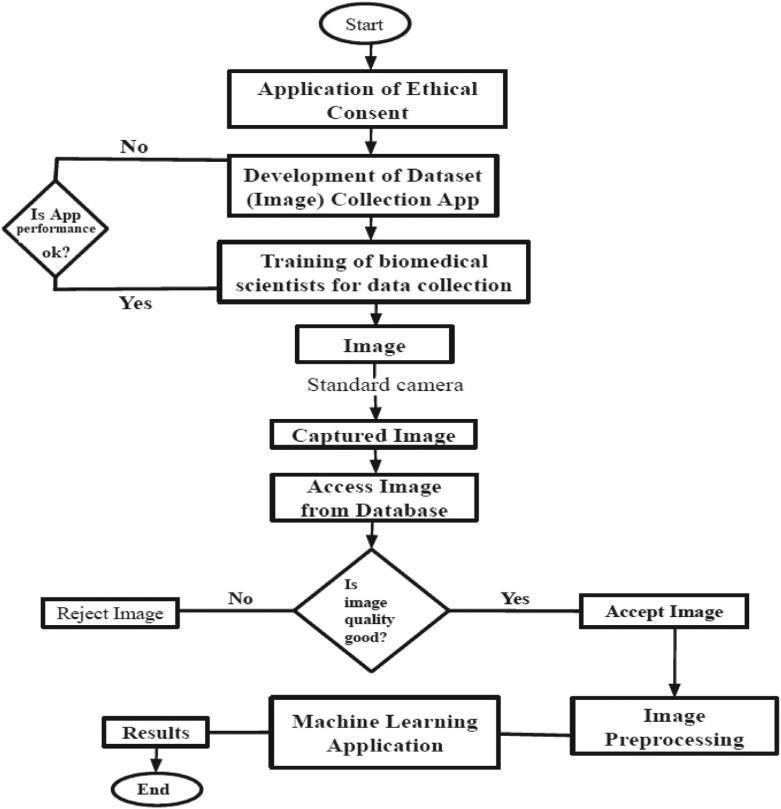
FIGURE1:Aflowchartshowingtheflowofworkinthe proposedmodels.#[12]
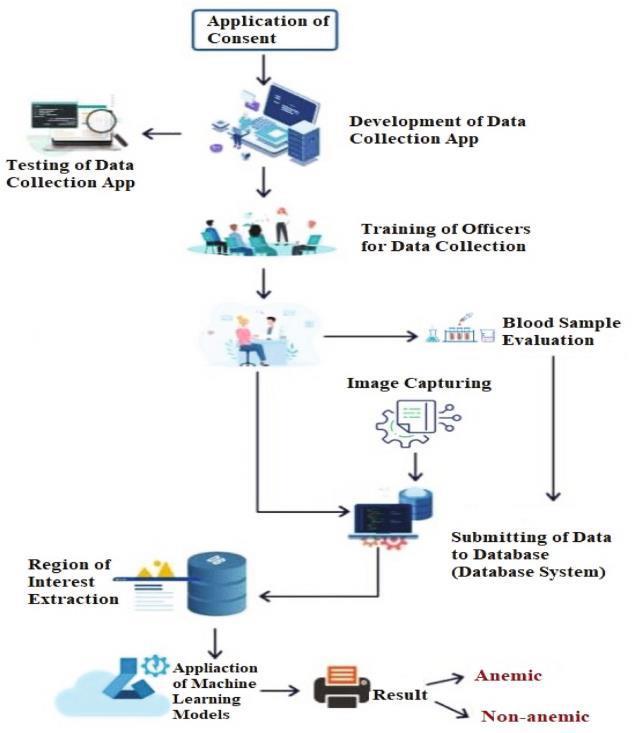
FIGURE2:Aconceptualframeworkfortheproposed methodology.#[12]
3.1.ImageAugmentation:
In machine learning, higher accuracy is often achieved by training models on large datasets, as small datasets may leadtooverfitting.Overfittingoccurswhenamodellearns the training data too well and fails to generalize to new, unseen data. To address this, image augmentation techniquesareemployed,involvingartificialgenerationof new data by applying procedures like rotation, shift, flip, andtranslationtoexistingimages.
Phase 1:ImageAugmentationoftheDataset(Images)
To increase the size of the original datasets, an image augmentation technique was applied on the original dataset.Thiswasdonebecausetheuseofinadequatedata could result in overfitting # [6]. The use of image or data augmentation increases the performance of machine learning models. This is because the utilization of image augmentation increases the size of the dataset to enable themodelstotrainwithhugedatasetsizesorsamplesand enhance the avoidance of overfitting # [6]. The rotation, flipping and translation image augmentation technique wasappliedontheoriginal.
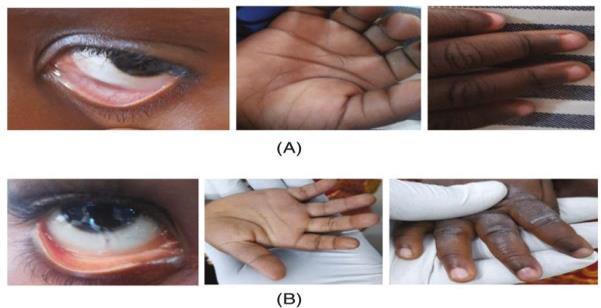
FIGURE3:Rawimagesoftheconjunctivaoftheeyes, palpablepalm,andcolorofthefingernails,where(A)isfor non-anemicimagesand(B)isforanemicimages.#[12]
Phase 2. Calculating the RGB and HB Levels of the Extracted ROI: Once the ROI conjunctiva, palm and fingernail has been detected, extracted, and saved as a newimage,wecomparethefinalShapetoasetoftrained, preciselyextracteddatatovalidateandverifyitisindeeda data we extracted. The conjunctiva's, palms, and fingernail’sHblevelwouldthenhavetobecalculated.This willbeaccomplishedbyextractingthered,blue,andgreen pixels from the image. Next, we computed the mean of each of the extracted hues, that is, the mean of all the red values,themeanofallthegreenvaluesandthemeanofall thegreenvalues.
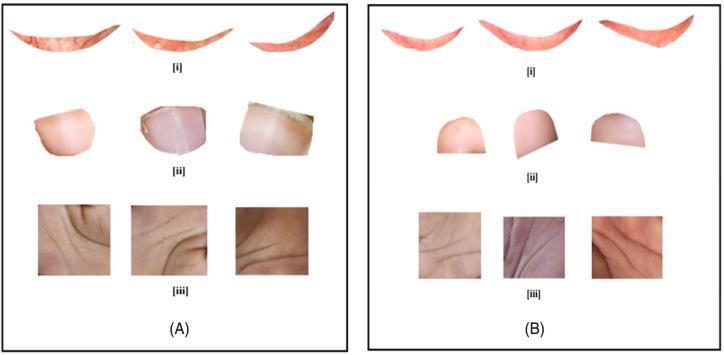
FIGURE4:Sampleofextractedimageswhere(A)are anemicimagesand(B)arenon-anemicimages.(i)–(iii)are conjunctivaoftheeyes,thecolorofthefingernails,andthe palpablepalmrespectively,forboth(A)and(B)(anemic andnon-anemic)images.#[12]
International Research Journal of Engineering and Technology (IRJET) e-ISSN:2395-0056
Volume:11Issue:11|Nov2024 www.irjet.net p-ISSN:2395-0072
Rotation: In the turn of the figure improving, the real figure is alternated 90◦, and 270◦ to gain the artificial countenance accompanying the principles of the mean force of the concept staying the same the locating of the countenance’s changes. The numerical model for turn representation augmentation is registered in Equations (1)–(5).The turn angle �� for the equating for the new matchesofapelisdelineatedas:
x′=xcos��−ysin��(1) y′=xsin��+ycos��(2)
in an antagonistic-opposite of left turn. In an analogous expression, the position of all pel (x′, y′) in the new countenance may be written as a heading and the turn mold:
x′[x′][cos��−sin��][x] y′[y′]=[sin��cos��][y](3)
The turn (x0, y0) is the matches (0, 0) point of root that rotates at the middle of the representation or about the point. For an concept or a pel to alternate about a point (x0,y0)internallytheequationisarticulatedas:
x′=x0+(x−x0)cos��+(y−y0)sin��.(4)
y′=y0+(x−x0)Sin��+(y−y0)cos��.(5)
Thepixelattheposition(x0,y0)istheonlypixelthatdoes not move from its position. If an additional image is intended from the original image one, x and y then describetheequationwhichneedstobesolved.
3.2.2Flipping:
Fortheaugmentationofvariousformsoffakeimages,the original countenances maybe across or across flipped as the locating concerning this movement is changed, while thefacialcharacteristicsandcomponentsoftheprinciples ofthemeanforcewaitunaltered.
Flipping the image results in its placement outside the original figure. When a mirrored image is needed along the y-axis, it requires an additional translation by the image height. The mathematical models for this flipping techniquearedefinedinEquations(6)–(7).
x′=x,(6)
y′=ymax−y.(7)
Themovementsonlykeepintegersofthecoordinatesand the borders of the countenance which are new expected usually equal to the traditional figure margins outside somebreak.
3.2.3Translation
The ROI of real faces exhibits slight variations in both X and Y directions. Translation does not alter the mean intensity characteristics of the facial features. The
numerical models for interpretation in countenance improvingarerecruitedinEquations(8)and(9).
x′=x+xT,(8)
y′=y+yT,(9)
Images were augmented through rotation, flipping, and translation,excludingoperationsthatheavilyimpactmean intensity, like Gaussian and cropping. The final conjunctiva, palpable palm, and fingernails datasets were created post-augmentation. A random split assigned 70% for training, 10% for validation, and 20% for testing. All datasets had consistent sizes and originated from the same patient; removing one image resulted in the exclusionofallimagesfromthatpatient.
3.3Machinelearningmodelsutilizedforthestudy
3.3.1Decisiontrees:Decisiontrees,effectiveforanalyzing multiplevariables,usea branch-likestructurewheredata splits based on various mechanism. # [2] Each branch represents attribute values, and nodes represent attributes.Thebinarytreehasaminimumof10 instances foreachleaf,atleast100trees,andsubsetssmallerthan5 arenotdivided.
3.3.2 Naïve Bayes: Naïve Bayes predicts classes using probability and is a probabilistic classifier with strong independence assumptions. Notably, it often generalizes effectively without requiring hyperparameter adjustments.
3.3.3 k-nearest neighbor (k-NN) algorithm: K-NN is a versatile algorithm suitable for both regression and classification. Despite potential slowdowns with larger datasets, its simplicity and easy implementation are commendable.Inthiscase,K-NNemployed100neighbors, Euclidean metric with uniform weight, and k=2 for the nearest neighbor in the class. It calculates distances between feature vectors and nearest neighbors, generating synthetic data points with slight variations to avoidduplicates.
3.3.4 Support vector machine (SVM): SVMs, a popular classification tool, integrate elements from various methods, assuming separable data. In this instance, the Sigmoid function was used with 100 iterations, a cost parameter (c) of 100, and an epsilon of regression (��) set to1.10,withanumericaltoleranceof0.1000.
3.3.5Convolutional neural network:InCNNs,featuresare identified through filter application, employing a kernel edge with differential values for effective categorization. Training utilizes AlexNet, employing SGD optimization, ReLu activation (regularized with a=0.0001), and a maximumiterationof10.Theactivationfunctioniscrucial for signal transformation, preventing linear regression andfacilitatingtrainingofcomplexmodels.
International Research Journal of Engineering and Technology (IRJET) e-ISSN:2395-0056
Volume:11Issue:11|Nov2024 www.irjet.net p-ISSN:2395-0072
3.4 Anemia detection condition: This text delves into the intricate use of CIE L*a*b* color space in medical image analysis, specifically targeting hemoglobin level assessment.
1.ImageProcessing: - ROIsextractionandtransformation intoCIEL*a*b*colorspace.
2.ColorCorrelation:-A*componentinCIEL*a*b*showsa robust correlation with hemoglobin levels. - Higher Hb levels associated with a* > 160; lower levels correspondtoa*<142.44.
3. CIE L*a*b* Advantages: - Device-independent image representation for accurate human vision simulation.Efficientincapturingsystematiccolorchangesovertime.
4. Perceptual Analysis: - Euclidean distance in L*, a*, b* coordinates for calculating perceptual differences. - L* denotes lightness, while a* and b* represent color channels.
5. Color Components System: - Cartesian coordinates (a*, b*) depict nonalignment as gray. - Red components align with the a* axis; opponent colors (yellow and blue) with b*.
6.ImageFilteringTechniques:-TranslationofRGBtriplets to CIE L*a*b*. - Optimal detection involves combining a*, b*,andG(green)values. - Filtering ensuresconsideration ofspecificpixelrangesforaccuratepallorassessment.
7. Mathematical Models: - Equations (10)–(13) provide modelsforCIEL*a*b*colorspace.
L∗=116f(Y/Yn)−16,(10) a∗=500{f(X/Xn)−f(Y/Yn)},(11) b∗=200{f(X/Xn)−f(Z/Zn)},(12),wheref(s)=s1/3,for s > 0.008856. And f (s) = 7.787s + 16/116, for s ≤ 0.008856. The color difference ΔE between two colors in theCIEL*a*b*(CIELAB)colorspaceis:��E=√(L∗2−L∗1)2 +(a∗2 − a∗1)2 +(b∗2 − b∗1)2, (13) ,where the ΔE unity valuedenotesajustnoticeabledifference.
8. Color Difference Computation: - Equation (13) computes color difference (ΔE) in CIE L*a*b*. This study focuses on using CIE L*a*b* color space to discern hemoglobin-related distinctions in medical images, emphasizingitsroleinpreciseandmeaningfulanalysis.
3.5 Experimental setup :The study detected anemia using conjunctiva, palm, and fingernail color images from 710 participants,augmentedto2635imageseach.Thedataset was split into training (70%), validation (10%), and test (20%) sets with 10-fold cross-validation.For anemia detection, CNN utilized SGD optimization, ReLu activation (witha = 0.0001).SVM employedSigmoid,100iterations, c = 100, �� = 1.10, and tolerance = 0.1000. k-NN had 100 neighbors,Euclideanmetric,anduniformweight.Decision
tree: min instances in leaves , no split for subsets <5, and 100trees.Orange,adataminingtoolonWindows11,with an Intel Core i3 processor, 4GB RAM, and SSD, was employed. Previous studies by Naik and Samant and Verma and Arjun confirmed Orange's efficacy in disease detection(anemia,diabetes,liverdisorder).
3.6 Performance measures :The study evaluated anemia detection models using key metrics (Accuracy, Recall, Specificity, Precision, AUC, F1-score) and 10-fold validation. Formulas (14)–(19) were applied, utilizing TP, TN, FN, P, R, and TNR. These metrics gauged the models' accuracy in identifying positive and negative instances, consideringtrade-offsbetweensensitivity,specificity,and overalleffectiveness.
Accuracy=(TP+TN)/TP+TN+FP+FN,(14)
Recall=TP/TP+FN,(15)
Specificity=TN/TN+FP,(16)
Precision=TP/TP+FP,(17)
AUC(TPR)=TP/TP+FN,(18) F1−score=2(P.R)/P+R,(19)
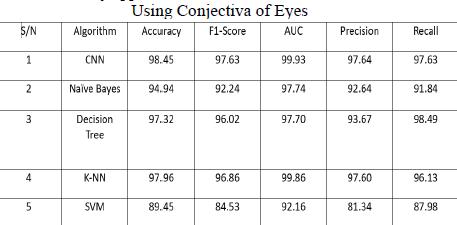
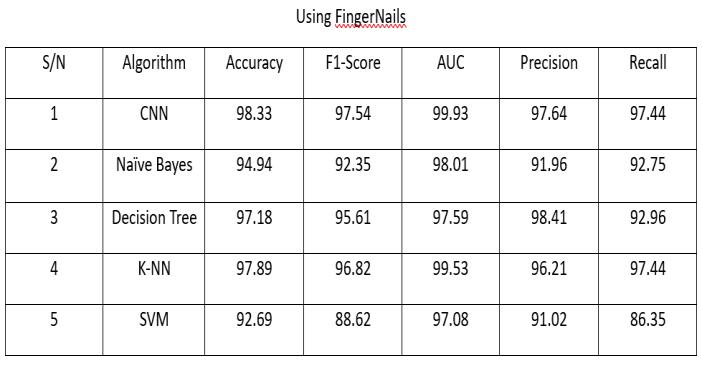
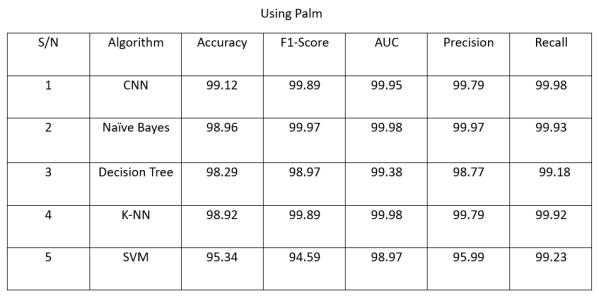
Aftertraining,validating,andtesting,theproposedmodels demonstrated significant results. The CNN achieved high accuracy: 98.45% on conjunctiva, 98.33% on fingernail color, and 99.12% on palpable palm. SVM had lower accuracy: 89.45% on conjunctiva, 92.96% on fingernail color, and 95.34% on palpable palm. Details and evaluation metrics are presented below , with graphical representations in Figures 4-6, showcasing the models' performance.
4.1.Discussion:
Thestudyaimedtodetectanemiausingmedicalimagesof conjunctiva, palpable palm, and fingernail color from 710 participants. Models were trained, validated, and tested, showing significant results. Naïve Bayes achieved the highest accuracy (98.96%) on palpable palm, while CNN had 99.12%. SVM had the lowest accuracy (95.34%). No significant variations were observed between fingernail color and conjunctiva images. The palm was found to be the most effective in detecting anemia, as supported by previous studies. The extensive and diverse dataset used in this study, publicly available for future research, contributedtoitssignificance.Theresultsemphasizedthe palm's accuracy, particularly in children under 6, and highlighted CNN's superior performance in conjunctiva andfingernailcolordetection.NaïveBayesperformedbest onthepalpablepalm.
International Research Journal of Engineering and Technology (IRJET) e-ISSN:2395-0056
Volume:11Issue:11|Nov2024 www.irjet.net p-ISSN:2395-0072
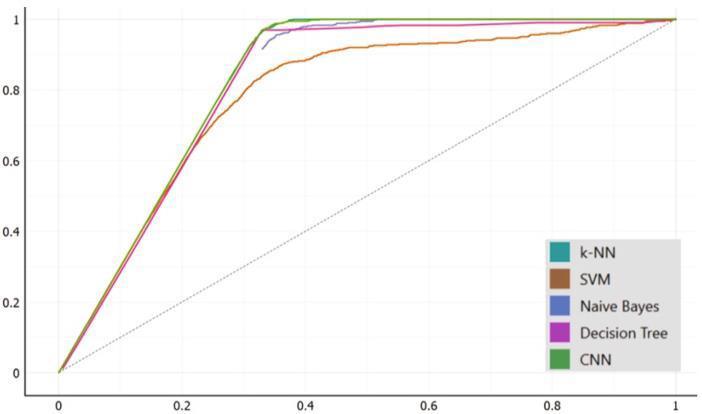
FIGURE4:AUCcurveoftheconjunctivaoftheeyesfor anemiadetection.#[12]
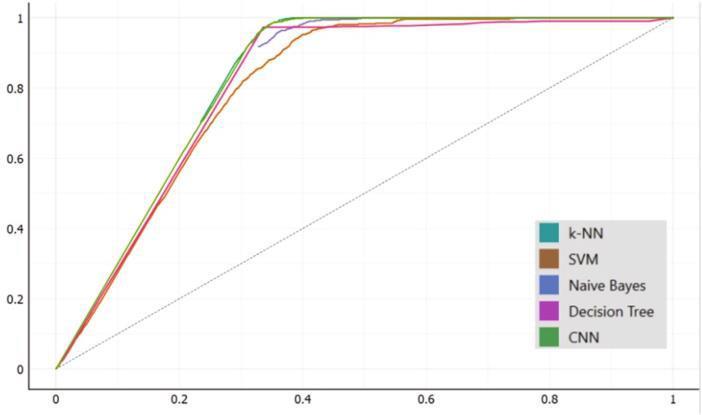
FIGURE5:AUCcurveofthefingernailsinanemia detection.#[12]
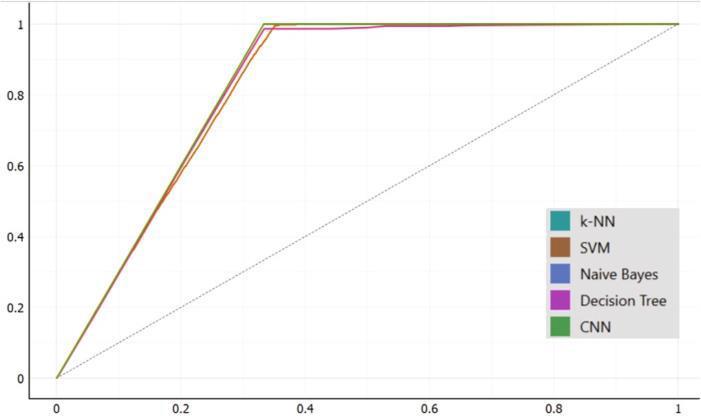
FIGURE6:AUCcurveofthepalminanemia detection.#[12]
4.2.Conclusion:
Thisitemproposedtodiscoverirondeficiencylifelessness, equating machine intelligence models (CNN, Naïve Bayes, resolution tree, k-NN and SVM) act accompanying the use ofhealingconcepts.Themodelswereprepared,validated, and proven on representations of the conjunctiva of analysis, real palm, and color of the fingernails. The CNN hada biggerveracitythanall themodelswhen provenon thefingernails,obvioustouch,andconjunctivaimages.The resultsgotforonemodelshowthattheCNNisstrongand acts better than Naïve Bayes, conclusion tree, k-NN and SVMinemptinessdiscoveryandtheconcretetouchisone of the trustworthy human physiognomies for chlorosis
discoveryinminorsduetoalluretallerdiscoveryveracity. Furthermore,theperformanceofthemodelsonthetouch had a bigger veracity than that of the fingernails and conjunctiva when proven accompanying the data set. The touch is plain to analyze distinguished to the eyes, that is questioning to approach the conjunctiva and the ROI, specifically for offsprings below 6 age whose eyes can frequentlyexperiencedropping.Additionally,minors’eyes wouldbeunlockedtotakepicturesortesttheconjunctiva of analysis straightforwardly. There is a chance that someone’s finger could infiltrate their eyes. This maybe a potential contamination beginning. The accomplishment of the models would have a great affect the well-being abilities having to do with the detection of ironimperfection chlorosis on account of the influence and adept performance of the projected models. The large acting of the models acquired by this study would have a great affect strength convenience general, particularly in health conveniences in country Ghana place approach to fitness facilities, supplies or money and energy experts is scarce. However, this study is restricted to the incident and arrangement of a movable request to enhance allure habit,this hopeful deliberatea futurework.Future works would acknowledge the growth of a travelling request at whichpointtheproposedmodelsgrownhopefuljoinedto reinforceeasyapproachanduse.
International Research Journal of Engineering and Technology (IRJET) e-ISSN:2395-0056
Volume:11Issue:11|Nov2024 www.irjet.net p-ISSN:2395-0072
:
Developing an offline modelto detectanemia through fingernail pictures is a promising solution for healthcare challenges in underserved regions with limited network access. It leverages technology to enhance diagnostic capabilities and improve healthcare outcomes in resource-constrained environments, addressingthelackofconsistentinternetconnectivityinremote areas.
VI.ACKNOWLEDGEMENT:
WeextendourheartfeltgratitudetoDr.SangeetaVhatkarforher generous and invaluable assistance in the successful completion of this project and her indispensable contributions to the researchpaper.
[1] Dimas Chaerul Ekty Saputra (2023), A New Artificial IntelligenceApproachUsingExtremeLearningMachineas the Potentially Effective Model to Predict and Analyze the Diagnosis of Anemia. 11(5), 697; https://doi.org/10.3390/healthcare11050697
[2]RoychowdhuryS,SunD,RenJ,BihisM,HageP,Rahman H.(2017).Screening pallor site images for anemia-like pathologies. Proceedings of the IEEE International ConferenceonBiomedicalHealthInformatics
[3]CollingsS,ThompsonO,HirstE,GoossensL,GeorgeA, Weinkove R (2016). Non-invasive detection of anaemia using digital photographs of the conjunctiva. https://doi.org/10.1371/journal.pone.0153286.
[4] Appiahene P, Asare JW, Donkoh ET, Dimauro G,Maglietta R. (2023). Detection of iron deficiency anemia by medical images: a comparative study of machine learning algorithms. https://doi.org/10.1186/s13040023-00319-z.
[5] Bauskar S, Jain P, Gyanchandani M. (2019) A noninvasive computerized technique to detect anemia using images of eye conjunctiva. Pattern Recogn Image Analhttps://doi.org/10.1134/s1054661819030027.
[6] Jain P, Bauskar S, Gyanchandani M(2023). Neural network based non-invasive method to detect anemia from images of eye conjunctiva. IntJ Imaging Syst. doi:10.1002/ima.22359
[7] Tamir A, Jahan CS, Saif MS, et al(2017). Detection of anemia from image of the anterior conjunctiva of the eye by image processing and thresholding. Proceedings of the 2017 IEEE Region 10 Humanitarian Technology Conference.doi:10.1109/R10-HTC.2017.8289053
[8]DimauroG,CaivanoD,GirardiF(2018).Anewmethod and a non-invasive device to estimate anemia based on
digital images of the conjunctiva. IEEE Access. 2018;6:4696846975.doi:10.1109/ACCESS.2018.286710
[9] Peksi NJ, Yuwono B, Florestiyanto MY(2021). Classification of anemia with digital images of nails and palmsusingthenaiveBayesmethod.
[10] Emmanuel DG, David OO, Stephen JB (2022). Deep Convolutional Neural Network Model for Detection of Sickle Cell Anemia in Peripheral Blood Images. Commun PhysSci.2022;8(1):9-22.
[11] Sevani N, Fredicia F, Persulessy GBV (2018). Detection anemia based on conjunctiva pallor level using k-means algorithm. IOP Conf Ser Mater Sci Eng.doi:10.1088/1757-899X/420/1/012101
[12] Justice Williams Asare, Peter Appiahene, Emmanuel Timmy Donkoh, Giovanni Dimauro.(2023) Iron deficiency anemia detection using machine learning models: A comparative study of fingernails, palm and conjunctiva of theeyeimages.https://doi.org/10.1002/eng2.12667