

A Review on the Progress and Challenges of Aluminum-Based Metal Matrix Composites: Fabrication and Applications
Sunil Prakash Rodrigues
1 , Dr.
Shrinivasa Mayya D
2
1Research Scholar, Srinivias University Institute of Engineering and Technology, Mangaluru, Karnataka, India
2Research Guide, Srinivias University Institute of Engineering and Technology, Mangaluru, Karnataka, India
Abstract - Composite materials, distinguished by a matrix and reinforcing elements, play a crucial role in augmenting characteristics such as durability, rigidity, and resilience against wear. This paper explores the production of Aluminum-Based Metal Matrix Composites (MMCs), focusing on their fabrication processes, applications, and associated challenges. Numerous Aluminum MMCs have been developed, incorporating diverse reinforcements like borides, carbides, oxides, and nitrides. These reinforcements have led to stable structures within the composites, resulting in outstanding mechanical and wear properties. With a surge in materials science interest, Aluminum-based composites have gained prominencefortheirlightweight,highstrength,andcorrosion resistance. This paper reviews recent advancements in Aluminum MMCs, delving into the exploration of innovative materials, fabrication techniques, and their applications in aerospace and automotive industries.
Key Words: Composites, Aluminium, Reinforcement, Hybrid, Nano, Stir Casting, Powder Metallurgy
1. INTRODUCTION
Composite materials are classified based on the type of matrix and reinforcement employed. In composites, a primarymaterialservesasthematrix,whilereinforcements are incorporated to improve characteristics like strength, stiffness, electrical conductivity, wear resistance and corrosion resistance. The reinforcements augment the matrix, bolstering its strength. The occurrence of wear is associated with relative movement between components andcanimpacttheperformanceofvariouscomponents. A MetalMatrixComposite(MMC)isacategoryofcomposite material whereina metal actsasthematrix,fortified with another material to improve distinct properties. The reinforcement phase is typically in the form of particles, fibers,orwhiskersembeddedwithinthemetalmatrix.Metal matrix composites are designed to combine the advantageous properties of metals with the enhanced characteristicsprovidedbythereinforcement.
NumerousAluminumMetalMatrixComposites(MMCs)have been manufactured using diverse fabrication processes, takingintoaccountdifferenttypesofreinforcementparticles such as borides, carbides, oxides, nitrides, and their combinations. The incorporation of these reinforcement particleshasledtotheformationofstablestructureswithin
the composites, resulting in Aluminum MMCs that exhibit outstanding mechanical and wear properties. In recent decades,thefieldofmaterialssciencehaswitnessedasurge in interest and research efforts directed towards the development of advanced materials with enhanced properties and functionalities. Among these materials, Aluminum-based composites have emerged as promising candidatesforawiderangeofapplications,owingtotheir exceptionalcombinationoflightweight,highstrength,and corrosionresistance.
Thedemandforhigh-performancematerialsinindustries suchasaerospace,automotive,andconstructionhasdriven the exploration of novel approaches for enhancing the mechanical,thermal,andelectricalpropertiesofAluminum and its alloys. Through the incorporation of reinforcing phases, such as ceramics, polymers, and carbon-based materials, Aluminum-based composites offer tailored solutionsto meetspecific engineering requirements. Over the past decade, there has been a substantial increase in research focused on Aluminum MMCs. These composite materials are increasingly replacing traditional metallic alloys,particularlyinaerospacecomponentslikewingsand fuselage, as well as automobile parts such as brake discs, drums, and pistons, offering enhanced performance at a comparativelylowerproductioncost.Thispaperoutlinesthe production methods of aluminium based composite materialsalongwiththeirapplicationsandtheissuesand challengesassociatedwiththem.
2. LITERATURE REVIEW
[1] Abideen Temitayo Oyewo et al., Thecurrentneedfor advancedengineeringmaterialscanbeaddressedthrough hybrid aluminum matrix composites (ABHCs), which find applications across various fields. Examination of the microstructure of hybrid composites with varying reinforcement percentages reveals a stable and uniformly distributed structure, particularly at lower percentages. Notably, the commonly employed fabrication methods for aluminum hybrid composites continue to be powder metallurgyandstircasting,withmoreintricateandprecise methodsbeinginfrequentlyutilized.Furthermore,thestudy suggeststhattheintroductionofsolidreinforcingparticles canenhancethestrengthofhybridcomposites.Additionally, themechanicalpropertiesofthesealloysundergosignificant improvement with the incorporation of ceramic particles
International Research Journal of Engineering and Technology (IRJET) e-ISSN: 2395-0056 Volume: 11 Issue: 01 | Jan 2024 www.irjet.net p-ISSN: 2395-0072 © 2024, IRJET | Impact Factor value: 8.226 | ISO 9001:2008 Certified Journal | Page720
***
such as silicon carbide, boron carbide, aluminum, and alumina.Solidlubricants,suchasgraphite(Gr),possessing commendablemechanicalandwearcharacteristics,havethe potentialtoactassecondaryreinforcement.Consequently, emergingvariationsofaluminum-basedhybridcomposites derivedfromagriculturalwastesourceslikericehuskash, Bagasse Ash, groundnut shell particles, coconut shell ash, and fly ash, demonstrate potential in competing with primary reinforcements in the new generation of hybrid composites.Ultimately,theintegrationofnovelcomposite materials like lithium aluminum alloy and fiber metal laminate(FML)holdspromiseforaeronauticalapplications.
[2] V.S.S. Venkatesh et al., This paper explores the synthesisofanaluminumcompositereinforcedwithnano SiC particles using ultrasonically assisted stir casting and investigates the impact of SiC weight percentage on mechanicalpropertiesandfractography.Keyfindingsreveal the uniform dispersion of SiC nanoparticles in various composites,exceptinthe2.0wt%SiCcomposite,wherean Al2Cu intermetallic phase was identified. The composite reinforced with 1.5 wt% SiC particles demonstrated an 82.6% increase in ultimate tensile strength (U.T.S) and a 73.4% increase in hardness compared to unreinforced aluminum.Themathematicalestimationofcompositeyield strengthforallweightpercentagesofreinforcementsclosely aligns with experimental yield strength. Composite strengthening is primarily attributed to the thermal mismatch mechanism, followed by the Orowan strengthening mechanism and grain size refinement strengtheningmechanism.Fractographyanalysisindicatesa transitionfromductiletobrittlefracturewithanincreasein SiCnanoparticleaddition.Thecompositereinforcedwith1.5 wt%SiCnanoparticlesexhibitedsuperiorU.T.S(431MPa) andhardness(163BHN)comparedtoothercompositions. Thestudyconcludesbysuggestingfurtherresearchavenues, such as investigating the effect of ultrasonic frequency on mechanical behavior and exploring the impact of SiC nanoparticles on phase evaluation and mechanical propertiesinAl-nanoSiCcomposites.
[3] Aniruddha V. Muley et al., This paper discusses the promisingrealmofAluminiumMatrixComposites(AMCs), which serve as lightweight engineering materials with exceptionalproperties.Thesecompositesfindapplications invarious fields,includingautomobile, mining, aerospace, and defense. Recent technological advancements have facilitatedtheintegrationofnano-sizedreinforcementsinto the aluminum matrix, leading to improved properties comparedtotheirmicro-sizedcounterparts.Theutilization of hybrid reinforcements, involving different materials, imparts superior characteristics to aluminum matrix compositeswhencomparedtothosereinforcedwithasingle material.Thepaperpresentsanoverviewoftheprogressin the development of aluminum-based metal matrix composites, with a specific focus on nano and hybrid aluminum-basedcomposites.
[4] Abuzer Açikgöz et al., This paper discusses the synthesis of innovative materials, often referred to as advanced or "high-tech" materials, by materials scientists usingarangeofsynthesisapproachesandmethods.Metal matrix composites reinforced with nano particles are particularlypromisingfordiverseapplicationsduetotheir exceptionalchemical,physical,andmechanicalproperties.In this investigation, nano Al2O3 was introduced as reinforcementinmicro-sizedironpowdersatvaryingrates of1,2,3,4,and5wt%.Thesamplesunderwentpreparation throughmechanicalalloying,pelletpressing,andsintering processes, followed by metallographic examinations involving grinding and polishing procedures. Despite a decrease in densities with an increase in the additive amount, a noteworthy outcome was the achievement of a 77%ratiooftheoreticaldensitytomeasureddensityindry pressing. Hardness values displayed a linear increase correspondingtotheaugmentationintheadditiveamount, withthehighesthardnessvaluereaching121.33HV1atthe 5wt%rate.
[5] Puneet Kumar Sonker et al., Thispaperdiscussesthe utilization of powder metallurgy in the fabrication of Aluminium Hybrid Metal Matrix Composites (AHMCs) reinforcedwith5%wt.Zinc(Zn)andvaryingpercentagesof Silicon Carbide (SiC-0, 5, 10, 15%wt.). The ensuing discussionoffersacomprehensiveoverviewofthehardness, tensile strength, and wear characteristics exhibited by AHMCs with different proportions of reinforcement elements.Thepowdermetallurgytechniqueproveseffective in synthesizing AHMCs. The incorporation of hybrid reinforcement,ratherthanrelyingonasinglereinforcement, enhances hardness and wear resistance within the composite. Mechanical properties, encompassing both hardness and tensile strength, depend on the weight percentageofSiCcontentinthecomposite.Thecrucialfactor influencing wear performance is the applied normal load, with friction coefficient values decreasing as the load is applied. Examination of composite surfaces during wear reveals the presence of adhesive and abrasive wear mechanisms.
[6] Muhammad Yasir Khalid et al., Thispaperdiscussthe current research efforts focused on enhancing aircraft performance through the exploration of lightweight materialswithdiversecombinationsofnanoreinforcements. AdvancedMetalMatrixComposites(AMMCs)areredefining the landscape of aerospace applications. This extensive review delves into the evolving nature of next-generation AMMCs designed specifically for aerospace purposes, coveringseveralkeythemes.Thesethemesencompassthe widespreadeffectivenessofAMMCsinvariousapplications suchasmilitary,aerospace,automobiles,andstructuraluses, owingtotheirremarkableproperties.Thecastingtechnique emerges as a preferred method for AMMC manufacturing, thanks to its simplicity, cost-effectiveness, and ability to uniformlydispersenanoreinforcementsforefficientmass production. The consistent incorporation of nano
International Research Journal of Engineering and Technology (IRJET) e-ISSN: 2395-0056 Volume: 11 Issue: 01 | Jan 2024 www.irjet.net p-ISSN: 2395-0072 © 2024, IRJET | Impact Factor value: 8.226 | ISO 9001:2008 Certified Journal | Page721
reinforcements proves instrumental in enhancing the mechanical,tribological,andmicrostructuralpropertiesof AMMC, regardless of the chosen manufacturing approach. However, challenges associated with reinforcement use, including improper mixing, agglomeration of particles, volumefractionissues,andcruciblesurfacesedimentation, have been identified as factors diminishing the overall mechanicalpropertiesofAMMC.Notably,theintegrationof machinelearningandalgorithm-basedapproachesisgaining prominence in Metal Matrix Composites, enabling the successful prediction and control of various process parametersandsubsequentmechanicalproperties.
[7] Yunhong Liang et al., This paper discusses the utilization of 3D printing to manufacture carbon fiberreinforced aluminum composites with systematically arranged architectures of shear-induced aligned carbon fibers.Themicrostructuresofboththeprintedandsintered samples were examined, and an exploration of the mechanical properties of the resulting composites was conducted. A bonding agent, resin, was utilized to bind carbonfibersandaluminumpowder.Duringthe3Dprinting process, the spatial configuration of carbon fibers was permanently established within the aluminum matrix through shear-induced alignment. Consequently, the compositesdisplayedanelongationof0.82%forthosewith a parallel arrangement of aligned fibers and an impact toughness of 0.41 J/cm2 for those with an orthogonal arrangement.Thesevalueswereapproximately0.4and0.8 times higher, respectively, than those achieved with a randomfiberarrangement.
[8] Kenneth Kanayo et al., Inthisinvestigation,thestudy delves into the structural characteristics, mechanical properties, and wear behavior of stir-cast Al-Mg-Si alloybased composites reinforced with varying weight percentages of steel particles, a hybrid mix of steel and graphite, and SiC particles. The findings indicate an approximately 11% increase in the hardness of the composites as the steel particle content rises from 4 to 8 wt.%. Over the same range of steel concentration, the ultimatetensilestrengthdemonstratesanupwardtrajectory with an increase in steel wt.%, surpassing the strength values of an 8 wt.% reinforced SiC by 3.2–24%. Specific strength and fracture toughness exhibit a similar trend concerning steel concentration, with strain to fracture experiencing only a slight decrease (less than 4%). These superior properties compared to the SiC-reinforced composite are attributed to enhanced grain refinement, interface bonding, and the inherent ductility of the steel particles. In the case of the 8 wt% hybrid-reinforced composite compositions containing steel and graphite, all mechanicalpropertiesexperienceaslightdecreasewithan increase in graphite content, trailing the composite reinforcedwith8wt.%steel.Nevertheless,thewearrates are lowest for the hybrid reinforcement mix of steel and graphite,followedbythosecontainingonlysteel,whilethe
SiC-reinforced composite exhibits the highest wear susceptibility. However, abrasive wear remains the dominantobservedwearmechanisminallthecomposites.
[9] Gowrishankar M C et al., Theinvestigationconcentrates onvalidatingtheactualweightpercentageofreinforcements (Silicon carbide and Boron carbide) and assessing their impact on Aluminium alloy composites produced through stir casting. The resulting composites showcase a consistently distributed hardness across the entire crosssection. The acid solubility test indicates the presence of approximately 95% of reinforcements in the Aluminium composites. The existence and quantity of reinforcements significantlyinfluencethepropertiesoftheAluminiumalloy, resultinginanotableincreaseof50–80%inhardnessanda 40–50% rise in tensile strength when compared to pure Aluminium alloy. The study concludes that stir casting proves to be an effective method for manufacturing Aluminiumcompositeswithenhancedproperties.
[10] Awss A. Abdulrazaq Thestudyexplorestheutilization ofmetalmatrixcomposites(MMCs),specificallyaluminum matrix composites (AMCs), in aerospace, automotive, and electronicapplications.Theprimaryfocusisondeveloping cost-effectiveAMCswithimprovedmechanicalandphysical properties by employing natural base reinforcement materialsthroughpowdermetallurgytechnology.Datepalm seeds and dolomite rocks were incorporated as reinforcementsatvariousweightsalongwiththealuminum matrix.Theproducedspecimensunderwentmorphological andsolid-phasecharacterizationthroughX-raydiffraction, optical, and scanning microscopy. The microstructure of bothreinforcementmaterialsdisplayedauniformparticle size distribution, indicating the successful embedding of waste particles within the aluminum matrix. Mechanical testsrevealedthatthecompositereinforcedwithdatepalm seeds demonstrated high hardness, reaching a peak of 50 HRV with 7.5% reinforcement, surpassing the dolomitereinforcedcomposite,whichachieved48.3HRVatthesame reinforcementlevel.Intermsofcompressivestrength,the datepalmseedscompositeexhibitedsuperiorperformance, withstanding23.8MPaat7.5%,comparedtothemaximum compression resistance of 16.68 MPa for the dolomitereinforcedaluminumcomposite.
3. FABRICATION PROCESS
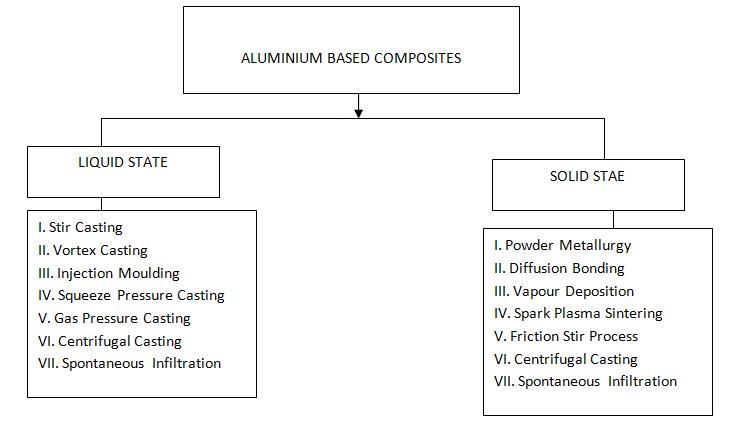
ThecreationofAl-basedcompositesprimarilyinvolvesthe use of two widely employed processing techniques: solidstate and liquid metallurgy. The choice of a specific fabricationmethodisinfluencedbyvariousfactors,suchas the selection of reinforcing materials and matrix, distributioncapacitywithinthematrix,diameter,heat,and the mechanical and chemical interaction between the reinforcingparticleandthematrix.[16,17].Figure1depicts the different trajectories that composites and hybrid compositesmaytakethroughouttheirdevelopment.
International Research Journal of Engineering and Technology (IRJET) e-ISSN: 2395-0056 Volume: 11 Issue: 01 | Jan 2024 www.irjet.net p-ISSN: 2395-0072 © 2024, IRJET | Impact Factor value: 8.226 | ISO 9001:2008 Certified Journal | Page722
methods,AbebeEmiruetal.[14]highlightedthesignificance ofthestircastingtechnique.Thismethodinvolvesstirringa molten metal alloy to incorporate reinforcement before casting. Various process parameters, such as stirring duration, speed, and feed rate, can be adjusted to achieve desired microscopic investigations [19, 22]. Another effective liquid-state processing method is centrifugal casting. In this technique, molten metal is poured into a rotatingmold,wherecentrifugalforcepropelsthemetalto spreadacrosstheinnermoldsurface.Inthebasiccentrifugal casting method, centrifugal force induced by the spinning moldcausessecondaryparticlephasestomoveradiallyfrom outertoinnerregionsconcerningtheaxisofrotation.This movement follows a pattern transitioning from areas of higher density to lower density compared to the matrix density[15,24].
Inthedomainofsolid-stateprocessing,commonlyemployed methodsencompasspowdermetallurgy,diffusionbonding, and vapor deposition. Conversely, within the liquid-state process, Fig. 1 [12, 18] illustrates less commonly used techniques such as gas pressure infiltration, stir casting, squeezecasting,andothers.Accordingtoexistingliterature, stir casting and powder metallurgy emerge as frequently employedapproachesformanufacturingparticle-reinforced metalmatrixcomposites[19,20].Notably,stircastingstands out as the most viable method for creating particle-based compositesinliquid-stateprocessingduetoitsuser-friendly natureandwidespreadcommercialavailability[21-23].In their examination of Aluminum composite production
Furthermore,withanincreaseinthecombinationofspeed and stirring duration, the distribution of reinforcement in thefabricatedcompositesbecomesmorehomogeneous.In the powder processing stage, components are blended in fine powder form to achieve the desired shape. Subsequently, elevated temperature in a controlled environmentisutilizedtobondthematerialstogether[11, 25,26].Achievingarobustmicrostructureintheproduced compositesrequiresauniformmixture.Forthesuccessful fabrication of composites through the powder metallurgy process, three essential procedures must be completed: mixing,compaction,andextrusion[13,16,27,and28].The powdermetallurgytechniqueplacesagreateremphasison cold pressing after sintering and homogeneous material mixing than on hot pressing. Cold plastic work is often carriedout,withthegreencomponentinitiallyundergoing sintering[29].Acomparisonofthemostcommonfabrication procedures for the creation of Aluminum Based Hybrid Composites(ABHCs)ispresentedinTable1.
State Process Utilization
Stir Casting Used for commercial purpose to create composites on Aluminium.
Liquid
Squeeze Casting Suitable for the manufactureofaircraft parts.
Gas Pressure
Infiltrati on
Primarily appropriate for engine mounts, wheel assemblies, tubes,androds.
DetailsofFabrication
Controlling mixing duration and speed at a mediumintensity.Pouringstageensuresproper wetting of the reinforcing components, while maintaining a controlled temperature before heatingenhancestheoverallfabricationprocess.
Success relies on precise control of the die preheating temperature, pouring conditions, alloy temperature, and optimal pressure level andduration.
Achieving desired properties hinges on meticulous control of the alloy's constituent elements, along with precise management of infiltrationdurationandtemperature.
Expense
Low/High
Moderate
Low/Moderate
International Research Journal of Engineering and Technology (IRJET) e-ISSN: 2395-0056 Volume: 11 Issue: 01 | Jan 2024 www.irjet.net p-ISSN: 2395-0072 © 2024, IRJET | Impact Factor value: 8.226 | ISO 9001:2008 Certified Journal | Page723
Fig -1: ProcessesforfabricatingAluminiumandHybrid compositesbasedonAluminium
Table -1: ContrastingvariousapproachesforthefabricationofAluminiumBasedComposites[15,24,30]
In-situ Processi ng
Mainly used in the aerospaceanddefense industries.
Centrifug alcasting Rings, Compressors, Flangers
Spontane ous
Infiltrati on
Powder Metallur gy
Turbine nozzle, Combustionliner
Optimaloutcomesareattainedthroughcareful controlofreactiontemperature,reactionspeed, andthemassquantityofreactants,ensuringthe synthesisofenhancedcompositematerials.
Moltenmetalispouredintoarotatingmoldwith a coated bottom, incorporating a thin solvent reinforcement layer and sandwiched between metalplatestoachieveuniformdistributionand enhancedmaterialproperties.
A nano-composite, often comprised of woven fibersorceramics,undergoesaperformpattern and is impregnated in a molten matrix, facilitating spontaneous infiltration and enhancingmaterialproperties.
High
High
Appropriate for intricate components and applications demanding elevated strength.
The synthesis involves controlling the powder size, ensuring compactness, and applying specific pressure, temperature, and duration duringthesinteringprocesstoachievedesired compositecharacteristics.
High Solid
Diffusion Bonding
Friction Stir Process
Suitable for the fuselage and various structuralcomponents.
Large volume fuel tank, nose barrier beam,EnginePart.
Precise control of temperature, duration, and bearing pressure is essential for fostering metallurgical bonding and optimizing the compositematerialproperties.
Non-consumable rotating tool stirring and heating a metal workpiece, followed by controlled deformation to achieve refined microstructures and improved material properties.
A noteworthy solid-state manufacturing method, such as sparkplasmasintering(SPS)utilizinglowvoltageanddirect current,standsout.SPSallowsfortheproductionofhighdensity composites characterized by excellent grain developmentandsuperiormechanicalproperties.Although itisarelativelyexpensiveprocessprimarilysuitedforbasic symmetricaldesigns,SPSisaswiftmethodthatcontributes totheproductionofadvancedcomposites[20,30,31].Hot isostatic pressing (HIP) employs casting and powder metallurgy processes for composite formation. The effectiveness of HIP processing is influenced by material structure, porosity, and density. One drawback of this methodistheneedforadditionalprocessesforallproduced components. Nevertheless, HIP is considered a superior methodforenhancingcompositeperformanceinstructural applications. Ultrasonic-assisted casting (UAC) is another techniquethataidsincompositeformation.UACpromotes thedevelopmentofcompositeswithfavorablemechanical andhomogeneousqualities,facilitatingmassproduction[30, 31].FrictionStirProcessing (FSP)emergesasaneffective technique that overcomes challenges associated with melting-relatedprocesses.Itisadeptatcreatingbothsurface andbulkcompositeswithtemperaturesbelowthematrix's melting point, ensuring environmental friendliness. FSP
Moderate
High
High
eliminates porosity, encourages an even distribution of reinforcement particles, and results in fine-grained composites. Despite its somewhat higher cost due to necessary tooling, FSP utilizes localized, severe plastic deformationtoalterthematerial'scharacteristics.Literature highlights significant improvements in performance behavior, hardness, and wear rate with the application of FSP[32,33].
4. APPLICATIONS
TheutilizationofAl-basedmetalmatrixcompositesholds immensepotentialowingtotheirexceptionalcharacteristics and a high degree of customization they offer. It has been observed that employing nano-sized particulates as reinforcement and hybridizing reinforcement can significantlyenhanceandtailorthepropertiesofAl-based composites in comparison to both Al-based alloys and composites reinforced with micron-sized particles alone. ThroughthejudiciousselectionofconstituentsinAl-based hybridandnanocomposites,variousfunctionalitiescanbe intentionallydesignedandachieved.
International Research Journal of Engineering and Technology (IRJET) e-ISSN: 2395-0056 Volume: 11 Issue: 01 | Jan 2024 www.irjet.net p-ISSN: 2395-0072 © 2024, IRJET | Impact Factor value: 8.226 | ISO 9001:2008 Certified Journal | Page724
4.1 Structural Applications
The primary challenges in structural applications revolvearoundachievingoptimalstrengthandstiffness.Albased composites present a competitive level of specific strengthandstiffness.Apartfromtheirexceptionalspecific stiffness and strength, applications in structural contexts necessitate elevated bearing strength, resilience to harsh environments, resistance against outgassing, efficient through-thickness thermal conductivity, notable wear resistance,strongdimensionalstability,effectiveresistance to impacts and erosion, resilience against burning, and adaptabilityforuseinhigh-temperaturescenarios.Al-based composites exhibit enhanced performance across these criteria.TheapplicationofAl-basedcompositesinfracturecritical scenarios, exemplified by their use in the tire stud anddriveshaftoftheChevroletS-10,providessubstantial evidence of their efficacy. Further enhancements in propertiescanbeattainedthroughachievingamoreuniform distributionandfinerparticulatesizes.[34].
4.2. Thermal Applications
Propertiessuchas elevatedheatconductivity,specific heat conduction, and thermal expansion of coefficient are crucial heat-related uses such as bases for computer processor chips, power semiconductor devices in telecommunications,constituentpartsinaerospacesystems, andautomotivepurposes.Al-basedcompositesprovetobe valuablefortheseapplications,asevidencedbytheuseof Al/SiCcompositesinsatellitemicrowavesystems,flipchip lidsinnetworkingandtelecommunications,aswellasintake and exhaust valves in the Toyota Altezza [34]. Reports indicate the advancement of hybrid composites based on aluminumforapplicationsinvolvingelevatedtemperatures incorporating reinforcements such as SiC, Al2O3, and TiB2 [35].Theincorporationofnano-sizedSiCreinforcementin aluminumexhibitssuperiordimensionalstability,makingit suitable for thermal applications that demand high dimensionalstability[36].
4.3. Precision Applications
In numerous precision applications, the demand for outstanding resistance to distortion arising from thermal and mechanical loads is crucial. This requirement is particularlyevidentindeviceslikeharddisk drives,video recordingheads,atomicforcemicroscopesupportframes, robotic arms, satellite antennae, and high-speed manufacturing equipment. Al-based composites offer enhancedresistancetotheseconditions,exemplifiedbytheir applicationincriticalcomponentssuchasthespaceshuttle mid-fuselage main frame and the Hubble Space Telescope antenna[34].
4.4. Wear Resistance
Wear resistance is a critical requirement for Al-based compositesinvariousapplications,includingthepistonand cylinder bore in engines, particularly in automotive brake systems (discs, rotors, pads, and calipers). Al-based composites present advantages such as high thermal conductivity, excellent wear resistance, reduced braking noise,lowdensityforfueleconomy,improvedacceleration, and shorter braking distances. For instance, Al/SiC composites are utilized in the rear brake drums of the Volkswagen Lupo 3L and the Audi A2, while Al/SiC brake disksareemployedintheIntercityExpress(ICE)high-speed traininGermany[34].NanocompositescontainingSiC,SiO2, TiO2,BN3,anddiamondembeddedwithinmatrixmaterials like Al, Ni, and Fe find applications in the automotive industry,significantlyimpactingthedurabilityofcarbodies andcomponents[37].
5. ISSUES AND CHALLENGES
Both nano and hybrid composites demonstrate improved properties in comparison to monolithic materials and composites reinforced with single micro-sized particles. Despite the new opportunities created by these advancements,addressingvariouschallengesisessentialto make them practical for engineering applications and commercially viable on a broad scale. Key concerns and obstaclesinnanoandhybridcompositesinclude:
(a) Implementing fabrication/processing techniques to achieve a consistent distribution of reinforcement in the matrixandensureeffectiveinterfacialbonding.
(b) Addressing formability concerns arising from reduced ductility.
(c) Enhancing mechanical properties concerning volume fraction and particle size, understanding strengthening mechanisms, and comprehending the role of individual reinforcementsinhybridcomposites.
(d) Evaluating tribological properties, including wear and friction.
(e) Assessing the use of composites in corrosive environments.
(f) Considering factors related to thermal conductivity, thermal expansion, and dimensional stability at high temperatures[36].
The performance of Al-based metal matrix composites heavilyreliesonvolumefractionandparticlesize.Thereisa necessity to refine existing processing methods for the fabrication of Al-based nano and hybrid composites and explore new techniques. Formability emerges as a critical issuesincetheadditionofreinforcementparticlesreduces
International Research Journal of Engineering and Technology (IRJET) e-ISSN: 2395-0056 Volume: 11 Issue: 01 | Jan 2024 www.irjet.net p-ISSN: 2395-0072 © 2024, IRJET | Impact Factor value: 8.226 | ISO 9001:2008 Certified Journal | Page725
the ductility of composites, making them unsuitable for forming. It is crucial to develop composites without compromising ductility. The weight loss of composites is significantlyinfluencedbyvolumefractionandparticlesize [40-43].Toachieveenhancedmechanical,tribological,and otherpropertiesforAl-basedcomposites,thefocusshould be on processing techniques,processparameters, process control,andhandlingoflargevolumefractions,particlesize, andinterface,methodstoenhancewettabilityanduniform distribution, and performance under extreme service conditions[37,45]
Developing composites without compromising toughness, producing low-cost reinforcement particles, and refining secondary processing techniques for large-volume production with low cost, recyclability, and commercial viability are essential aspects requiring attention [46,38]. Specialattentionmustbegiventoaddressingenvironmental andcostissuesrelatedtoaluminummatrixnanoandhybrid composites to expand their use as alternative lightweight materials.Environmentalconditionssignificantlyimpactthe performance of Al matrix composites, and the corrosion behavior of aluminum matrix composites in various environments is a crucial selection criterion for specific applications.VariousformsofcorrosionassociatedwithAl matrix composites include pitting corrosion, galvanic corrosion, crevice corrosion, stress corrosion cracking, corrosionfatigue,andtribo-corrosion.Theprimarysources of corrosion for Al matrix composites include galvanic corrosionbetweenthematrixandreinforcement,chemical degradationofinterfacesandreinforcements,corrosiondue to processing conditions of Al matrix composites, and resultingmicrostructures.Corrosion-resistantAMCscanbe producedbycontrollingthemicrostructuresofcomposites, processing conditions, and interactions at the composite interface[39].
ThecostoffabricatingAMCswithnano-sizedreinforcement isgenerallyhighduetotheelevatedcostofobtainingnanosized reinforcement. Despite the development of various synthesisandproductiontechniquesfornanoreinforcement (particlesandfibers),thereisaneedtocreatemethodsthat canproducenano-sizedreinforcementinlargequantitiesat an affordable cost. Processing techniques for nano and hybrid AMCs that ensure a uniform distribution of reinforcements, preserve the nanostructure in the end product without excessive grain growth, and allow bulk productiontoreducecostsareessential[48].Thecontroland optimization of process parameters play a pivotal role in reducingtheproductioncostsofnanoandhybridAMCs.
6. CONCLUSION
TheevolutionofAluminum-BasedMetalMatrixComposites (MMCs) presents a promising trajectory, marked by advancements in fabrication techniques and applications. Thesecomposites,designed tocombine theadvantages of metals with the enhanced characteristics provided by
reinforcements, exhibit exceptional properties in terms of strengthinmechanics,thermalconductivity,andresistance to wear. The demand for high-performance materials in aerospace,automotive,andotherindustrieshaspropelled researchinAluminumMMCs,replacingtraditionalalloysin criticalcomponents.Theliteraturereviewunderscoresthe versatility of fabrication methods, emphasizing powder metallurgyandstircastingasprevalenttechniques.Hybrid Aluminum matrix composites, incorporating diverse reinforcements, showcase stability and uniformity in microstructure, contributing to superior mechanical properties.Fromnano-sizedSiCreinforcementtoutilizing wastematerialsforhybridcomposites,researcherscontinue to explore innovative approaches, showcasing the adaptability and potential of Aluminum-based materials. Applications in structural, thermal, precision, and wearresistant domains demonstrate the diverse capabilities of Aluminum MMCs. Their efficacy is evident in critical componentslikethespaceshuttlemid-fuselagemainframe and Hubble Space Telescope antenna, affirming their resilienceinfracture-criticalapplications.Furthermore,their use in thermal applications, precision instruments, and automotive components highlights the broad spectrum of theirapplicability.However,challengespersist,rangingfrom uniformreinforcementdistributiontoformabilityconcerns andenvironmentalconsiderations.Addressingtheseissues requiresaconcertedeffortinrefiningfabricationprocesses, optimizing parameters, and developing cost-effective methods for producing nano-sized reinforcements. Additionally,environmentalandcostconcernsnecessitate furtherexplorationtoestablishAluminumMMCsasviable alternativesinvariousindustries.Inconclusion,theongoing researchinAluminum-basedcompositespresentsadynamic landscape with opportunities for continued innovation, ensuring these materials contribute significantly to the evolutionofhigh-performanceengineeringapplications.
REFERENCES
[1]OyewoAbideenTemitayo,OluwoleOlulekeOlugbemiga, Ajide Olusegun Olufemi, Omoniyi Temidayo Emmanuel, Hussain Murid, “A summary of current advancements in hybridcompositesbasedonaluminiummatrixinaerospace applications”, https://doi.org/10.1016/j.hybadv.2023.100117, Volume 5,April2024,100117.
[2] V.S.S. Venkatesh, Rao Ganji Prabhakara, Patnaik Lokeswar, Gupta Nakul,Sunil Kumar, KuldeepK.Saxena, B.D.Y.Sunil,SayedM.Eldin,FatimaHiaderKuthamAl-kafaji, “ProcessingandevaluationofnanoSiCreinforcedaluminium compositesynthesizedthroughultrasonicallyassistedstir casting process”, Volume 24,May–June 2023, https://doi.org/10.1016/j.jmrt.2023.05.030, Pages 73947408.
[3]AniruddhaV.Muley,,S.Aravindan,I.P.Singh,“Nanoand hybrid aluminum based metal matrix composites: an
International Research Journal of Engineering and Technology (IRJET) e-ISSN: 2395-0056 Volume: 11 Issue: 01 | Jan 2024 www.irjet.net p-ISSN: 2395-0072 © 2024, IRJET | Impact Factor value: 8.226 | ISO 9001:2008 Certified Journal | Page726
overview”, Published by EDP Sciences, 2015 DOI: 10.1051/mfreview/2015018
[4] Abuzer Açıkgöz A., Aktaş B., Demircan G, Amasyalı F., Akdemir F, “Characterization of Nano Aluminium Oxide Reinforced Iron Composites Produced by Powder Metallurgy” UDCS'19 Fourth International Iron and Steel Symposium,4-6April,Karabuk
[5] PuneetKumarSonker, ThingujamJacksonSingh, NiteeshPratapYadav, “Experimental research andefect onmechanical andwear properties ofaluminium based composites reinforced withZn/Sic particles”, Volume3, DiscoverMaterials,articlenumber9,(2023)
[6]MuhammadYasirKhalid,RehanUmer,KamranAhmed Khan, “Review of recent trends and developments in aluminium 7075 alloy and its metal matrix composites (MMCs) for aircraft applications”, Volume 20,December 2023, 101372, https://doi.org/10.1016/j.rineng.2023.101372
[7] Yunhong Liang, Han Wu , Zhaohua Lin, Qingping Liu, ZhihuiZhang“3Dprintedaluminummatrixcompositeswith well-defined ordered structures of shear-induced aligned carbon fibers”, Volume 4, Issue 4,December 2022, Pages 366-375,https://doi.org/10.1016/j.nanoms.2021.06.003
[8] Kenneth Kanayo Alaneme, Adetomilola Victoria Fajemisina, Nthabiseng Beauty Maledi, “Development of aluminium-based composites reinforced with steel and graphite particles: structural, mechanical and wear characterization”,Volume8,Issue1,January–March2019, Pages670-682,https://doi.org/10.1016/j.jmrt.2018.04.019
[9]GowrishankarMC,PavanHiremath,ManjunathShettar, Sathyashankara Sharma∗ , Satish Rao U, “Experimental validityonthecastingcharacteristicsofstircastaluminium composites”,Volume9,Issue3,May–June2020,Pages33403347,https://doi.org/10.1016/j.jmrt.2020.01.028
[10]AwssA.Abdulrazaq,SaadR.Ahmed,FaroukM.Mahdi, “Agricultural waste and natural dolomite for green productionofaluminumcomposites”,Volume11,December 2022,100565,https://doi.org/10.1016/j.clet.2022.100565
[11]A.Sudalairaja,K.S.Hussain,P.Sankaran,S.Selvakumar, A. Raja, K.R. Jeyasingh, “A Review of Fabrication and StructuralAnalysisofHybridMetalMatrixCompositesUsing StirCastingProcess”,2022.
[12] B. Singh, S. Chandel, P. Singhal, “Investigation of mechanical properties of synthesized AA2024-T351/SiO2 metal matrix nano-composite”, Mater. Today: Proc. 26 (2020)1082–1086.
[13] S. Tang, et al., “Microstructure and mechanical behaviorsof6061Almatrixhybridcompositesreinforced withSiCandstainless-steelparticles”,Mater.Sci.Eng.,A804 (2021), 140732,
https://doi.org/10.1016/j.msea.2021.140732, 2021/02/ 15/.
[14] A. Abebe Emiru, D.K. Sinha, A. Kumar, A. Yadav, “Fabrication and characterization of hybrid aluminium (Al6061)metalmatrixcompositereinforcedwithSiC,B4C andMoS2viastircasting”,Int.J.Metalcast.(2022)1–12.
[15] V. Chak, H. Chattopadhyay, T. Dora, “A review on fabrication methods, reinforcements and mechanical properties of aluminum matrix composites”, J. Manuf. Process.56(2020)1059–1074.
[16] K.C. Nayak, A.K. Pandey, P.P. Date, “Mechanical and physical characterization of powder metallurgy based aluminiummetalmatrixhybridcomposite”,Mater.Today: Proc.33(2020)5408–5413.
[17] L. Natrayan, M.S. Kumar, “Optimization of wear behaviour on AA6061/Al2O3/SiC metal matrix composite usingsqueezecastingtechnique–Statisticalanalysis”,Mater. Today:Proc.27(2020)306–310.
[18]R.Chandel,N.Sharma,S.A.Bansal,“Areviewonrecent developments of aluminum-based hybrid composites for automotiveapplications”,EmergentMaterials4(5)(2021) 1243–1257.
[19]R.Nandal,A.Jakhar,R.K.Duhan,“Reviewonsynthesisof AA 6061 metal matrix alloy using stir casting method” , Mater.Today:Proc.78(2023)462–468.
[20]M.Kadam,V.Shinde,“Stircastaluminiummetalmatrix compositeswithmechanicalandmicro-structuralbehavior: areview”,Mater.Today:Proc.27(2020)845–852.
[21] B.V.V. Naidu, K. Varaprasad, K.P. Rao, “Experimental analysis on wire spark erosion machining of aluminium hybrid metal matrix composites” by Taguchi approach, Mater.Today:Proc.39(2021)206–210.
[22] A.-H.I. Mourad, J.V. Christy, P.K. Krishnan, M.S. Mozumder, “Production of novel recycled hybrid metal matrix composites using optimized stir squeeze casting technique”,J.Manuf.Process.88(2023)45–58.
[23] S. Mondal, “Graphene based aluminum matrix hybrid nano composites, Graphene and Nanoparticles Hybrid Nanocomposites:FromPreparationtoApplications(2021)” 313–330.
[24] E.W.A. Fanani, E. Surojo, A.R. Prabowo, H.I. Akbar, “Recent progress in hybrid aluminum composite: manufacturingandapplication”,Metals11(12)(2021)1919.
[25]S.SureshPungaiah,etal.,“Investigationonmechanical behaviour of LM6 aluminum alloy hybrid composites processedusingstircastingprocess”,Adv.Mater.Sci.Eng. 2022(2022).
International Research Journal of Engineering and Technology (IRJET) e-ISSN: 2395-0056 Volume: 11 Issue: 01 | Jan 2024 www.irjet.net p-ISSN: 2395-0072 © 2024, IRJET | Impact Factor value: 8.226 | ISO 9001:2008 Certified Journal | Page727
[26] B. Vinod, S. Ramanathan, V. Ananthi, N. Selvakumar, “Fabricationandcharacterizationoforganicandin-organic reinforced A356 aluminium matrix hybrid composite” by improveddouble-stircasting,Silicon11(2019)817–829.
[27]S.Chand,P.Chandrasekhar,“InfluenceofB4C/BNon solid particle erosion of Al6061 metal matrix hybrid composites fabricated through powder metallurgy technique”,Ceram.Int.46(11)(2020)17621–17630.
[28]G.Manohar,K.Pandey,S.Maity,“Effectofmicrowave sinteringonthemicrostructureandmechanicalproperties of AA7075/B4C/ZrC hybrid nano composite fabricated by powdermetallurgytechniques”,Ceram.Int.47(23)(2021) 32610–32618.
[29] V. Venkatesh, A.B. Deoghare, “Microstructural characterization and mechanical behaviour of SiC and kaoline reinforced aluminium metal matrix composites fabricatedthroughpowdermetallurgytechnique”,Silicon14 (7)(2022)3723–3737.
[30]B.Kumar,P.Kumar,“Preparationofhybridreinforced aluminium metal matrix composite by using ZrB2: a systematicreview”,Mater.Today:Proc.61(2022)115–120.
[31] N. Kumar, G. Irfan, “Mechanical, microstructural properties and wear characteristics of hybrid aluminium matrixnanocomposites(HAMNCs)–review”,Mater.Today: Proc.45(2021)619–625.
[32]T.Minasyan,I.Hussainova,“Laserpowder-bedfusionof ceramicparticulatereinforcedaluminumalloys:areview” , Materials15(7)(2022)2467.
[33]N.Menachery,S.Thomas,B.Deepanraj,N.Senthilkumar, “Processing of Nanoreinforced Aluminium Hybrid Metal MatrixCompositesandtheEffectofPost-heatTreatment:a Review”,AppliedNanoscience,2022,pp.1–25.
[34]D.B.Miracle,“Metalmatrixcomposites–Fromscience to technological significance, Composite Science and Technology”65(2005)2526–2540.
[35] S.C. Tjong, Z.Y. Ma, “The high temperature creep behaviourofaluminium-matrixcompositesreinforcedwith SiC, Al2O3 and TiB2 particles”, Composite Science and Technology57(1997)697–702.
[36]S.M.Zebarjad,S.A.Sajjadi,E.Z.VahidKarimi,“Influence of nanosized silicon carbide on dimensional stability of Al/SiC nanocomposite”, Research Letters in Materials Science2008(2008)835746.
[37] H. Presting, U. Konig, “Future nanotechnology developments for automotive applications”, Materials ScienceandEngineeringC23(2003)737–741.
[38]V.M.Kvorkijan,“Aluminiumcompositeforautomotive applications:aglobalperspective”,JOM(1999)54–58.
[39] B. Bobic, S. Mtrovic, M. Babic, I. Bobic, “Corrosion of aluminium and zinc-aluminium alloys-based metal matrix composites”,TribologyinIndustry31(2009)44–53
[40]K.S. Lokesh, J.R. Naveen Kumar, Vinayaka Kannantha, Thomas pinto, U. Sampreeth, Experimental evaluation of substrate and annealing conditions on ZnO thin films preparedbysol-gelmethod,MaterialsToday:Proceedings, Volume 24, Part 2, 2020, Pages 201-208, ISSN 22147853,https://doi.org/10.1016/j.matpr.2020.04.268.
[41] Lokesh KS, "Study on Processing and Axial loading ConditionsofLightweightMaterials",InternationalJournal of Scientific Research in Mechanical and Materials Engineering(IJSRMME),ISSN:2457-0435,Volume2,Issue 4, pp.21-27, September-October.2018 URL :https://ijsrmme.com/IJSRMME18347
[42]KSLokesh,PreparationandTensilestrengthEvaluation of Synthetic fibers Sandwiched with Foam structures. International Research Journal of Engineering and Technology(IRJET),e-ISSN:2395-0056Volume:05Issue:09 |September-2018,p-ISSN:2395-0072
[43] KS Lokesh, Evaluation of Toughness on Varied Thickness of Chopped Strand Mat /PU-foam Sandwich Structures, International Research Journal of Engineering and Technology (IRJET), e-ISSN:2395-0056 Volume: 05 Issue:09|September-2018,p-ISSN:2395-0072
[44]KSLokesh,SynthesisandStudyonEffectofThickness on 3-point Bending Strength of Sandwich Composites, International Research Journal of Engineering and Technology(IRJET),e-ISSN:2395-0056Volume:05Issue:08 |August-2018,p-ISSN:2395-0072
[45]SriramamurthyLK,HunasikattiS,RamegowdaNKJ,et al.EffectofE-wasterubberonmechanicalbehaviorofglassa fiberreinforcedwithepoxycomposites.InAIPconference proceedings; 2019 March; Mangalore. Vol. 2080, No. 1, p. 020003.AIPPublishingLLC
[46] Nithin Kumar, K.S. Lokesh, Vinayaka Kannantha, Raghavendra Pai, Ajit M. Hebbale, Development and experimental investigation of mechanical properties of graphene-based aluminum 6061 alloys, Materials Today: Proceedings,Volume46,Part7,2021,Pages2421-2424,ISSN 2214-7853,https://doi.org/10.1016/j.matpr.2021.01.303
[47]Lokesh K S, Dr.Thomas Pinto, Mohammed Gowspeer, EffectofE-wasteRubberonWearBehaviourofGlassfibre Reinforced with Epoxy Composites Pages: 20-25 DOI: 10.7324/IJASRE.2018.32624 DOI URL: http://dx.doi.org/10.7324/IJASRE.2018.32624
[48]KSLokesh,TPinto,ComparativeStudyonAxialLoading Conditions and Effect of Mineral Filler on CSM and WF Fibres, International Research Journal of Engineering and Technology(IRJET),e-ISSN:2395-0056Volume:05Issue:10 |October-2018,p-ISSN:2395-007
International Research Journal of Engineering and Technology (IRJET) e-ISSN: 2395-0056 Volume: 11 Issue: 01 | Jan 2024 www.irjet.net p-ISSN: 2395-0072 © 2024, IRJET | Impact Factor value: 8.226 | ISO 9001:2008 Certified Journal | Page728