
International Research Journal of Engineering and Technology (IRJET) e-ISSN: 2395-0056
Volume: 11 Issue: 11 | Nov 2024 www.irjet.net p-ISSN: 2395-0072

International Research Journal of Engineering and Technology (IRJET) e-ISSN: 2395-0056
Volume: 11 Issue: 11 | Nov 2024 www.irjet.net p-ISSN: 2395-0072
Meenal Katole1 , Prof. Pramila M Chawan2
1MTech student, Dept of Computer Engineering and IT, VJTI college Mumbai, Maharashtra, India
2Associate Professor, Dept of Computer Engineering and IT, VJTI college Mumbai, Maharashtra, India
Abstract - Diabetic retinopathy (DR) is one of the primary causes of blindness among adults globally, making early diagnosis essential for preventing vision impairment. Recent progress in machine learning, especially in the areas of trans fer learning and ensemble learning, presents valuable opportunities for automating the detection of DR through retinal imaging. This paper reviews current research and methodologies that utilize these techniques to enhance the precision and reliability of DR diagnosis, emphasizing the importance of improving early detection and treatment outcomes. Additionally, thepaperexploresdataaugmentation techniques that addressthechallengeofsmallandimbalanced datasets, a common issue in medical imaging. Thedatasetsize can be artificially increased by applying transformations like image rotation and flipping, and scaling, the models can generalize better and improve their detection capabilities. With the ongoing advancements indeeplearning,thesehybrid approaches have the potential to make automated DR detection a standard tool in clinical settings, improving the speed and accuracy of diagnoses and ultimately reducing the global bur den of diabetic-related blindness.Transferlearning leverages pre-trained models, enabling faster and more accurate detection even with limited datasets, whileensemble learning combines multiple models to increase diagnostic robustness and reduce error rates. This paper surveys recent research on the application of these advanced techniques in DR detection, emphasizing their potential to improve early diagnosis and patient outcomes. By integrating the strengths of both transfer and ensemble learning, more robust and scalable models can be developed, paving the wayforefficient, automated DR screening systems
Key Words: Diabetic Retinopathy, Transfer Learning, EnsembleLearning,DeepLearning,RetinalImages,Medical Imaging
Diabetic retinopathy (DR) is a severe diabetes complication that harms the blood vessels in the retina, potentiallycausingsignificantvisionimpairmentandeven blindnessifleftuntreated.Astheprevalenceofdiabetesrises globally, the need for effective and timely diagnosis of DR becomesincreasinglycritical.Traditionally,ophthalmologists manuallyexamineretinalimagestodiagnoseDR.However,
thisprocesscanbedemanding,takeasignificantamountof time, and be prone to mistakes , especially in large-scale screenings. To address these challenges, automated diagnostic systems based on deep learning have gained significant attention in past years. Deep learning, machine learningsubset,hastheabilitytoanalyzelargedatasetsof retinalimages,makingithighlysuitablefordetectingsubtle signsofDRthatmaybeoverlookedbythehumaneye.These systemscannotonlyacceleratethediagnosticprocessbut alsoimproveaccuracyandconsistencyinidentifyingvarious stagesofDR.Amongthekeyadvancementsinthisfieldare transferlearningandensemblelearningtechniques.Transfer learning allows the use of pre-trained models are initially trainedonextensivedatasetsforvarioustasksadaptsthem for DR detection. This approach significantly reduces the amountoftrainingdataandcomputationalresourcesneeded, whilestillachievinghighaccuracy.Pre-trainedmodelscanbe fine-tunedtoidentifyspecificretinalfeaturesassociatedwith DR.
Ensemble learning, on the other hand, focuses on combiningthestrengthsofmanymodelstodevelopamore robustandreliablesystem.Byconsideringpredictionsfrom variousensemblemethodscanaddresstheweaknessesor biasesofindividualmodels,resultinginmoreaccurateand well-rounded diagnoses. Techniques such as bagging, boosting, and stacking are commonly used in ensemble learningtorefineDRdetectionsystems.Thissurveydelves into the integration of trans fer learning and ensemble learning for building more powerful and reliable DR detection models. By leveraging the advantages of both techniques,researchersaimtodevelopsystemsthatarenot onlymoreaccuratebutalsoscalableforwidespreadclinical use. The use of such hybrid models has the potential to revolutionize early DR diagnosis, enabling earlier interventionandimprovingtreatmentoutcomesforpatients atriskofvisionloss.
SeveralchallengesariseintheautomaticdetectionofDR: Data Scarcity: Medical image datasets are often small, limitingtheworkingofdeeplearningmodels.
Class Imbalance: Diabetic retinopathy is less frequent in earlystages,leadingtoimbalanceddatasets.
International Research Journal of Engineering and Technology (IRJET) e-ISSN: 2395-0056
Volume: 11 Issue: 11 | Nov 2024 www.irjet.net p-ISSN: 2395-0072
VisualSimilarity:EarlysignsofDRcanbesubtle,makingit difficulttodistinguishbetweenhealthyandmildlyaffected images.Thesechallengesmakeitcrucialtoexploremethods like transfer learning, which can leverage large, general datasets, and ensemble learning, which can combine the strengthsofmultiplemodelstoaddresstheseissues.
Transfer learning enables a model trained on a large datasettobeadaptedtoanew,smallerdataset,helpingto address the challenge of limited medical data. Pre-trained convolutional neural networks (CNNs) such as ResNet, Inception, and VGG have been successfully applied to DR detectiontasksbyfine-tuningtheirweightsonretinalimage datasets.
Ensemblelearningjoinsmultiplemodelstomodifythe predictionaccuracyandreducegeneralizationerrors.Inthe contextofDRdetection,variousensemblemethodssuchas bagging, boosting, and stacking have been explored. Combiningtransferlearningandensemblelearningprovides awaytoexploitthestrengthsofbothapproaches.Transfer learning provides a solid foundation through pre-trained models, while ensemble learning enhances robustness by reducingoverfittingandimprovinggeneralization.
[1]InthisstudybyAryanKokaneetal.,theauthorspresenta CNN-basedmodelforthediagnosisofdiabeticretinopathy. ThemodelwastrainedontheKaggledatasetandusesbasic image preprocessing techniques. The authors attained an accuracy of 74.8%, indicating the necessity for future improvements. The article advises introducing attention processestoenhancethemodel’scapacitytofocusoncrucial retinalfeaturesforgreaterperformanceinfuturestudies.
[2]Gulshanetal.(2016)employedapre-trainedCNNmodel onretinalimagestodetectDR.Byusingtransferlearning,the model achieved an accuracy comparable to that of human ophthalmologists.Themodelwastrainedonalargedataset of labeled images and fine-tuned for specific DR features, suchasmicroaneurysmsandhemorrhages.
[3]Tingetal.(2017)furtherexploredtransferlearningby applyingitacrossmultiethnicdatasets,demonstratingthat the robustness of the method holds across diverse populations. The use of data augmentation techniques to artificiallyincreasethesizeofthedatasetfurtherenhanced modelperformance.
[4]Inthisstudy,Quellecetal.(2017)proposedanensemble approach combining multiple CNNs trained on different subsets of the dataset. The model improved accuracy by
reducingvarianceandcombiningdiverseperspectivesonthe sameproblem.
[5] Le et al. (2020) proposed a hybrid model that used transferlearningonOCTA(OpticalCoherenceTomography Angiography) images to extract high-level features, which were then fed into an ensemble classifier. This approach demonstratedasignificantimprovementindetectingearlystageDRcomparedtostandalonetransferlearningmodels.
[6]Inthisresearch,Lametal.(2018)usedpatch-baseddata augmentation,whereinpatchesofretinalimageswereused instead of full images, allowing the model to learn local features more effectively. This technique, combined with ensemblemethods,significantlyimprovedthedetectionof DRlesionssuchasexudatesandhemorrhages.
[7] Pratt et al. used ResNet-50 as a base model for DR detection and enhanced the model using an ensemble of networks. By utilizing transfer learning and combining multipledeepnetworksinanensemble,thestudyachieveda highaccuracyof93.5
[8] This paper focused on reproducing a previously developeddeeplearningmodel forDR detectionusingthe DenseNet-121architecture.Itexploredtransferlearningby fine tuning the DenseNet model on a diabetic retinopathy dataset. Thestudyachieveda slightly lower accuracy than someothertransferlearningmodels,butstilldemonstrated solidperformancewithanaccuracyof89.6
Table -1: LiteratureReview
3.1 Problem Statement
To develop a robust transfer learning model with ensemblelearningtoaccuratelydetectdiabeticretinopathy
International Research Journal of Engineering and Technology (IRJET) e-ISSN: 2395-0056
Volume: 11 Issue: 11 | Nov 2024 www.irjet.net p-ISSN: 2395-0072
from retinal images, enhancing early diagnosis and treatmentefficacy.
Diabetic retinopathy is one of the most common and seriouscomplicationsofdiabetes,affectingtheretina’sblood vesselsandpotentiallyleadingtoblindness.Earlydetection ofDRcansignificantlyimprovepatientoutcomesbyenabling timely interventions. However, manual analysis of retinal images by medical professionals is labor-intensive, timeconsuming, and prone to errors, especially in cases with subtle symptoms in the early stages of DR. Automated detection systems based on deep learning have shown promise in addressing these challenges. This project proposesahybridapproachthatintegratestransferlearning and ensemble learning methods to overcome these challenges.Transferlearningallowsthesystemtoutilizepretrained models onlarge datasets, while ensemblelearning improvesoverallaccuracybycombiningmultiplemodelsto reduce variance and bias. The combination of these techniques will enhance the system’s ability to accurately detectandclassifyvariousstagesofDRfromretinalimages, contributingtoearlydiagnosisandmoreeffectivetreatment planning.
To address the issue of limited training data, data augmentation techniques such as image flipping, rotation, andscalingarecommonlyused.Thesemethodsartificially increasethesizeanddiversityofthedataset.TheEyePACS datasetisanextensiveandcommonlyuseddatasetforDR detection.Itwasusedinthe2015Kagglecompetitionandis frequentlyutilizedfordeeplearningapplicationsinmedical imaging.
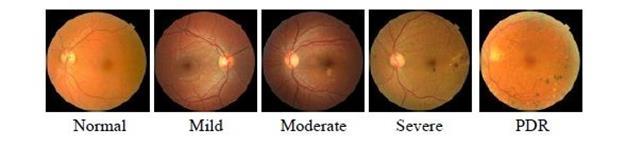
The dataset will be divided into five different Classes/Labels:
TheClass0representstheNoDiabeticRetinopathy.The Class1representstheMildDiabeticRetinopathy.TheClass2 representstheModerateDiabeticRetinopathy.TheClass3 represents the Severe Diabetic Retinopathy. The Class 4 represents the Proliferative Diabetic Retinopathy. The datasetconsistsofthevariousimages.Thetotalnumberof imagesare88,702images.TheTrainingSetconsistsofthe 35,126images.TestSetconsistsof53,576images
ImageFormat:High-resolutioncolorfundusimages,with variationsinimagequalityandlightingconditions.
Challenges:Theimageshavevaryingresolutions,andsome maybeblurryorunderexposed.Thereisaclassimbalance, withmostimagesfallingintothe”NoDR”category.
Preprocessing:Resizing,cropping,andnormalizationare applied to handle the variations in resolution and image quality.
The development of a robust transfer learning model combined with ensemble learning techniques has the potential to significantly enhance the early detection and classificationofdiabeticretinopathyfromretinalimages.By leveraging the strengths of pretrained models through transfer learning, we can reduce training time while ensuringhighaccuracy,especiallywhenfacedwithlimited labeleddata.Ensemblelearningfurtherboostsperformance byaggregatingpredictionsfrommultiplemodels,leadingto more reliable outcomes. Additionally, the integration of attention mechanisms helps the model focus on critical regions in retinal images, such as microaneurysms and hemorrhages,improvingthedetectionofearly-stagediabetic retinopathy. This approach not only increases diagnostic accuracy but also ensures interpretability, making the system more practical for clinical use. With continuous advancements in model architecture and access to highqualitydatasets,suchmodelscanbescaledforreal-world applications. Early diagnosis of diabetic retinopathy is essential to prevent vision loss, and these innovations in machine learning have the potential to make a profound impactonhealthcare,facilitatingmoreefficientandeffective screeningprograms.Furtherresearchcanexploretheuseof larger, more diverse datasets, along with optimizing the model for even better generalization and deployment in clinicalenvironments.
[1] AryanKokane,GourhariSharma,AkashRaina,Shubham Narole, and Prof. P M Chawan. 2021. Detection of Diabetic Retinopathy Using Neural Networks. International Research Journal of Engineering and Technology (IRJET), Vol 8, Issue 3.M. Young, The TechnicalWriter’sHandbook.MillValley,CA:University Science,1989.
[2] Gulshan, V., Peng, L., Coram, M., et al. (2016). Development and Vali dation of a Deep Learning Algorithm for Detection of Diabetic Retinopathy in Retinal Fundus Photographs. JAMA, 316(22), 2402–2410.
International Research Journal of Engineering and Technology (IRJET) e-ISSN: 2395-0056
Volume: 11 Issue: 11 | Nov 2024 www.irjet.net p-ISSN: 2395-0072
[3] Ting, D. S., Cheung, C. Y., Lim, G., et al. (2017). DevelopmentandValidationofaDeepLearningSystem forDiabeticRetinopathyandRelatedEyeDiseasesUsing Retinal Images From Multiethnic Populations With Diabetes.JAMA,318(22),2211–2223.
[4] Quellec, G., Charri`ere, K., Boudi, Y., Cochener, B., Lamard, M. (2017). Deep Image Mining for Diabetic Retinopathy Screening. Medical Image Analysis, 39, 178–193.
[5] Le, D., Alam, M., Lim, J. I., Yao, X. (2020). Transfer Learning for Automated OCTA Detection of Diabetic Retinopathy.TranslationalVisionScienceTechnology, 9(2),35–35.
[6] Lam,C.,Yu,C.,Huang,L.,Rubin,D.(2018).RetinalLesion Detection with Deep Learning Using Image Patches. InvestigativeOphthalmologyVisualScience,59(1),590–596.
[7] Pratt, H., Coenen, F., Broadbent, D. M., Harding, S. P., Zheng, Y. (2016). Convolutional Neural Networks for Diabetic Retinopathy. Procedia Computer Science, 90, 200-205.
[8] Voets, M., Møllersen, K., Bongo, L. A. (2019). ReproductionStudy:DevelopmentandValidationofa Deep Learning Algorithm for Detection of Diabetic Retinopathy in Retinal Fundus Photographs. arXiv preprintarXiv:1803.04337.