
International Research Journal of Engineering and Technology (IRJET) e-ISSN: 2395-0056
Volume: 11 Issue: 11 | Nov 2024 www.irjet.net p-ISSN: 2395-0072

International Research Journal of Engineering and Technology (IRJET) e-ISSN: 2395-0056
Volume: 11 Issue: 11 | Nov 2024 www.irjet.net p-ISSN: 2395-0072
J.
Sheeba Ebenezer1, Shahnawaz Ahmad2 , Kiran R. Govindappa3 , Khaled Alawi Mohammed4 , Mohammed Amin Bait Fareed5 , Ahmed Mohammed Kashoob6
1,2,3Lecturer, Civil and Architectural Section, College of Engineering and Technology, University of Technology and Applied Sciences, PO Box 608, PC: 211, Salalah, Oman
4,5,6Student, Civil and Architectural Section, College of Engineering and Technology, University of Technology and Applied Sciences, PO Box 608, PC: 211, Salalah, Oman
Abstract - In this project, the results of a pilot study were conducted to study the effects when the use of plastic waste in concrete as a replacement for fine aggregate. This study takes advantage of plastic waste to propose an environmentally friendly solution to address the plastic waste problem. In this experimental study, the replacement was done at 0% 1% 2% 3% and an optimum proportion of plastic was estimated based on compressive strength test results. Replacement results were comparable with the controlled mix results in terms of compressive strength test result, 2% replacement showed a considerable amount of increase in compressive strength, and further addition of plastic decreases the compressive strength.
Key Words: Plastic, Waste, Concrete, Compressive strength.
1.1 General
Polymers are the main component of the diverse class of synthetic or semi-synthetic materials known as plastics. Plastics can be moulded, extruded, or pressed into solid objectsofmanyshapesbecauseoftheirfluidity.Ithasgained popularity due to its versatility as well as several other attributes, such as being strong, lightweight, flexible, and reasonablypricedtoproduce.Usually,plasticsareproduced usinghumanindustrialsystems.[1]
Natural, organic materials like cellulose, coal, natural gas, salt,and,ofcourse,crudeoilaretherawmaterialsusedto make plastics. Before it can be used, crude oil must be processedbecauseitisacomplicatedmixtureofthousands ofdifferentcompounds.Crudeoilisfirstdistilledinanoil refinerybeforeplasticsaremade.Bydoingthis,theheavy crudeoilisseparatedintofractions,whicharecollectionsof lightercomponents.Eachfractionisablendofhydrocarbon chains, which are chemical compounds composed of hydrogenandcarbon.Themoleculesinthesechainsvaryin size and structure. Naphtha, one of these fractions, is an essentialsubstanceformakingplastics.[2]
The world is facing a global plastics crisis. Out of the 8.3 billion tons of plastics produced since the 1950s, there is virtuallynoplaceonEarthwhichisleftuntouchedbyplastic
pollution. Plastic waste is now so universal in the natural environment that scientists have even suggested it could serveasageologicalindicatorofthenextera.[3]
The aim of the experimental study is the use of plastic wasteinconcreteasareplacementoffineaggregate. This wasdonetoreduceplasticwaste,preservetheenvironment, and do something innovative and new in concrete. The resultsofthestudygavethepossibilityofusingplasticwaste asbuildingmaterials.
Themainobjectiveofthisstudyis
1.tostudytheuseofwasteplasticmaterialsinconcrete mixandfindingthestrengthandworkabilityresultsofwaste plasticreinforcedconcreteandconventionalconcrete.
2. The different percentages of waste plastic reinforced concreteusedintheexperimentationare0%,1%,2%,and 3%withC25mixconcrete.
3. The results are compared with the plastic reinforced concreteproducedandconventionalconcrete
P. Pooja (2019), Accordingtothisstudy,oneofthemain issuesthatarisesineverynationisthedisposalofplastic. According to government statistics, over 15,000 tons of plastic waste are produced daily in India, with 6,000 tons goinguncollectedandendingupinthestreets.Reusinglarge waste is thought to be the most environmentally friendly waytoaddressthedisposalissue.Plasticisonesuchwaste thathasseveralpotentialuses.
In this project, it was discussed about the behaviour of concrete with partial replacement of fine aggregate with plastic wastes ranging from 15-30% with small grain size incorporatedand20%replacementshowedaconsiderable amount of increase in compressive strength, and further additionofplasticdecreasesthecompressivestrength.[4]
Volume: 11 Issue: 11 | Nov 2024 www.irjet.net
Dharmaraj (2016) researchedthetopicofRecyclingplastic wastecontributestothenation'ssustainabledevelopment andlessenswastedisposalissues.Themechanicalstrength characteristicsofconcretecontainingvaryingpercentages (0–55%)ofwasteplasticaggregateswereevaluated.Plastic aggregates,whicharegrainsproducedasthebyproductof thepolymerrecyclingindustry,areutilizedinthisworkto replace fine aggregates in concrete. Compressive, split tensile, and flexural strengths are increased when plastic aggregateisaddedinplaceoffineaggregate,whichaidsin thecreationofsustainableconcrete.Itisobservedthat,the optimum%ofreplacementofsandwithwasteplasticwaste is 40% and it is also found that up to 55% of sand replacements with plastic wastes. Mechanical strength valuesarecomparablewiththatofthenormalconcrete.[5]
Rakinul Islam (2020) foundthat,becauseofitsbenefitsto theenvironmentandtheeconomy,reusingplasticwasteto make concrete or mortar seems like an environmentally friendlywaytogetridofit.Thetypesofplastics,recycled plastics,andtherecyclingprocessarefirstillustratedinthis paper.Theinfluenceoncementitiouscompositesproperties is then discussed in three sections: durability, mechanical properties,andphysicalproperties.Largeamountsofwaste plasticarepresent,andtheirlimitedbiodegradabilityhasa detrimentalimpactontheenvironment.Everykindofplastic usedindailylifeeventuallyturnsintowasteandcannotbe recycledcompletelyrightaway.Tonsofplasticwasterequire a lot of space to be stored. Reusing waste has several benefits,includingrecycling,loweringenergyconsumption and pollution levels, and maintaining and conserving irreplaceablenaturalresources.[6]
Dr. T. Srinivas (2020) investigated the use of recovered plastic trash to partially substitute fine aggregate in the creation of sustainable concrete. The use of two recycled plastic wastes, polyethylene terephthalate (PET) and polypropylene(PP),asfineaggregateinconcretehasbeen examinedinthisstudy.Inthepercentagesof5,10,15,20, and 25, recycled plastic trash has been used to partially replace the fine aggregate (River Sand) in M30 grade concrete.TodeterminetheappropriatepercentageofPET and PP incorporation in concrete, the workability and compressive strength results are examined. As the percentage of regenerated plastic waste increases, the workabilitydecreases,accordingtothedata.Tenpercentis theidealreplacementpercentageforPET. PPhasshowna marginal reduction in compressive strength for 5% replacement.[7]
Thefollowingmethodologywasusedtostudyofstrength behaviourofconcreteusing plasticwaste inconcreteasa replacementoffineaggregate.Here,thebasicpropertieslike specific gravity of fine aggregates and sieve analysis of coarseaggregatesweredone.C25mixwasdesignedandfor
the concrete samples, weight-based batching was used. Mixture mixing was used to mixaggregates, cement and water. Vibration compacting was used for compacting concretesamples.Curingofconcretespecimenwasdoneby keeping samples inside the water tank. Testing of compressivestrengthtestwasdoneusingtheCompressive strength testing Machine. Fine aggregate was partially replaced with 0%, 1%, 2%, and 3% by weight with the plastics.CompressivestrengthtestsforC25gradeconcrete withvariedamountsofwasteplasticsweredoneafter7and 28 days of curing. The strength results obtained were comparedtothoseofstandardconcreteandtheresultsfor compressivestrengthwerestudied.Thetestsweredonein thelaboratoryandtheresultsaretabulatedgiven.
S.No TestsdoneinLab Result
Materials:Inthisresearchstudy,the53gradeofordinary Portlandcement(OPC)wasused. Thecoarseaggregateused inthisstudywasangularshapedbecauseangularaggregate providesmorestrength. C25gradeconcretedesignmixwas done Theaggregatesizesusedinthetestwereintherange between 10mm and 20mm. Fine aggregate was having a
International Research Journal of Engineering and Technology (IRJET) e-ISSN: 2395-0056
Volume: 11 Issue: 11 | Nov 2024 www.irjet.net
specificgravityof2.728.Locallyavailabletransportablewater wasused.
Table – 2: Quantitiesofmaterialsused
Inthisstudy,plasticswasusedasapartialreplacementoffine aggregate Theaggregatesusedinthisstudywasreplaced0%, 1%,2%and3%byweightwithplasticsformakingconcrete andresultscomparedwithNormalconcrete.
Table – 3: %Replacementofplasticswithfineaggregate
S. No. %Replacementof plasticswithfine aggregates
1
Testing:
The slump test was done, and the table below shows the value.
Table -4 - Slump test
Table- 5 – Standard Result of slump test
Degree of workability
Very low
Slump (mm)
0-25mm
Low 25-50mm
Medium
High
Compressivestrength:Cubesandspecimensof150mmby 150mmby150mmareusedforcompressivestrengthtests. The design of the concrete mix, concrete quality, cement strength,water-to-cementratio,curing,andothervariables allaffecttheconcrete'scompressivestrength.Otherfactors includingthemixing,placing,andcuringoftheconcretealso have an impact. Concrete's compressive strength was determinedbyusingacompressivetestingmachine.
CompressiveStrength=P/Awhere,P=Compressiveload inkNandA=Areaofcubeinmm2
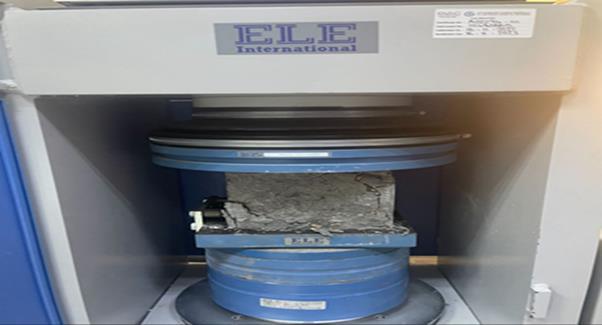
Figure -5: Compressivestrengthtest
The7daysand28daysaveragecompressivestrengthof6 specimensweretakenandresultsareshownbelowinTable -6.
Table -6: 7daysand28daysCompressivestrengthtest
ofplasticswith fineaggregates
50-100mm
100-175mm
Very high collapsed
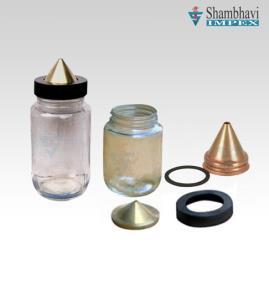
The density of the aggregate in relation to the density of waterisitsspecificgravity.Anaggregate'sspecificgravity value indicates how thick it is in relation to water. a material's mass per unit volume at a certain temperature dividedbythemassofanequivalentvolumeofwateratthe sametemperature. Anaggregate'sspecificgravityservesas agaugeforthematerial'sstrengthorquality.Ingeneral,low specific gravity aggregates are weaker than high specific gravity aggregates. This characteristic aids in the broad classificationofaggregates.
International Research Journal of Engineering and Technology (IRJET) e-ISSN: 2395-0056
Volume: 11 Issue: 11 | Nov 2024 www.irjet.net p-ISSN: 2395-0072
Thespecificgravityoffineaggregateisbetween2.4to2.9 andtheresultis2.728
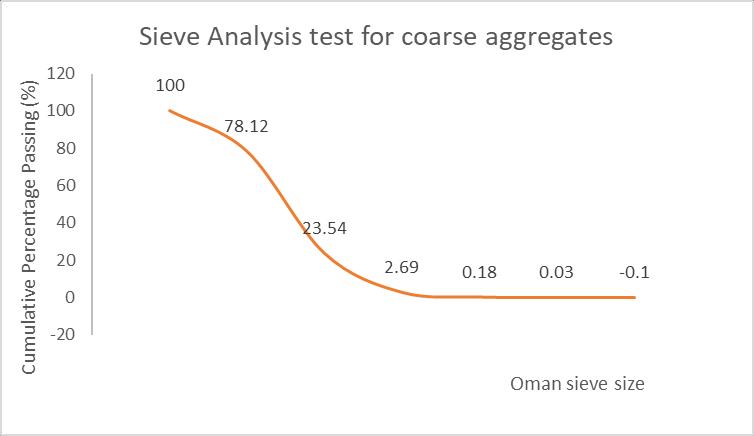
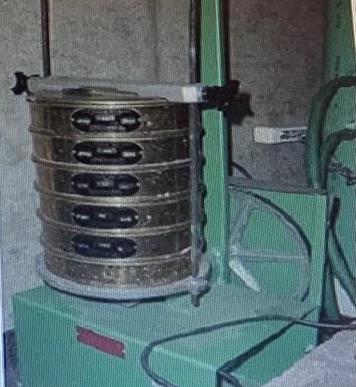
The distribution of aggregate particles by size inside a sampleisascertainedusingagradationtest,oftenknownas a sieve analysis. It is employed to assess adherence to productionanddesignspecifications.
Gravel,orcoarseaggregate:Theaggregatethatremainsona 4.75mmsieveisreferredtoascoarseaggregate.
Well-graded:Aggregatesthatarewell-gradedhaveauniform particle size distribution from the finest to the course. A well-graded aggregate concrete core slice reveals a dense field of particles with a wide range of sizes. It is distinguishedbyanS-shapedgradientcurve.
Poorgraded:Small sizevariationsarea hallmark ofpoorgradedaggregate.Aggregateparticlesofnearlyuniformsize arepresentinit.Thismeansthattheparticlespacktogether, leavingrelativelylargevoidsintheconcrete.Itisalsocalled “uniform-graded”.Itischaracterizedbysteepcurve
Theaggregateusedisproperlygradedasitisclearfromthe abovecurve.
The purpose of the slump test was to determine the consistencyandworkabilityoffreshlymixedconcrete,and consequently, the ease of flow. To guarantee immediate concrete quality in a construction project, this test is essential.Almostallbuildingsitesuseit.
The slump test is quite straightforward and manageable. Additionally,itrequiresrelativelylessequipmentandcanbe completedquickly.Underfieldconditions,theslumptestis usedtoguaranteehomogeneityforvariousconcreteloads. Mostpreferredvaluerangeofslumpis5-17.5cm.
Theresultismorethantherangeofslumpvalue.
The7daysand28daysaveragecompressivestrengthof6 specimens were taken and results are shownbelowinfigure7andfigure8
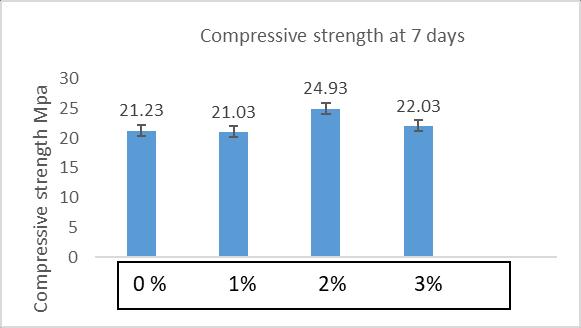
From the above Figure 7 the compressive strength of plasticreplacedconcreteat7daysstrengthcanbestudied. Accordingtothegraphabove,whenplasticisaddedupto 2%byweightoffineaggregates,concretehasanoptimum compressive strength of 24.93 MPa. When plastic content exceeds2%,compressivestrengthgraduallyfalls.
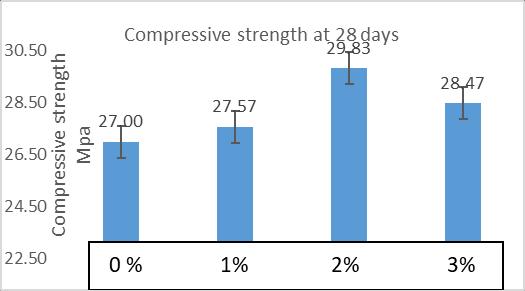
From the above Figure 8, the compressive strength of plasticreplacedconcreteat28daysstrengthcanbestudied Accordingtothegraphabove,whenplasticisaddedupto 2%byweightoffineaggregates,concretehasanoptimum compressive strength of 29.83 MPa. When plastic content exceeds2%,compressivestrengthgraduallyfalls.
Theabilityofamaterialorstructuretosupportloadsonits surface without cracking or deflecting is known as compressivestrength.Theconcretecubetest'scompressive strength gives you a general sense of all the concrete's properties.Onecandeterminewhetherconcretehasbeen done correctly with this one test. In commercial and industrialbuildings,concrete'scompressivestrengthranges from15MPato30MPaand beyondgeneral construction. Numerous factors, including the water-to-cement ratio, cementstrength,concretematerialquality,qualitycontrol throughout production, etc., affect concrete's compressive strength.Themainpurposeofcompressivestrengthdatais
International Research Journal of Engineering and Technology (IRJET) e-ISSN: 2395-0056
Volume: 11 Issue: 11 | Nov 2024 www.irjet.net p-ISSN: 2395-0072
to ascertain whether the concrete mixture as supplied on sitesatisfiesthetaskspecification'sstipulatedstrength,fc'.
Thecompressivestrengthofconcreteis29.83MPaat2% replacementofplasticswithfineaggregate.
Results from replacement were similar to those from the controlledmix.2%replacementdemonstratedasignificant gain in compressive strength, however additional plastic addition leads in a drop in compressive strength. 0% outcomesintermsofcompressivestrengthtestresults.
[1] Availablefrom:https://en.wikipedia.org/wiki/Plastic
[2] Available from: https://plasticseurope.org/plasticsexplained/how-plastics-are-made/
[3] Availablefrom: https://www.genevaenvironmentnetwork.org/resource s/updates/plastics-and-the-environment/
[4] P. Pooja, Manendra Vaitla, Gudapati Sravan, Mt.Purusotham Reddy, M. Bhagyawati Use of Plastic AggregatesinConcrete,Volume8,Part1,2019.
[5] Dharmaraj,R.,&Iyappan,G.(2016).Suitabilityofpartial replacement of pulverized plastic as fine aggregate in cement concrete. Indian journal of science and technology, 9(23),1-6.
[6] Islam,M.J.,Meherier,M.S.,&Islam,A.R.(2016).Effects of waste PET as coarse aggregate on the fresh and harden properties of concrete. Construction and Buildingmaterials,125,946-951.
[7] Gurlhosur, Shrikrishna, Halemani, Srinivas (2023) Studies on the use of waste plastic in cement-based compositeforlightweightconcreteproduction DO -10.13140/RG.2.2.13084.87681