
International Research Journal of Engineering and Technology (IRJET) e-ISSN: 2395-0056 p-ISSN: 2395-0072

Volume: 11 Issue: 11 | Nov 2024 www.irjet.net


International Research Journal of Engineering and Technology (IRJET) e-ISSN: 2395-0056 p-ISSN: 2395-0072
Volume: 11 Issue: 11 | Nov 2024 www.irjet.net
Yashaswini S P1 , T Gnanaprasuna2 , Supriya S Kyalakond3
1Bachelor of Engineering, Information Science and Engineering, Bapuji Institute of Engineering and Technology, Davangere, affiliated to VTU Belagavi, Karnataka, India.
2Bachelor of Engineering, Information Science and Engineering, Bapuji Institute of Engineering and Technology, Davangere, affiliated to VTU Belagavi, Karnataka, India.
3Bachelor of Engineering, Information Science and Engineering, Bapuji Institute of Engineering and Technology, Davangere, affiliated to VTU Belagavi, Karnataka, India.
Abstract - A type of artificial intelligence known as "generative AI" is capable of producing original text, images, audio, and video on its own. By addressing gaps in the metaverse's evolution, generative AI offers creative methods forcreating material inthe metaverse. Productslike ChatGPT could improve the way people search, change how content is generated and presented, and open up new channels for web traffic. This should have a big effect on conventional search engine products, spurring innovation and modernization in the sector. This study provides insights for improving the efficacy of generative AI in producing creative material, as well as an outline of the technologies and potential uses of generative AI in the metaverse technology breakthrough.
Key Words: Virtual AI Agents, AI-Powered Worlds, Deep Learning Algorithms, Computer Vision AI, Edge AI Computing,AIin3DModeling,Speech-to-ActionAI,CloudAI Infrastructure.
By automating intelligent decision-making and producing highlytailoreduserexperiences,artificialintelligence(AI) holdsthepotentialtosignificantlyenhancethemetaverse. Customers can perform financial transactions online with more privacy and security thanks to Web3's distributed network design [1–3]. Furthermore, data security and integrity are ensured by the immutable data storage and transfer protocols enabled by blockchain technology. By tacklingissueswithdigitalassetsandcontentcreationand bridgingcrucialgapsinWeb3'sdevelopment,generativeAI technologies such as Chat Generative Pre-Trained Transformer (ChatGPT) have the potential to become productivitytoolsintheWeb3era[4].Theindustryhaspaid close attention to the inventiveness and adaptability of generativeAIsincetheintroductionofChatGPTandother similartechnologies.WiththeaidofChatGPT,whichisbased ondeeplearningmodelsandcanproducecontentinawide range of situations and satisfy a wide range of needs, the effectivenessandCaliberofcontentcreationanddistribution maybesignificantlyincreased.

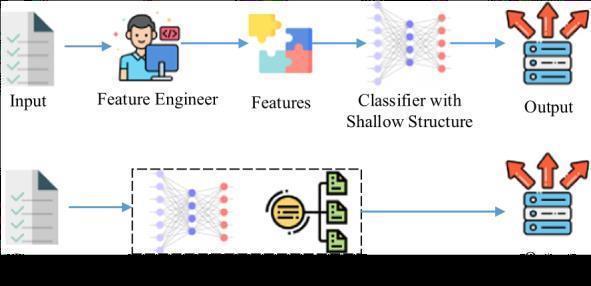
Fig.1. Comparison of workflow between traditional computervisiontechniquesanddeeplearningmethodsin generativeAI.
Furthermore,inordertominimizethetechnicalbarrierto achieving creativity in the metaverse era, the new technology ChatGPT, which is based on generative AI, is investigated.
2. Implementation Of Different Metaverse Components with Generative AI Support
2.1 The theoretical underpinnings of generative AI
As AI technology has developed, generative AI has emergedasakeyresearchtopic.GenerativeAIisanewAI system that can automatically create new material using inputdata,claimLimetal.(2023)[5].computervisionisa crucialtheoreticalfoundationforgenerativeAIsinceitdeals withtheprocessingofpicturedatatolearnnewthingsand produceavarietyofcontentfromvariousimagecollections. Theworkflowsfordeeplearningandconventionalcomputer visionapproachesarecontrastedinFig.1.Furthermore,by facilitatingsmoothinteractionbetweentheactualandvirtual worlds, several basic computer vision algorithms may improve users' experiences in virtual environments [6–8]. Furthermore,generativeAIcanhelparchitectsswiftlycreate complex interior spaces, including layouts, finishes, and interiordecorations.AccordingtoHaleem&Javaid(2022) [9], generative AI can also help architects create complex materialsmorerapidly.Intricatematerialsincludingwood, metal, cement, ceramics, steel, rubber, oak, bamboo, aluminiumalloy,copperalloy,titaniumalloy,andmorecan be made by architects using generative AI. Additionally, sophisticated security mechanisms that are impervious to theftcanbecreatedusinggenerativeAI.Insummary,the

Volume: 11 Issue: 11 | Nov 2024 www.irjet.net
International Research Journal of Engineering and Technology (IRJET) e-ISSN: 2395-0056 p-ISSN: 2395-0072
effectivenessofbuildingdesigncanbegreatlyincreasedby includinggenerativeAIintothedevelopmentofmetaverse buildings.
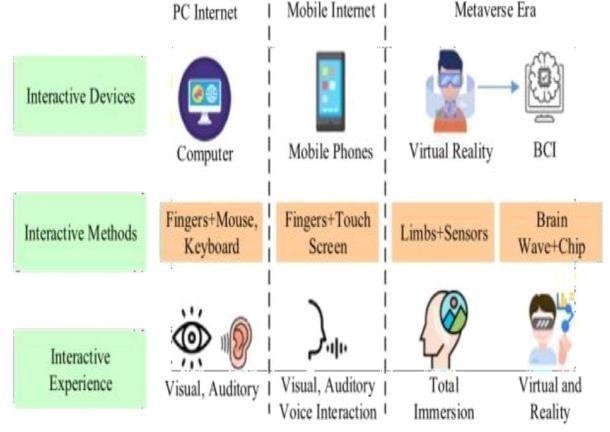
Fig.2. Theevolutionofinteractionmethodsbasedon generative
AccordingtoastudybyLuetal.(2022)[10],generativeAI can help with the design of complicated materials and functional features, the implementation of energy control techniques,andtheefficiencyofenergypools,inadditionto helping withthecreation of elaborate shapes and interior decorations.
Huang et al. (2021) [11] discovered that generative AI could improve players' comprehension of game landscapes and characters, leading to a more engaging gaming experience. By functioning as an intelligent agent in the game, generative AI enables players to design unique strategies and smoothly combine various components. Through the use of generativeAI, playerscan bettercontrolgamescriptsandcharacters,alterthegame's look, comprehend the characters' emotions, analyze the game more quickly, and maximize the game's difficulty and overall player experience. To enhance the gaming experience, developers can also use generative. Because virtual worlds appear in the user's head, this would essentially release users from the limitations of time and location.Thedevelopmentofinteractivetechniques based on generativeAIis depicted inFig.2.GenerativeAI-based multilingual translation in the metaverse According to Razumovskaia et al. (2022) [12], multilingual translation technology uses natural language processing (NLP) algorithms to identify the user's input language and translate it into other users' languages. There are numerous applications for this technology, such as facilitating multilingual communication or offering text-based chats withautomatictranslation.Additionally, itcanmakeautomatictranslationeasier.
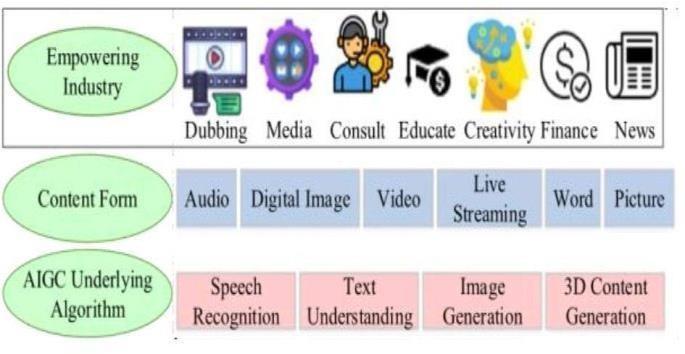
Fig.3.one-stopcontentgenerationapplicationbasedon generativeAI.
For audio discussions, enabling people who don't speak the same language to interact. An example of a generative AIbasedone-stopappforcontentproductionisshowninFig. 3. Additionally, users can access content in many languages by using it for content sharing on social media networks. The following are some benefits of generative AI-based multilingual translation technology over conventional machine translation techniques [13–15]: (1) great precision. It can produce more accurate translation results because it employs neural networks to learn the mapping relationships between many languages; (2) it is quick.Itcangenerate faster translation results;(3)higher scalabilitysinceitemploysneuralnetworkstounderstand themappingrelationshipsbetweendifferentlanguages.
Itcanachievemore scalabilitysince itlearnsthe mapping relationships across languages using neural networks. in terms of the outcomes of translation. By facilitating rapid, accurate, and fluid communication, generative AI's multilingual translation technology holds promise for increasing the effectiveness of cross- border communication. By making it easier for companies to quickly and accurately introduce their goods and services to other nations, it can also help them grow their operationsintheglobalmarket.
Volume: 11 Issue: 11 | Nov 2024 www.irjet.net
International Research Journal of Engineering and Technology (IRJET) e-ISSN: 2395-0056 p-ISSN: 2395-0072
3. Using generative AI to create metaverse content
3.1 The application of generative AI
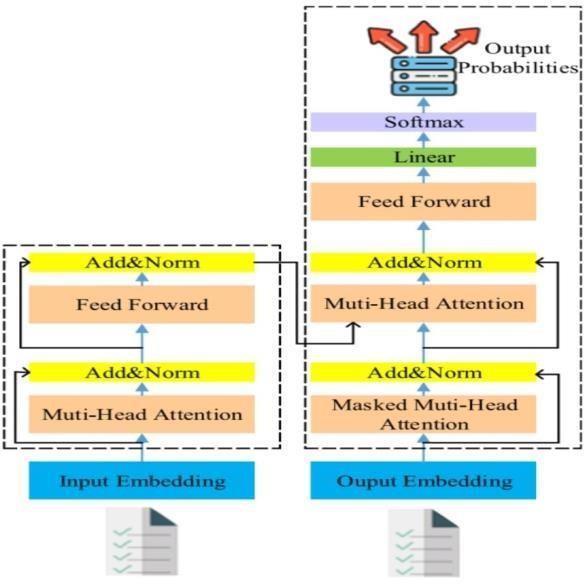
Fig.4. Architectureofthetransformeralgorithm.
According to Barn es (2022) [16], generative AI operates by learning a probability distribution p(x) and using it to create new samples in the form of F (•). For example, machine algorithms for facial generation learn from large amounts of data, such as text, language, and photos, and take into account the constraints of facial models, facial features, and the physical laws of biomechanics. This enables the machine to render and sample from a subspace associated with learnt human faces. There are two primary parts to the transformer: an both a decoder and an encoder. The output sequence is produced by the decoder using the feature vectors that the encoder converted from the input sequence data. Based on generative adversarial networks, the Deep Convolution Generative Adversarial Network Model One of the most representative models is networks due to its capacity to producerealisticpictures.
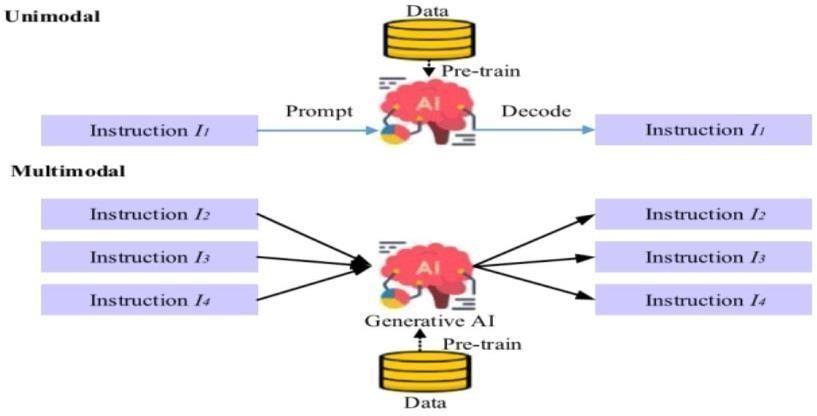
Fig.5. TwotypesofgenerativeAImodels.
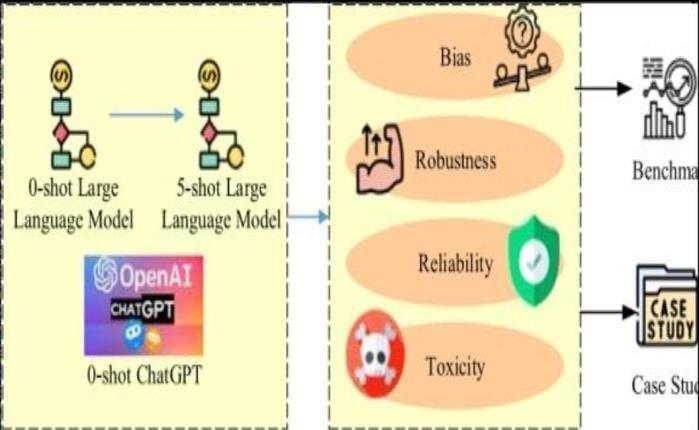
AIethicaldiagnosisframework.
Generative AI can be applied to audio applications like music production and speech synthesis. One of the most well-known examples, the Wavenet model, can create realistic-soundingartificialmusicandvoice.As illustrated in Fig. 5, there are two primary types of generative AI models:single-modal andmulti-modal.Whilemulti-modal modelscantakeinputfrom multiplesourcesandproducea variety of output forms, single-modal models get instructions from input types that are identical to their output[17–19].
Inthefuture,ChatGPT'sabilitytoproduce"cross-domain" effects including its particular application scenarios in the metaverse industry-should be undeniable. For instance, byutilizingChatGPT'sfundamental technologies, advanced knowledge or experiences from related disciplines can be replicated, leading to "integrated innovation." While ChatGPT itself lacks unique functionality, as noted by Tlili (2023) [201], its deep learning and imitation skills may have the potential for "cross-domain" learning and reference, which calls for moreresearch.
4. A VIEWPOINT
Themaingoals ofgenerativeAI's future development will be to advance technological research, investigate novel application scenarios, and foster industry expansion. An important development in this area is generative AI's capacity to autonomously create excellent content. However, generative AI technology is still in its infancy at the moment, and the material it produces could be inaccurate.ItisanticipatedthatgenerativeAIwillproduce material that is more accurate and of higher quality as technologydevelops.Digitalassistants,thenextgeneration of automobiles, are being made possible by developments in conversational AI, natural language processing, gesture recognition,andavataranimation.Whileinternalcameras, deep neural networks, and multimodal interaction can guaranteethatthedriver'sattentionis ontheroadandthat no passengers or pets are left behind at the end of a journey, these AI butlerscanalso use naturallanguage understanding to make reservations, accessvehicle
Volume: 11 Issue: 11 | Nov 2024 www.irjet.net
International Research Journal of Engineering and Technology (IRJET) e-ISSN: 2395-0056 p-ISSN: 2395-0072
controls, and provide alerts. Furthermore, theutilization of extensive language models and in order to find hidden patterns and hints that will enableadvancements in healthcare, science, customer service, and autonomous traffic, structured data will be extendedto large volumes of unstructured data, including images, videos, tweets, and more. Neural networks will also benefit from the incorporation of unstructured data; for example, a neural network can create fake profiles to resemble the healthy records it has learned from. Consequently, supervised and unsupervised machine learningwillbothbecomecrucial.
Themetaverseisexpectedtobeamassive,intricatesystem withextremelyhighconcurrentdatavolumes.Theescalation of information dimensionality in this digital environment will also result in an exponential increase in information complexity, surpassing the computing capabilities of the humanbrain.Thisstudyexplorestheimportantroleofthe metaverse in a number of areas, including industry, governance,andscientificresearch,byprovidingathorough analysis of the main metaverse technologies and the application of generative AI. Through the integration of fundamentaltechnologiessuchasblockchain,AR/VR,AI,and the Internet of Things, the metaverse facilitates the highquality development of the intelligent economy. These technologies are positioned to become the main driver of upcoming improvements in computing power, creating a significant demandforcomputing resourcesandchanging thewaythatcomputationisdeployed.Withtheuseofthe metaverse'sspecializedplatformandartificialintelligence (AI), which is a key component of future technological advancementandisdemonstratedbyappslikeChatGPT,a new social and economic space where socioeconomic activitiescanthriveinaclosed-loopsettingcouldbecreated. However,carefulthoughtanddeliberationarerequiredfor thecreationanduseofthemetaverse.Achievingabalance betweenprivacyprotectionandtechnologicaladvancement, maintainingtheopennessandvarietyofthemetaverse,and resolvinganypotentialsecuritythreatsorethicaldilemmas areallimportantchallengestoaddress.
[1] S. Mondal, S. Das, V.G Vrana, How to bell the cat? A theoretical review of generative artificial intelligence towards digital disruption in all walks of life, Technologies 11(2)(2023)44.
[2] S.Pal,T.Rabehaja,M.Hitchens,A.Hill,Onthedesignof aflexibledelegationmodel fortheInternetofThings using blockchain,IEEETrans.Ind.Inf.16(5)(2019)3521–3530.
[3] M. Jovanovic, M. Campbell, Generative artificial intelligence: trends and prospects, Computer (Long Beach Calif)55(10)(2022)107–112.
[4] J. Perkins, Immersive metaverse experiences in decentralized 3d virtual clinical spaces: artificial intelligence-driven diagnostic algorithms, wearable internet of medical things sensor devices, and healthcare modeling and simulation tools, Am. J. Med. Res. 9 (2) (2022)89–104.
[5]W.M. Lim, A. Gunasekara, J.L. Pallant, J.I. Pallant, E. Pechenkina, Generative AI and the future of education: ragnarök or reformation? A paradoxical perspective from management educators, Int. J. Manage. Edu. 21 (2) (2023) 100790.
[6] M. Hawkins, Metaverse live shopping analytics: retail data measurement tools, computer vision and deep learningalgorithms,anddecisionintelligenceandmodeling, J.Self-GovernanceManage.Econ.10(2)(2022)22–36.
[7]R. Watson, The virtual economy of the metaverse: computer vision and deep learning algorithms, customer engagement tools, and behavioral predictive analytics, Linguistic Philos Investig (21) (2022) 41–56 . [8]M. Hawkins,Virtualemployeetrainingandskilldevelopment, workplace technologies, and deep learning computer vision algorithms in the immersive metaverse environment, Psychosociological Issues Human Resour. Manage.10(1)(2022)106–120.
[9]HaleemA.,JavaidM.,SinghR.P.AneraofChatGPTasa significant futuristic support tool: a study on features, abilities, and challenges. BenchCouncil Transactions on Benchmarks, Standards and evaluations, 2022, 2(4): 100089.
[10] X. Lu, W. Liao, Y. Zhang, Y. Huang, Intelligent structural design of shear wall residence using physicsenhanced generative adversarial networks, Earthq Eng. Struct.Dyn.51(7)(2022)1657–1676.
[11]X. Huang, D. Zou, G. Cheng, X. Chen, H Xie, Trends, researchissuesandapplicationsofartificialintelligencein language education,Edu. Technol.Soc. 24(3) (2021) 238–255.
[12]E. Razumovskaia, G. Glavas, O. Majewska, E.M. Ponti, A. Korhonen, I. Vulic, Crossing the conversationalchasm: a primer on natural language processing for multilingual task- oriented dialogue systems, J. Artificial Intelligence Res. 74 (2022) 1351–1402.
Volume: 11 Issue: 11 | Nov 2024 www.irjet.net
International Research Journal of Engineering and Technology (IRJET) e-ISSN: 2395-0056 p-ISSN: 2395-0072
[13] J. Long, Application of Artificial Intelligence (AI) technologyinChineseEnglishtranslationsystemcorpus,J. Artif.Intell.Practice5(3)(2022)8–13.
[14] W. Hariri, Unlocking the potential of ChatGPT: a comprehensiveexplorationofitsapplications,Technology 15(2)(2023)16.
[15] L. Xiang, Y. Zhao, Jl Zhu, Zero-shot language extension for dialogue state tracking via pre-trained models and multi-auxiliary-tasks fine-tuning, Knowl. BasedSyst.259(2023)110015.
[16]R. Barnes, Healthcare diagnosis and treatment in the metaverse: remote sensing algorithms, networked wearabledevices,andvirtualpatientdata,Am.J.Med.Res. 9(2)(2022)41–56.
[17]Q.Sun,Y.Xu,Y.Sun,C.Yao,J.S.A.Lee,KChen,GNCNN: a point cloud analysis method for metaverse applications,Electronics(Basel)12(2)(2023)273.
[18]H.Zhang,S.Lee,Y.Lu,X.Yu,H.A.Lu,Surveyonbigdata technologiesandtheirapplicationstothemetaverse: past,currentandfuture,Mathematics11(1)(2023)96.
[19]S.E. Bibri, Z. Allam, J. Krogstie, The Metaverse as a virtual form of data-driven smart urbanism: platformization and its underlying processes, institutional dimensions, and disruptive impacts, Computat. Urban Sci. 2(1)(2022)24.
[20] A. Tlili, B. Shehata, M.A. Adarkwah, A. Bozkurt, D.T.Hickey, R. Huang, B. Agyemang, What if the devil is my guardian angel: chatGPT as a case study of using chatbotsineducation,SmartLearn.Environ.10(1)(2023) 15.