
International Research Journal of Engineering and Technology (IRJET) e-ISSN: 2395-0056
Volume: 11 Issue: 11 | Nov 2024 www.irjet.net p-ISSN: 2395-0072

International Research Journal of Engineering and Technology (IRJET) e-ISSN: 2395-0056
Volume: 11 Issue: 11 | Nov 2024 www.irjet.net p-ISSN: 2395-0072
Abdulaziz Salihu Aliero1, Neha Malhotra2
1,2School of Computer Applications, Lovely Professional University, Punjab, India ***
Abstract - These days, one of the necessities for humankind is electricity. The idea of smart grids was developed to solve problems and difficulties in the traditional grid’s ability to transmit electricity. The survey looks at relevant literature on machine learning (ML) and deep learning (DL) for smart grid applications, with a focus on works published in the last three years. A variety of databases, including Web of Science, Scopus, IEEE Xplore, Science Direct, and Google Scholar, were used to gather research publications. The research on machine learning (ML) and deep learning (DL) approaches used for load forecasting, grid stability, load optimisation, and anomaly detection in smart grids is systematically reviewed in this survey. Additionally, it offers more research problems for using DL and ML technology to make genuinely intelligent grids a reality. The survey will assist the industry and researcher in their future study and analysis of the latest advancements in smart grid technology.
Key Words: SmartGrid,MachineLearning,DeepLearning, Models
Asmartgridisaninterconnectedpowersystemthatuses automation and digital communication technologies to increase the long-term viability, dependability, and effectiveness of the production, dispersion, and use of electricity.ItmakesitpossiblefortheElectricityCompany and customers to communicate in both directions, which permitsreal-timemonitoringandmanagementofelectricity consumption.Smartgridscollectdataonelectricalsupply anddemandusingsensors,meters,andotherdevices.This allows for improved resource management and grid stability through energy optimization, distribution, and reducingtransmissiondefeats.Smartgridscancontribute toenergyefficiencyandsavingsoncostsforconsumersand utilities. In addition to facilitating demand- side managementandloadbalancing,thedeploymentofsmart gridsallowsdemandresponseprograms,inwhichuserscan modify their electricity consumption according to price indicationsor system circumstances. Overall,smartgrids are essential in modernizing the electrical sector and addressingthechallengesofclimatechange,risingenergy prices, and the need for a more sustainable and resilient electricity infrastructure [1]. The smart grid provides various services in real life that enable demand management, allowing clients and proprietors to control
energy use and lower demand during peak hours, thus avoidingpoweroverload[2].
Machine learning (ML) is the prediction and ongoing learning from available data. ML is composed of various algorithmsthatevaluatethedataandgenerateconclusions orforecastsaboutthecurrentsituation.DeepLearningisa machinelearningsubfieldthatfocusesonartificialneural networktechniquesmodeledafterthebrain’sarchitecture and operations [3]. The integration of ML and DL has various applications in the context of smart grids. These applicationsincludeloadforecasting,gridstability,energy optimizationanalysis,anomalydetection,andensuringthe stabilityoftheSmartGrid[4]. Furthermore,deeplearning andmachinelearningareutilizedinenergyfore-castingto evaluate vast volumes of data and produce precise forecasts. These methods are capable of handling substantialvolumesofdataandextractingimportanttraits to increase predicting accuracy [5]. Hossain et al. carried outathoroughinvestigationoftheuseofmachinelearning insmartgrids,highlightingitspotentialinloadforecasting, data acquisition, and stability assessment [6]. They emphasizedtheneedforadvancedtechniquestohandlethe massivedatavolumegeneratedbysmartgrids.Whereby Massaoudietal.reviewedtheadvancementsandprospects ofdeeplearninginsmartgrids,discussingitsapplicationsin energy forecasting, fault detection, and cybersecurity awareness [7]. Deep learning, in particular, involves stacking and connecting different learning layers that accuratelymapthelinkbetweeninputdataandoutput[8].
This paper primarily focuses on understanding the opportunitiesforusingtheapplicationofmachineanddeep learningmodelsinsmartgrids.Thiswillinvolveadetailed discussion of the various techniques, algorithms, and modelsusedinmachinedeeplearningforthesmartgrid. The paper will also enumerate the different data sources that were used in machine and deep learning for understanding how the smart grid works, like communicationnetworks,intelligentmeters,detectors,grid management networks, solar and wind turbines, grid storage systems, and data management. In addition, the paperwill discusswhysmartgridareimportant,andthe architectureofsmartgrid.Finally,thissurveycomestoa closewithadiscussionofwhereresearchinthisareawillgo inthefuture.Aspartofthis,itwillbenecessarytoidentify research areas that need additional study, such as the creationofdeeplearningalgorithmsthataremoreaccurate
International Research Journal of Engineering and Technology (IRJET) e-ISSN: 2395-0056
Volume: 11 Issue: 11 | Nov 2024 www.irjet.net p-ISSN: 2395-0072
andefficient,aswellastherequirementforlargerandmore varieddatasets.
Over the next few decades, it is anticipated that energy consumptionwill risevery highasa resultoftheworld’s growingpopulation,industrialization,andexpandingglobal economy.Withthisincreaseinelectricitydemandthetraditionalgridcannothandleit,consumerdatacanbecombined withsmartgridtechnologytocreateaneffectiveelectricity distributionnetwork.Themotivationbehindsmartgridsis to address the limitations and challenges of traditional power grids. The power system is becoming more complicated, and traditional grids are not resilient or scalable enough to handle it, such as the integration of renewableenergysourcesandthegrowingscaleofthegrid [9][10].Furthermore,findingpatternsandstandardsinthe production process and extracting knowledge from aggregated data are the driving forces behind machine learninganddeeplearning.Intheindustrialsector,these methodsarecrucial,especiallyforsmartmanufacturingand thesmartgridparadigm.MLandDLcanincreaseoutput, findproduct flaws,andforecasthowlongmachinery will last with the help of diagnostic, descriptive, prescriptive, and predictive analytics. Applications for ML and DL technologiescan alsobefoundinsmartgrids,secureIoT architectures, transportation, logistics and supply chains, andelectricma-chineconditionmonitoring.TheuseofML and DL technologies is becoming more widespread and promising, with advantages including increased general quality, dependability, and safety in a variety of domains [11][12][7].However,smartgridsaimtoimproveenergy efficiency,interaction,security,andstabilityanalysisinthe power system [13]. They are designed to be self-healing, adaptable,andcapableofintegratingvarioussystems,such as information systems, thermal energy systems, and transportationsystems[2].Smartgridsenablecustomersto send information to the grid station and improve communication between the grid station and customers, allowingfor real-timeinformation exchangeanddemand management [12]. Additionally, smart grids facilitate the incorporationofrenewableenergysourcesandassistinthe growthoftheelectricalmarketmoreeffective,reliable,and persistentenergynetwork.
In light of the above, the primary contributions of this surveycanbesummedupasfollows:AnoverviewofML, DL, and SG has been explored to get in-depth knowledge behindthemandreviewtheapplicationsofMLandDLinSG systems,whichincludeloadforecasting,gridstability,load optimization,andanomalydetection
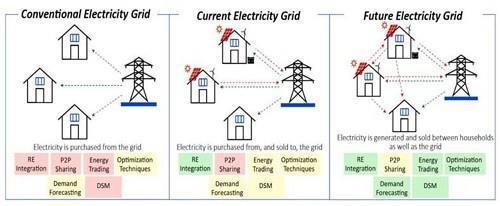
-1:Anillustrationofastandard,modern,and prospectiveelectricalgrid [15]
Thepaper’sorganizationisdelineatedasfollows:SectionI comprisestheintroduction,succeededbyanexaminationof smartgridsinSectionII,applicationsofthemachineand deeplearninginSmartGridsinSectionIII,acomprehensive review and discussion of existing literature in Section IV, explorationofchallengesandfutureprospectsinSectionV, andasuccinctrecapitulationoftheconclusionsinSection VI.
The smart grid is a modern electric power grid in which electricityflowsfromthesuppliertothecustomerinasmart way.Itrepresentstwo-waycommunicationbydistributing powerandoptimizingconsumption.Thesystemthatallows bidirectionalenergyandinformationflowisfundamentally referred to as a smart grid, where data travels in both directionsfromthedevicestothecentralserverandfrom theservertothesmartdevices,makingtheinformationflow bidirectional [14]. As mentioned on [2], Smart Grid is a modernized electricity network designed to improve the efficiency and stability of power supply through the integrationofninemachinelearningalgorithms.Unlikethe conventional grid where electricity is purchased from the grid to the customers. Likewise in the current smart electricitygrid,theelectricityisobtainedfromthegridand alsosoldtothegrid,andinthefuturesmartgridElectricity isgeneratedfromthegridandsoldbetweencustomersas well as the grid [15] as illustrated in Figure1. There are several types of smart grid which include: Advanced metering infrastructure, Distribution Automation, Renewable energy integration, Demand response, Energy storageintegration,Electricvehicles,andmicrogrids.The smartgridiswellpoisedtofundamentallychangeourlives withthehelpofmachinelearninganddeeplearningmodels. Smartgridhasseveralusesfordeeplearningandmachine learning.Theycanbeappliedtoevaluateandextractuseful informationfromthevastamountsofdatageneratedinan Internet of Things-based grid system [6]. To efficiently analyzethedataandmaketherightjudgmentstooperate thegrid,MLmethodsaremadepossible[16].Thesemethods canbeappliedtoanomalydetection,adaptivecontrol,sizing,
International Research Journal of Engineering and Technology (IRJET) e-ISSN: 2395-0056
Volume: 11 Issue: 11 | Nov 2024 www.irjet.net p-ISSN: 2395-0072
consumption, price, power generation, future optimal schedule,anddetectingnetworkintrusionsintheeventofa dataleak[17].Inthefuture,deeplearningandbigdatamay beessentialtoolsforresolvingissueswiththesmartgrid.It can improve the smart grid’s responsiveness, efficiency, security,stability,anddependability.
Thecurrentelectricitygridinfrastructurewasestablished overacenturyago,primarilytomeettherelativelystraightforwardelectricityneedsofthatera.Thisgridsystemcomprised power lines and substations, facilitating the transmissionofelectricityfromcoalandfossilfuel-powered plantstoresidentialandcommercialproperties.Thepower generation process was localized, with power plants strategicallylocatedwithincommunitiestocatertomodest energy demands. Consequently, the grid was designed to deliver electricity from utilities to individual customer premises.
The contemporary energy landscape presents challenges thatthetraditionalgridstructurestrugglestoaddress.The grid’s inherent limitation lies in its one-way directional flow, which impedes its ability to adapt to the dynamic energy demands characteristic of the 21st century. For instance,disruptionssuchaspowerlinefailurescanleadto inadequate energy supply from power plants precisely when demand peaks. Moreover, the current grid predominantly relies on a singular power source, lacks granularity in usage data, and consequently, poses challengesineffectiveenergymanagement.
To remedy these shortcomings, historical approaches involvedtheconstructionofadditionalpowerplants.
Within this context,) machine learning (ML) and Deep Learning(DLmodelshaveemergedascompellingtoolsfor addressingchallengesacrossvarioussectorswithinsmart grids [18]. The adoption of machine learning methods withinsmartgridshasgainedsignificanttraction,especially inareasthatincludeloadbalancing,faultdetection,energy management, and cybersecurity. Researchers have leveraged algorithms such as support vector machines (SVM), decision trees, and ensemble methods to predict energy demand patterns. Additionally, clustering algorithms have been employed to group consumers with similarenergyconsumptionprofiles,aidinginpersonalized energy management strategies [19]. For demand forecasting,deeplearningmodelssuchaslongshort-term memorynetworks(LSTMs)andrecurrentneuralnetworks (RNNs) have demonstrated superior capabilities in capturing complex temporal relationships. These models have been successfully applied to predict short-term and long-termenergyconsumptionpatterns,enablingutilities tooptimizeresourceallocationandgridoperations.
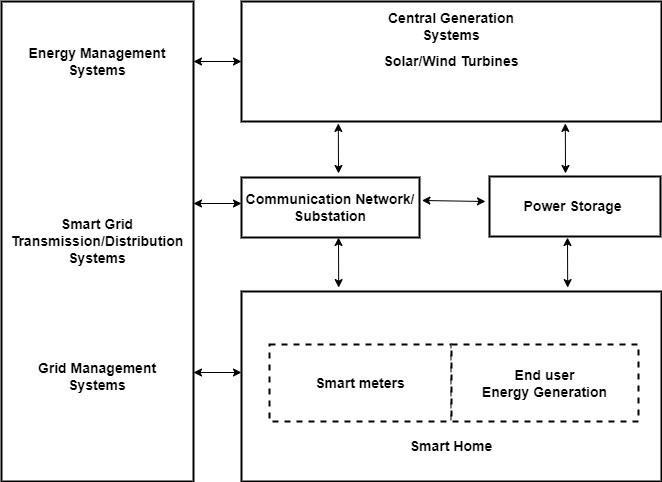
A smart grid is a computerized electrical system that improves the sustainability, efficiency, and consistency of energydeliverythroughtheuseofdigitaltechnologiesto provide a more intelligent and responsive energy infrastructure[3].Traditionalgridsarenotcapableoftwoway communication, but the infrastructure of the new smart grid, as shown in Figure2, has distributed delivery systems and sophisticated controls. A smart grid’s architecture combines several different parts and technologiesasfollows:
• Smart Metering: Smart meters, facilitating bidirectional communication between utilities and customers, are ubiquitous within smart grid infrastructures. With the utilization of these meters, energy usage can be monitored in real time, improving demand responsiveness, billing accuracy, and outage management.
• Communication Networks: Powerfulcommunication networksarenecessaryforinformationsharingamongst the various smart grid components. This covers both conventionalandwirelesscommunicationtechnologies, includingcellularnetworks,WiFi,andfiberoptics.
• Sensors:Thegridisequippedwithsensorsthatgather informationonvoltage,current,andtemperature,among other characteristics. By enabling utilities to promptly detectandresolveproblems.
• Grid Management Systems: Thesmartgridis monitored and controlled by sophisticated software and controlsystems.Utilitiescanusethesesystemstodetect andaddressdefects,optimizethedistributionofenergy, andinstantlybalancesupplyanddemand.
- Solar panels and wind turbines: The advent of the smart grid heralds a paradigm shift in the utilization of renewable energy sources. Power generation is now diversified across multiple sources, resulting in a more robust and efficient system. Renewable resources like wind and solar energy, being sustainable and increase prevalent, play a pivotal role in modern electric power generation.However, theintermittencyinherentinthese renewable sources introduces complexities to conventional grid operations. The smart grid infrastructure facilitates the integration of renewable energy sources by providing essential data and automation capabilities. This enables solar panels and windfarmstocontributeenergytothegridandoptimize itsutilization.Thegrid’scapacityforcommunicationand electricitymanagementenhancesitsintelligence,paving thewayforreducedrelianceonfossilfuelsinthefuture.
• Cybersecurity Measures: Considering smart grids primarilyrelyondigitaltechnologyandcommunication
International Research Journal of Engineering and Technology (IRJET) e-ISSN: 2395-0056
Volume: 11 Issue: 11 | Nov 2024 www.irjet.net p-ISSN: 2395-0072
networks,strongcybersecuritydefensesareessentialto thwarting cyberattacks and guaranteeing the confidentialityandintegrityofgriddata.
• Electric Vehicles Integration: Smartgridsaremade to facilitate the integration of electric vehicle charging infrastructure in response to the growing popularity of electricvehicles.Toeffectivelyhandletheincreasedload, there’s a need for intelligent charging stations and grid controltechnologies.
• Grid Storage Systems: Batteries and other energy storage devices are essential for balancing changes in supplyanddemand.Theystoreextraenergyattimes of lowdemandandreleaseitduringmomentsofhighneed.
• Analytics and Data Management: Through advancedanalytics,thevastquantitiesofdataproduced by smart grid components undergo processing and analysis.Utilitiescanforecastsystembehavior,maximize gridperformance,andmakewell-informeddecisionswith theaidofthisdata-drivenstrategy.
Machinelearning algorithms can be categorized into two main types: supervised and unsupervised learning. In supervisedlearning,thedatasetcomprisesattributes,with each data instance being assigned a class label or target class. Deep learning which uses a deep neural network (DNN)mosteffectivelyisanexpandedversionofartificial neuralnetworks(ANNs)todeterminethenetwork’sdepth, artificialneuralnetworks(ANNs)withalargernumberof significantlayersareemployed.Deeplearningalgorithms typicallyutilizethedatasettolearntheentireprobability distribution, either through indirect means (such as synthesis)ordirectlythroughdensityapproximation[20]. Machine learning and deep learning have various applicationsintheelectricgrid.Theseapplicationsareused forpowerforecasting,whichisveryimportantinfacilitating thedependabletransitionofpowersystems[9].Theyhave
beenemployedtoenhancethestability,reliability,security, efficiency,andresponsivenessofsmartgrids[13].Machine learningmodels,includingK-NearestNeighbor(KNN)and Gaussian Process Regression, have been employed to analyze the impact of customer schedulable loads and forecasted daily electricity price profiles on aggregator profits [2]. Deep learning models, including Deep Neural Networks (DNN) and Long Short-Term Memory (LSTM), havebeenappliedforloadforecastingatthetransformer levelwithinextensiveelectricaldistributionnetworks[12]. These models have demonstrated encouraging outcomes regardingaccuracyandscalability,therebycontributingto effective demand response management, generation scheduling, and loss reduction [21]. Overall, machine learninganddeeplearningapplicationsholdthepromiseof enhancing the efficiency and reliability of smart grids. Figure3 illustrates the diverse applications of Machine Learning
TheapplicationofMLandDLintheprofessionofsmart gridincludes:
1. Load forecasting: Theabilitytopredicttheamountof electricity that will be consumed by the grid is known as load forecasting and it is essential to the power system’s effective operation. Conventional techniques like exponential smoothing and AutoRegressive Moving Average (ARMA) are not as good at capturing the intricate nonlinear patterns found in load data. For this reason, modelsbasedonmachinelearninghavebecomemoreand more common in load forecasting. These models can manage the nonlinear relationships between input and output variables and uncover hidden patterns in huge datasets. Examples of these models are Artificial Neural Networks (ANNs), Decision Tree Regression, Support VectorRegression(SVR),andExtremelearningmachines (ELM) [2] [12] [21]. Load forecasting can be categorized into three categories based on the duration of predicted required: short-term LF (STLF), which forecasts the load from minutes to hours; mid-term LF (MTLF), which forecaststheloadfromhourstoweeks;andlong-termLF (LTLF), which forecasts the load over years. In addition, several additional variables can impact LF, including the typeofconsumer,theweather,thetimeofday,theseason, andtheacademiccalendar.Inmostcases,historicaldataon power consumption is used to model MTLF and LTLF predictions together with additional variables including consumers, weather, and demographic information. ResearchhasshownthatthemajorityofSTLFhasseveral applications, which include demand response, energy transfer scheduling, and real-time control. Future power plant planning and power system dynamics visualization can be accomplished by leveraging both MTLF and LTLF methodologies. Various techniques are proposed and applied for power system load forecasting, utilizing data obtainedfromsmartmeters[22].
International Research Journal of Engineering and Technology (IRJET) e-ISSN: 2395-0056
Volume: 11 Issue: 11 | Nov 2024 www.irjet.net p-ISSN: 2395-0072
ML Approaches: Themostwidelyusedmachinelearning methodsthatproduceaccurateloadforecastsarerandom forest(RF),supportvectorregression(SVR), andextreme gradient boosting (XGBoost). However, the multilayer perceptron (MLP), a form of recurrent neural network (RNN), temporal convolutional network (Conv- 1D), long short-term memory (LSTM), and feed forward artificial neuralnetworks(ANN)areappliedtoboosttheresilienceof the best AI modeling and forecasting methods for power consumption[23].
DL Approaches: There was a presentation of a new taxonomyandarepresentationofthemaindeeplearn-ing (DL)techniquesforthesmartgrid.Accordingtothestudyby [24], among the various deep learning techniques, RNN, CNN,andLSTMwerethethreemainmethodswiththemost applications for load forecasting. However, DL employs multiple layers of neurons of intricate structures to representahighlevelofabstraction,alsoDLmodelsarea goodsubstituteforlearningpat-ternsTheprocessinvolves utilizing consumer data and forecasting demand over multiple forecasting periods, Long Short- Term Memory networkswhicharebasedonrecurrentneuralnetworksare amongthefrequentlyusedartificialneuralnetworks[25].
2. Grid Stability: Gridstabilityistheabilityofanelectrical powersystemtosustainasteadyanddependablesupplyof electricityunderarangeofoperatingcircumstanceswithout any disruptions. Grid stability can benefit from machine learninganddeeplearningapproachesinseveralways,such as by predicting maintenance voltage control, demand response, and theft detection. The stability of grid is very importantwhenimplementingmachinelearninganddeep learningmethods,whicharecommonlyusedtoanalyzegrid stability using datasets for simulation of result [10] [13]. Furthermore, Smart Grid stability evaluation is essential since the process is dynamically time-sensitive. This is becausesmartgridstabilitypredictionenhanceselectrical supplyconsistencyandreliability,analysesdisruptionsand variationsinenergyproductionorconsumption,andaidsin efficiencygrowththroughgridoptimisation[29].
ML Approaches: Toforecastthestabilityofthesmartgrid network,astudybyAmjadetal.[30]employsanovelmultilayer Perceptron-Extreme Learning Machine technique (MLP-ELM) to anticipate the smart grid’s sustainability. Karthikeyanetal.proposeamodelwithfourMLclassifiers suchasNB,RandomforestNu-SVMandExtremeGBMwith fourMLclassifiersCS-SEMmodelwasdevelopedtopredict thestabilityofthesmartgridtheresultshowstheCS-SEM haseffectivelypredictedtheaccuracyofthesmartgridwith 98.57accuracy[31].
DL Approaches: The application of deep learning algorithms in smart grid stability becomes essential to enhancethedependabilityofthesmartgridandboostthe effectiveness and uniformity of the power supply. In this paper [29]. A novel neural network methodology is proposedtopredictsmartgridstabilityinafour-nodestar network,consideringbothcompleteandmissinginputdata variables. Similarly, employing full input data, the classic FFNNisdesignedforpredictingthestabilityofafour-node star network smart grid system [29]. A study by [32] developedanewfusionmodelthatcombinedMLSVMand DL artificial neural networks (ANN) these inputs were subsequently utilized by the primary neural network to generate stability predictions, yielding results with an accuracyof98.92
3 Load Optimization: Load optimization is an essential piece of smart grid application that keeps contemporary society running smoothly. It makes sure that residences, companies, andindustriesalways haveaccess to a steady supply of power, which promotes economic expansion, advances technology, and enhances quality of life. Nevertheless, there are a lot of optimization techniques and procedures that entail analyzing several alternatives to determine an appropriate or ideal solution to a problem [15].Today,numerousoptimizationalgorithmsareavailable toconserveenergy,reducecosts,andaddresssecurityissues acrosstheproduction,transmission,anddistributionsectors ofenergyineachdomain.Similarly,thesmartgridemploysa diverserangeofoptimizationtechniquesforachievingcost minimization, managing energy on the distribution side, implementingprotection systems,andoptimizingvarious aspectsofthesmartgridinfrastructure[33].
3.1.3 ML and DL Approaches forLoad Optimization ML Approaches: ThisStudy[33]investigatesoptimization techniques within the demand sector of the smart grid, encompassing heuristics and meta-heuristics algorithms aimedatenergyconservation,costreduction,andsecurity enhancementacrossenergygeneration,trans-mission,and distribution.Additionally,machinelearningalgorithmscan beleveragedtofurtherenergygenerationanddistribution bypredictingtheoptimaloutputofenergysources.
DL Approaches: Deep learning can improve energy grid optimization by predicting energy demands, enhancing production and distribution, and preventing fraud. However, neural networks are a fundamental deeplearning technique widely utilized in energy grid optimization[15].Astudyby[34]Integratedartificial neural networks ANN and HGAC optimization algorithms for demand-sidemanagementinsmartgridswithrenewable energy resources and real-time price-based demand responseprogramstoenhanceconsumerenergyusageand reduce the costs, peak loads, carbon emissions, and user discomfort.
International Research Journal of Engineering and Technology (IRJET) e-ISSN: 2395-0056
Volume: 11 Issue: 11 | Nov 2024 www.irjet.net p-ISSN: 2395-0072
4.Anomaly Detection: Ananomalyreferstoanunexpected phenomenonthatmanifestswithinadataset,oftenusedfor detecting data without a label, any occurrences or modificationsinthesmartgriddatathatdeviatefromthe typicalpatternarereferredtoasanomalies[36].Fromthe perspective ofsecurity and revenue protection, thereare twoproblemsintheadoptionofsmartgrids.Thefirstare anomaliesthatarisenaturally,whereasthesecond,inwhich malicious individuals steal electricity, is tied to human circumstances [16]. The authors in [37] present a comprehensivesurveyofdifferentdetectionalgorithmsfor FDIA in smart grids, comparing their pros and cons, identifying challenges, and outlining criteria for future development.
ML Approaches: The study [16] employs the Isolation Forestmachinelearningmodeltoleveragehistoricaldata for forecasting future values of grid parameters, facilitating the identification of potential attack points with a precisionof98.74Furthermore,itmonitorsgridactivityto detectintrusionsfollowingsuccessfulpenetrationsorany otheranomaliesimpactinggridparameters.
DL Approaches: Deeplearningcombinedwithreinforcement learning to have DRL models in power systems to identify and mitigate vulnerabilities in DRL models, enablingpowergridoperatorstominimizesecurityrisks [38].Anomalydetectionalgorithmsanalyzeunlabeleddata todetectdeviationsfromnormalpatterns,pro-vidingearly warningsforpotential grid faults.Thishelpsin proactive maintenance, reducing system failure risk. Anomaly detectiontechniques,combinedwithclusteringprovidea comprehensive understanding of the energy grid system, optimizing energy generation and distribution strategies [15].
Having presentedinthe previous studythe studiesshow that there is a considerable emphasis on enhancing the predictionofloadforecasting,scalability,loadoptimization, anomaly detection and effectiveness of smart grid managementinseveralareassuchascomplexitiesindata pre- processing, model accuracy in real-world scenarios, scalabilityforlargenetworks,andvalidationusingrealdata areamongthemainissuesthathavebeendiscovered.By engagingwiththesechallenges,researchersarepoisedto make substantial contributions to the development of predictive models, security mechanisms, and the holistic optimizationofsmartgridoperations.Theincorporationof advanced ML and DL methodologies demonstrates how smartgridtechnologiesarealwaysevolvingtomeetthese issues.Toassuredependableandusefulgridmanagement solutions,futureresearchareasmightfocusonimproving
modelrobustnessandscalability,integratingreal-timedata streams,andtestingmodelswithsubstantialfielddata.
Inthissurvey,wehaveexploredthediverseapplicationsof machinelearning(ML)and deeplearning(DL)modelsin enhancingsmartgridfunctionalities.Fromloadforecasting to optimizing grid operations. Through a comprehensive review of recent literature and advancements, we have highlightedthekeycontributionsofMLandDLtechniques inaddressingvariouschallengesthatmoderngridsystems face. These include improving forecasting accuracy, enhancingpredictivemaintenancestrategies,enablingrealtimemonitoringandcontrol,andfosteringtheintegration ofrenewableenergysources.
[1] V.Laitsos,G.Vontzos,D.Bargiotas,A.Daskalopulu, and L. H. Tsoukalas, “Enhanced automated deep learning applicationforshorttermloadforecasting,”2023.
[2] A.GhoshandA.KOLE,“Acomparativeanalysisof enhanced ma- chine learning algorithms for smart grid stabilityprediction,”AuthoreaPreprints,2023.
[3] N.N.Thilakarathne,M.K.Kagita,D.S.Lanka,andH. Ahmad, “Smart grid: a survey of architectural elements, machinelearninganddeeplearningapplicationsandfuture directions,”arXivpreprintarXiv:2010.08094,2020.
[4] L.AlhmoudandW.Marji,“Optimizationofthreephase feeder load balancing using smart meters,” IEEE CanadianJournalofElectricalandComputerEngineering, vol.45,no.1,pp.9–17,2022.
[5] T. Ahmad, H. Zhang, and B. Yan, “A review on renewableenergyandelectricityrequirementforecasting modelsforsmartgridandbuildings,”SustainableCitiesand Society,vol.55,p.102052,2020.
[6] E.Hossain,I.Khan,F.Un-Noor,S.S.Sikander,and M. S. H. Sunny, “Application of big data and machine learninginsmartgrid,andassociatedsecurityconcerns:A review,”IeeeAccess,vol.7,pp.13960–13988,2019.
[7] M.Massaoudi,H.Abu-Rub,S.S.Refaat,I.Chihi,and F. S. Oueslati, “Deep learning in smart grid technology: A review of recent advance- ments and future prospects,” IEEEAccess,vol.9,pp.54558–54578,2021.
[8] J.Ruan,G.Liang,J.Zhao,H.Zhao,J.Qiu,F.Wen,and Z.Y.Dong,“Deeplearningforcybersecurityinsmartgrids: Review and perspectives,” Energy Conversion and Economics,vol.4,no.4,pp.233–251,2023.
[9] B.Ibrahim,L.Rabelo,E.Gutierrez-Franco,andN. Clavijo-Buritica, “Machine learning for short-term load
International Research Journal of Engineering and Technology (IRJET) e-ISSN: 2395-0056
Volume: 11 Issue: 11 | Nov 2024 www.irjet.net p-ISSN: 2395-0072
forecastinginsmartgrids,”Energies,vol.15,no.21,p.8079, 2022.
[10] S. Tiwari, A. Jain, N. M. O. S. Ahmed, Charu, L. M. Alkwai, A. K. Y. Dafhalla, and S. A. S. Hamad, “Machine learning-basedmodelforpredictionofpowerconsumption in smart grid-smart way towards smart city,” Expert Systems,vol.39,no.5,p.e12832,2022.
[11] T.Kotsiopoulos,P.Sarigiannidis,D.Ioannidis,and D.Tzovaras,“Ma-chinelearninganddeeplearninginsmart manufacturing: The smart grid paradigm,” Computer ScienceReview,vol.40,p.100341,2021.
[12] T.Mazhar,H.M.Irfan,I.Haq,I.Ullah,M.Ashraf,T. A. Shloul, Y. Y. Ghadi, Imran, and D. H. Elkamchouchi, “Analysisofchallengesandsolutionsofiotinsmart grids using ai and machine learning techniques: A review,” Electronics,vol.12,no.1,p.242,2023.
[13] J. Jiao, “Application and prospect of artificial intelligenceinsmartgrid,”inIOPConferenceSeries:Earth andEnvironmentalScience,vol.510,no.2.IOPPublishing, 2020,p.022012.
[14] V. Garg and B. Agarwal, “Survey of literature on machine intelligence and deep learning for smart grid applications,” in 2019 8th International Conference on PowerSystems(ICPS).IEEE,2019,pp.1–5.
[15] S. K. Fasogbon and S. A. Shaibu, “Energy grid optimization using deep machine learning: A review of challengesandopportunities,”2023.
[16] V. Garg and B. Agarwal, “Survey of literature on machine intelligence and deep learning for smart grid applications,” in 2019 8th International Conference on PowerSystems(ICPS).IEEE,2019,pp.1–5.
[17] S.Azad,F.Sabrina,andS.Wasimi,“Transformation of smart grid using machine learning,” in 2019 29th Australasian Universities Power Engineering Conference (AUPEC).IEEE,2019,pp.1–6.
[18] X.Fang,S.Misra,G.Xue,andD.Yang,“Smartgrid the new and improved power grid: A survey,” IEEE communicationssurveys&tutorials,vol.14,no.4,pp.944–980,2011.
[19] A. E. Ezugwu, A. M. Ikotun, O. O. Oyelade, L. Abualigah,J.O.Agushaka,C.I.Eke,andA.A.Akinyelu,“A comprehensive survey of clustering algorithms: State-ofthe-art machine learning applications, taxonomy, challenges,andfutureresearchprospects,”EngineeringApplications of Artificial Intelligence, vol. 110, p. 104743, 2022.
[20] Q.-V. Pham, M. Liyanage, N. Deepa, M. VVSS, S. Reddy,P.K.R.Maddikunta,N.Khare,T.R.Gadekallu,W.-J.
2024, IRJET | Impact Factor value: 8.315 |
Hwang et al., “Deep learning for intelligent demand responseandsmartgrids:Acompre-hensivesurvey,”arXiv preprintarXiv:2101.08013,2021.
[21] D. Syed, H. Abu-Rub, A. Ghrayeb, S. S. Refaat, M. Houchati,
O. Bouhali, and S. Ban˜ales, “Deep learning-based shortterm load forecasting approach in smart grid with clustering and consumption pattern recognition,” IEEE Access,vol.9,pp.54992–55008,2021.
[22] O.A.OmitaomuandH.Niu,“Artificialintelligence techniquesinsmartgrid:Asurvey,”SmartCities,vol.4,no. 2,pp.548–568,2021.
[23] M.Cordeiro-Costas,D.Villanueva,P.Egu´ıa-Oller,M. Mart´ınez-Comesan˜a,andS.Ramos,“Loadforecastingwith machine learning and deep learning methods,” Applied Sciences,vol.13,no.13,p.7933,2023.
[24] R.Rituraj,“Aninvestigationintothemethodsand applicationsofdeeplearninginsmartgrid,”in2022IEEE 10th Jubilee International Conference on Computational CyberneticsandCyber-MedicalSystems(ICCC).IEEE,2022, pp.000351–000358.
[25] J.M.Aguiar-Pe´rezandM.A´.Pe´rez-Jua´rez,“An insightofdeeplearningbaseddemandforecastinginsmart grids,”Sensors,vol.23,no.3,p.1467,2023.
[26] G.Hafeez,K.S.Alimgeer,andI.Khan,“Electricload forecasting based on deep learning and optimized by heuristicalgorithminsmartgrid,”AppliedEnergy,vol.269, p.114915,2020.
[27] T.Alquthami,M.Zulfiqar,M.Kamran,A.H.Milyani, andM.B.Rasheed,“Aperformancecomparisonofmachine learningalgorithmsforloadforecastinginsmartgrid,”IEEE Access,vol.10,pp.48419–48433,2022.
[28] H.Alghamdi,G.Hafeez,S.Ali,S.Ullah,M.I.Khan,S. Murawwat, and L.-G. Hua, “An integrated model of deep learning and heuristic algorithm for load forecasting in smartgrid,”Mathematics,vol.11,no.21,p.4561,2023.
[29] M.B.Omar,R.Ibrahim,R.Mantri,J.Chaudhary,K. RamSelvaraj,and K.Bingi,“Smartgridstabilitypredictionmodelusingneural networkstohandlemissinginputs,”Sensors,vol.22,no.12, p.4342,2022.
[30] A. Alsirhani, M. M. Alshahrani, A. Abukwaik, A. I. Taloba,R.M.AbdEl-Aziz,andM.Salem,“Anovelapproach topredictingthestabilityofthesmartgridutilizingmlp-elm technique,” Alexandria Engineering Journal, vol. 74, pp. 495–508,2023.
International Research Journal of Engineering and Technology (IRJET) e-ISSN: 2395-0056
Volume: 11 Issue: 11 | Nov 2024 www.irjet.net p-ISSN: 2395-0072
[31] K.Ramasamy,A.Sundaramurthy,andD.Velusamy, “Assessment and classification of grid stability with costsensitivestackedensembleclassifier,”Automatika,vol.64, no.4,pp.783–797,2023.
[32] A. Lakshmanarao, A. Srisaila, T. Srinivasa Ravi Kiran,K.VasanthKu-mar,andC.SekharKoppireddy,“An efficient smart grid stability prediction system based on machine learning and deep learning fusion model,” IndonesianJournalofElectricalEngineeringandComputer Science,vol.33,no.2,p.1293,2024.
[33] S. Akkara and I. Selvakumar, “Review on optimizationtechniquesusedforsmartgrid,”Measurement: Sensors,vol.30,p.100918,2023.
[34] H.W.Khan,M.Usman,G.Hafeez,F.R.Albogamy,I. Khan,Z.Shafiq,
M. U. A. Khan, and H. I. Alkhammash, “Intelligent optimization framework for efficient demand-side managementinrenewableenergyintegratedsmartgrid,” IEEEAccess,vol.9,pp.124235–124252,2021.
[35] K. Li, Y. Wang, N. Zhang, and F. Wang, “Precision and accuracy co-optimization-based demand response baseline load estimation using bidirectional data,” IEEE Transactions on Smart Grid, vol. 14, no. 1, pp. 266–276, 2022.
[36] P. K. R. Shabad, A. Alrashide, and O. Mohammed, “Anomalydetectioninsmartgridsusingmachinelearning,” in IECON 2021–47th Annual Conference of the IEEE IndustrialElectronicsSociety. IEEE,2021,pp.1–8.
[37] A.S.Musleh,G.Chen,andZ.Y.Dong,“Asurveyon thedetectionalgo-rithmsforfalsedatainjectionattacksin smartgrids,”IEEETransactionsonSmartGrid,vol.11,no.3, pp.2218–2234,2019.
[38] Y.Zheng,Z.Yan,K.Chen,J. Sun,Y.Xu,and Y.Liu, “Vulnerabilityassessmentofdeepreinforcementlearning models for power system topology optimization,” IEEE TransactionsonSmartGrid,vol.12,no.4,pp.3613–3623, 2021.
[39] I.U.Khan,N.Javeid,C.J.Taylor,K.A.Gamage,andX. Ma,“Astackedmachineanddeeplearning-basedapproach for analysing electricity theft in smart grids,” IEEE TransactionsonSmartGrid,vol.13,no.2,pp.1633–1644, 2021.
[40] S. Abbas, I. Bouazzi, S. Ojo, G. A. Sampedro, A. Almadhor,A.AlHe-jaili,andZ.Stolicna,“Improvingsmart gridssecurity:Anactivelearningapproachforsmartgridbasedenergytheftdetection,”IEEEAccess,2023.