
International Research Journal of Engineering and Technology (IRJET) e-ISSN: 2395-0056
Volume: 11 Issue: 11 | Nov 2024 www.irjet.net p-ISSN: 2395-0072

International Research Journal of Engineering and Technology (IRJET) e-ISSN: 2395-0056
Volume: 11 Issue: 11 | Nov 2024 www.irjet.net p-ISSN: 2395-0072
1 Dr. Krishna Kumar Bohra, 2 Rajni Verma
1Assistant Professor, Department of Computer Science, Lachoo Memorial College of Science & Technology, Rajasthan, India
21Assistant Professor, Department of Computer Science, Lachoo Memorial College of Science & Technology, Rajasthan, India ***
Abstract - Imagewatermarkingisanessentialmethodin digital image processing, aimed at protecting IPR(intellectual property rights) and deterring unauthorizeduseofimages. Thispapertestsandcompares both visible and invisible implementations in PHP and Python, focusing on their effectiveness, ease of use, and performance. By providing practical code examples, this highlights how each language handles watermark embedding and extraction, emphasizing their respective advantages and disadvantages. PHP, often preferred for web-based applications, offers straightforward integration withwebservers,fordynamiccontent.Inotherside,Python, known for its powerful libraries and ease of use, bests in standalone applications, providing flexibility for complex image processing tasks. This paper includes insights into best use cases for each approach, addressing scenarios whereonelanguagemightbepreferredovertheother.This study serves as a controller for developers looking to implement watermarking solutions in different environments, ultimately contributing to enhanced protection of digital assets and intellectual property. By exploring these implementations, the paper tries to facilitate choices between PHP and Python for watermarking projects, with effective protection of images inthedigitalworld.
Key Words: Image Watermarking, Intellectual Property Rights (IPR), Visible Watermarking, Invisible Watermarking, PHP, Python, Digital Rights Management (DRM),ImageProcessing,GDLibrary,OpenCV.
1.INTRODUCTION
In today’s digital landscape, images are easily shared and often repurposed without permission, making the protection of image ownership crucial for photographers, designers, and content creators. Watermarking, which involves embedding a mark to identify ownership, has emergedasanessentialtoolinsafeguardingdigitalassets. Watermarking techniques can be categorized into visible and invisible methods, each offering unique applications and challenges. This paper investigates watermarking implementations in PHP and Python, comparing the capabilities and limitations of these widely used
programming languages. By examining their effectiveness forwebapplicationsandstandaloneprocessing,thestudy aims to shed light on how these languages can be leveragedforimageprotectioninvariouscontexts.
Watermarking is categorized into two main types: visible and invisible. Visible watermarking involves embedding text or logos directly onto an image, making the mark clearlyvisibletodeterunauthorizeduse.Thisapproachis effective for promoting ownership but can alter the viewer's experience of the image. In contrast, invisible watermarking hides information within the image itself, oftenutilizingfrequencytransformationssuchas Discrete Cosine Transform (DCT) or Discrete Wavelet Transform (DWT), as well as bitwise manipulation. This technique is commonly used for digital rights management and tracking image usage without affecting the image's visual quality, allowing for ownership protection while maintaining a seamless user experience. Steganography has a wide range of applications, from military and intelligence operations to digital watermarking and copyright protection (Image hiding by using spatial domain steganography, 2023). Digital Rights Management (DRM) technologies (also known as Electronic Rights Management System) ensure copyright throughidentifyingandprotectingthecontentcontrolling access of the work, protecting the integrity of the work and ensuring payment for the access. DRM technologies prevent illegal users in accessing the content, Access is protected through the user ID and password, licensing agreements. (Ansari,2019).
PHP is widely employed in server-side web applications, making it a practical choice for dynamically adding watermarks to user-uploaded images on websites. Its GD library provides basic image manipulation capabilities, allowing for straightforward implementation of visible watermarking. In contrast, Python has gained popularity in data science and machine learning due to its powerful libraries, such as Pillow (pillow · PyPI, n.d.) and OpenCV. These libraries offer robust image-processing capabilities
International Research Journal of Engineering and Technology (IRJET) e-ISSN: 2395-0056
Volume: 11 Issue: 11 | Nov 2024 www.irjet.net p-ISSN: 2395-0072
that are particularly suited for standalone applications. Python'sversatilityenablesdeveloperstoimplementboth visible and invisible watermarking techniques effectively, cateringtoabroaderrangeofimageprocessingneeds.
PHP:ToimplementwatermarkinginPHP,theGD library (PHP:Installation-Manual,n.d.) mustbe enabled, which is commonly available by default in many PHP installations. This library provides thenecessarytoolsforcreatingand manipulating images, enabling the embedding of visible watermarkseffectively.
Python:ForPython,thePillowlibraryisrequired for visible watermarking, which can be installed using the command pip install pillow. Additionally, for invisible watermarking and extraction, the OpenCV library is necessary and can be installed via pip install opencv-python (opencv-python · PyPI, n.d.). This setup allows developers to leverage the robust imageprocessing capabilities of Python for both visible andinvisiblewatermarkingtechniques.
4. IMPLEMENTATION OF WATERMARK EMBEDDING AND EXTRACTION
4.1 Visible Watermarking Code
4.1.1 PHP Code for Text Watermarking (explained)
ClickHere: Github Link : WatermarkingByPhp.git
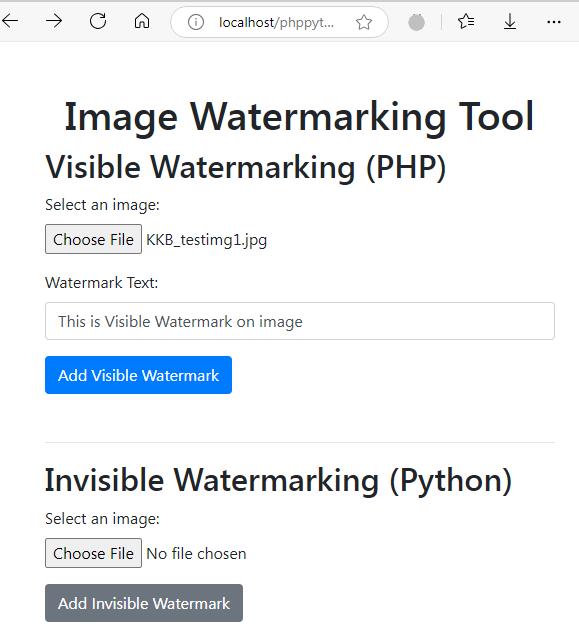
Fig-1: UI to Implementing watermarking (Php/Py)
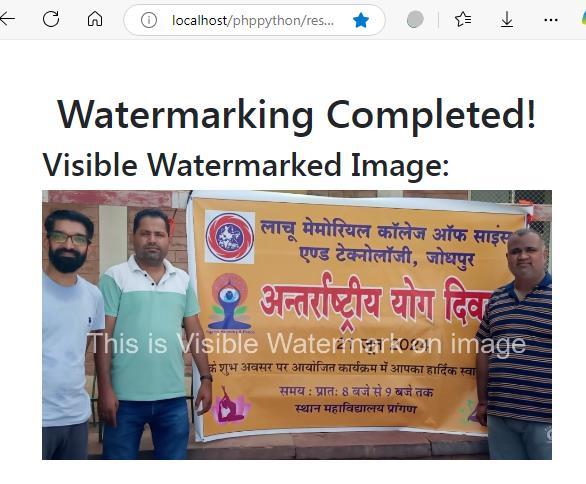
4.1.2 Python Code for Text Watermarking
ClickHere: Github Link : /WatermarkingByPython.git
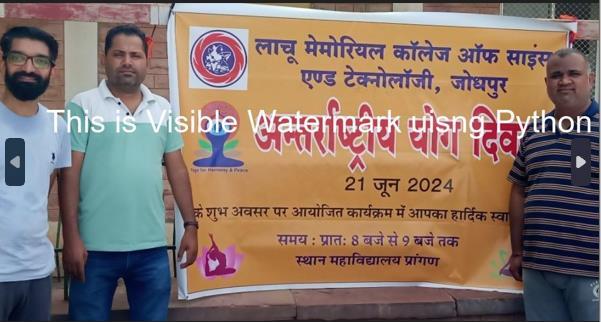
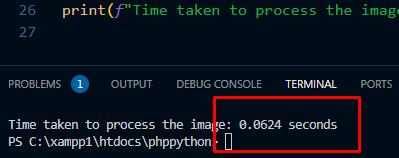
Time taken to embed watermark on image
4.2 Invisible Watermarking Code
Python Code for Invisible Embedding Watermarking and Extraction with DCT
Embedding an Invisible Watermark:
DCT Transformation is applied to embed the watermarkbyalteringtheDCTcoefficients.
Watermark Extraction reads the modified DCT coefficients, recovering the embedded characters. (Begum&Uddin,2020)
International Research Journal of Engineering and Technology (IRJET) e-ISSN: 2395-0056
Volume: 11 Issue: 11 | Nov 2024 www.irjet.net p-ISSN: 2395-0072
The PHP implementation of visible watermarking leverages the GD library, which is efficient for basic image manipulations. It begins by loading the image using the imagecreatefromjpeg() function, which reads the image file into memory. The watermark text properties,suchasfontsizeandsemi-transparentwhite color, are defined using imagecolorallocatealpha(). The text's dimensions are calculated using imagettfbbox(), which helps determine the exact placement for the watermark.Bysubtractingthetextdimensionsfromthe image dimensions, the code ensures the text is positioned in the bottom-right corner, offset by 10 pixels. The imagettftext() function then rendersthetext directly onto the image. Finally, the modified image is saved using imagejpeg() with a specified compression level, and memory resources are freed with imagedestroy(). This process is straightforward and optimizedforquickexecutioninwebenvironments.
The Python implementation uses the Pillow library, a modern and flexible image-processing tool. The script starts by loading the image with Image.open() and creating a Draw object to facilitate text rendering. The watermark textis definedalong with itsfont properties using ImageFont.truetype(), which supports TrueType fonts. The textbbox() method calculates the text’s bounding box, enabling precise positioning of the watermark. The coordinates for placing the text are adjustedsothatitappearsnearthebottom-rightcorner withanadditionalverticaloffsetof300pixelsforbetter visibility.Thewatermarkisdrawnontotheimageusing the draw.text() function, which allows for specifying a semi-transparent color. The modified image is saved withtheimage.save()method.
Additionally, the implementation measures the time takentoprocess the image usingPython’stime module, highlighting its suitability for more complex imageprocessing workflows, albeit at a slightly slower speed comparedtoPHP.
The performance comparison of PHP's GD library, Python'sPillow,andPython'sOpenCVforaddingvisible watermarks to images highlights the differences in design philosophy, execution speed, and use cases of these tools. PHP's GD library emerged as the fastest, with a processing time of 0.0195 seconds. This speed can be attributed to GD's low-level nature and lightweight implementation, which is written in C and tightly integrated into PHP. It is specifically optimized for basic image manipulations, with minimal overhead fortaskslikeloading,renderingtext,andsavingimages.
In contrast, Python's Pillow library, while slower at 0.0624 seconds, offers a higher-level interface and is built on top of the Python Imaging Library (PIL). This additional abstraction introduces some performance overhead but also provides a more user-friendly and extensible framework for developers. OpenCV, a library designed for complex and advanced image processing, takes significantly longer around 2 seconds because of the comprehensive initialization it performs and its focus on more robust, detailed operations. Its text rendering, while highly customizable, is not optimized for quick, lightweight tasks like adding simple watermarks.
The difference in execution speed between PHP and Pythoncanalsobeunderstoodthroughtheirunderlying architectures and resource management. PHP's GD library directly interfaces with low-level graphics operations, ensuring efficient handling of small-scale tasks like watermarking. Its simplicity and integration with PHP make it ideal for web applications where dynamic content needs to be generated quickly. On the otherhand,Python'sinterpretednatureinherentlyadds processing overhead. Pillow, being a high-level library, introduces further abstraction, which, while making code easier to write and maintain, affects raw performance. OpenCV's focus on versatility and advanced capabilities leads to a heavier footprint, making it better suited for applications requiring compleximageanalysesratherthanquickmodifications.
GD is the clear choice for performance-critical tasks in web environments, Pillow is more appropriate for standalone image-processing workflows where flexibility and functionality are prioritized. OpenCV is reservedfortasksdemandinghighcomputationalpower and advanced features, such as real-time video processing or machine vision applications. Ultimately, thechoiceoflibrary dependson the use case, balancing speed, simplicity, and the complexity of the required operations.
When the provided PHP and Python watermarking codes are applied to 100 images of varying formats, resolutions, and complexities, the results and analysis can be summarized based on performance, compatibility, and use cases. Here's a detailed breakdown:
PHP Implementation:
Speed: PHP’s GD library is optimized for speed, so processing 100 images would be significantly faster
International Research Journal of Engineering and Technology (IRJET) e-ISSN: 2395-0056
Volume: 11 Issue: 11 | Nov 2024 www.irjet.net p-ISSN: 2395-0072
compared to Python. For example, if it takes approximately 0.0195 seconds per image, all 100 images would be processed in about 2 seconds. Output Quality: The output images will have consistent watermark placement, as the GD library handles positioning and rendering efficiently. Compatibility: Limited to formats supported by GD (JPEG,PNG,GIF),andmaynothandlehigh-resolution or non-standard image formats as effectively as Python.
Python Implementation (Pillow):
Speed: At an average processing time of 0.0624 secondsperimage,Pillowwouldtakeapproximately 67 seconds to watermark 100 images. This is slower than PHP but still reasonable for batch processing Output Quality: Pillowprovidesexcellentcontrolover font rendering and color management, resulting in high-qualitywatermarks.Itsupportstransparencyand complex font styles, ensuring visually appealing results. Compatibility: Supports a wider range of image formats (JPEG, PNG, BMP, TIFF, etc.), making it more versatile for handling diverse images. It also performswellwithhigh-resolutionimages.
Challenges with Both Approaches:
o High-Resolution Images: Processing large images(e.g.,4Kresolution) mayrequiremorememory andprocessingtime.
o Transparency Issues: If some images lack an alpha channel, transparency settings might behave differently.
o Text Visibility: Depending on the image's background color or texture, the watermark text's visibility might vary, potentially requiring dynamic coloradjustments.
Performance Analysis:
PHP GD:
Excels in batch processing due to its lightweight architecture.
The speed remains consistent across all supported formats but may degrade slightly with high-resolution imagesorcomplexfiletypes.
Python Pillow:
SlightlyslowerthanPHPGDduetoPython’sinterpreted natureandPillow’shigher-levelabstraction.
Processing time may increase for high-resolution or complex images but offers better customization and control.
Flexibility and Compatibility:
PHP GD is less flexible, primarily limited to web-friendly formats like JPEG and PNG. Customization options for fontsandcoloursareavailablebutbasic.Pillowsupportsa wider range of formats and offers more control over watermark styling, making it ideal for diverse image processingtasks.
Scalability:
PHP GD is better suited for servers processing real-time requests for web applications. Pillow, though slower, is more reliable for offline or bulk processing tasks where high-qualityresultsandformatversatilityarecritical.
Quality Analysis:
PHP’s GD library may slightly compromise output quality, especially for high-resolution images, due to its focus on speed over quality. Pillow ensures high-quality watermarks with better anti-aliasing and transparency effects,suitableforprofessionalimageprocessing.
PHP GD is ideal for speed-critical tasks, such as adding watermarkstoimagesonawebserver,asitislightweight, fast, and well-suited for common formats like JPEG and PNG.Ontheotherhand, Python’s Pillow library isbetter suited for offline batch processing of images, particularly whenhandlingdiverseformatsorhigh-resolutionimages. While Pillow is slower due to its higher-level abstraction andPython'sinterpretednature,itofferssuperiorquality, flexibility, and customization options, making it ideal for professional image-processing tasks where quality is prioritizedoverspeed.
6.1
PHP: Efficient for visible watermarking in web applications but lacks support for invisible watermarking and extraction due to limited transformationtools.
Python: Suitable for both visible and invisible watermarking. Libraries like OpenCV make it possible to embed and extract invisible watermarks.
A comparison was performed by processing 100 images with both PHP and Python for visible
International Research Journal of Engineering and Technology (IRJET) e-ISSN: 2395-0056
Volume: 11 Issue: 11 | Nov 2024 www.irjet.net p-ISSN: 2395-0072
watermarking. For invisible watermarking and extraction,onlyPythonwastested.
PHP Visible Watermarking 0.0195seconds
Python(Pillow) Visible Watermarking 0.0624seconds
Python(OpenCV) Invisible Watermarking 2.0seconds
Table 1: Comparing with different languages/Library
6.3 Flexibility
Python,withlibrarieslikeOpenCV,offersflexibilityfor bothvisibleandinvisiblewatermarkingandextraction in comparison to Pillow of Python. PHP’s GD library is effective for basic visible watermarking but is limited in invisible watermarking techniques and extraction capabilities.
ThisstudyshowsthatPHPandPythoneachoffervaluable toolsforimagewatermarking,withPHPbeingparticularly well-suited for visible watermarking in web applications, thanks to its GD library, which enables dynamic watermarking of user-uploaded images. In contrast, Python, with libraries like OpenCV, excels in both visible andinvisiblewatermarkingandextraction,makingitideal for standalone applications that require advanced image processingcapabilities,suchasdigital rightsmanagement (DRM) and image tracking. However, challenges arise in invisible watermarking, as it necessitates frequency transformations not supported by PHP's GD library; in Python, DCT-based watermarking requires careful management of coefficients to avoid visible distortion whileensuringthewatermarkremainsextractable.
[1] (n.d.). Retrieved from Image Processing OpenCV Vs PIL - GeeksforGeeks: https://www.geeksforgeeks.org/image-processingopencv-vs-pil/
[2] (n.d.). Retrieved from PHP: Installation - Manual: https://www.php.net/manual/en/image.installation.p hp
[3] (n.d.). Retrieved from pillow · PyPI: https://pypi.org/project/pillow/
[4] (n.d.). Retrieved from opencv-python · PyPI: https://pypi.org/project/opencv-python/
[5] Ansari, S. A. (2019). 2019 Intellectual Property Rights and The Digital World. International Journal of Legal ScienceandInnovation
[6] Arifin, S., Nicholas, A., Suwarno, Baskoroputro, H., Faisal,Setyo,A.P.,...Rahayu,A.(2023).Algorithmfor Digital ImageEncryptionUsingMultiple Hill Ciphers,a Unimodular Matrix and Logistic Map. International Journal of INTELLIGENT SYSTEMS AND APPLICATIONS INENGINEERING,311-324.
[7] Begum, M., & Uddin, M. S. (2020). Digital Image Watermarking Techniques: A Review. doi:doi:10.3390/info11020110
[8] Hiding Information in Digital Images Using LSB Steganography Technique. (2023). International Journal of Interactive Mobile Technologies, 167-178. doi:10.3991/ijim.v17i07.38737
[9] Image hiding by using spatial domain steganography. (2023). Wasit Journal of Computer and Mathematics Science, 25-29. doi:https://doi.org/10.31185/wjcm.110
[10] Sharma, S., Zou, J. J., Fang, G., Shukla, P., & Cai, W. (2023). A review of image watermarking for identity protection and verification. Multimedia Tools and Applications. doi:https://doi.org/10.1007/s11042023-16843-3
[11] The Evolution of Intellectual Property Rights in the Digital Age. (2023). Journal of Modern Law and Policy.
[12] Fig-1:UItoImplementingwatermarking(Php/Py)
[13]
Fig-2VisiblewatermarkedimagebyPHP
[14] Fig-3VisiblewatermarkedimagebyPython
[15] Fig-4:Timetakentoembedwatermarkonimage
[16]
Table1:Comparingwithdifferent languages/Library
BIOGRAPHIES


Dr. Krishna Kumar Bohra, PhD in Digital Watermarking (Computer Applications), Assistant Professor, Faculty of Computer Science, Lachoo Memorial College of Science &
International Research Journal of Engineering and Technology (IRJET) e-ISSN: 2395-0056
Volume: 11 Issue: 11 | Nov 2024 www.irjet.net p-ISSN: 2395-0072
Technology, Jodhpur. I have an interest in Web Architecture and Computer Vision (Watermarking)

Rajni Verma, Pursuing PhD. In Computer Applications, Assistant Professor, Faculty of Computer Science,LachooMemorialCollege ofScience&Technology,Jodhpur. Having an interest in ProgrammingLanguages. o
© 2024, IRJET | Impact Factor value: 8.226 | ISO 9001:2008 Certified
|