
International Research Journal of Engineering and Technology (IRJET) e-ISSN: 2395-0056
Volume: 11 Issue: 11 | Nov 2024 www.irjet.net p-ISSN: 2395-0072

International Research Journal of Engineering and Technology (IRJET) e-ISSN: 2395-0056
Volume: 11 Issue: 11 | Nov 2024 www.irjet.net p-ISSN: 2395-0072
Mayank Singh1, Bhoj Ram Sahu2
1Mtech Scholar, Department of Civil Engineering, Bharti Vishwavidyalaya Durg (Chhattisgarh), 2Assistant Professor, Department of Civil Engineering, Bharti Vishwavidyalaya Durg (Chhattisgarh)
Abstract - Concrete, the world's second most used buildingmaterial,isknownforitsgreatcompressive,tensile, andflexuralstrength.Self-curingconcreteisanalternativeto immersion that avoids water limitations. This study investigatestheeffectsofaddingpolyethyleneglycol-400to an M-30 grade concrete mix during internal curing. This approachisutilizedwhenoutdoorcuringisnotanoption, such as in places with restricted water supply or human access.Self-curingiscriticalfordevelopingconcrete'spore structure and microstructure, whereas water curing is requiredtopreventunwantedqualities.Thestudy'sgoalis todiscoverthebestamountofpolyethyleneglycol-400asa 0%, 05%, 1%, and 1.5% for self-curing, resulting in highqualitycuring.
Keywords: Slump cone test, PEG-400 self-curing agent, compares the compressive, tensile, and flexural strength selfcuring concrete, regular concrete.
1. INTRODUCTION
Concrete constructions require adequate curing to meet performanceanddurabilitystandards.Conventionalcuring requiresexteriorcuringaftermixing,putting,andfinishing, whereas self-curing or internal curing adds moisture for effectivecementhydration.Concreteisthemostextensively used building material due to its low cost, strength, and durability. It is suitable for bridges, highways, and infrastructure. Concrete's versatility and strength make it ideal for a variety of construction applications. New admixtures can increase the workability and strength of concrete.
1.1 Curing: the process of controlling moisture transfer from concrete during cement hydration. It can be done duringtheproductionprocessoraftertheconcretehasbeen laid. Curing time is critical for concrete strength and durability since it takes days or weeks to hydrate. Temperature management is also important in curing because it affects the cement's hydration rate. The basic purpose of curing is to keep the moisture content of the concreteconstantwhilereinforcingit.
1.2 Self-curing and its necessity: Self-curing is a way of increasingconcrete'swatercapacitywhiledecreasingwater lossascomparedtonormalconcrete.PEG-400isutilizedto dothissinceitminimizeswaterlosswhileincreasingwater
capacity.Self-curingcompoundscanbecreatedfromwatersoluble polymers, unlike conventional concrete, which requiresexternalcuringforstrength.Thepolymersestablish hydrogen bonds with water molecules, lowering their chemical potential and vapor pressure, so slowing evaporationfromthesurface.Properhydrationiscriticalfor meeting durability requirements in cement concrete projects.
1.3 Process and Mechanism of self-curing or internal curing: The process of releasing water from an exposed surface due to the presence of hydrogen and oxygen is knownasself-curingorinternalcuring.Thismethodslows the chemical reaction and reduces the pace of concrete evaporation.Theoxygenintheatmospherecombineswith thehydrogentomakewater.Moistureevaporatesfroman exposed surface due to chemical changes, resulting in cement hydration and shrinkage. This leaves empty holes andreducesrelativehumidity,allowingthecementpasteto self-desiccateandformmicrocracksandcapillarypores.Selfcuring inhibits self-desiccation while maintaining relative humidity. Maintaining the moisture content is critical becausecementhydrationbecomesineffectivewhenrelative humiditygoesbelow80%.
2.0 LITRATURE REVIEW:
Singh G et al. (2021) discoveredthatincreasingthe doseoftheself-curingchemicalPEG-400increases the workability and performance of M30 grade concrete, resulting in greater compressive, split tensile,andflexuralstrengths.
Azhagarsamy and Sundaraman's 2016 studyon thestrengthanddurabilityofM20gradeconcrete usingwater-solublepolyethyleneglycol(PEG400) as a self-curing agent discovered that self-curing concrete had an average increase of 12.73% in compressive strength and 13.31% in split tensile strength, indicating superior performance over conventionalconcrete.
Tyagi's 2015 studylookedattheusageofPEG-400 in concrete at various quantities (0.5-2%). The study examined M25 and M40 grades of OPC cement in accordance with IS 12269-1987. The optimumvaluesforM40gradewere0.5%and1% for M25 grade PEG-400, enhancing concrete strengthanddurability.
International Research Journal of Engineering and Technology (IRJET) e-ISSN: 2395-0056
Volume: 10 Issue: 03 | Mar 2024 www.irjet.net p-ISSN: 2395-0072
M-30-grade concrete contains 1% PEG-400 as an optimum dosage for self-curing concrete by the weight of cement to provide strength without compromisingworkability.
ToexaminetheimpactofPEG-400,thecuringagent, onthestrengthpropertiesoftheconcrete.
Analyze the concrete's compressive, tensile and flexuralstrengths.Basedontheinformation,draw conclusionsregardingthecompressive,tensile,and flexural strengths of conventional and self-curing concrete.
Our project's primary goal is to produce concrete withlesswaterwhilemaintainingitssimplicityof useandstrength-boostingproperties.
4.1 Polyethylene glycol (PEG)-400: Polyethylene glycol (PEG) is a condensation polymer that serves as a nonirritating,lubricating,non-volatile,odorless,andnon-toxic additive in concrete. It dissolves quickly in a variety of solventsandiswidelyutilizedinsanitaryapplications.PEGn,acombinationofethyleneoxideandwater,retainswater particlesinconcretebyproducingathinshellaroundthem. Thishelpstopreservewaterbyloweringevaporationrates and minimizing the requirement for external curing. Additionally, it minimizes shrinkage in concrete. PEG is benign,withadensityof1.13g/cm3andaslightodor
Table-1 Properties of PEG-400
Properties of (PEG-400)
400gr/mol pH >6-7
H(OCH2CH2)nOH
1.13gr/cm3 Specific-gravity 1.12at27_Ċ
4.2 Fine aggregate: Theexperimentemployednaturalriver sand with a maximum size of 4.75 mm as fine aggregate. Sand zone II, which was accessible locally, had a specific gravity of 2.51, a fineness modulus of 2.7, and a water absorptionof1.19%,supportingI.S.383-1970.
4.3 Coarse aggregate: A significant portion (30–40%) of coarse-particle concrete is void. crushed granite stone, 20 mmisthenominalsizeoftheaggregateusedinconstruction withaspecificgravityof2.65andafinenessmodulusof2.7, as per I.S. 383-1970. In the construction process, this substanceisessential.
4.4 Water: Thehydrationofconcretewithwaterdetermines its strength and workability. It is critical to utilize water judiciously, as too much water might induce segregation.
Waterisrequiredforconcrete'schemicalinteractionwith cement. An experimental operation employed portable waterthatmetIS456-2000criteriaformixingandcuring, ensuringthatthepHlevelwasmaintained.
Test data of material:
Specificgravityofcement=3.130
Specificgravityofcoarseaggregate=2.651
Specificgravityoffineaggregate=2.511
Waterabsorptionofcoarseaggregate=0.989
Waterabsorptionforfineaggregate=1.191
Initialsettingtimeofcement=32min
Finalsettingtime=420min
Consistencyofcement=32%
Typeofaggregate=uniformlygradedaggregate.
Mix design for M-30 grade conventional concrete: Mixdesignby(IS10262-2019)
(A)Design Required:
1.Gradeofconcrete-M30(asperISCode10262:2019)
2.Cement–OPC-53Grade
3.FineAggregate-ZoneII
4.CoarseAggregate–20mmNominalsize
5.SlumpValue–75mm(IScode456:2000)
6.ConditionofExposure–Severe
7. Degreeofsitecontrol=Good
8. Workability=75mm
9. Methodofconcreteplacing=manual
10.Watercementratio=0.45
11.Watercontent=191.58kg/m3
12.Minimumcementcontent=320kg/m3
C) Target mean strength:
f’ck = fck+ 1.65xS
f’ck =30+(1.65x5)
f’ck =38.25N/mm2
OR
f’ck = fck+ X
f’ck =30+6.5
f’ck =36.50N/mm2
where S= standard deviation (Table -8 IS Code 456:2000, Clause9.2.4.2)X=factorbasedongradeofconcrete.Asper IScode10262:2019
D) Approximate air Content: For 20 mm nominal maximum size of aggregate 1.0%. As per IS 10262:2019
Table3Clause5.2
E) Cement Content =425.73kg/m3
F) Calculation of Coarse and fine aggregate content: AsperISCode10262(2019),Table-5,Clause5.5Table-4
SizeofCoarseAggregate=20mm
SizeofFineaggregate=4.75mm
Volumeofcoarseaggregate=0.62
Corrected proportion of volume of coarse aggregate = 0.01+0.62=0.63
International Research Journal of Engineering and Technology (IRJET) e-ISSN: 2395-0056
Volume: 10 Issue: 03 | Mar 2024 www.irjet.net p-ISSN: 2395-0072
Volumeoffineaggregate=1-0.63=0.37
G) Mix Design:
i. VolumeofConcrete=1m3
ii. Volumeofcement=0.13601m3
iii. Volumeofwater =0.19158m3
iv. Volumeofallaggregate=0.6625m3
v. Weightofcoarseaggregate=1106.04kg
vi. Weightoffineaggregate=615.26kg
H) Site Correction:
(i)Absorptionoffineaggregate=1.191% =(1.191/100)×615.26 =7.327lt.
(ii)Absorptionofcoarseaggregate=0.989% =(0.989/100)×1106.04 =10.831lt.
Totalabsorptions=18.154lt.
(iii)Actualamountofwatertobeused=191.50+18.154 =209.654lt.
(iv)Actualweightoffineaggregatetobeused=615.26-7.32 =607.94kg.
(v)Actualweightofcoarseaggregate=1106.04-10.83 =1095.21kg
Table-02 mix proportion of conventional concrete after site correction
Table -03 Mix proportion of internal curing concrete after site correction
4.5 Casting Schedule:
CastingofthespecimensweredoneasperIS:10086-1982,
Table No: 4 Mix proportion
4.6 Test on Concrete:
Slump cone test: There is a concrete workability test becauseconcretecanbemixed,transported,andusedina specificapplication.Themostpopularmethodforassessing workability is the slump test. It doesn't measure every elementthataffectsworkability.
I) Mix Design of concrete with PEG-400 as a self-curing concrete:
Adding 1% of PEG-400 Admixture by weight of cement:
Cement=425.73kg/m3
Cementcontent=425.73-4.257=421.48kg/m3
Mix Design:
Volumeofcement=0.134m3
Volumeofwater=0.19158m3
VolumeofPEG-400=0.0037m3
Volumeoftotalaggregate=0.6613m3
Weightofcoarseaggregate=1104.04kg
Weightoffineaggregate=614.149kg
Site Correction:
Absorptionoffineaggregate=7.32lt.
Absorptionofcoarseaggregate=10.83lt.
Totalabsorptions=18.15lt.
Actualamountofwatertobeused=209.65lt.
Actualweightoffineaggregateto=606.82kg.
Actualweightofcoarseaggregate=1093.21kg
TABLE-5 Slump Values of conventional Concrete and Self curing concrete
International Research Journal of Engineering and Technology (IRJET) e-ISSN: 2395-0056
Volume: 10 Issue: 03 | Mar 2024 www.irjet.net p-ISSN: 2395-0072
TABLE-6 compressive strength values of conventional Concrete and Internal cured concrete
Chart-1 Slump cone test of conventional concrete vs self-curing concrete
4.7 Casting of Cube, Beam and Cylinder:
The strength parameters of self-cured concrete were compared with conventional cured concrete at 7days, 14daysand28days.
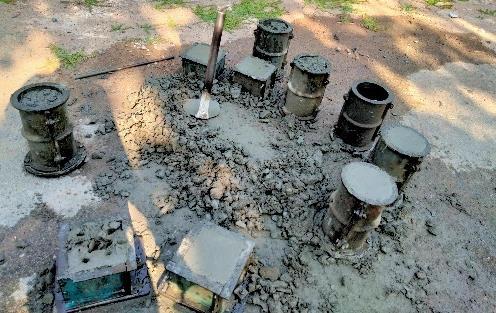
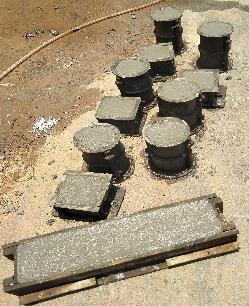
Fig-01 Casting process of concrete for beam cube and cylinder
4.8 Compressive Strength Test:
Casted concrete cube 150×150×150mm size and it was testedfor7,14and28days.
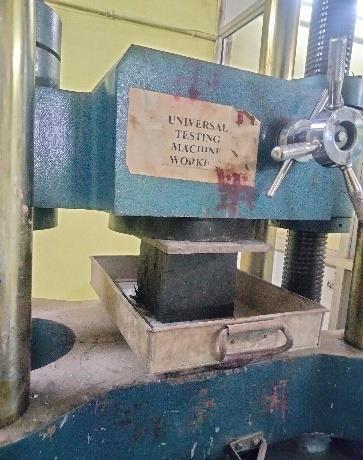
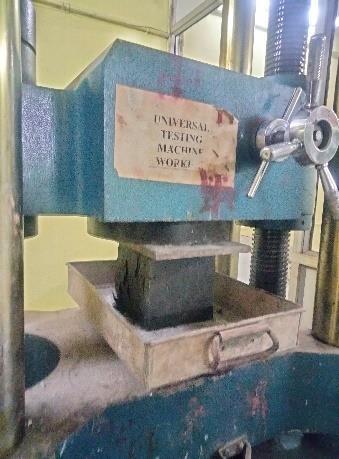
Fig -02 Compressive strength test of concrete cube in UTM
CompressiveStrengthofM-30GradeConcrete.

Chart-02compressivestrengthbehaviourofconventional concreteafter7,14and28-daysvsSelfcuringconcrete.
Split tensile strength test of concrete:
Thestudyexaminedsplittensilestrengthutilizing150mm diameterand300mmheightcylinderscastandtestedover7, 14,and28daysusingauniversaltestingequipmentwitha 2000KNcapability.
International Research Journal of Engineering and Technology (IRJET) e-ISSN: 2395-0056
Volume: 10 Issue: 03 | Mar 2024 www.irjet.net
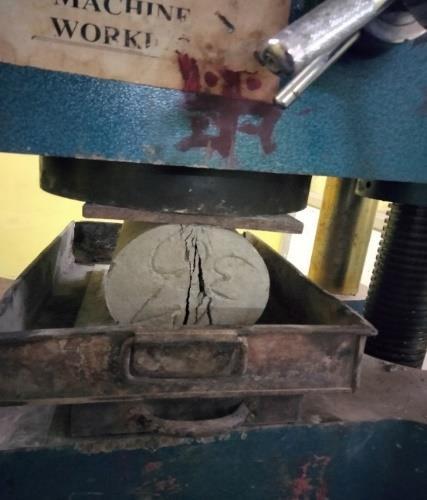
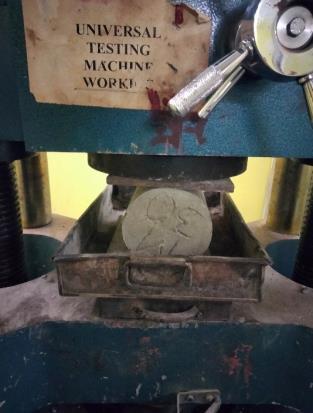
TABLE-7tensilestrengthresultof
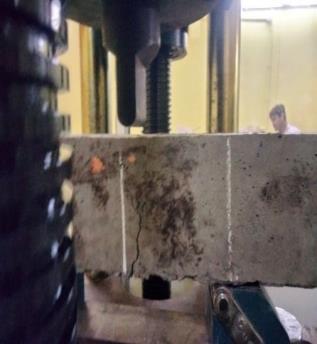
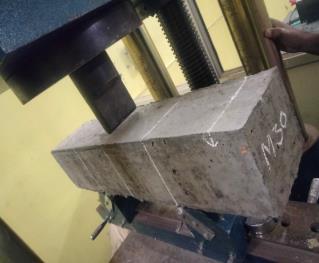
-04Flexuralstrengthtestofconcretebeam.
TABLE-8tstrengthresultof

Chart3Tensilestrengthbehaviourofconventional concreteafter7,14and28-daysvsSelfcuringconcrete.
Thebeamspecimenofsize150×150×700mmistestedon universal testing machine with a2000 KN load for point loadingtocreateapurebending.Observedthatthestrength oftheconcretemixat7,14,and28days.fstrength=WL/bd2

Chart4Flexuralstrengthbehaviourofconventional concreteafter7,14and28-daysvsSelfcuringconcrete.
3. CONCLUSIONS
1. TheaforementionedresultindicatesthatPEG-400 achieves 1% of the mix-30's compressive, tensile, andflexuralstrengths.
2. Chemical admixtures are advised in order to producehigh-qualityconcrete.
International Research Journal of Engineering and Technology (IRJET) e-ISSN: 2395-0056
Volume: 10 Issue: 03 | Mar 2024 www.irjet.net p-ISSN: 2395-0072
3. Using self-curing PEG-400 concrete instead of traditionalconcretecuringattheagesof7and28 resulted in an average increase in compressive strengthof11.99%and12.77%,respectively.
4. Thereisasignificantexpansionintheconstruction sector,whichleadstomoreconstructionactivities. Theconstructionindustryalsousesalotofwater, and the curing process wastes more water every day. The use of alternative methods, such as selfcuring mechanisms, is required to attain sustainabilityinwatermanagement.
5. The self-healing mechanism lowers the need for labor and is advantageous when used in areas wherethereisashortageofwater.
6. Utilizing PEG-400 was determined to be the superiorchoiceinordertoproduceinternallycured concretewithoutsacrificingitsstrength.Allofthe water required for curing can be saved because internal cured concrete doesn't need a curing process.
SCOPE OF RESEARCHS
Thechemicaladditionneedstomaketheconcrete moreworkable.
tocontrastthestrengthcharacteristicsofconcrete producedusingacuringcompound polyethylene glycol with concrete produced using traditional curing.
Calculatetheconcrete'srelativehumidity.
[1]M.Lokeshwari,B.R.PavanBandakli,S.R.Tarun,P.Sachin, VenkatKum.arUnderGraduateStudents,“Areviewonselfcuring concrete” Department of Civil Engineering, R V CollegeofEngineering,Bengaluru,Karnataka,India.
[2] Wen-Chen Jau, ‘‘Self-Curing Concrete” United States Patent Application Publication, (2008), Pub. No: U.S. 2008/0072799A1.
[3]EL-DIEBA.2007.Self-curingconcrete:Waterretention, hydrationandmoisturetransport.ConstructionandBuilding Materials.21,1282-1287.
[4]D.S.Vijayan,S.Aravindan,D.Parthiban,R.SanjayKumar, B.Saravanan, YumnamRobert “An experimental study on mechanicalanddurablepropertiesofself-curingconcreteby adding admixture Department of Civil Engineering, AarupadaiVeeduInstituteofTechnology,VinayakaMissions ResearchFoundation,Paiyanoor,Chennai603104,India
[5] Prakash Mandiwal1, Sagar Jamle2 Useof Polyethylene Glycol as Self Curing Agent in Self Curing Concrete an ExperimentalApproachM.Tech.Scholar,DepartmentofCivil Engineering, Oriental University, Indore, M.P., India 2Assistant Professor, Department of Civil Engineering, OrientalUniversity,Indore,M.P.,India.
[6]ShikhaTyagi,(2015),“AnExperimentalInvestigationof SelfCuringConcreteIncorporatedwithPolyethyleneGlycol as Self Curing Agent”, International Research Journal of EngineeringandTechnology(IRJET),Vol.2,Issue6, ISSN: 2395-0056,pp.129-132.
[7]IS10262:2009RecommendedGuidelinesforConcreteMix DesignBureauofIndianstandardNewDelhi.
[8]BureauofIndianStandardsIS516:1959MethodsofTests forStrengthofConcrete.
[9]IndianStandardcode456:2000ofpracticeforgeneral structuraluseofplainandreinforcedconcrete.
[10]Methodoftestsforstrengthofconcrete.Specificationfor 53gradeordinaryPortlandcement.
[11] Sathanandham, Gobinath, Preliminary Studies of Self Curing Concrete with The Addition of Polyethylene Glycol InternationalJournalofEngineeringResearch&Technology (IJERT)Vol.2Issue11,November–2013.
[12] Dieb A.S, “Self-curing concrete: Water retention, hydrationandmoisturetransport,ConstructionandBuilding Materialsjournal,2007,Vol21,pp1282-1287.
[13]M.V.JagannathaKumar,M.Srikant,K.JagannadhaRao, ‘Strengthcharacteristicsofself-curingconcrete”.
[14] IS 383:1970 Code for fine and coarse aggregate for concrete.
[15] Concrete Technology: Theory and Practice by M. S. Shetty.
[16] Concrete Technology: Theory and Practice by M. L Gambhir.
[17]ConcreteTechnology:byS.S.Bhavikatti.