
International Research Journal of Engineering and Technology (IRJET) e-ISSN: 2395-0056
Volume: 11 Issue: 11 | Nov 2024 www.irjet.net p-ISSN: 2395-0072

International Research Journal of Engineering and Technology (IRJET) e-ISSN: 2395-0056
Volume: 11 Issue: 11 | Nov 2024 www.irjet.net p-ISSN: 2395-0072
Maria Sobana.S1, Krishna Veni.M2, Mirsha Shelyn.J3, Nagarani.V.O4
1Assistant Professor, Department of Computer Science and Engineering, K.L.N. College of Engineering, Sivagangai, India 2,3,4Student, Department of Computer Science and Engineering, K.L.N. College of Engineering, Sivagangai, India
Abstract - Recognizing and predicting human activities in smart homes is increasingly important for enhancing resident’squalityoflifeandsafety.Onekeyfeatureofsmart home systems is the abilitytorecognize humanactivities in real-time, enabling automation, improving energy efficiency, and offering personalized assistance. This model introduces a method for real-time human activity recognition using the K-Nearest Neighbors (K-NN) algorithm in a smart home environment. Sensor data from various sources, such as motion, pressure, temperature and sound sensors is collected to identify and classify different activities performed by residents. The K-NN algorithm is chosen for its simplicity, robustness, and effectiveness in handling multi-dimensional data. By analyzing patterns in sensordata,thesystemaccuratelypredictsactivitiessuchas walking, sitting, cooking and falling. The process includes sensor data collection, data preprocessing, feature extraction, and the implementation of K-NN for classification.Thesystemsperformanceisevaluatedusinga dataset collected from a simulated smart home, demonstrating high accuracy in real-time activity recognition. This approach is particularly useful for applications like elderly care where understanding and predicting human behavior is critical for ensuring safety andefficiency.
Key Words: Real-Time Human Activity Recognition, Machine Learning, Sensors, KNN Algorithm, Elderly Care.
Smart home technologies play a crucial role in enhancing the quality of life for elderly individuals living alone, addressing the growing need for remote monitoring solutions due to the challenges faced by youngsters who live far from their elderly parents. In this context, the proposed system leverages the K-Nearest Neighbors (KNN)algorithmforreal-timeHumanActivityRecognition (HAR) in smart homes. By analyzing sensor data, the systemeffectivelyclassifiesa rangeofactivities,including walking, sitting, sudden falls etc. The primary objective is toensurethesafetyofelderlyindividualswhileproviding peace of mind to their family members through real-time updatesontheirelderlypeopleactivities
The motionsensordetectsany physical movement within a defined area. This is crucial for tracking whether an individual is active or stationary, enabling the system to monitor daily activities such as walking, entering or exiting a room, or detecting prolonged inactivity. By identifying these movements, the motion sensor helps in distinguishing between regular behaviors and potential concerns.Thesesensorsaretypicallyplacedinhigh-traffic areaslikehallways,livingrooms,orentryways tocapture comprehensivemovementdataacrossthehome.
Apressuresensormeasurestheforceorweightappliedto a surface, making it especially useful for determining whether a person is sitting, standing, or lying down. For example,itcandetectwhensomeonesitsonachairorlies on a bed, providing valuable information for recognizing regularactivities,suchasrestorrelaxation,andabnormal events like sudden collapses. These sensors are often placed on chairs, beds, or on the floor in key locations whereindividualsfrequentlysitorliedown.Thishelpsthe system track important behavioral patterns and detect irregularitiesinposture.
The temperature sensor continuously monitors the ambienttemperatureinvariousareasofthehome.Thisis useful for detecting environmental changes that may indicate specific activities, such as an increase in temperature when someone is cooking or using an appliance,orasuddendropwhenawindowisleftopenor if the heating system fails. In elderly care, this sensor can alsodetectchangesinroomtemperaturethatmayimpact theindividual'scomfortorhealth,suchasextremecoldor heat, which could signal a dangerous situation. These sensors are typically placed in living areas, kitchens, or other rooms where temperature changes are critical to monitor.
International Research Journal of Engineering and Technology (IRJET) e-ISSN: 2395-0056
Volume: 11 Issue: 11 | Nov 2024 www.irjet.net p-ISSN: 2395-0072
Soundsensorsdetectvariationsin noiselevels,whichcan be helpful in identifying irregularities like shouting, banging, or sudden noises that may indicate distress or emergencies. They can detect sounds associated with normal conversations, television noise, or sudden outburstsofnoisethatcouldsignalafalloracryforhelp. Soundsensorscomplementothersensorsbyprovidingan auditory layer of context that enhances the system’s responsivenesstopotentialemergencies.Theyareusually placed in living rooms, bedrooms, or other areas where noiselevelscouldindicateactivityorconcern.
The existing system for activity recognition employs six different machine learning algorithms, including SVM, KNN, Random Forest, Logistic Regression, MLP, and Decision Tree. While these algorithms aim to improve accuracy, the system becomes highly complex due to the integration of multiple models and sensor fusion, making theprocessresource-intensive.Despiteleveragingvarious models, the overall accuracy of activity recognition remains low, largely due to noise and inconsistencies in sensor data. Furthermore, the use of wearable devices, sensors,andcamerasintroducesprivacyconcerns,making the system less suitable for users who prioritize privacy. Additionally, the reliance on multiple algorithms and sensors demands significant computational power, resulting in slower processing times and higher operationalcosts.
The proposed system simplifies activity recognition by using only the K-Nearest Neighbors (KNN) algorithm, reducing complexity and resource requirements comparedtosystemswithmultiplealgorithms.Itrelieson non-intrusive sensors, such as motion, sound, pressure, and temperature sensors, ensuring privacy while improving accuracy through comprehensive sensor input. By avoiding cameras and focusing on fewer algorithms, thesystemismoreefficientandeasiertomanage.Correct coding practices and thorough testing ensure reliable outputs, making the system suitable for real-time monitoring of elderly activities with enhanced performanceandprivacy.
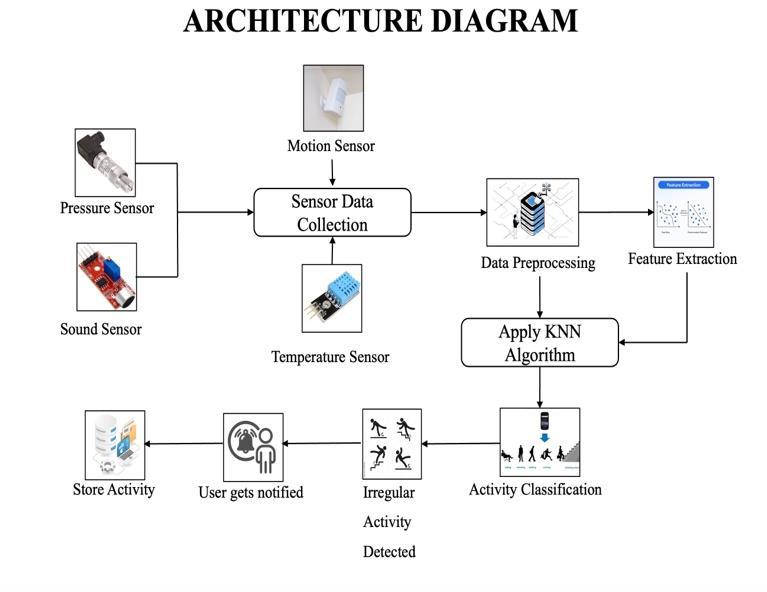
The system integrates various sensors - pressure, sound, motion, and temperature to provide comprehensive monitoringforsafetyinsmarthomes.Thepressuresensor detects changes in weight or force to recognize activities like sitting or lying down, while the sound sensor identifies sound variations that may indicate movements or disturbances. The motion sensor tracks activity or
inactivity, distinguishing between normal behaviors like walking and irregular ones like falling. The temperature sensor monitors environmental changes, helping detect activities such as cooking or potential emergencies. Data from these sensors is aggregated, cleaned, and processed toextractkeyfeatures,whicharethenclassifiedusingthe K-Nearest Neighbors (KNN) algorithm. This allows the system to differentiate between regular and irregular activities. If irregularities like falls or unusual sounds are detected, alerts are sent, and all activities are logged for futureanalysis,improvingsafetyanduserexperienceover time.
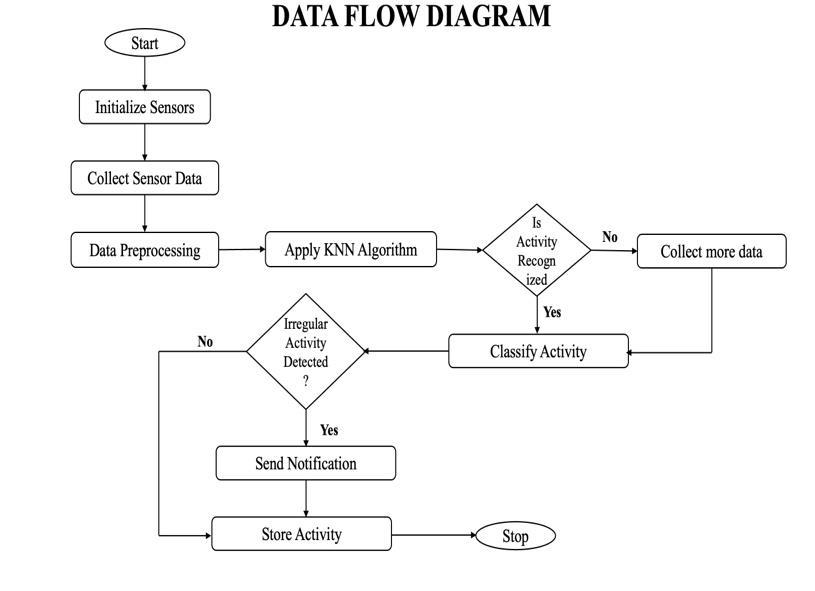
The system starts by initializing and preparing sensors, including motion, pressure, sound and temperature, to collectreal-timeenvironmentaldatainasmarthome.The sensors continuously gather information about the elderly's activities, which is then preprocessed to remove noiseandinconsistencies.Thiscleaneddataisfedintothe k-Nearest Neighbors (KNN) algorithm for activity classification. The system checks if the activity is recognized; if not, it collects more data to improve accuracy. Recognized activities are categorized into regular and irregular events, with notifications sent to caregiversifanirregularactivity,suchasafall,isdetected. Allactivitiesarestoredinthedatabaseforfutureanalysis, ensuring continuous monitoring and data flow unless reprocessingisrequired.
International Research Journal of Engineering and Technology (IRJET) e-ISSN: 2395-0056
Volume: 11 Issue: 11 | Nov 2024 www.irjet.net p-ISSN: 2395-0072
5.
DataCollection
DataPreprocessing
FeatureExtraction
ActivityRecognition
NotificationandStorage
5.1
The Data Collection forms the core of the system, connecting to various sensors strategically placed around the smart home environment. These sensors include motion, pressure, sound, and temperature sensors, each servinga distinctpurpose. Motionsensorsdetectphysical movement, helping identify activities like walking, sitting, or falling. Pressure sensors measure the force applied to surfaces, such as chairs or beds, to detect whether the individual is sitting or lying down. Sound sensors capture noise levels, detecting sounds such as shouting or sudden loud noises, which can be critical for identifying emergencies. Temperature sensors monitor room temperature, helping the system recognize activities like cooking or identify environmental changes that could affecttheelderlyperson’swell-being.Thecollecteddatais continuously transmitted to the microcontroller, ensuring that the system remains updated with real-time information. This module is essential for maintaining a continuousflowofdatafromthesensorstotheprocessing unit,allowingthesystemtomonitortheelderly'sactivities effectively.
5.2
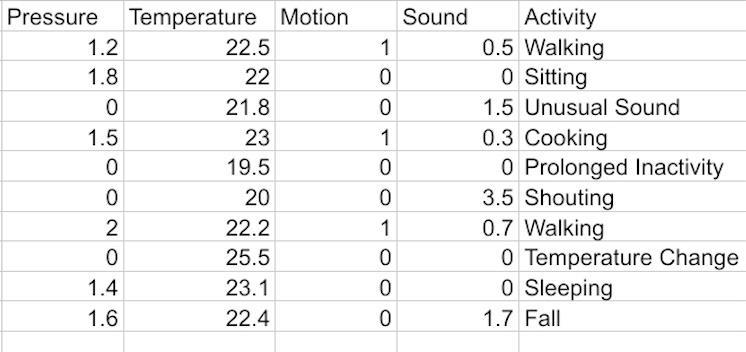
Once the raw sensor data is collected, the Data Preprocessing cleans and prepares it for analysis. This stage involves several important tasks to ensure the data is usable and accurate. First,noise removalis applied to filteroutanyirrelevantorerroneousreadings,whichmay occurduetosensormalfunctionsorexternalinterference. Next, the module handlesmissing values, filling in any gapswheresensordatamightbeincomplete,ensuringthe dataset is as complete as possible for analysis.Normalizationis another key function of this module, as different sensors produce data on varying scales. For example, temperature readings are on a different scale than pressure readings. Normalization adjusts the values so that they can be compared accurately. Finally, the module filters outirrelevant information, focusing only on the data directly related to activity recognition. This process results in a clean, consistent dataset, which is then passed on to the feature extractionmodule.Thisensuresthatthemachinelearning model receives high-quality input, leading to better performanceandmoreaccuratepredictions.
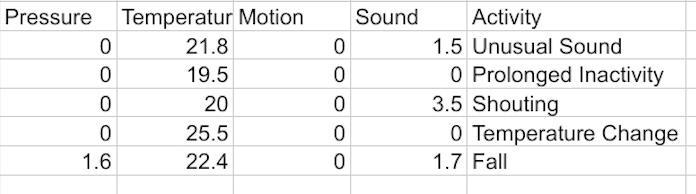
The Feature Extraction is responsible for identifying the mostrelevantpatternsfromthepreprocessedsensordata. ThisisacrucialstepbecausetheeffectivenessoftheKNN algorithm depends on the quality and relevance of the features extracted. The module analyzes the cleaned data and extracts key indicators of activities. For instance, it mightextractfeaturessuchasthefrequencyandduration of movementfrom the motion sensor,pressure changesfrom the pressure sensor,sound intensity patternsfrom the sound sensor, andtemperature
International Research Journal of Engineering and Technology (IRJET) e-ISSN: 2395-0056
Volume: 11 Issue: 11 | Nov 2024 www.irjet.net p-ISSN: 2395-0072
fluctuationsfrom the temperature sensor. These features encapsulate important aspects of the elderly’s behavior and are essential for distinguishing between different activities. The module also reduces thedimensionalityof the data by focusing on only the most important features, which improves the computational efficiency of the system. After extracting these features, the data is preparedforclassificationbytheKNNalgorithm,ensuring that the system can effectively differentiate between activitieslikewalking,sitting,orfalling.
The Activity Recognition is where the core classification process takes place. It uses theK-Nearest Neighbors (KNN)algorithmtoclassifyactivitiesbasedonthefeatures extractedfromthesensordata.TheKNNalgorithmworks by comparing the real-time data collected from the sensors with historical data that has been labelled as specific activities By analysing thedistance between data points, the algorithm can identify the most likely activity beingperformedatanygivenmoment.Thesimplicityand lowcomputationalcomplexityoftheKNNalgorithmmake it well-suited for real-time applications in smart homes. This module provides fast and accurate classifications by leveraginginputsfrommultiplesensors,ensuringthatthe systemcanmakereliablepredictions.


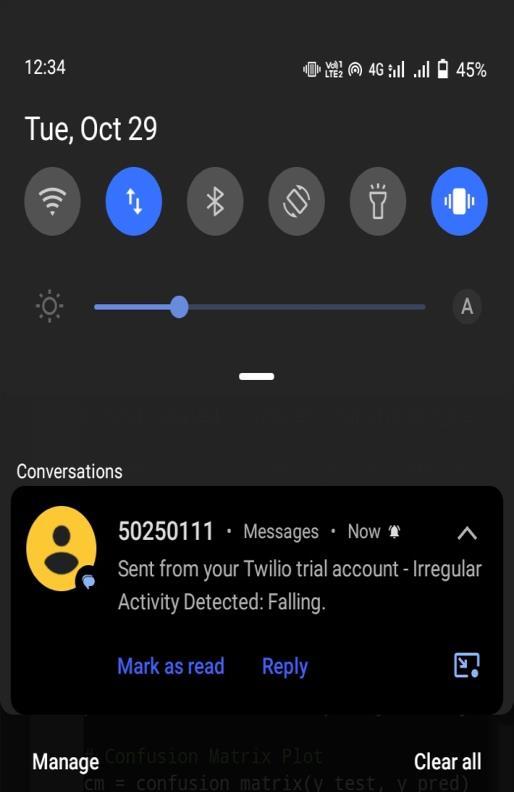
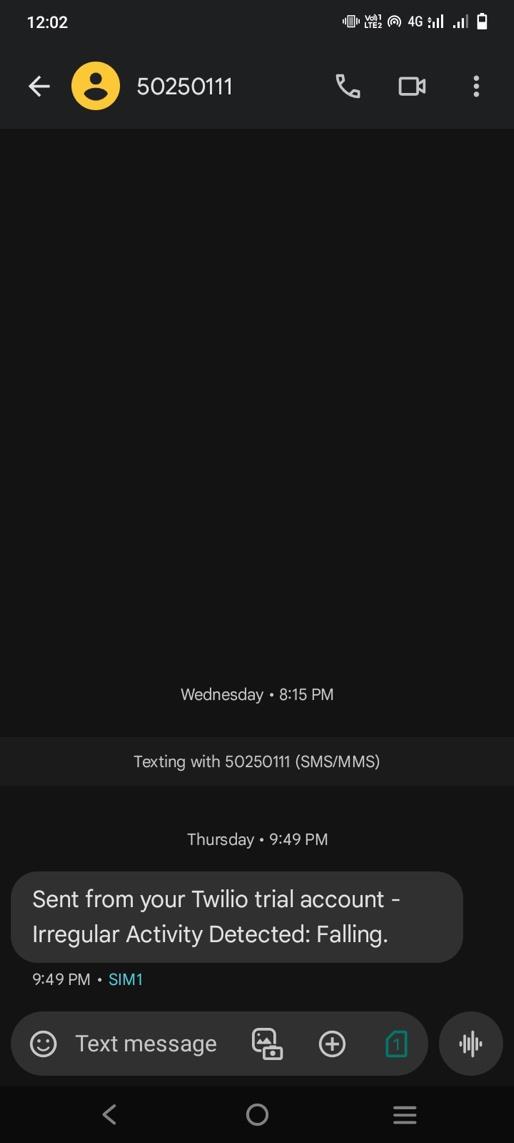
TheNotificationandStoragehandlesbothreal-timealerts andlong-termdatamanagement.Whenthesystemdetects anirregularactivity,suchasa fall orprolongedinactivity, it immediately sendsreal-time notificationsto family members or caretakers. These alerts can be sent via mobile apps, SMS, or email, ensuring that the elderly individual's support network is informed of potential emergencies.Additionally,thismodulelogsall recognized activities - both regular and irregular - into aSQL databasefor long-term storage. This allows forhistorical analysisof the individual's activities, which can be useful foridentifyingtrendsorchangesinbehaviorovertime.By storing this data, caretakers and family members can access detailed reports on the elderly person’s daily
routines,providingvaluableinsightsforongoingcare.This module ensures that the system not only responds to immediate concerns but also contributes to long-term monitoringandanalysis.
International Research Journal of Engineering and Technology (IRJET) e-ISSN: 2395-0056
Volume: 11 Issue: 11 | Nov 2024 www.irjet.net p-ISSN: 2395-0072
The system provides continuous real-time monitoring to enhance the safety of elderly individuals in smart homes using motion, pressure, sound, and temperature sensors with the K-NN algorithm to classify activities. It supports independent living by ensuring reliable assistance during emergencies, sending immediate notifications to caregivers via SMS or email. With non-intrusive sensors that prioritize privacy, the system serves as a privacyconscious alternative to camera-based surveillance while maintaininghighaccuracyandminimizingfalsealarmsfor effectivemonitoring
7. ACKNOWLEDGEMENT
We extend our heartfelt thanks to Mrs. S.MARIA SOBANA, Assistant Professor in the Department of Computer Science and Engineering, for her invaluable guidance and encouragement throughout the development of this project.Wearealsogratefultoourpeersandthefacultyof K.L.N. College of Engineering for their support and feedback. Finally, we appreciate the contributions of all the researchers whose works have provided the foundationforourstudy.
[1] Shih-Yuan Chen, Chi-Lun Lin, “Wi-Fi-Based Human Activity Recognition for Continuous, Whole-Room MonitoringofMotorFunctionsinParkinson’sDisease” on IEEE open Journal of Antennas and Propagation, Volno:5,pp788-799,April2024
[2] Saeed Mohsen, Ahmed Elkaseer, Steffen G. Scholz, “Human Activity Recognition Using K-Nearest Neighbor Machine Learning Algorithm” in Proceedings of the 8th International Conference on Sustainable Design and Manufacturing (KES-SDM 2021),Volno:262,pp304-313,2022.
[3] WeiGuo,ShunseiYamagishi,LeiJing,“HumanActivity Recognition via Wi-Fi and Inertial Sensors with Machine Learning ” on IEEE Access, Vol no: 12, pp 18821-18836,January312024
[4] Zhi Wang, Jian Gao, Rong Chen, Jinyan Wang, “A Modified KNN Algorithm for Activity Recognition in SmartHome”inproceedingsofthe18thInternational Conference on Electronic Business (ICEB), pp 53-61, December62018.
[5] AminaJarraya,AmelBouzeghoub,AmelBorgi,Khedija Arour, “DCR: A New Distributed Model for Human Activity Recognition in Smart Homes” on Expert Systems with Applications, Vol no : 140, pp 1128491:112849:19, July202022.