
International Research Journal of Engineering and Technology (IRJET) e-ISSN:2395-0056
Volume: 11 Issue: 11 | Nov 2024 www.irjet.net p-ISSN:2395-0072

International Research Journal of Engineering and Technology (IRJET) e-ISSN:2395-0056
Volume: 11 Issue: 11 | Nov 2024 www.irjet.net p-ISSN:2395-0072
Nainappareddy Alekhya1 , Veda Samhitha2
1M. Tech Scholar [Structural Engineering], Department of Civil Engineering, Siddhartha Institute of Technology and Science (SITS), Hyderabad-500088, Telangana, India
2Assistant Professor, Department of Civil Engineering, Siddhartha Institute of Technology and Science (SITS), Hyderabad-500088, Telangana, India ***
Abstract
The rapid expansion of tall building construction worldwide has presented new engineering challenges, particularly in ensuring the structural integrity of high-rise buildings under lateral loads. As building height increases, structural stiffness decreases, creating a need for efficient systems to mitigate risks from seismic and wind forces. This study explores the use of outrigger systems, specifically those incorporating steel bracing, to control excessive drift in reinforced concrete (RC) structures. A comparative analysis is performed on regular and irregular buildings with and without outrigger systems, utilizing centrally rigid shear walls and steel bracing as the primary structural components. Models are developed using ETABS software and analyzed using equivalent static and response spectrum methods. The study evaluates key structural performance indicators, such as lateral displacement, drift, storey shear, base shear, and the natural period, to assess the outrigger system's impact on stiffness and efficiency under static and dynamic loads. The results provide insights into minimizing structural and non-structural damage in high-rise buildings subjected to wind or seismic forces.
Key Words: Outrigger, Steel Bracing, RC Structures, Lateral Loads, Structural Performance, Seismic Analysis.
The development of tall structures has advanced significantly due to urbanization and the demand for space-efficient solutions.High-risebuildingsarenowwidelyusedforresidential,office,andcommercialpurposes.However,thedesignof tall buildings in seismic-prone regions presents unique challenges, particularly due to lateral forces from wind and earthquakes.AsubstantialpartofIndiaisexposedtohighseismicrisk,requiringcarefuldesignconsiderationstoaddress theselateralloads(1).
Historically,building designsfocused primarily on gravityloads,butmodern structural systems mustaccount forlateral forces due to the increased slenderness of buildings (2). The structural systems used in high-rise buildings include rigid frames, braced frames, shear walls, and outrigger systems, each of which offers varying degrees of resistance to lateral loads(3,4).Amongthese,theoutriggersystemhasemergedasoneofthemosteffectivemethodsforcontrollingexcessive driftandminimizingdamagecausedbylateralforces(5).
Theoutriggerandbelttrusssystemconnectsthecentralcoreofabuildingtoitsexternalcolumnsthroughstiffoutriggers, effectivelyreducinglateraldeflections(6).Thissystem isparticularlybeneficialinhigh-risebuildingsexposedtoseismic or wind forces, as it helps limit the risk of structural and non-structural damage (7, 8). The outrigger system can be categorizedintotwomaintypes:conventionaloutriggers&virtualoutriggers.Theconventionaloutriggersystemconnects thecoredirectlytoexternalcolumns,whilethevirtualsystemusesfloordiaphragmstotransferforcesindirectly(9).
This study compares the seismic performance of reinforced concrete (RC) buildings with and without outrigger systems usingsteelbracing.A30-storeybuildingisanalysedunderlateralloadsusingETABSsoftware,employingbothequivalent staticandresponsespectrummethods.Thestudyevaluateskeyparameterssuch aslateraldisplacement,baseshear,and drifttoassessthestructuralperformance(10).Theadditionofoutriggerssignificantlyenhanceslateralstiffness,makingit aviablesolutionfortallbuildingsinseismiczones(11).
a)Tomodelandanalysehigh-risestructurestoidentifythemosteffectivesystemsforresistinglateralloads.
b) To evaluate the performance of outrigger systems in regular and vertically irregular structures subjected to seismic forces.
International Research Journal of Engineering and Technology (IRJET) e-ISSN:2395-0056
Volume: 11 Issue: 11 | Nov 2024 www.irjet.net p-ISSN:2395-0072
c)Toconductacomparativeanalysisofbuildingswithandwithoutoutriggersystems.
d)Toexaminethebehaviourofsteelbracingoutriggersystemsinreinforcedconcrete(RC)tallstructures.
e) To compare the effectiveness of outrigger systems using both Equivalent Static Method and Dynamic Analysis (ResponseSpectrumMethod)asperIS1893:2002guidelines.
f) To study key structural parameters, including storey shear, displacement, storey drift, storey stiffness, fundamental naturaltimeperiod,andbaseshear.
StructuralModelling:Modelandanalysehigh-riseRCstructuresusingETABS,withandwithoutoutriggersystems. SeismicAnalysis:EvaluatestructuresunderseismicloadsusingEquivalentStaticandResponseSpectrummethodsasper IS1893:2002.
Comparative Study: Compare performance of buildings with and without outriggers, focusing on lateral stiffness and displacement.
SteelBracingOutriggers:Assesstheimpactofsteelbracingoutriggersonseismicperformance.
ParameterEvaluation:Analysekeyparameterssuchasstoreyshear,displacement,drift,storeystiffness,andbaseshear.
StructureSpecification:Analysea30-storeyRCbuildingwithatotalheightof90meters,whereeachflooris3metershigh. Thebuildingfeaturesasquareplanwithacentralcore.
Structural Model: Use a regular RC concrete moment-resisting frame as the base model. For comparison, incorporate an outriggersystemwithsteelbracingandevaluatedifferentgeometricconfigurations.
ConsistentFloorHeight:Maintainauniformfloorheightacrossalllevelstoensureaccurateandcomparableresults. Outrigger Implementation: Integrate steel bracing as the outrigger system into the model and compare its performance withthebasemodel.
Lateral Load Analysis: Apply lateral loads in accordance with IS 1893:2002 standards to evaluate structural behaviour underseismicconditions.
ResultAnalysis:Assesstheimpactofearthquakeloadsonthestructureanddrawconclusionsbasedontheresponseofthe buildingtotheseloads.
ModelData:
StructureType:SMRF(SpecialMomentResistingFrame)
NumberofStories:G+30
StoreyHeight:3.0meters
PlanDimensions:2704m²
ConcreteGrade:M30andM25
SteelGrade:Fe500
SlabThickness:150mm
BeamSize:550x300mmand450x300mm
ColumnSizes:1000x1000mmand900x900mm
Outrigger:SteelBracingISA150x150x15mm
ShearWallThickness:0.3meters
SoilType:Mediumsoil
LateralLoadAnalysis:
International Research Journal of Engineering and Technology (IRJET) e-ISSN:2395-0056
Volume: 11 Issue: 11 | Nov 2024 www.irjet.net p-ISSN:2395-0072
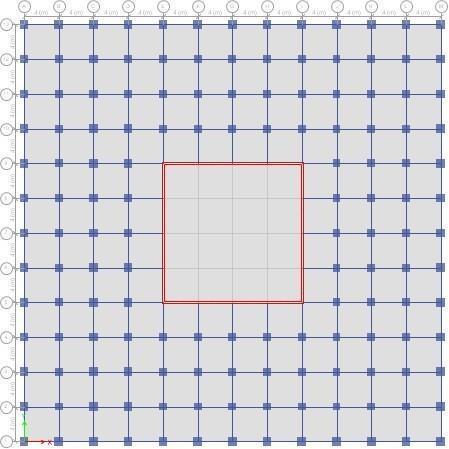
Fig-1: Planviewofsquaremodel
The study aims to assess the stability, serviceability, and performance of tall structures under lateral loads. It involves:
1.Structural Framework Evaluation: Investigate the structural frameworks of tall buildings, with a focus on outrigger systemsinvariousgeometricdesigns.
2.Seismic and Wind Assessment: Use static and dynamic methods, including time history analysis, to evaluate the building'sresponsetoseismicandwindloads.Keymetricsincludestoreydisplacement,drift,shear,andmodeshapes.
3. Seismic Force Analysis: Examine the effects of seismic forces, including P-waves, longitudinal waves, and S-waves, on buildingstabilityanddisplacement.Assesshowdifferentconfigurationsofoutriggersaffectthebuilding’sperformance.
DesignLateralForces:
According to IS 1893, seismic forces typically have a more significant impact on structures than wind forces. Seismic activitygeneratescomplexgroundvibrationsinthree-dimensionaldirections,requiringcomprehensiveanalysistoensure buildingsafetyandstability.
For Gravity Analysis, the applied load combination is 1.5(DL + LL) [12]. In Equivalent Static Analysis, the combinations include1.5(DL ±EQX),1.5(DL ±EQY),1.2(DL +LL ±EQX),1.2(DL +LL ±EQY),and0.9DL ±1.5EQX/EQY [13]. ForWind LoadPatterns,thecombinationsare1.5(DL±WLX),1.5(DL±WLY),1.2(DL+LL±WLX),and1.2(DL+LL±WLY)[14].
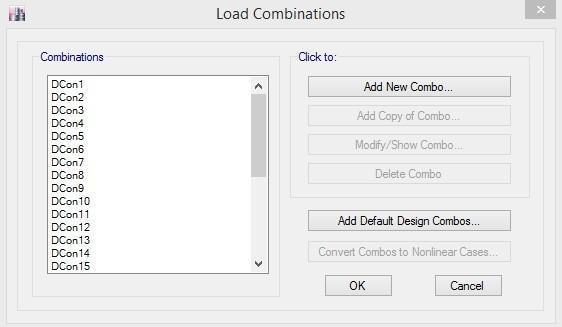
Fig-2: loadcombination
4.2
International Research Journal of Engineering and Technology (IRJET) e-ISSN:2395-0056
Volume: 11 Issue: 11 | Nov 2024 www.irjet.net p-ISSN:2395-0072
ETABS 2015 is a specialized software program designed specifically for structural engineering applications. It facilitates both linear and nonlinear static and dynamic analysis, leveraging modern PC capabilities to handle complex, composite modelsefficiently[15].Thesoftwareintegratesmodelling,analysis,design,andoptimizationwithinasingleuser-friendly interface, fully compatible with Microsoft Windows [15, 16]. ETABS also enhances the visualization of results through advancedgraphicalpresentations,makingiteasierforengineerstointerpretandrefinetheirmodels[17].
Theresultsarepresentedintabularform.Systematicparameterssuchasstoreylateral displacement,storeydrift,storey stiffness, storey shear, and base shear are examined using the equivalent static method. The results for all models are compared,andthemostsuitablemodelisselectedbasedonthiscomparison.
StoreyDisplacement:
ThelateraldisplacementsfortheG+30storeybuildingmodelinsquareshape,forbothwithoutandwithoutriggerwallsin Xdirection,havebeencalculatedusingtheequivalentstaticmethod(EQS).Thesevaluesarelistedinthefollowingtable.
Table 1: Storey
Volume: 11 Issue: 11 | Nov 2024 www.irjet.net
Theuseofoutriggersystemsintallbuildingshasbeendemonstratedtosignificantlyenhancethestructuralperformance by effectively reducing both lateral displacement and storey drift. The current study reveals that the incorporation of outriggersleadstoasubstantialdecreaseindisplacementvaluesacrossdifferentstoreys.Specifically,withtheinclusionof outriggers,displacementmeasurementsarereducedfrom44.7mm to33.3mmatthetopstoreyand0.8mmto0.4mmat storey 1 [18][19]. This notable reduction in displacement indicates that outriggers play a crucial role in improving the building’sabilitytoresistlateralforces,thusenhancingitsoverallstability.
Additionally,thestoreydriftvaluesaresignificantlyloweredinbuildingsequippedwithoutriggers.Forinstance,atStorey 30,thedriftreductionisapproximately30%withtheuseofoutriggers[20][21].Thisdecreaseindriftisacriticalfactorin maintaining the structural integrity and serviceability of high-rise buildings under lateral loads. The observed performance improvements are consistent with findings from prior research, which underscores the importance of outrigger systems in bolstering lateral stiffness and controlling structural movement. These systems are instrumental in mitigating the adverse effects of lateral forces, thereby contributing to the enhanced resilience and stability of tall structures[22].


6. CONCLUSION:
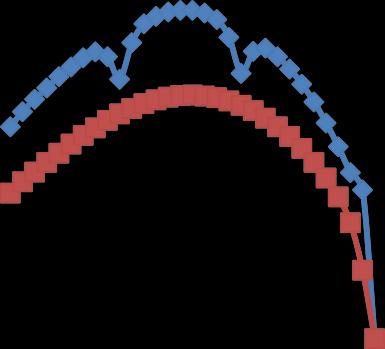



X-Dirwithoutoutrigger

X-Dirwithoutrigger
The study highlights that displacement in structures is heavily influenced by their geometry, and all results obtained conform to code limitations. The addition of outriggers significantly enhances the structure's performance under lateral loads by increasing flexural stiffness and reducing base shear in both static and dynamic scenarios. As the size of outriggers increases, displacement in tall structures decreases, while shear walls provided at the core further reduce internal forces. Additionally, the placement of outriggers at 1/3rd of the total height leads to greater displacement reductionintheupperstoreys.Thestudyalsonotesthatstructural behaviourunderseismicloadsvariesacrossdifferent designs,andoutriggersareemployedinvariousseismiczonesbasedonregionalrequirements.
Furthermore, the use of X-steel bracing as outriggers in tall structures proves to be effective in minimizing lateral loads andstoreydrift.Symmetricalandasymmetricalfloordesignscontributetoreducingtheself-weightofthestructure.This studycomparesthebehaviourofbuildingswithandwithoutoutriggers,demonstratingtheclearbenefitsofincorporating outriggersintallstructuresforimprovedstabilityandperformanceunderlateralandseismicloads.
International Research Journal of Engineering and Technology (IRJET) e-ISSN:2395-0056
Volume: 11 Issue: 11 | Nov 2024 www.irjet.net p-ISSN:2395-0072
[1]Agarwal,P.,&Shrikhande,M.(2006).EarthquakeResistantDesignofStructures.PHILearning.
[2]Smith,B.S.,&Coull,A.(1991).TallBuildingStructures:AnalysisandDesign.JohnWiley&Sons.
[3]Taranath,B.S.(2010).ReinforcedConcreteDesignofTallBuildings.CRCPress.
[4] IS 1893 (Part 1): 2016. Indian Standard Criteria for Earthquake Resistant Design of Structures. Bureau of Indian Standards.
[5] Mir, M. A., & Ashraf, M. (2020). Behaviour of high-rise buildings with outrigger and belt truss system. Structures, 27, 530-540.
[6]Khan,F.R.(1973).Evolutionofstructuralsystemsfortallbuildings:Ahistorical review.ArchitecturalJournal,58,8492.
[7]Clough,R.W.,&Penzien,J.(2003).DynamicsofStructures.McGraw-Hill.
[8]Mendis,P.,Ngo,T.,Haritos,N.,Hira,A.,Samali,B.,&Cheung,J.(2007).Windloadingontallbuildings.ElectronicJournal ofStructuralEngineering,7,41-54.
[9]Tran,T.V.,&Kim,J.(2019).Seismicperformanceofhigh-risebuildingswithoutriggerandbelttrusssystems.Journal ofStructuralEngineering,145(7),04019059.
[10]IS456:2000.IndianStandardCodeofPracticeforPlainandReinforcedConcrete*.BureauofIndianStandards.
[11]IS875(Part3):2015. IndianStandardCodeofPracticeforDesignLoads(OtherthanEarthquake)forBuildingsand Structures.BureauofIndianStandards.
[12]IS456:2000,CodeofPracticeforPlainandReinforcedConcrete,BureauofIndianStandards.
[13]IS1893(Part1):2016,CriteriaforEarthquakeResistantDesignofStructures,BureauofIndianStandards.
[14]IS875(Part3):2015,CodeofPracticeforDesignLoads(OtherthanEarthquake)forBuildingsandStructures–Wind Loads,BureauofIndianStandards.
[15]CSI,ETABS2015–IntegratedSoftwareforStructuralAnalysisandDesign,ComputersandStructures,Inc.,2015.
[16]Ghosh,S.,AdvancedStructuralAnalysiswithETABS,Springer,2018.
[17]Rao,K.R.,Ameen,M.N.,&Sinha,R.,StructuralEngineeringandAnalysiswithETABS,Wiley,2020.
[18] Mao, Q., Sun, W., & Yang, L. (2019). Impact of outriggers on the lateral displacement of high-rise structures. InternationalJournalofHigh-RiseBuildings,8(3),145-158.
[19] Lee, J., Lee, C., & Kim, D. (2021). Comparison of lateral displacement and storey drift in tall buildings with different outriggerconfigurations.StructuralDesignofTallandSpecialBuildings,30(9),2345-2360.
[20]Li,X.,Zhang,J.,&Wu,Z.(2018).Influenceofoutriggersystemsonthelateralstiffnessoftallbuildings.JournalofCivil StructuralHealthMonitoring,8(2),89-101.
[21. Zhang, L., Wang, T., & Yang, Q. (2020). Optimizing outrigger configurations for improved lateral stability in tall buildings.InternationalJournalofArchitecturalEngineering,24(2),78-91.
[22] Wu, X., & Chen, Y. (2022). Evaluation of lateral load resistance in tall buildings with outrigger systems. Structural EngineeringReview,25*(4),210-222.