
International Research Journal of Engineering and Technology (IRJET) e-ISSN: 2395-0056
Volume: 11 Issue: 10 | Oct 2024 www.irjet.net p-ISSN: 2395-0072

International Research Journal of Engineering and Technology (IRJET) e-ISSN: 2395-0056
Volume: 11 Issue: 10 | Oct 2024 www.irjet.net p-ISSN: 2395-0072
Jitendra Kumar Dahariya1 , Kamesh Sahu2 , Khomesh Verma3, Mr.Ganesh Ram Ratnakar4 , Mr.Vikas Chandra5, Mrs. Mohini Moitra Bhaduri6 1, 2, 3–B.TECH Scholar, Chouksey Engineering College, Bilaspur 4, 5, 6 – Assistant Professor, Chouksey Engineering College, Bilaspur Department of Electrical & Electronics Engineering
Abstract - This work examines PID controllers with various response functions. In industrial control systems, control engineers utilize a PID (Proportional – Integral – Derivative) control to adjust temperature, flow, pressure, speed, and other process-related parameters. The most precise and reliable controllers are PIDs, which regulate process variables via a feedback loop.
An established method for guiding a system toward a target location or control parameters is PID control. It is used in many scientific and chemical processes, as well as automation, and is essentially universal as a temperature control method. PID control maintains a process's real output as near to the set point or target output as feasible.
Key Words: PID controller, step, ramp, parabolic, sinusoidal function.
Inindustrialautomationandprocesscontrolsystems,aPID (Proportional-Integral-Derivative) control is a commonly used control algorithm. By continuously modifying the control input in response to the difference between the setpoint(thedesiredcondition)andaprocessvariable(also known as the present state), it can maintain the desired resultlevel.Thisiswhatmakesiteffective.PIDcontrollers areakeyelementofcontemporarycontrolengineeringsince theyare necessaryin many differentapplications,such as motorspeedcontrolandfurnacetemperaturemanagement
Feedback control was first conceptualized in the early 1800s.Asindustrialprocessesgrewmorecomplicatedand necessitatedmoreadvancedcontrol tactics,theword"PID controller" gained popularity in the middle of the 20th century.PIDcontrolwasmadefeasiblebytheadvancement ofelectroniccomponents,whichpavedthewayforitsbroad useinavarietyofindustries,includingrobotics,aerospace, andmanufacturing.
APIDcontrolleroperatesonthepremisethateachofthe threeterms proportional("P"),integral("I"),andderivative ("D") needs to be "tuned" or changed separately. The
correctionfactoriscomputedandutilizedfortheinputbased on the variation between these values. For instance, the temperaturewillberaisediftheoveniscolderthanneeded.
Thethreestepsareasfollows:
Correctingagoalaccordingtothedifferenceisknownas proportional tuning. Because the applied correction decreasesasthedifferencegetsclosertozero,thedesired valueisneverreached.
1.2 Uses
1.ControlofTemperature
PID controllers are widely utilized in HVAC systems, furnaces,andovensthatregulatetemperature.
2.ControlofSpeed
PID controllers regulate the motor's voltage or current to controlspeedinelectricmotors.
3.ControlofPosition
PID controllers, which are utilized in robotic and CNC (Computer Numerical Control) equipment, guarantee accuratemechanicalcomponentplacement.
4. Flow Control PID controllers manage the movement of gasesandliquidsinreactors,tanks,andpipelines.
5.ControlofPressure
PIDcontrollersregulatepressurelevelsinsystemssuchas reactors,boilers,andgaspipelines.
2. DIFFERENT RESPONSE FUNCTION
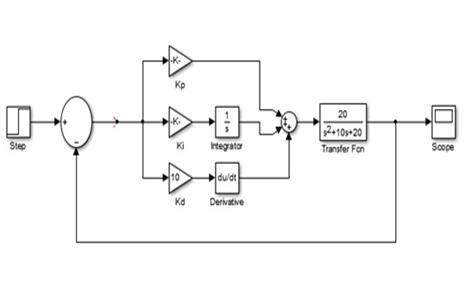
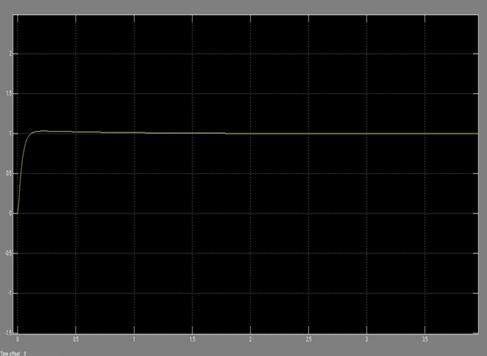
2.1 Unit Step Function
A key idea in control theory, processing of signals, and systemsanalysisistheunitstepfunction,whichisfrequently represented as u(t) and H(t) (Heaviside step function). It functionsasamathematicalrepresentationofasignalthat changesfrom0to1atagivenmoment
International Research Journal of Engineering and Technology (IRJET) e-ISSN: 2395-0056
Volume: 11 Issue: 10 | Oct 2024 www.irjet.net p-ISSN: 2395-0072
2.2
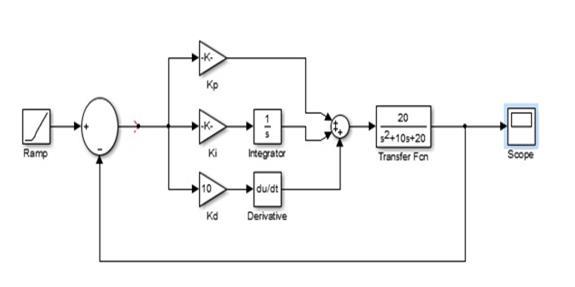
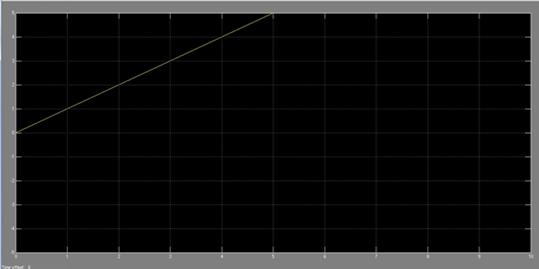
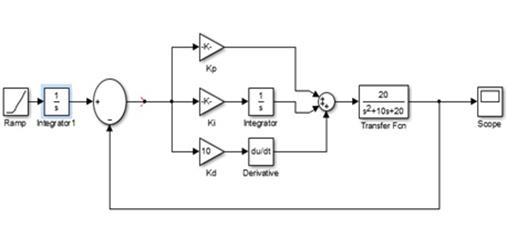
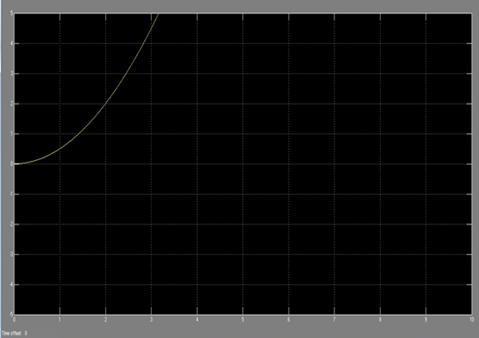
Anothercrucialcomponentinthestudyofsignalprocessing, control systems, and systems analysis is the unit ramp function.Theunitrampfunctiongrowslinearlyovertime,in contrasttotheunitstepfunction,whichstaysconstantata certainpoint.
A mathematical function utilized in signal processing and controlsystemsistheunitparabolicfunction.
2.4
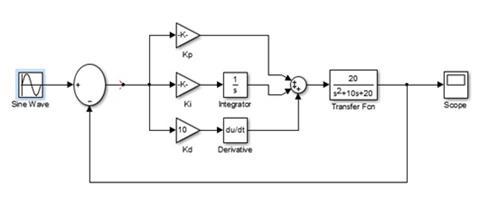
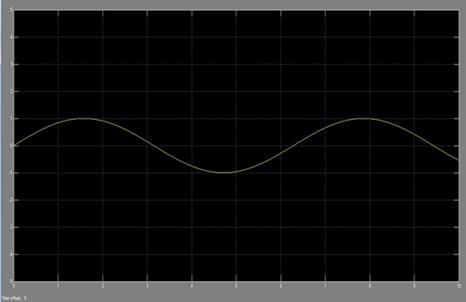
A basic mathematical function that characterizes periodic oscillationsisthesinusoidalfunction.Itisextensivelyusedto depict waveforms and oscillating motion in a variety of domains, including signal processing, engineering, and physics.
International Research Journal of Engineering and Technology (IRJET) e-ISSN: 2395-0056
Volume: 11 Issue: 10 | Oct 2024 www.irjet.net p-ISSN: 2395-0072
Thedesignandoptimizationonthecontrolsystemsinthis studydependheavilyontheanalysisonPIDcontrollersthat have different response functions. Engineers may create responsive,stable,andeffectivesystemsbycomprehending howPID controllers work withstep,ramp,andsinusoidal inputs. PID controllers are still a mainstay in robotics, industrialautomation,andmanyotherdomainsduetotheir adaptability. PID controllers' capabilities may be further improvedbycontinuingresearchintosophisticatedcontrol algorithmsastechnologyadvances,guaranteeingtheirusein thefuture.
[1] K.J. Astr ˙ om, T. H ¨ agglund, The future of PID controller, Control Engineering Practice 9 (12) (2001)1163-1175.
[2] C. Hernandez, A new adaptive PI for bicarbonate regulationinananaerobicdigestionprocess,Asian JournalofControl13(6)(2011)785-796
[3] D. Davendra, I. Zelinka, R. Senkerik, Chaos driven evolutionaryalgorithmsforthetaskofPIDcontrol, ComputersandMathematicswithApplications60 (4)(2010)1088-1104.
[4] S.Das,I.Pan,K.halder,S.Das,A.Gupda,LQRbased improved discrete PID controller design via optimumselectionofweightingmatrices.
[5] Ali,S.Majhi,Integralcriteriaforoptimaltuningof PI/PIDcontrollersforintegratingprocesses,Asian JournalofControl13(2)(2011)328-337.