

Volume: 11 Issue:10 | Oct 2024 www.irjet.net
DESIGNING AND IMPLEMENTATION OF SMART ENERGY METERING SYSTEM
Dr. Monika Gairola* , Aanya Garg# , Dr. Ravi Saxena*, Varija Pandey* , Riya Dimri*, Stuti Bhaguna*
* College of Technology , G.B.P.U.A.T, Pantnagar, Uttarakand, India # RAN Public School, Rudrapur, Uttarakhand, India
Abstract:- The demand for power has grown exponentially over the last century, especially in countries like India where energy consumption is high and generation is insufficient to meet needs. This rising demand is driven by population growth and industrial expansion. One of the effective way to address today's energy challenges is by reducing energy usage in households. This has highlighted the need for accurate and cost-effective methods of power measurement. Currently,traditional energy meters used in households are offline deviceswhere readings are taken manually and are provided monthly to consumers in the form of a bill showing kilowatt-hours (kWh) consumed. To improve this system, the smart energy meter is needed to develop a comprehensive system for measuring, monitoring, and controlling power and energy consumption. In addition to energy consumption, these smart energy meters provides detailed information about other parameters like voltage (v) , current (i), power (p) , power factor, and frequency. The developed system also allows monitoring of changes in various load parameters, facilitating optimal load management and implementing an automatic billing system. The measurement of all these parameters is facilitated by an Energy Chip. Real-time data collection and monitoring are also achieved using Excel Data Streamer. Raspberry Pi is used to transmit data to the cloud, enabling remote access and analysis through graphical representations of load parameter variations. Consumers can view their energy consumption on a 16X2 LCD display and receive alerts through an LCD screen and buzzer in case of overload conditions. The developed Smart Energy Meter system aims to enhance energy efficiency, helps consumers with real-time information and control, and contribute towards effective and reliable energy management in households.
Keywords- Smart Energy Meter (SEM), Raspberry Pi, Energy Chip,Excel Data Streamer etc.
I. Introduction
Incurrentpowerutilitysetups,consumerstypicallyreceive usage information only once a month with their bill. This infrequent feedback interval makes it so difficult for
consumerstoobservehowchangesinbehavioraffecttheir power usage. Due to this consumers are not able to use powerefficiently.Forinstance,ifconsumersareabletosee the power usage regularly, they become more careful in using the equipments and power efficiently. The ultimate goal of the present work is to increase the awareness among consumers for energy usage, leading to optimized consumption,reducedcosts,andenergyconservation.
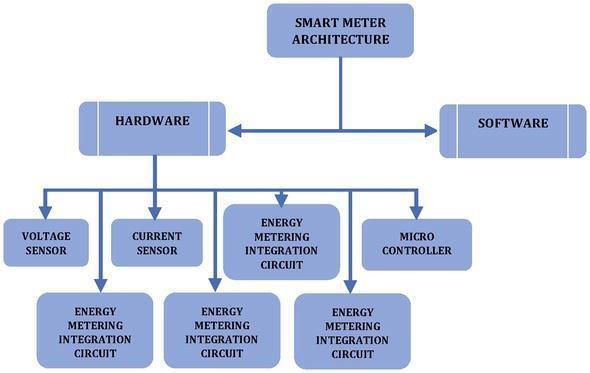
Toaddresstheaboveissue,thereis therequirement of an efficient system that provides real-time feedback on energyconsumptioninhouseholds.OnesuchtoolisPZEM004T energy chip, that helps to measures power consumption, voltage, current, energyusage, power factor, and frequency By integrating this chip with an Arduino Unoand anLCD display, a practical measurement tool can bedeveloped.Thissetupnotonlyinform usersabouttheir electricity usage but also alert them about the overloading conditions, thereby able to reduce the electricity consumption. The present work constitutes the design, fabrication and operation of Cloud Based Smart Metering and Load Management using Raspberry Pi which are playingimportantroleintheeffectiveenergymanagement. Thesesystems offer advantages such as preventing energy metertamperingandensuringfairusageofelectricity.Allin all, the implementation of advanced metering technologies and real-time monitoring tools can significantly enhance consumer awareness and management of energy consumption whichultimatelyleadtocostsavings, energy efficiency, and conservation efforts. The architecture of SmartEnergyMeterisshowninFig.1.
International Research Journal of Engineering and Technology (IRJET) e-ISSN:2395-0056
Volume: 11 Issue:10 | Oct 2024 www.irjet.net
II. Conventional Energy Meter Vs Smart Energy Meter
The comparison between conventional energy meter and smartenergymeteristabulatedinTable1.
Table1.ConventionalVsSmartMeter
Parameters Conventional Meter Smart Energy Meter
Monitoring Monthly Real-Time
Reading Manual Automatic
Communicati on None Bidirectional
Response Time Slow Faster
Cost Less More
III. Problem Statement
Thecurrentsystemformonitoringandcontrolling energy consumption suffers from significant limitations. Conventional energy meters used in households are offline devices, requiring manual readings that are cumbersome and prone to errors. These meters lack the capability to provideimportant parameters such as voltage, current, power factor,and frequency, limiting theutility's ability tounderstandand manage energy usage effectively. Moreover, consumers lackdirect access to their energy bills, often receiving inaccurate or estimated bills, leading to disputes and dissatisfaction. The absence of centralized access to consumer data furthercomplicates energy management forutilities, missingopportunities for load variation analysis and improved efficiency. Additionally, traditional meters are vulnerable tophysical tampering, increasingtheriskofelectricitytheft,whichposesfurther challengestotheintegrityofthesystem. To avoid these problems, in this new generation, anautomatic reading metersystemcameintouse.
IV. Objective
Designanddevelopenergymeasurementsystemwhichis reliable, portable, accurate and low cost. Following are theobjectivesofthepresentwork:
1. Toremotelymeasurethevoltage,current,power andenergyconsumedinacircuit.
2. To measure the frequency and power-factor to obtainanideaaboutefficiencyofasystem.
3. To measure the consumer’s real consumption inrupeesaccordingtoconsumertariff.
p-ISSN:2395-0072
4. To create awareness in consumer regard
The consumption by means of overuse and overloadalert.
5. ToenabletheutilitytocarryoutPeakLoad.
V.
Working of Smart Energy Meter
Smart energy metering system can effectively monitor and record electrical energy consumption in real-time. Energy chip PZEM 004T measures voltage, current, power, energy,power factor of an electric load. Arduino that interfaces with the energy chip is used to read measured data. Raspberry Pi (single-board computer) is used for data processing, storage, and communication with user interface. The circuit diagram of SEM to understand the detail working is shown in Fig.2.
Components used in the project are Raspberry Pi, inArduino Uno., 16*2 LCD Display I2C Module , Piezo Buzzer,jumpercables,connectingwires.
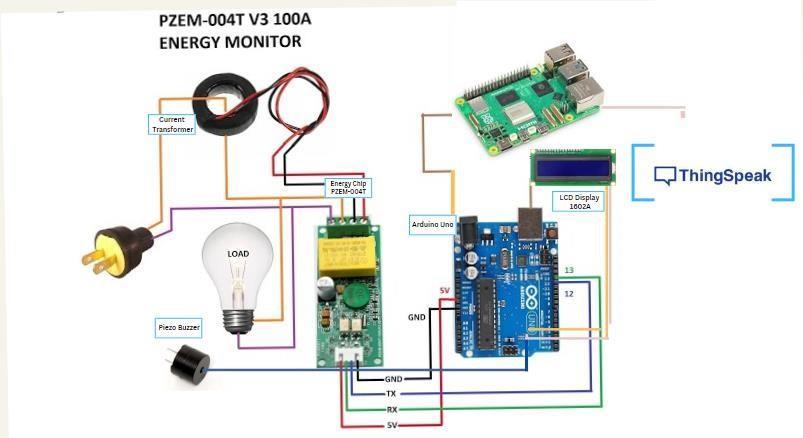
PZEM-004t measures voltage, current, power, power
factor by connecting PZEM 004t with electrical load. It communicate with Arduino via serial interface. The Arduino reads data from PZEM 004t using a serial communication port (over USB). The Arduino transmit data at certain intervals (delay). In case of overloading (when operating current is greater than the safe limit), the Piezo Buzzer get pulses with certain frequency to produce an alarm sound and the LCD Display flashes an “OverloadAlert”.
The real time data is transmitted from Arduino to Excel Data Streamer via serial communication and a datasheet is generated. This data sheet can be used to monitor variation trends in various electrical parameters and importance decisions such as load management, powerfactorandefficiencyimprovementcanbetaken.
International Research Journal of Engineering and Technology (IRJET) e-ISSN:2395-0056
Volume: 11 Issue:10 | Oct 2024 www.irjet.net p-ISSN:2395-0072
Raspberry Pi also receives data from the Arduino.The
real-timestoreddatafromRaspberryPiisfurthersentto IoT analytics platform service “Things peak” that is used to graphically monitor data by just using mobile phone/computer at the click of a button. The complete experimental setup of SEM is shown in Fig.3. which showstheintegrationofdifferentcomponent.
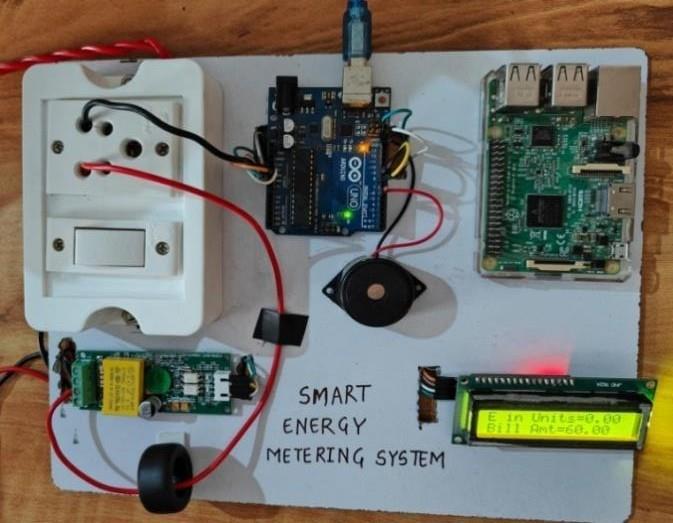
Fig.3.CompleteSetupofSEM
VI. Experimental Results
The software that is used in the present work is Arduino IDE and python 3. In order to get the correct results it is important to testtheEnergychip in orderto checkwhetherthevaluesofvoltageandcurrentobtained from Energy Chip (serial Monitor Output) is matching with the value of ammeter and multimeter or not. The testingsetupofthisisshowninFig.4.
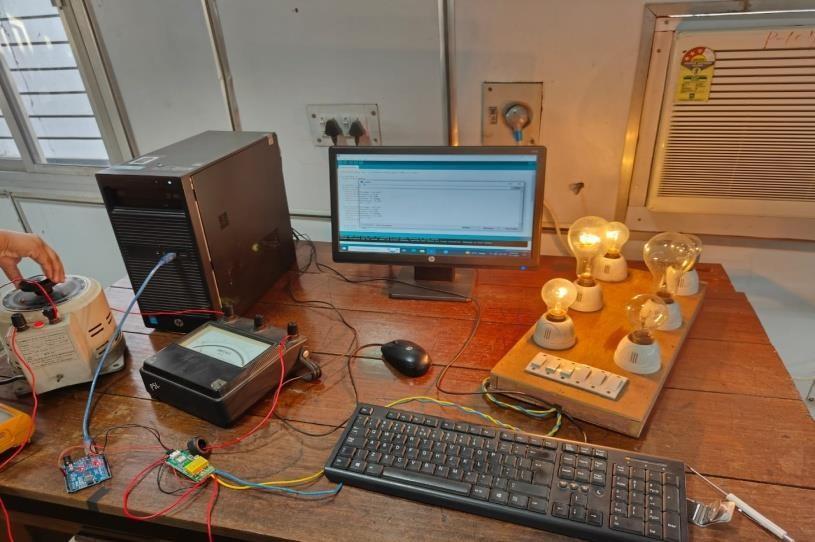
Fig.4.TestingSetupofEnergyChip
Table2.ComparisonofAmmeterCurrentwithCurrent usingEnergychip
Table3.ComparisonofMultimeter VoltagewithVoltage usingEnergyChip
FromTable2andTable3 it is foundthat theoutput of Energy chip matches with that of Ammeter and Multimeterresults.
The Data Sheet is generated by the transmission of the real time data from Arduino to Excel Data Streamervia serial communication. This data sheetis used to monitor the variation in different electrical parametersasshowninthetable4below.
International Research Journal of Engineering and Technology (IRJET) e-ISSN:2395-0056
Volume: 11 Issue:10 | Oct 2024 www.irjet.net
Table4.DatasheetGenerated
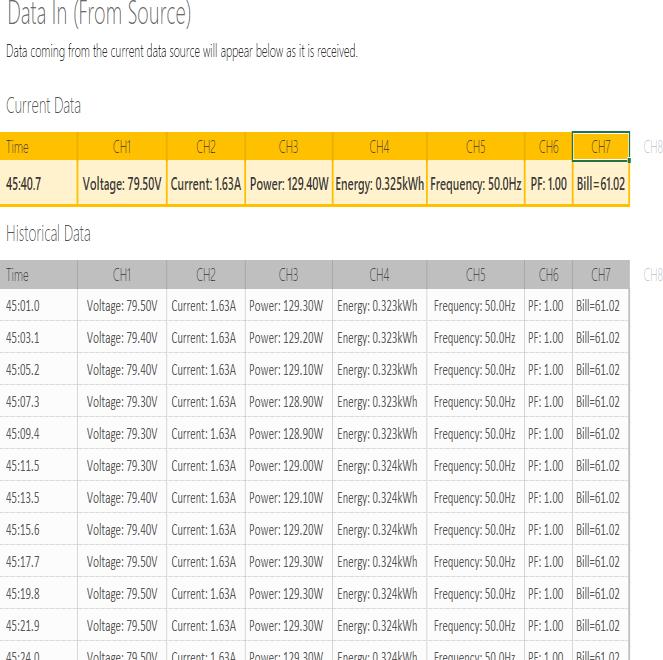
Data from the Arduino is also sent to the Raspberry Pi. This real-time stored data from Raspberry Pi is further senttoIoTanalyticsplatformservicecalled“Thingspeak” that is used to graphically monitor the parameters by using mobile phone or computer at the click of a button. ThegraphicalresultsobtainedareshowninFig.5.below.
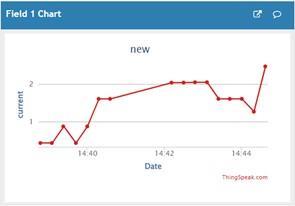
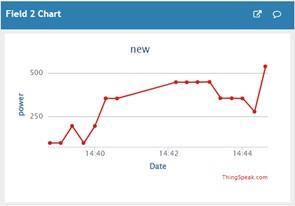
Fig.5. (a) and(b)ThingspeakPlots
p-ISSN:2395-0072
VII. Conclusion
From the above experimental results it becomes clear that the smart meters are more efficient when comparedwiththeconventionalmeters.Theyprovide anefficientway of measuring electricity consumption in near real time. The future of smart energy metering systems using PZEM-004, Arduino, and Raspberry Pi is promising, withsignificant potential for innovation and impact. By leveraging advancements in data analytics, machinelearning, and IoT connectivity, these systems can offer enhanced predictive maintenance, detailed energy usage insights, and efficient load forecasting. Integration with smart grids will enable responsive demand managementand support the seamless incorporation ofrenewableenergysources. Due to the advantages offered
REFERENCES
[1]. Prashanthi, G. L. and K. V. Prasad. "Wireless power meter monitoring with power theft detection and intimation system using GSM and Zigbee networks." Journal of Electronics and Communication Engineering9,no.6(2014).
[2]. Barman, Bibek Kanti. "Smart meter using IoT." Department of international electronics and electrical engineering(IEEE)(2017).
[3]. Prathik, M., Komma Anitha, and V. Anitha. "Smart energy meter surveillance using IoT." In 2018 International conference on power, energy, control and transmission systems (ICPECTS), pp. 186-189. IEEE,2018.
[4]. Xu, Yizhe, Chengchu Yan, Huifang Liu, Jin Wang, Zhang Yang, and Yanlong Jiang. "Smart energy systems: A critical review on design and operation optimization." Sustainable Cities and Society 62 (2020):102369.
[5]. Fekri, Mohammad Navid, Harsh Patel, Katarina Grolinger, and Vinay Sharma. "Deep learning for load forecasting with smart meter data: Online Adaptive Recurrent Neural Network." Applied Energy 282 (2021):116177.
[6]. Yildiz, Baran, Jose I. Bilbao, Jonathon Dore, and Alistair B. Sproul. "Recent advances in the analysis of residentialelectricityconsumptionandapplicationsof smart meter data." Applied Energy 208 (2017): 402427.
[7]. Zakariazadeh, Alireza. "Smart meter data classification using optimized random forest algorithm."ISA transactions126 (2022): 361-369.