
International Research Journal of Engineering and Technology (IRJET) e-ISSN: 2395-0056
Volume: 11 Issue: 10 | Oct 2024 www.irjet.net p-ISSN: 2395-0072

International Research Journal of Engineering and Technology (IRJET) e-ISSN: 2395-0056
Volume: 11 Issue: 10 | Oct 2024 www.irjet.net p-ISSN: 2395-0072
Priya Dubey1, Dipti Ranjan Tiwari2
1Master of Technology, Computer Science and Engineering, Lucknow Institute of Technology, Lucknow, India
2Assistant Professor, Department of Computer Science and Engineering, Lucknow Institute of Technology, Lucknow, India
Abstract - Healthcare stands as a cornerstone of human well-being, with cardiovascular disease posing a significant threat to the general populace. In the current era, characterized by prevalent sedentary lifestyles, a substantial portion of the population grapples with this issue. Existing methodologies often fall short in accurately predicting viralinduced diseases, marking them as perilous infectionsnotonly in India but across the globe. Statistics reveal that a staggering 28.1% of fatalities stemfromheartdisease, making it a leading cause of death, claiming over 17.6 million lives in 2021 post the Covid-19 pandemic. The delayed identification of heart ailments drastically diminishes patients' chances of survival. Consequently, the necessity for a precise and reliable diagnostic system for timely detection and treatment of such conditions becomes paramount. The innovative framework proposed leverages a sophisticated deep learning algorithm known as Convolutional Neural Networks (CNN) fused with advanced optimization techniques to enhance the accuracy and prognosis of heart disease from chest X-ray imagery. The primary objective of our model is to cultivate a precise and effective diagnostic mechanism boasting an 85.2% accuracy rate, thereby aiding healthcare practitioners in the prompt and early management of cardiovascular disorders.
Key Words: Heart Disease Prediction, Deep Learning, Convolutional Neural Networks (CNNs), Recurrent Neural Networks (RNNs), Personalized Healthcare, Model Interpretability,DataQuality
Heartdiseaseremainsoneoftheleadingcausesofmortality worldwide,contributingsignificantlytotheglobalburdenof disease.Earlydetectionofheart-relatedconditionsiscrucial, asitcansubstantiallyimprovepatientoutcomesbyenabling timely interventions, lifestyle changes, and medical treatments. Identifying the risk factors or symptoms associatedwithheartdiseaseatanearlystagecanprevent the progression to more severe conditions, such as heart attacks,strokes,orheartfailure.
The importance of early detection lies in its potential to reduce the strain on healthcare systems, lower mortality rates,andimprovethequalityoflifeforindividuals.Early diagnosis allows healthcare professionals to implement preventativemeasures,managethediseasemoreeffectively, andreducethelikelihoodofcomplications.Inmanycases, heart disease is asymptomatic in its early stages, which
makesaccurateandtimelypredictionmethodsevenmore critical. Traditional diagnostic techniques often rely on clinicalexaminations,patienthistory,orbasicbiomarkers, which can sometimes fail to detect underlying cardiovascularissues.Thishasledtothegrowinginterestin leveragingadvancedtechnologies,suchasdeeplearning,to enhance the predictive accuracy and reliability of heart diseasedetection.Throughtheanalysisofvastamountsof data,thesetechniquesofferthepotentialtoidentifypatterns and risk factors that might be missed by conventional methods, thereby playing a vital role in the early identificationandpreventionofheartdisease.
Deep learning has emerged as a powerful tool in medical research and diagnosis due to its ability to process vast amounts of data and automatically extract meaningful patterns. When it comes to heart disease prediction, deep learningoffersseveraladvantagesthatmakeitparticularly well-suited for this task. Firstly, heart disease prediction involves complex interactions between numerous risk factorssuchasage,bloodpressure,cholesterollevels,and lifestyle habits. Deep learning models, especially neural networks, excel at capturing these intricate, non-linear relationships that traditional statistical methods may overlook. By leveraging these models, deep learning can provide more accurate predictions by learning from large datasets that contain diverse patient data. Secondly, deep learning models have the ability to learn from both structured and unstructured data. In the context of heart diseaseprediction,thisishighlybeneficialasdatasources mayincludestructuredmedicalrecords,laboratoryresults, andpatientdemographics,alongsideunstructureddatalike medicalimagesandclinicalnotes.Deeplearning'sabilityto integrate these different data types allows for a more comprehensiveanalysisofapatient’soverallhealth,leading to more precise risk assessments. Another significant advantageisthatdeeplearningalgorithmscancontinuously improvetheirperformanceasmoredatabecomesavailable. This adaptability is particularly important in healthcare, wherenewpatientdatacanbeusedtorefinemodelsover time, leading to more reliable predictions. Furthermore, deep learning techniques, such as convolutional neural networks (CNNs) and recurrent neural networks (RNNs), have shown promising results in handling temporal and spatialdata,whichcanbecrucialindetectingsubtlechanges
International Research Journal of Engineering and Technology (IRJET) e-ISSN: 2395-0056
Volume: 11 Issue: 10 | Oct 2024 www.irjet.net p-ISSN: 2395-0072
in medical conditions over time. Finally, deep learning reduces the need for manual feature extraction, a process where domain experts must identify the most relevant featuresofthedataforanalysis.Inheartdiseaseprediction, deep learning models can automatically identify critical patterns and relationships within the data, potentially uncoveringnovelinsightsthatmaynothavebeenpreviously considered by medical experts. These strengths position deeplearningasahighlyeffectiveapproachforheartdisease prediction,offeringimprovedaccuracy,adaptability,andthe abilitytoprocesscomplexandvarieddatatypes.
Applying deep learning techniques to heart disease prediction is to improve the accuracy and reliability of diagnosis by analysing complex patterns within large datasets. Deep learning models have the potential to outperform traditional methods, automating the feature extraction process and reducing the need for manual intervention.Byhandlingdiverseandcomplexdatatypes, including both structured and unstructured information, these models can offer a more comprehensive and personalisedriskassessment.Additionally,theuseofdeep learningcanenablereal-time,earlypredictions,allowingfor timelymedicalinterventionsandultimatelycontributingto better patient outcomes and advancements in AI-driven healthcaresolutions.
Historically,heartdiseasepredictionhasreliedonstatistical methodsandmachinelearningalgorithmstoanalysepatient data and identify risk factors. Statistical methods such as logisticregression,linearregression,andCoxproportional hazardsmodelshavebeenwidelyusedinmedicalresearch toestimatetheprobabilityofheartdiseasebasedonfactors like age, cholesterol levels, and blood pressure. These models are interpretable and effective for identifying relationships between individual variables and the likelihoodofdisease.However,theyareoftenlimitedintheir abilitytocapturecomplex,non-linearinteractionsbetween multiple risk factors. In recent years, machine learning algorithmssuchasdecisiontrees,randomforests,support vector machines(SVMs),andk-nearestneighbours(KNN) havebeenemployedtoimprovepredictionaccuracy.These methods can handle larger datasets and capture more intricatepatternswithinthedata,makingthemwell-suited forcomplexmedicaldiagnoses.Randomforestsanddecision trees,forexample,provideinsightsintofeatureimportance, while SVMs are known for their ability to classify highdimensionaldata.Despitetheiradvantages,thesetraditional machine learning methods often require manual feature engineering and may struggle with large-scale or highly unstructureddata.Whiletheseapproacheshavesignificantly contributedtoheartdiseaseprediction,theycanbelimited bytheirrelianceonpredefinedfeaturesandtheirinabilityto
fullyexploitthevastandcomplexdataavailableinmodern healthcaresettings.Thishasledtotheexplorationofdeep learning techniques, which aim to overcome these limitationsbyautomaticallylearningpatternsfromthedata withoutrequiringextensivemanualinput.
Deep learning has revolutionised healthcare by offering advancedtoolsforprocessingcomplexanddiversemedical data,leadingtoimproveddiagnostics,treatmentplanning, andpatientoutcomes.Unliketraditionalmethods,whichrely heavilyonmanualfeatureextraction,deeplearningmodels suchasconvolutionalneuralnetworks(CNNs)andrecurrent neuralnetworks(RNNs)canautomaticallyidentifypatterns in large and unstructured datasets, including medical images,electronichealthrecords(EHRs),andgenomicdata. This ability makes deep learning particularly effective in tasks such as medical imaging analysis (e.g., detecting tumoursinradiologyscans),predictingdiseaseprogression, and personalising treatment plans. In areas like heart disease, cancer detection, and neurology, deep learning modelshaveshownsuperioraccuracyinidentifyingdiseases atearlierstages,oftensurpassingtheperformanceofhuman experts. Additionally, deep learning systems can continuously improve as more data becomes available, allowingforthedevelopmentofmorerefinedandadaptive models. Furthermore, with the integration of wearable devices and real-time data monitoring, deep learning can provide continuous health assessments, aiding in early diagnosisandpreventivehealthcare. Whiledeeplearning hasimmensepotentialinhealthcare,challengessuchasdata privacy, model interpretability, and the need for large, annotateddatasetsremain.However,withongoingresearch andtechnologicaladvancements,deeplearningcontinuesto transformhealthcarebymakingmedicalpredictionsfaster, moreaccurate,andmorepersonalised,ultimatelyimproving patientcare.
The neural network's architecture plays a pivotal role in determiningitsperformanceandsuitabilityforspecifictasks such as the prediction of heart disease. Neural networks typicallycompriselayersofinterconnectednodes(neurons), witheachlayerprocessingtheinputdatainvariouswaysto generate the desired output. The architecture commonly consistsofthreeprimarytypesoflayers:input,hidden,and outputlayers.
Theinputlayerreceivestherawdata,encompassingpatient demographics,medicalhistory,andclinicalmeasurements suchascholesterollevelsandbloodpressure.Eachfeaturein thedatasetisdepictedasanodeinthislayer.
Volume: 11 Issue: 10 | Oct 2024 www.irjet.net p-ISSN: 2395-0072
Hidden layers are the cradle of actual processing and learning within neural networks. In the realm of deep learning,thepresenceofmultiplehiddenlayers-hencethe term "deep" - empowers the model to discern intricate patterns and interactions within the data. Each neuron nestledinahiddenlayerestablishesconnectionswithevery neuron in the preceding layer, with each connection endowedwithaspecificweight.Theseneuronsmeticulously processtheweightedinputsthroughanactivationfunction, suchasReLUorsigmoid,therebyenablingthenetwork to encapsulate non-linear relationships between various features. The profound depth of the network directly correlates with its ability to assimilate abstract features, therebyfacilitating themodeling ofintricate relationships betweenriskfactorsassociatedwithheartdisease.
Theoutputlayerproducesthepredictioninthecontextof heartdiseaseprognosis,typicallyinvolvingaclassification taskwheretheoutputlayercomprisesoneormoreneurons thatgeneratethelikelihoodofheartdiseasepresence.For binary classification, such as determining the presence or absence of heart disease, a single neuron with a sigmoid activation function is commonly utilized, yielding a probability ranging from 0 to 1. Convolutional Neural Networks(CNNs),traditionallyusedforimagedata,canalso be harnessed for structured data by capturing localized patterns in the input data. Recurrent Neural Networks (RNNs), particularly Long Short-Term Memory (LSTM) networks, prove advantageous when handling sequential dataliketime-seriespatientrecords.
6.Modules-Connectivity Diagram
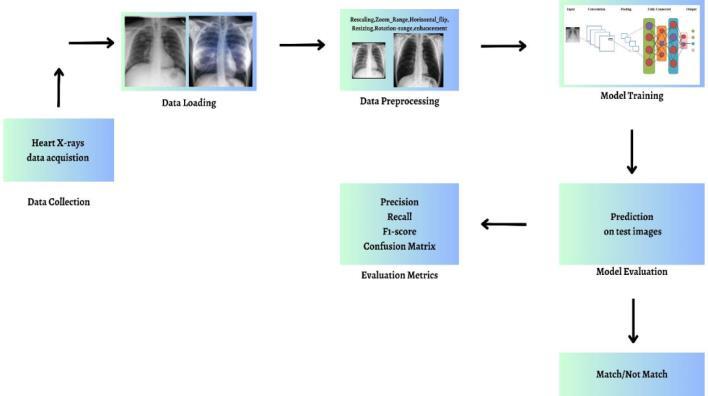
Amoduleconnectivitydiagramforadeeplearningproject servesasavisualrepresentationofhowdataflowswithin thesystempipeline.Thisdiagrambreaksdowntheproject intologicalcomponentsknownasmodules,eachplayinga crucialroleintheoverallfunctioningofthesystem.Tobetter understandthisconcept,let'sconsideranexamplewherethe deep learning project involves image recognition. In this scenario, the modules could include data preprocessing, feature extraction, neural network training, and classification.
Thearrowsinthediagram,suchasthoseshowninFigure illustrate the flow of data between these modules. For instance,dataprocessedinthepreprocessingmodulemay then be passed on to the feature extraction module for further analysis. This sequential flow of information is essential for the efficient functioning of the deep learning project. By clearly visualizing the connectivity between modules,stakeholderscangaininsightsintohowdatamoves through the system and identify potential bottlenecks or areasforoptimization.
In summary, a module connectivity diagram is a valuable toolforunderstandingthestructureanddataflowwithina deep learning project. It provides a clear overview of the relationships between different components, helping to streamlinethedevelopmentprocessandimprovetheoverall efficiencyofthesystem.
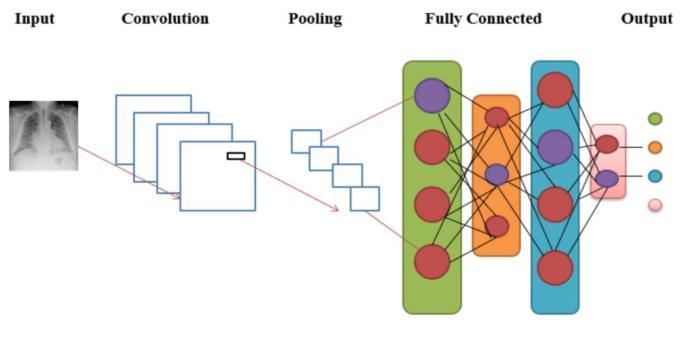
Similar to the initial convolutional block, the second convolutional block also plays a crucial role in the neural networkarchitecture.Inthisblock,aConv2Dlayerisutilized with64filtersanda3X3kernelsize.Theactivationfunction employedhereisReLU,whichhelpsintroducenon-linearity intothemodel.Additionally,max-poolinganddropoutwitha dropoutrateof0.3areincorporated.Thesemechanismsaid inenhancingthenetwork'sdepth,allowingittoextractmore intricate features from the data. Moving on to the third convolutionalblockwith128filters,thenetwork'sdepthis further increased. Following a similar pattern, another convolutional layer witha 2X2kernel sizeisadded.Batch normalization is then applied to ensure that the network trains more efficiently by normalizing the inputs. Subsequently, max-pooling and dropout operations are executedtopreventoverfittingandimprovegeneralization.
By cascading these convolutional blocks, the network progressively captures increasingly abstract and complex features present in the input images. This hierarchical feature extraction process is essential for the network to learn and distinguish patterns effectively. For example, in image recognition tasks, the first block might detect basic shapes like edges, while subsequent blocks could identify more intricate patterns like textures or object parts. This iterativerefinementoffeaturesultimatelycontributestothe network's ability to make accurate predictions and classifications. International Research Journal of Engineering and Technology (IRJET) e-ISSN: 2395-0056
International Research Journal of Engineering and Technology (IRJET) e-ISSN: 2395-0056
Volume: 11 Issue: 10 | Oct 2024 www.irjet.net p-ISSN: 2395-0072
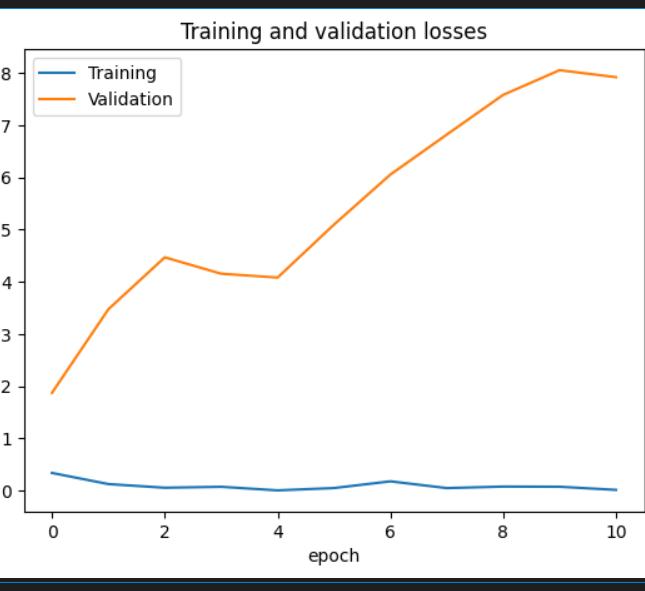
Trainingandvalidationlossesarepivotalmetricsutilizedto assess the efficacy of a machinelearning model during its trainingphase.Itprovestobeaformidabletasktomodelthe probabilities linked to heart disease diagnosis, especially whenemployingConvolutionalNeuralNetworkswithX-ray images as input. The data embedded in these images are sourced from primary medical repositories. With the integrationofthismodel,itwillembarkontrainingwitha broader spectrum of real-world images than it currently encompasses.Withintherealmofheartdiseaseprognosis utilizingX-rayimagesandConvolutionalNeuralNetworks, these losses offer insights into the model's proficiency in recognizing patterns and rendering precise predictions. Broadlyspeaking,withinthetrainingdataset,trainingloss gaugesthediscrepancy.Itisessentiallycomputedforeach training instance as the disparity between the forecasted outputandtheauthenticlabel.
7.1.Training loss
Training loss comprises the discrepancy computed on a training set, representing the difference between the anticipatedoutputpredictedbytheCNNandtheactuallabel foreachtraininginstance.Typically,adecliningtrainingloss indicatesthemodel'sassimilationofthetrainingdata.These metricsareessentialforkeepingtheuserinformedaboutthe training and validation progress, preventing potential overfitting scenarios where the training loss decreases significantlywhilethevalidationlossremainshigh.
7.2.Validation loss
Validation loss serves a crucial purpose in assessing the erroronthevalidationset,whichshouldideallyconsistof data distinct from that used in the training phase. An additionalsignificanceofvalidationlossliesinitsabilityto gaugeamodel'scapacityforgeneralization.Alowvalidation lossindicatesthemodel'sproficiencyinhandlingnewdata, whereasasubstantialdisparitybetweenthevalidationloss andtraininglosssuggestsoverfitting.
At the completion of this project, the proposed model successfullyattainedtheprimaryobjectivesoutlinedinthe preceding sections. By harnessing a deep learning convolutionalneuralnetwork(CNN),themodeleffectively predicts, analyzes, and classifies patient X-ray images for heart disease detection. This serves to indicate whether a patientexhibitssymptomsofheartdiseaseorisconsidered normalandhealthy.Ourmodelstrivestoenhanceprediction performanceandaccuracythroughtheimplementationofa sequential model architecture, coupled with advanced optimizationtechniques.Thesignificanceofourproposed modelliesinitsabilitytoenableearlyandprecisedetection ofheartconditions,potentiallysavinglives.Theautomation ofdiagnosticprocedurescannotonlyaidinsavinglivesbut alsoassistdoctorsinprovidingmoreaccuratediagnoses.
Theproposedsystemmakessubstantialcontributionstothe fieldsofmedicine,healthcare,andartificialintelligence(AI), particularlyintherealmofmedicalimagingforheartdisease prediction using X-ray images. The incorporation of automated diagnostic processes in our proposed system exemplifieshowdeeplearningtechniquescanstreamlinethe diagnosis process, leading to faster and more accurate medical image predictions. This is particularly crucial in hospital and clinical settings. Key achievements of our proposed system include the successful development of a deeplearningmodeldesignedfortheanalysisandprediction of patient X-ray images. The model encompasses data preparation,involvingacurateddatasetcomprisingimages of hearts and normal samples categorized for testing and trainingpurposes.
1. Agrahary, A. (2020). Heart disease prediction using machinelearningalgorithms.InternationalJournalof Scientific Research in Computer Science Engineering
International Research Journal of Engineering and Technology (IRJET) e-ISSN: 2395-0056
2. Bhatt,C.M.,Patel,P.,Ghetia,T.,&Mazzeo,P.L.(2023). Effective heart disease prediction using machine learning techniques. Algorithms, 16(2), 88. https://doi.org/10.3390/a16020088
3. Chitra, R., & Seenivasagam, D. (2013). Heart disease predictionSystemusingSupervisedLearningClassifier. BonfringInternationalJournalofSoftwareEngineering and Soft Computing, 3(1), 01–07. https://doi.org/10.9756/bijsesc.4336
4. Darmawahyuni,A.,Nurmaini,S.,&Firdaus,F.(2019). Coronary heart disease interpretation based on deep neural network. Computer Engineering and Applications Journal, 8(1), 1–12. https://doi.org/10.18495/comengapp.v8i1.288
5. Gupta,P.,&Seth,D.(2022).Comparativeanalysisand feature importance of machine learning and deep learning for heart disease prediction. Indonesian JournalofElectricalEngineeringandComputerScience, 29(1), 451. https://doi.org/10.11591/ijeecs.v29.i1.pp451-459
6. Haq, A. U., Li, J. P., Memon, M. H., Nazir, S., & Sun, R. (2018).Ahybridintelligentsystemframeworkforthe prediction of heart disease using machine learning algorithms. Mobile Information Systems, 2018, 1–21. https://doi.org/10.1155/2018/3860146
7. Haque,E.,Paul,M.,&Tohidi,F.(2024).PredictingHeart FailurewithAttentionLearningTechniquesUtilizing Cardiovascular Data. arXiv (Cornell University). https://doi.org/10.48550/arxiv.2407.08289
8. Javid, I., Khalaf, A., & Ghazali, R. (2020). Enhanced Accuracy of Heart Disease Prediction using Machine Learning and Recurrent Neural Networks Ensemble Majority Voting Method. International Journal of Advanced Computer Science and Applications, 11(3). https://doi.org/10.14569/ijacsa.2020.0110369
9. JournalofAdvancesinInformationTechnology.(2023). Journal of Advances in Information Technology. https://doi.org/10.12720/jait
10. Latifi, S. A., Ghassemian, H., & Imani, M. (2024). ClassificationofheartsoundsusingMulti-BranchDeep ConvolutionalNetworkandLSTM-CNN.arXiv(Cornell University).
https://doi.org/10.48550/arxiv.2407.10689
11. Li,D.,Fu,J.,Zhao,J.,Qin,J.,&Zhang,L.(2023).Adeep learningsystemforheartfailuremortalityprediction. PLoS ONE, 18(2), e0276835. https://doi.org/10.1371/journal.pone.0276835
12. Makumba,D.O.,Cheruiyot, W.,& Ogada, K.(2019).A modelforcoronaryheartdiseasepredictionusingdata mining classification techniques. Asian Journal of Research in Computer Science, 1–19. https://doi.org/10.9734/ajrcos/2019/v3i430098
13. Miao, K. H., & H, J. (2018). Coronary Heart Disease DiagnosisusingDeepNeuralNetworks.International Journal of Advanced Computer Science and Applications, 9(10). https://doi.org/10.14569/ijacsa.2018.091001
14. Prediction of Heart Disease using Artificial Neural Network. (2018). VFAST Transactions on Software Engineering, 102–112. https://doi.org/10.21015/vtse.v13i3.511
15. S,S.V.,V,V.,M,V.,&Bhuvana,S.(2019).Heartdisease prediction system using K- Nearest Neighbour Classification technique. International Journal of Scientific Research in Computer Science Engineering and Information Technology, 229–236. https://doi.org/10.32628/cseit195247
16. Samagh,J. S.,& Singh,D.(2022).AMachineLearning Model for Predicting Heart Disease using Ensemble Methods.InternationalJournalofAdvancedComputer Science and Applications, 13(9). https://doi.org/10.14569/ijacsa.2022.0130965
17. Saranya, S., & Manavalan, R., PhD. (2019). ComputationalFrameworkforHeartDiseasePrediction usingDeepBeliefNeuralNetworkwithFuzzyLogic.In ArignarAnnaGovernmentArtsCollege,Departmentof Computer Science, & Department of Computer Applications&InformationTechnology,International JournalofComputerApplications(Vols.181–181,Issue 49, pp. 26–27). https://www.ijcaonline.org/archives/volume181/num ber49/saranya-2019-ijca-918675.pdf
18. Shinde,A.A.,NBNSinhgadSchoolofEngineering,Kale, S.N.,Samant,R.M.,Naik,A.S.,&Ghorpade,S.A.(2017). Heart Disease Prediction System using Multilayered FeedForwardNeuralNetworkandBackPropagation NeuralNetwork.InInternationalJournalofComputer Applications (Vols. 166–166, Issue No.7, pp. 32–33). https://www.ijcaonline.org/archives/volume166/num ber7/shinde-2017-ijca-914080.pdf
19. Singh,P.,Singh,S.,&Pandi-Jain,G.S.(2018).Effective heart disease prediction system using data mining techniques. International Journal of Nanomedicine, Volume 13, 121–124. https://doi.org/10.2147/ijn.s124998
20. Tuba,S.(2023).OptimizationHeartDiseasePrediction using Machine Learning Models. FIDELITY Jurnal
Volume: 11 Issue: 10 | Oct 2024 www.irjet.net p-ISSN: 2395-0072 © 2024, IRJET | Impact Factor value: 8.315 | ISO 9001:2008 Certified Journal | Page595 and Information Technology, 137–149. https://doi.org/10.32628/cseit206421
International Research Journal of Engineering and Technology (IRJET) e-ISSN: 2395-0056
Volume: 11 Issue: 10 | Oct 2024 www.irjet.net p-ISSN: 2395-0072
Teknik Elektro, 5(1), 53–59. https://doi.org/10.52005/fidelity.v5i1.142
21. Yahaya, L., Oye, N. D., & Garba, E. J. (2020). A comprehensive review on heart disease prediction using data mining and machine learning techniques. American Journal of Artificial Intelligence, 4(1), 20. https://doi.org/10.11648/j.ajai.20200401.12
22. Yewale,D.,Vijayaragavan,S.P.,&Bairagi,V.K.(2023). AnEffectiveHeartDiseasePredictionFrameworkbased on Ensemble Techniques in Machine Learning. International Journal of Advanced Computer Science and Applications, 14(2). https://doi.org/10.14569/ijacsa.2023.0140223
23. Yousef,M.,&Batiha,K.(2021).Heartdiseaseprediction model using naïve Bayes algorithm and machine learning techniques. International Journal of Engineering & Technology, 10(1), 46. https://doi.org/10.14419/ijet.v10i1.31310
© 2024, IRJET | Impact Factor value: 8.315 | ISO 9001:2008