
International Research Journal of Engineering and Technology (IRJET) e-ISSN:2395-0056
Volume: 11 Issue: 10 | Oct 2024 www.irjet.net p-ISSN:2395-0072

International Research Journal of Engineering and Technology (IRJET) e-ISSN:2395-0056
Volume: 11 Issue: 10 | Oct 2024 www.irjet.net p-ISSN:2395-0072
Sachin Kumar1, Diwakar Yadav2 , Swadesh Prabha Jetli3, Arti Maurya4, Vikas Bharti5 , Shubhendu Mishra6 ,
1,2,3,4,5Student, Department of Civil Engineering, AKTU University, Goel Institute of Technology and Management, Lucknow, India
6Assistant Professor, Department of Civil Engineering, AKTU University, Goel Institute of Technology and Management, Lucknow, India
Abstract – This research paper investigates the impact of seismic and wind load effects on high-rise buildings,emphasizingtheirstructuralperformanceand safety. As urbanization increases, the necessity for taller structures has become paramount, necessitating a thorough understanding of the forces acting upon them. This study employs a combination of numerical simulations and experimental data to analyze how various design parameters influence a building's responsetoseismicandwindloads.
The findings reveal that the interaction between these forces significantly affects the structural integrity and overall stability of high-rise buildings. Advanced modelling techniques, including response spectrum analysis and time-history analysis, are utilized to assess the dynamic behavior of structures under different loading scenarios. The paper also highlights the importance of incorporating efficient design strategies and materials to mitigate potential damage during extremeevents.
Ultimately, the research underscores the need for updated codes and standards that account for the combined effects of seismic and wind loads in high-rise building design. Recommendations for future research directions and practical implications for engineers are alsodiscussed,aimingtoenhancetheresilienceofurban infrastructureinthefaceofnaturalhazards
Keywords
1. Seismic loads ,2. Wind loads ,3. High-rise buildings ,4. Structural performance ,5. Dynamic analysis
1. INTRODUCTION
1.1Seismicload
An earthquake is defined as the shaking of the surface of the Earth resulting from a sudden release of energy in the Earth’s lithosphere that creates seismic waves. This release of energy usually occurs because of the movement of tectonic plates beneath the Earth’s surface.
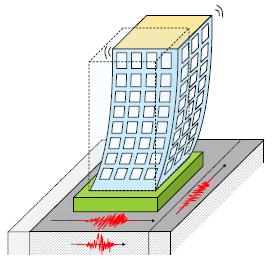
Seismic load refers to the forces imposed on structures by an earthquake. These loads arise from ground motion, causing dynamic shaking that can lead to structural deformation or collapse if not properly accounted for. Engineers design buildings to resist seismic loads by using materials and systemsthatabsorbanddissipateenergy,ensuringsafetyand stability during earthquakes. This includes incorporating flexible structures, base isolators, and dampers to reduce seismiceffectsonthebuilding.
1.2Windload
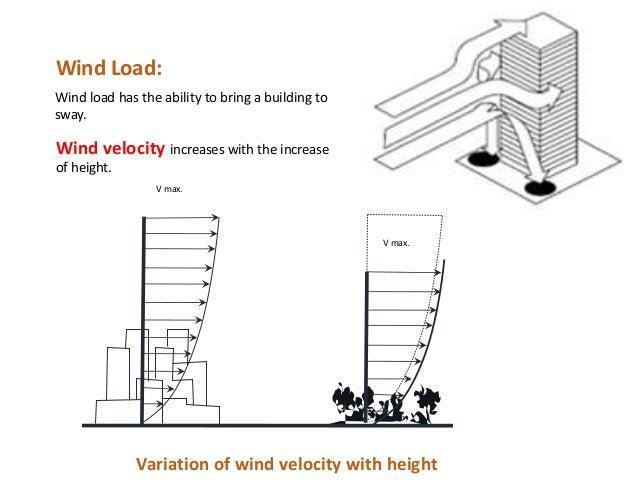
1.2 Variation of wind velocity with height
International Research Journal of Engineering and Technology (IRJET) e-ISSN:2395-0056
Volume: 11 Issue: 10 | Oct 2024 www.irjet.net p-ISSN:2395-0072
Any stresses or tensions that the wind transmits to a component or structure are referred to as wind loads in this context. Essentially, there are three different kindsofwindloadsthatcouldbeappliedtoabuilding. Uplift, shear and lateral wind load. Even standard building designs must take wind loads into account. Especially, if located in some areas with significant wind forces such as coastal areas. When designing structures to effectively avoid these effects, wind analysis is utilized to evaluate the dynamic effects of windonastructure.
Windloadistheeffectofwindonbuildings,structures and other objects. It is caused by wind pressure, air speedandwindvelocity.
The primary objectiveof controllingseismicand wind load effects on high-rise buildings in Srinagar is to ensure thestructural safety andresilience of buildings against natural hazards. This includes analyzing the unique seismic and wind conditions of the region, developing design strategies that minimize structural vulnerability,andoptimizingmaterialuseforenhanced strength and flexibility. The study also aims to integrate advanced modeling techniques, such as response spectrum and time-history analysis, to predict building behavior under combined loading conditions. Ultimately, the goal is to improve building codes and standards, promoting safer, more sustainableurbandevelopmentinSrinagar
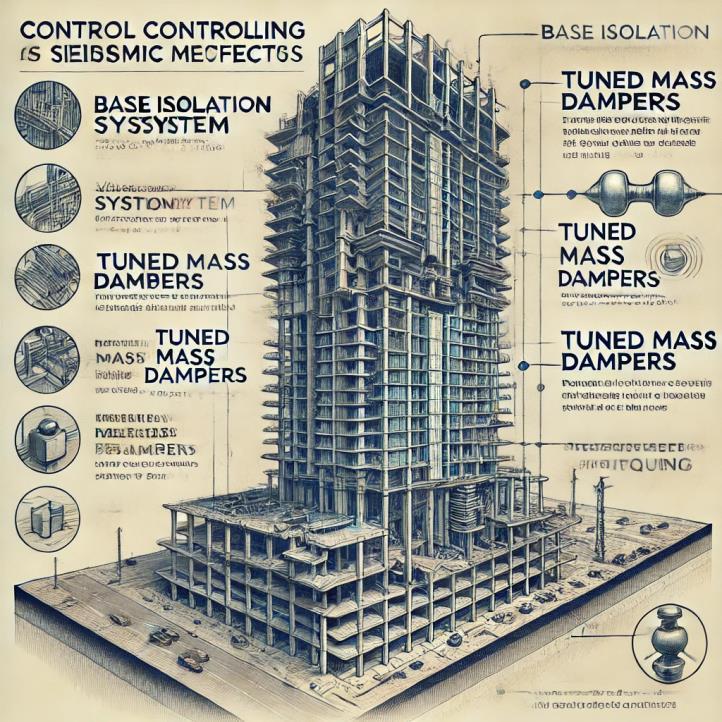
Anewmethodtocontrolseismicandwindloadeffects on high-rise buildings involves the integration of adaptive structural systems, advanced materials, and cutting-edge technology. One promising approach is the use of **tuned mass dampers (TMDs)** in conjunctionwith**baseisolationsystems**,creatinga dynamic dual defense against both seismic and wind forces. Tuned mass dampers reduce vibrations by counteracting motion through oscillating weights, while base isolation decouples the building from ground motion during an earthquake, mitigating seismic effects. Combining these two systems ensures protection against lateral forces caused by both wind andseismicactivities.
**Smart materials** such as shape memory alloys (SMAs) and fibre-reinforced polymers (FRPs) can further enhance structuralresilience.SMAscandeformduringseismicorwind eventsandreturntotheiroriginalshape,reducingpermanent structural damage. FRPs, known for their strength-to-weight ratio, offer excellent stiffness and flexibility, making them suitableforreinforcingcriticalload-bearingcomponents.
Another innovative solution is the use of **active control systems**, where sensors detect real-time environmental forces,andactuatorsrespondbyadjustingstructuralelements to counteract excessive loads. Such systems are particularly effective in regions like Srinagar, where buildings face both seismicandwindchallenges.
International Research Journal of Engineering and Technology (IRJET) e-ISSN:2395-0056
Volume: 11 Issue: 10 | Oct 2024 www.irjet.net p-ISSN:2395-0072
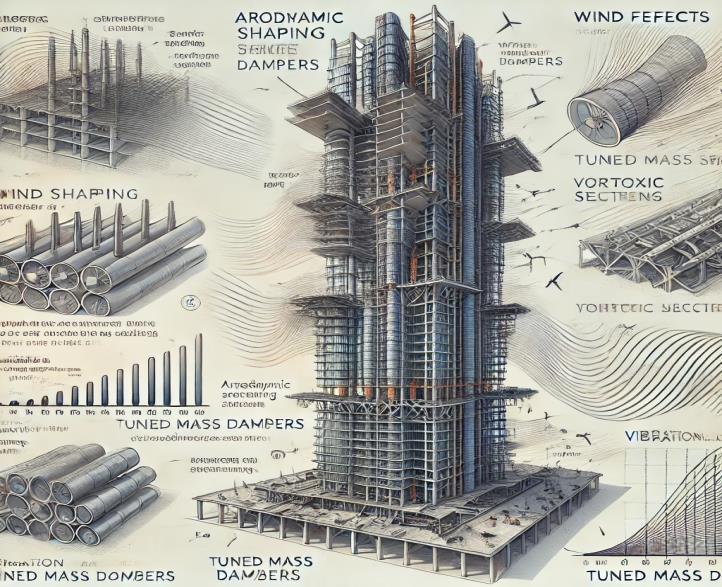
Lastly,incorporating**aerodynamicbuildingdesigns** that reduce wind drag and lateral pressures can significantly lower wind-induced stresses on high-rise structures. By integrating these methods, high-rise buildings can achieve improved performance, increaseddurability,andenhancedsafetyinthefaceof seismic and wind loads, paving the way for more resilienturbaninfrastructure.
In conclusion, controlling seismic and wind effects on high-risebuildingsrequiresacombinationofadvanced technologies, innovative materials,and efficient design strategies. Integrating systems like tuned mass dampers, base isolation, and smart materials can significantly enhance a building's resilience. By adoptingthesemethodsandupdatingstructuralcodes, we can ensure safer, more durable high-rise buildings capableofwithstandingextremenaturalforces
1.https://onlinelibrary.wiley.com/doi/10.1155/2020/ 8850688
2.https://www.sciencedirect.com/science/article/abs/pii/S22 1067071730594
3. http://eprints.utar.edu.my/3759/1/1600469_FYP_Report__YEE_JIN_TAN.pdf
4.https://www.nature.com/articles/s41598-023-46207-8
5.https://www.iitk.ac.in/nicee/wcee/article/WCEE2012_128 1.pdf
6.https://ascelibrary.org/doi/abs/10.1061/(ASCE)07339445(2008)134:7(1139)
7 WAYNESEAMES
8 LIMITSTATEDESIGNOFSTEELSTRUCTURE(S.K.DUGGAL)
9 SEISMICANALYSISOFSTRUCTURE(T.K.DATTA)
10.SEISMICHAZARDANDRISKANALYSIS(JACKW.BAKER)