
International Research Journal of Engineering and Technology (IRJET) e-ISSN: 2395-0056
Volume: 11 Issue: 10 | Oct. 2024 www.irjet.net p-ISSN: 2395-0072

International Research Journal of Engineering and Technology (IRJET) e-ISSN: 2395-0056
Volume: 11 Issue: 10 | Oct. 2024 www.irjet.net p-ISSN: 2395-0072
Dr. Dada S. Patil1 , Alware Azain Zafar2 , Nihal Layak Ali Sayyed3 & Ayman A. Khan4
1Associate Professor, Civil Engineering Department, AIKTC, SoET, Panvel, Navi Mumbai, India
2Final Year Civil Engineering Student, AIKTC, SoET, Panvel, Navi Mumbai, India
3 Final Year Civil Engineering Student, AIKTC, SoET, Panvel, Navi Mumbai, India
4Final Year Civil Engineering Student, AIKTC, SoET, Panvel, Navi Mumbai, India
Abstract - If structural grade lightweight aggregates (LWAs) are utilized, in place of usual locally available soil, in backfill and above the soft soils for the retaining structures, they offer advantages in terms of geotechnical physical properties like increased stability, high thermal resistance, highpermeability andreduced density. Highangleof internal friction (angle of shearing resistance) leads to improved stability; reduced specific gravity enhances the physical properties. A closely controlled manufactured aggregate gradation leads to an open texture, which in turn results in high permeability. The porosity getting developed during the LWA manufacturing process results in improved thermal resistance. The various LWAs that can be used as backfill materials are Light Expanded Clay aggregates (LECA), ExpandedShale, Slate, Perlite, Pumice, SinteredFlyAshLWAs, etc. LWA fills are approximately half the weight of fills consisting of common materials. The decreased load, combined withhigh internalfrictionangle leadto decrease in vertical and lateral earth forces by more than one-half. This leads to economy owing to the fact that the sizes of various parts ofretainingstructures are reduced, thereby resultingin saving in quantities of concrete and reinforcement steel. The paper discusses engineering and economical benefits of using LWAs as backfill materials. Few cases from the developed countries are mentioned. A need to adopt this approach on a wider scale in India is highlighted.
Key Words: LWA Fill, Lateral Earth Pressure, Drainage, Weight,RetainingStructure,UnitWeight,Permeability,etc.
Shales,claysandslateshavebeenexpandedinrotarykilnsto manufacturestructuralgradeLWAsforuseinmasonrywork andconcrete,for morethan 8decades.Hugequantities of these aggregates are used in structural concrete constructions,withwidespreadavailabilityacrossUSAand other developed countries [1]. An idea of utilizing these aggregatesforgeotechnicalapplicationoriginatesprimarily fromtheirenhancedphysicalproperties.Theparticleshapes ofLWAsvaryfromangulartoroundwithintrinsicallyhigh interstitialvoidswhichareduetoanarrowrangeofparticle sizes.TherearetwobasicrequirementsforLWAstobeused for the geotechnical applications. First is high interstitial
void content typical of closely controlled manufactured granular coarse aggregates, which are similar to a clean, crushedstone.Secondishighporevolumeenclosedwithin thecellularparticle[1].
Whenslates,claysandshalesaresubjectedtotemperatures morethan11000 Cinrotarykilns,acellularstructuregets formed.Itcomprisesofnon-interconnectedsphericalpores which are surrounded by a strong and durable ceramic matrixhavingcharacteristicssameasthatofvitrifiedclay bricks [1]. Oven dry specific gravities of LWAs vary. However,thevaluesare between1.25to1.40.Highinterparticlevoidcontentalongwithlowspecificgravityleadsto bulk dry densities usually in the range of 720 kg/m3 [1]. Compaction of LWAs in a way similar to that used with crushedstoneresultsinahighlystableinterlockingnetwork. Thisresultsindevelopmentofin-placemoistdensitiesless than1040kg/m3 [1].
Expanded Shale, Clay and Slate (ESCS) fills need no specializedmachineriesorformsfortheirinstallation.Usual equipmentavailableonsitecanbemadeuseofforplacing them in all weathers. They are easy to handle and more importantly,durableunderextremeweatherconditions[2]. They don’t need liners. They also don’t require additional measurestopreventbuoyancyissues.ESCSfillsareangular artificial LWAs which are freely draining and strong structurally[2].WatermovesveryeasilythroughESCSfills. Hence,thereisnoneedtoplacespecialdrainagechannels throughoutthefill.
Whenusedasabackfillmaterialagainstretainingwall,LECA reduces the weight on the rear of the structure by approximately75%,ascomparedtousualfillmaterial[3]. Differentialsettlementbetweenembankmentfillandpiled bridgeabutmentsisminimizedbyusingLECA[3].Rearwall block drainage is not needed as LECA is a free-draining material.
International Research Journal of Engineering and Technology (IRJET) e-ISSN: 2395-0056
Volume: 11 Issue: 10 | Oct. 2024 www.irjet.net p-ISSN: 2395-0072
Structural grade LWAs provide cohesionless, granular fill whichderivesstabilityduetointer-particlefriction.Angleof internal friction of more than 400 was reported in an extensivetestingonlargespecimensofsize(250mmx600 mm) [4]. Triaxial compression tests carried-out on LWAs from six plants, which included variations in moisture content, gradations and compaction levels indicated high anglesofinternalfriction.Withanin-placemoistcompacted unit weight less than 960 kg/m3, it can be realized that lateral pressures, overturning moments and gravitational forces become one-half of that of commonly used backfill soils [4]. The extensive direct shear tests carried-out by Valsangkar and Holm [5], given in table 1 revealed high anglesofinternalfriction.
Table-1:AngleofInternalFriction(DirectShearTest)[5] Angle of Internal Friction (Degrees)
TwobasicaspectsofLWAfillmodifytheusualinterpretation of Proctor test results. Firstly, absorption of LWA is more thanthatofnaturalsoils.Someofthewateraddedduring the test gets absorbed within the aggregate particle. This doesnotinfluenceinter-particlephysics(surfacelubrication, bulking,etc.).Secondly,unlikecohesivenaturalsoils,LWAs consist of small amounts of fines, thereby restricting the densityincreaseowingtothepackingoffinesbetweenlarge particles.TheprocessofcompactingLWAfillisnottoobtain highestin-placedensity,ratheritistoaimforanoptimum densitywhichcanimparthighstabilitywithoutconsiderably increasingcompacteddensity[1].Inmanyprojects,in-place compactedmoistdensitydidnotexceed960kg/m3,asper specificationrequirements[1].
Valsangkar and Holm [7] revealed outcomes of testing programsoninteractionbetweenLWAfillsandgeotextiles whichcomprisedofvariablesofvariousaggregatetypesand densities,aggregatethicknesslayerandtypesofgeotextile. Theoverallroadbedstiffnesswasobservedtobeunaffected when LWAs were utilized instead of NWAs for small deflections and initial load applications. These tests were followed by a large-scale test [5], which led to conclusion thatthecomparisonoffrictionanglesbetweenLWAorNWA andgeotextilesshowedthatinterfacefrictioncharacteristics arebetterforLWAsthanNWAs.
AttemptstoknowthepermeabilityofunboundLWAswere not conclusive due to inability to measure uncontrolled increasedwaterflowratepassingthroughanopen-graded structure. This phenomenon hasalso been experienced in the field, where huge water volumes have been shown to pass through LWA drainage systems [1]. Exfiltration applications of LWAs have shown a capacity to efficiently cope-up with huge quantities of storm water runoff. Subterranean exfiltration systems offered reasonable alternativestoinfiltrationpondsbynotutilizingexpensive property areas and totally eliminating long-term maintenanceissueincaseof openwaterstorage[1].
Large-scale compressibility tests conducted on LWA fills revealedthatthecurvatureandslopeoftheLWAfillstressstraincurvesinconfinedcompressionweresimilartothose seen for limestone samples [5]. Cyclic plate-bearing tests carried out on LWA fills resulted in vertical subgrade reactionresponseswhichweresimilarforLWAandnormal weightaggregate(NWA)samples[6].
3. STRUCTURAL LIGHTWEIGHT AGGREGATE AS A BACKFILL MATERIAL FOR THE RETAINING STRUCTURES
ReferringESCSI[2],typicaldesignvaluesfortheusualsoil backfill materials are: Soundness loss < 6%, abrasion resistance10-45%,compactedin-placebulkdensity15.7-20 kN/m3,angleofinternalfrictionforsandandgravel300-380 , loosebulkdensity14-16.5kN/m3 andpHvalue5-10.
For ESCS LWAs, typical values are: Soundness loss < 6%, abrasionresistance20-40%,compactedin-placemoistbulk density6-10kN/m3,angleofinternalfriction350-450+,loose bulkdensity4.5-9kN/m3,pHvalue7-10andchloridecontent 10-70ppm.
Referring cantilever retaining wall in fig. 1, active earth pressureatbaseispa=kaϒHandthetotalactivetrustonthe wallperunitlengthofwallisPa =kaϒH2/2[8].ItactsatH/3 from the base, through the centroidal of the pressure distributiondiagram.
International Research Journal of Engineering and Technology (IRJET) e-ISSN: 2395-0056
Volume: 11 Issue: 10 | Oct. 2024 www.irjet.net p-ISSN: 2395-0072
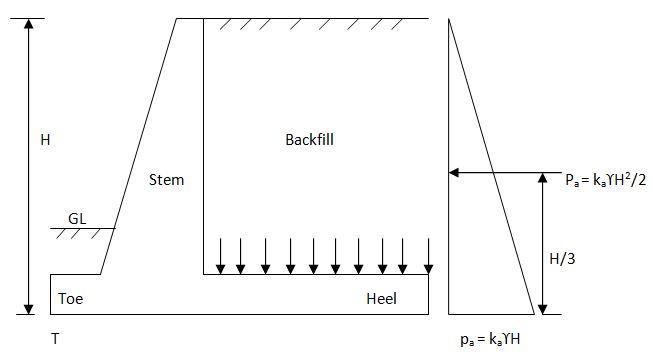
Fig -1:ActiveEarthPressureofDryCohesionlessSoilRankine’sTheory[8]
If Φ is the angle of internal friction of soil, coefficient of activeearthpressure,ka=(1-sinΦ)/(1+sinΦ)
Considering usual soil backfill material: let Φ = 320 and compacted in-place moist bulk density ϒ = 19 kN/m3 . Therefore,ka=0.47/1.53=0.307.
AssumingoverallwallheightHas7m,totalactivethrustper metrelengthofwallPa =(0.307x19x72)/2=142.90kN. Itactsat(7/3)=2.33mfromthebase.
Overturning moment about the toe T is (142.90 x 2.33) = 332.95kNm.
Forthesamewall,consideringLWAbackfill:letΦ=420and ϒ=8kN/m3.Therefore,ka =0.33/1.67=0.197.
Pa =(0.197x8x72)/2=38.61kN,actingat(7/3)=2.33m fromthebase.
Thelateralactiveearththrustisreducedby(142.90–38.61) =104.29kN.Hence,thewallbecomessaferagainstsliding, duetotheuseofLWAs.
Overturning moment about the toe T is (38.61 x 2.33) = 89.96kNm.
Overturningmomentisreducedby(332.95–89.95)=243 kNm. Hence, the wall becomes safer against overturning, becauseofusingLWAs.
Further,assumingthestemheightas6.6mandheellength as3m,theresultantweightofthebackfillontheheelslab permetrelengthoftheretainingwallis(6.6x3x1xϒ).
Forϒ=19kN/m3,weightis376.2kNandforϒ=8kN/m3 , weightis158.4kN.
Thus,thereductioninbackfillmaterialweightonheelslab byusingLWAfillis(376.2–158.4)=217.8kN.
Thesecalculationsclearlyindicatethatthesizesofstemand baseslabwillbegreatlyreducedifLWAisusedasabackfill material.Thiswillleadtolessconsumptionofmaterialslike concrete and reinforcing steel, thereby resulting in considerableeconomy.
If the water table rises to the top of the backfill in certain situations, like rainy season, the backfill will be under submergedconditionsuchthatϒsub =(ϒsat –ϒwater).
Thelateralactiveearthpressuredistributiondiagramgets modifiedasshownnfig.2.
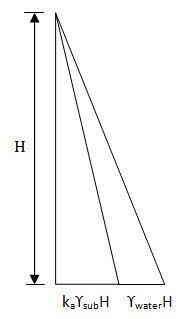
From fig. 2, it can be seen that the pressure at the base increases to (kaϒsubH + ϒwaterH). For common backfill material,thisholdscompletelytrueowingtothefactthatthe water will be held in the void spaces of the saturated soil particles,therebyexertingextralateralpressure.Saturation reducesΦtosomeextent,therebyincreasingka
However,ifLWAfillissubmerged,aggregatesabsorbwater due to their porous nature; they become partially or fully saturated;moreoverwaterwilldrainouteasilyduetohigh permeability.
TherewillbenegligiblereductioninthevalueofΦ;sokawill not increase considerably. This results in lateral earth pressuremuchlowerthanthatofsubmergedsoilbackfill.
Retainingwallfailuresmayoccurthroughthevariousmodes showninfig.3.
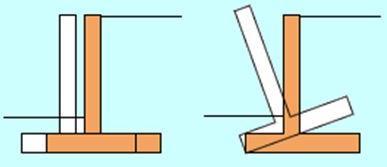
a) Sliding b)Overturning
International Research Journal of Engineering and Technology (IRJET) e-ISSN: 2395-0056
Volume: 11 Issue: 10 | Oct. 2024 www.irjet.net p-ISSN: 2395-0072
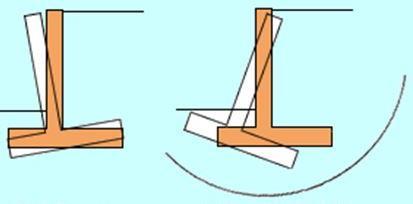
c)SoilBearingFailure d)GlobalInstabilityFailure
Fig. - 3:ModesofFailuresofRetainingWall
4. USE OF LWA BACKFILL FOR THE RETAINING STRUCTURES IN DEVELOPED COUNTRIES
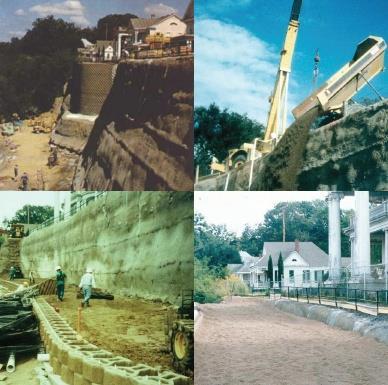
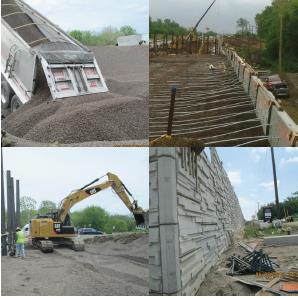
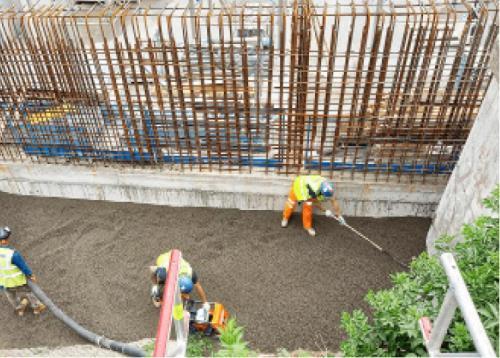
In developed countries, LWA backfill for the retaining structuresarepracticedonareasonablescale.FewCasesare mentioned.
5. SCOPE FOR UTILIZING LWA FILLS FOR THE RETAINING STRUCTURES IN INDIA
InIndia,LWAfillsarenotused;ratherlocallyavailablesoils, withdesiredgeotechnicalproperties,areutilized.Thisleads to uneconomic outcome in terms of bulky sizes of the retaining wall components, requiring huge quantities of concrete and steel. Drainage of water is also an issue of concern. Therefore, there is a scope for using LWAs as backfill materials on a large scale. Manufactured LWAs of requiredsizesareeasilyavailableinvariouspartsofIndia. These materials are environment-friendly, leading to a sustainabledevelopment.
6. CONCLUSIONS
Ascomparedtotraditionalbackfillmaterials,thedecreasein weightandlateralearthpressurebroughtaboutbyLWAfills canavoidpotentialsliding,slipandtitling,overturningand bearing failures. The sizes of various components of retaining wall can be reduced resulting in to economy. Drainagecanbegreatlyimproved.LowdensityofLWA,with easeofhandlingandplacingmakethempotentialmaterials tobeusedasbackfillmaterials.
[1]T.A.Holm&A.J.Valsangkar, TransportationResearch Record,1422.
[2]ESCSI(ExpandedShale,ClayandSlateInstitute):Rotary Kiln Structural Lightweight Aggregate, Publication #6600.5.04-2018,www.escsi.org
[3]InnovativeRetainingWallDesignwithLECALightweight Fill,SaintGobain,www.leca.co.uk
[4]Stoll,R.D.,andT.A.Holm.ExpandedShaleLightweight Fill: Geotechnical Properties. Journal of Geotechnical Engineering,ASCE,Vol.111,No.8,Aug.1985.
International Research Journal of Engineering and Technology (IRJET) e-ISSN: 2395-0056
Volume: 11 Issue: 10 | Oct. 2024 www.irjet.net p-ISSN: 2395-0072
[5]Valsangkar,A.J.,andT.A.Holm.GeotechnicalProperties of Expanded Shale Lightweight Aggregate. Geotechnical TestingJournal,ASTM,Vol.13,No.1,March1990,pp.10-15.
[6]Valsangkar,A.J.,andT.A.Holm.CyclicPlateLoadTests onLightweightAggregateBeds.Presentedat72ndAnnual MeetingoftheTransportationResearchBoard,Washington, D.C.,Jan.1993.
[7] Valsangkar, A. J., and T. A. Holm. Model Tests on PeatGeotextile Lightweight Aggregate System. Geotextiles and Geomembranes.ElsevierSciencePublishers,Ltd.,England, 1987.
[8] Venkatramaiah, C. Geotechnical Engineering. Revised Third Edition. New Age International (P) Ltd. Publishers, NewDelhi,2006.
Dr. Dada S. Patil is working as an Associate Professor in Civil Engineering Department in AIKTC,Panvel,NaviMumbai,India.Hisareasofinterestare Structural Engineering, Advanced Concrete Technology, GeotechnicalEngineering,etc.

Mr. Alware Azain Zafar is a final year civilengineeringstudentinAIKTC,SoET,Panvel.

Mr.NihalLayakAliSayyedisafinalyear civilengineeringstudentinAIKTC,SoET,Panvel.

Mr. Ayman A. Khan is a final year civil engineeringstudentinAIKTC,SoET,Panvel.