
Volume: 11 Issue: 10 | Oct 2024 www.irjet.net p-ISSN: 2395-0072

Volume: 11 Issue: 10 | Oct 2024 www.irjet.net p-ISSN: 2395-0072
Limat Teklay Gebremariam1 , Tesfaldet Gebregerges Gebreegziabher2, Fentahun Abebaw Belete3*
1Department of Chemical Engineering, African Youth for Peace and Sustainable Development, PO Box 1313, Mekelle, Ethiopia
2Department of Chemical Engineering, Sustainable Process Developer at INDEA ENERGY, Hong Kong University Science and Technology, Spain
3Department of Chemical Engineering, Ethiopian Institute of Technology-Mekelle, Mekelle University, PO Box 231, Mekelle, Ethiopia
Due to increasing environmental concerns especially related to the use of fossil fuels, new solutions to limit the greenhouse gas effect and energy scarcity are continuously sought. Biomass has emerged in the renewable energy area with a high potential to contribute to the energy needs of both industrialized and developing countries. This study aims at the process simulation and performance analysis of combustion-based small-scale biomass power plants. The adiabatic flame temperature of the biomass waste in the combustion chamber was modeled and estimated in stoichiometric air and with excess air in a Microsoft Excel 2016 (GRG) Non-linear add-in solver. The achievable flame temperature under such conditions was estimated as 1706.3oC The effect of increasing excess air in the achievable maximum temperature, for the combustion chamber, is also studied by considering different air-to-biomass fuel ratios. A comprehensive model of biomass Rankine cycle power plant feed with white eucalyptus biomass waste is modeled and simulated using Aspen plus chemical engineering software. A high enthalpy flow of 13293 KW enters the turbine and 910 KWpower was produced
Keywords: Adiabatic, Biomass, Flame temperature, Power plant,Whiteeucalyptus
Biomass is a type of renewable energy among various energy sources and has various advantages as it is estimated to have low cost and no CO2 emissions (Gebreegziabher et al. 2014) According to a 2016 World Energy Council report, biomass as a flexible renewable energy resource can play an important role in meeting the global demand profile in energy sectors such as heat, power, buildings, and transport Among different types of renewable energy, biomass is one of the largest energy sources, accounting for 14% of the 18% of renewable energy in the global energy mix (World Energy Council
In the process industry, there are various simulation packages used to simulate, analyze, and optimize different processes to achieve efficient operations and maximize profits. In the field of biomass conversion, many researchers modeled the process of thermochemical, biochemical,andmechanicalconversionpathwaysbyusing the Aspen Plus process design program (Lan et al. 2018). An alternative source of energy that is promised to drive the future becomes more common in the energy mix (REEEP,2014) Therefore,thisstudyaimstodeterminethe adiabatic flame temperature (Tf) of the waste biomass (white Eucalyptus) combustion as well as to simulate and analyze the performance of a small-scale biomass power plantusingAspenpluschemicalengineeringsoftware. International Research Journal of Engineering and Technology (IRJET) e-ISSN: 2395-0056
2016) Biomass can be converted into useful energy forms through three main routes: thermochemical extraction, biochemical/biological extraction, and mechanical extraction (Do et al. 2014) and it is considered a suitable precursortechnologyfortheproductionofcommercialbiobased fuels and chemicals (Menin et al.,2020) Although biochemicalconversionprocesseshavebeenestablishedon a commercial scale, they are economically unsustainable and exert market pressures on food crops and biodiversity (Shemfe, Gu, and Ranganathan 2015). The chemical composition of biomass fuels includes combustible elementssuchascarbon(C),hydrogen(H),andSulphur(S). Of these elements, sulfur is undesirable because it reacts withmoistureintheflue gas toformsulfuricacid,whichis highlycorrosivetometalelements intheincinerator.Other elements involved in the combustion process are: Oxygen (O) is present in the fuel because it is bound, and nitrogen (N) is considered an inert element in the development of biomass power plants and therefore does not react with other elements in the fuel. In the combustion chamber, nitrogenoxides,nitrogendioxide,andothernitrogenoxides (NOx) are produced during the combustion process when fuelisburnedathightemperatures(Paraschiv,Serban,and Paraschiv2020).
International Research Journal of Engineering and Technology (IRJET) e-ISSN: 2395-0056
Volume: 11 Issue: 10 | Oct 2024 www.irjet.net
The design, operations, and innovation of products and processesareallinfluencedbythedecisionsmadewiththe help of chemical engineering process simulation software, which also provides accurate insights. In this study, the simulation and modeling process was carried out using Aspen Plus v11 (produced by Aspen Tech), which can define processes containing solids in addition to vapor and liquid streams (Lan et al. 2018) FORTRAN blocks (calculators), sensitivity analysis, optimization, and design requirements are some of the performance analysis methodologies used for these models. Each flowchart variable or function of a flowchart variable can have a design value specified by the user through design specifications, which are utilized for feedback control. Design specifications change the flowchart variables, feed streams, or block inputs that you manipulate to achieve design values. Fortran instructions can be used within design specifications and operation blocks to estimate the functional values of a design specification (Magnusson 2011).
2.1.1.
After specifying the inlet streams, all the blocks were specified according to the design operating condition using unit operation blocks and connecting material and energy streams. The pressures of all feed streams and UNIT operation blocks were specified according to thermodynamic conditions. Aspen Plus is based on minimizing the Gibbs free energy at equilibrium. This means that the residence time is long enough for the chemical reactiontoreach anequilibriumstate. The boiler, anAspen Plus heater,wasusedto evaporatehigh-pressure liquidwaterintohigh-pressuresteamatconstantpressure. In this step, the amount of water with no vapor fraction is changed to completely vapor/steam. The turbine section is just a compressor, high-pressure steam was turned to use full work isotropic condition and a reversible adiabatic expansionofsteamisconsidered.
2.2.
Process evaluation includes the thermodynamic analysis of theprocess.Thethermodynamicpartaimstomaximizethe power generation using the waste biomass (white Eucalyptus).
The adiabatic flame temperature of a white eucalyptus biomass combustion chamber assumes that all the heat produced by combustion is used only to increase the temperature of the combustion products, in other words, the calorimetric temperature and it was decided that determined only under adiabatic conditions (Mbada et al. 2016).Thestoichiometricequationsofcombustionproduct arewrittenasfollows;
The above reaction equation represents the overall reactions in terms of starting materials and final products, the system efficiency, theoretical flue gas composition, and determining requirements of combustion air (Law et al., 2006).

Volume: 11 Issue: 10 | Oct 2024 www.irjet.net
Energy balance was developed for the constant pressure combustionsystem,andthegeneralenergybalancesystem isestimatedbyusingequation(1).
(1)
Where; CV is the calorific value of the fuel at a standard temperature of 25oC (KJ/Kg), Hr and HP are enthalpies of reactant and product respectively at a standard temperature of 25oC in (KJ) and Qc, case loss outside of the combustion system (KJ) and Qu is useful heat of the system (KJ).
Here Qc and Qu are considered to be zero due to adiabatic conditions Thereforeequation(1)issimplifiedto;
CV+HR=Hp (2)
Basedontheaboveargument,CVisthenetspecific heatof thefuelandhenceHp includesonlythesensibleheatterms. Thenetspecificheatofwhiteeucalyptusbiomasswastecan be calculated by using the result of higher heating value (HHV) calculated from Messobo Cement factory (in KJ/Kg) by bomb calorimeter To calculate the lower heating value (LHV),themoisturecontent isconsideredandEquation(3) isusedinestimatingit. (3)
Where; mH isthemassfractionofhydrogeninthesolidfuel and hfg is the enthalpy of vaporization of water/latent heat ofvaporizationofwater
The enthalpy of the white eucalyptus biomass waste fuel andair(ref.25oC)wasestimatedbyusingequation(4) )
Where;Risareactantandi,arecomponentslikeO2,N2, etc., and the summation was carried out for each of the species presentinthereactants.
The specific heats of the fuel, O2, and N2 were evaluated at themean/averagetemperaturebyusingequation(5).
Where; Tm and Ti are the average temperature (mean temperature) and initial temperature respectively. The enthalpy of the reactants was then evaluated by using MicrosoftExcel
The enthalpy of the products of equation (6), however, is notaseasilyevaluatedasitisdefinedby:-
It is known that this relationship can’t be solved explicitly for Tf as there will be a considerable difference between flame temperature and reference temperature 25oC. Therefore, the value of flame temperature was required to evaluate the specific heat of the combustion products. The specific heat of the combustion product was calculated by using a polynomial expression with a straightforward integerpowerseries,usingequation(7)(Hanby1994)
Where; Cp is specific heat ( ), T is the mean temperature a is a constant value. The data for all product gasesareprovidedinTable1.
International Research Journal of Engineering and Technology (IRJET) e-ISSN: 2395-0056
Volume: 11 Issue: 10 | Oct 2024 www.irjet.net p-ISSN: 2395-0072
Standard Generalized Reduced Gradient (GRG) Non-linear Solver in Microsoft Excel was used to solve the required maximum achievable temperature in stoichiometric air withthesameprocedurewith adiabatic flame temperature in excessair was estimated byusingthefollowingaddition formulas. The actual air which is used to calculate the heating value of oxygen in the reacting air is estimated by usingequation(8); (8)
Where:AAisactualair,EARisExcessAirRatio,andTORis TotalOxygenrequired.
The unreacted oxygen which was used to estimate the amount of excess oxygen in the flue gas was estimated by usingequation(9);
Where:UOisUnreactedOxygen
Where:ARisairrequired
Theheatingvalueofnitrogenintheairwasestimatedfrom the amount of Nitrogen in the air and the amount of nitrogenintheairwasestimatedbyusingequation(11):(11)
Where:NAisnitrogenintheair
The Nitrogen in the flue gas was then estimated by using equation(12). (12)
Where:Nistheamountofproductnitrogenin .
Todeterminethestoichiometricandexcessadiabaticflame temperature of a typical white eucalyptus woody biomass material (no-ash) General and Detailed Calculations of Air levels atvarious points wereestimatedusing the Microsoft Exceladd-insolver(GRG).
A simple steam power plant operating in the steam/water Rankinecycleisconsideredandthecyclewasdevelopedby Aspen plus version 11 to estimate the thermodynamic properties of the steam power cycle. Modeling and simulating a simple Rankine cycle for power generation includes basic equipment such as a steam turbine, steam condenser,condensatepump,andthesteamsideofaboiler. Of course, an ideal steam combustion-based Rankine cycle would not include internal irreversibility, with isentropic compression in the pump, constant-pressure heat addition in the boiler, isentropic expansion in the turbine, and constant-pressure heat radiation in the condenser (Fitri, Zaman, and Azizi 2019) The red color streamlines out of theboilershowsupperheatedhigh-pressuresteamandthe blue color stream line flowing from the condenser shows condensedwater.
Volume: 11 Issue: 10 | Oct 2024 www.irjet.net
Figure3:AspenplussimulationmodelofsteamRankinecycle
By using the condition given around the pump, the density ofthemassandenergyratesare;
(13)
Where, wp is the work of the incoming power per unit of massthroughthepump,h1enthalpy-1andh2,enthalpy-2.
Again, the rate of heat transfer from the energy source to the working fluid (Qin) was calculated using the following formula.
(14)
Hence, the operating condition for the steam side of the boilerwasspecifiedundertheflashtypeofdegreeofsuperheating, in which the fraction is vapor, therefore the outlet streamwasestimatedas asaturatedvapor.Byignoringthe heat transfer with its surroundings, the equilibrium of the energyandmassratesforthevolumesetinaturbineinthe softconditionbecomes
(15)
WhereWT istherateofworkproducedperunitofmass vaporthroughaturbine.
In the condenser, heat is transferred from the steam to cooling water flowing in a separate stream. A reversible constantpressure(steamtosaturatedliquid)heatrecovery process was considered. The condensed steam and the temperature of the cooling water were increased step wisely In steady-state, the equilibrium of the mass and
energy rates for the regulating volume surrounding the condensationandheatexchangerpartis:
(16)
Where; h4 and h1 are the heat of enthalpy in the exhaust stream from the turbine and the heat of enthalpy in the lower-pressure water section from the condenser section respectively.
To model the steam turbine of the biomass ideal Rankine cycle FORTRAN (The calculation is estimated by programmingasubroutineinFortran)inacalculatingblock (PIR-CALCULATOR)) manipulator was applied. Based on theFortrandeclarationprocedure,theexactpressureofthe block steam turbine was estimated by using an executable Fortranstatement (17)
Fromtheaboveresult,thethermalefficiencyoftheRankine cycleisdeterminedbyusingequation(18).
Where;W-netisworknetoutputfromthecycle,Q inisheat infromthesourceandQ out isheatoutfromthecycle.So, theworknetoutofthecycleisthencalculatedbyequation (18).
2.3.1.
The steam turbine is a prime mover that changes kinetic energy in steam into rotational mechanical energy through the impact of the steam against the blades (Kareemetal.,2018).Theperformanceofaturbinehavingan isentropic process is expressed by an isentropic efficiency of 1% in the Aspen Plus software. The turbine steam inlet pressure drop is a major parameter affecting turbine performance. To control the design efficiency of the steam turbine, the steam inlet pressure should be maintained. Lowering steam inlet pressure affects to reduction of turbineefficiencyandincreasessteamconsumption.A10% example sample increase in steam pressure in the whole steam Rankine cycle is going to reduce steam consumption by about 1% in a condensing steam turbine and by about 4% in a back-pressure steam turbine. The consequence of efficiencyfora10%increaseinpressureisabout1.5%fora condensing steam turbine and 0.45% for a backpressure
steam turbine (Gladysz et al. 2020) The back pressure turbine in the combined heat and power system flow diagramlayoutisdepictedinFigure4.
Theturbinestreaminlettemperatureisalsoanothermajor parameter affecting turbine performance. As mentioned earlier, reducing steam inlet temperature reduces the enthalpyoftheturbine,whichisafunctionofboththeinlet temperature and pressure. At higher steam inlet temperatures, heat extraction by the turbine is also increased. An estimated increment of about 50°C temperature will reduce the steam consumption by about 6.6% in a condensing steam turbine and 8.8% in a backpressure turbine. At 55oC temperature, the efficacy of the turbineisincreasedby0.6%foracondensingsteamturbine and0.65%foraback-pressureturbine.Itisprovedthatthe overall efficiency in the utmost cases for a condensing steamturbine(30–35%)isaboutdoubleofaback-pressure turbine(18–20%)(Schröder,Andreas;etal,2013)
Pump Efficiency
Morepumpefficiencymeansthatthepumpcanincreasethe discharge fluid pressure before the boiler and less output power of the Rankine cycle will be used for pump work. Discharge pressure increase from the pump means; larger boiler pressure is produced. To examine how the pump efficiency affects the steam Rankine cycle performance, by usingequations( )(20),and(21) Adifferentvalue istastedintheEngineeringEquationsolvercomputer(EES) model.
(20)
Where: m standsformassflowrateinthe cycle,ηpump stands for efficiency of the pump, and h1 and h2 are the amountsofenthalpybeforeandafterthepump.
Andworknetofthewholesteam-basedRankinecycleis estimatedusingtheequation(21):(21)
WhereWnet standsforworknet,Wturbine, andWpump stands forworkturbineandworkofthepump.
3.1. Effect of Moisture Content on Calorific Value (LHV)
The standard measure of the energy content of waste biomass fuel is its heating value (HV), also called the calorific value or heating value (KJ/Kg) of combustion. The calorificvalueofwhiteeucalyptusbiomasswastedecreases withanincreaseinitsmoisturecontent.TheLHVofthefuel increasesasthehydrogencontentincreases.Thelegendfor row 1 of the graph below shows the decrease in the lower
Volume: 11 Issue: 10 | Oct 2024 www.irjet.net
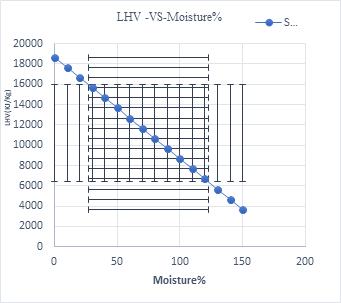
Figure5: GraphofLHVvs.moisturecontentofthewhite eucalyptusbiomasswaste
A higher calorific value is achieved when all the water produced during combustion is liquid. A lower calorific value is achieved when all the water produced during combustion is steam. The higher heating value outweighs thelowerheatingvaluebytheenergyrequiredtoevaporate theliquidformed.
3.2. Effect of Moisture and Air-Fuel-Ratio on Flame Temperature
The air-fuel ratio, which indicates the mass of air supplied per1kgoffuelrequiredforcombustionofwhiteeucalyptus biomass waste, is directly proportional to the excess air ratio (n) and it also leads to a reduction in adiabatic flame temperature,asshowninTable2 Whentheair-fuelratioin the combustion chamber changes; the adiabatic flame temperature also changes inversely. The adiabatic flame temperature of white eucalyptus biomass waste is 1706°C at n = 1 and 1280 °C at n = 1.5, while at n = 3, the combustion temperature is 742 °C and the response to temperaturedropsshowninTable2
Table2:Resultofadiabaticflametemperatureconcerning anotherparameter
If the fuel is burned with exactly stoichiometric air requirements,thereisnooxygenpresentinthefluegasand the enthalpyofcarbondioxide reaches up to3890(KJ/kg), and the maximum temperature achievable also up to 1706
oCrelative to excess air supply. As the supply of excess air increases, the enthalpy of carbon dioxide on the product side decreases (2870 kJ/kg) and the amount of excess oxygen in the exhaust gas gradually increases from 0 (kJ/kg) to 2140 (kJ/kg). Generally, the adiabatic flame temperature reaches its maximum at the stoichiometric air/fuel ratio When there is excess or lack of air in the combustion chamber, the adiabatic flame temperature drops rapidly [Figure 6].Excess air simply passes through the system as a passenger and is warmed in the process, which inevitably leads to a reduction in system efficiency Thiscausesincompletemixingoffuelandair.
Figure6: Variationofbiomassfuelflametemperatureand Excessairratio
As shown in the graph in Figure 7, by increasing the air excessratioandmoisturecontentofbiomass fuel,themass of flue gas increases uniformly with respect to the mass of fuel witha correspondingreduction inachievingmaximum flametemperature.Inthecornerofthegraph,themoisture contentislessthan10%,theexcessairratioisfrom1.5up to the stoichiometric air, and at this point, the maximum amount of flame temperature is occurred in the range of 1217oC up to 1706oC. The estimated relationship between the excess air ratio, moisture content, and the adiabatic flametemperatureisshowninFigure7.
Figure7: GraphofAdiabaticflametemperature,ExcessAir, andMoisturecontent
Burning a fuel below the total stoichiometric air requirementis generally notbeneficial, as notonly is some oftheenergy contained inthefuel wasted, butitalsohas a serious impact on emissions in the exhaust gas. The excess airrequirementmeansthatthecarbondioxideproduced is diluted by the additional nitrogen in the flue gas, making additional NOx gas products available in the flue gas. The presence of additional nitrogen in the combustion air influences the efficiency of a combustion process as it reduces the flame temperature in the combustion chamber and increases the heat loss due to sensible heat in the flue gasesexitingthechimney(Paraschiv,Serban,andParaschiv 2020).
The adiabatic flame temperature of the combustion chamber defines the temperature of the products after all chemical reactions have reached equilibrium and no heat can enter or leave the combustion chamber (Mbada et al. 2016) In most systems, such as cogeneration biomass power plants, heat is intentionally removed from the burning mixture for heating or other purposes. Complete combustion of flammable elements requires a minimum amountofoxygenintheair.
The biomass waste flow rate to the boiler and the steam flow rate throughout the cycle are constant and by using equation (22), the steam flow rate of the power plant is estimated at 1kg/sec. According to the conservation of mass; (22)
Where:M=steamflowrateoftheworkingfluid.
A schematic diagram of the power plant and the T-S diagramofthecycleareshowninFigure9 Consideringthe power plant operates on an ideal Rankine cycle, the pump andtheturbineare isentropic, thereareno pressuredrops in the boiler and condenser, and steam leaves the condenserandentersthepumpas asaturatedliquidatthe condenser pressure. The boiler and the condenser of the idealRankinepowercycledonotinvolveanywork,andthe pump and the turbine are assumed to be isentropic. Then the conservation of work for the pump and condenser are 13Kwand1542Kwrespectively.
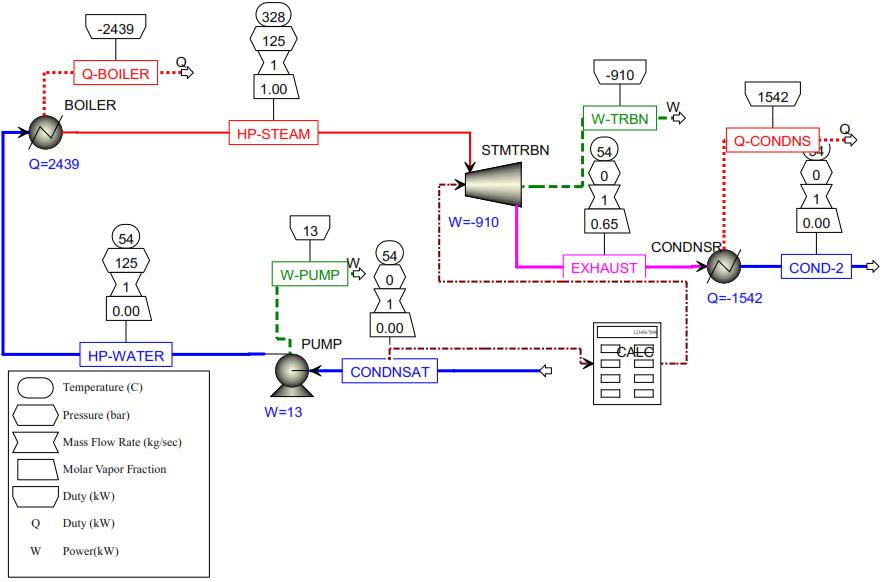
Figure9: Aspenplusbasedthermodynamicsimulation resultofsteamRankinecycle
Figure8: Oxygeninfluegas,MC(%),Excessairratio,and Adiabaticflametemperature
International Research Journal of Engineering and Technology (IRJET) e-ISSN: 2395-0056
Volume: 11 Issue: 10 | Oct 2024 www.irjet.net
In a real power plant, all of the mechanical energy of the steam cannot be utilized to operate the power generation system due to losses due to friction, viscosity, blade bending, and others. Most of the thermal energy generated intheboileris 2439KWandisdiscardedto1542KWinthe steam condenser. The net power delivered by the Rankine cycle is the difference between the turbine power of 910 kWandthepumppowerof13kWyielding897kW.Hence, oneofthesignificantadvantagesoftheRankinecycleisthat the pump power is usually quite small compared with the magnitude of the turbine power. According to Abdelhady, Borello, and Shaban 2018; the efficiency of the steam Rankine cycle power plants in Egypt is reported to be between 25% and 40% (Abdelhady, Borello, and Shaban 2018). Here, the efficiency of the estimated power plant is 36.7% which is within the range of values under consideration This thermal efficiency measures the effectivenessofthissimplesteamRankinecycle.
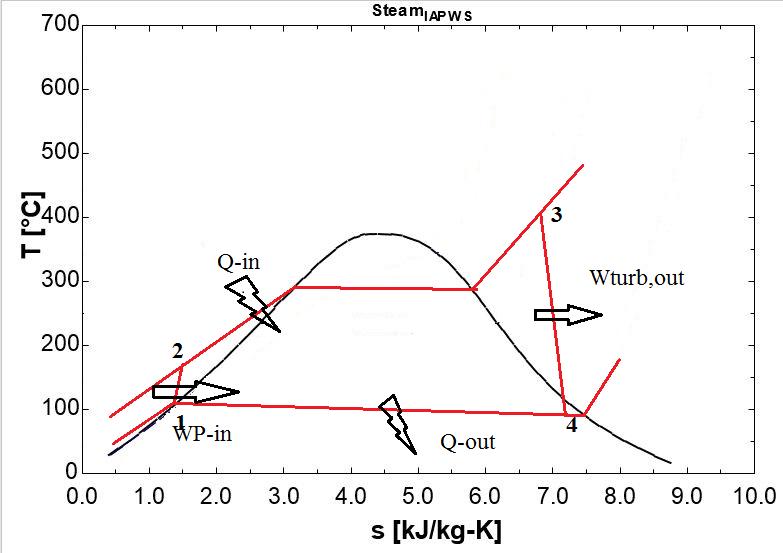
10: T-sdiagramofthesimpleidealRankinecycle usingEES
Low-pressure steam leaving the turbine in state 4 is first condensed to liquid in state 1, then pressurized by a pump to state 2. This high-pressure liquid water then passes through a steamgeneratorto thesteam chambertostate3 and is reused in the Rankine cycle, as shown in Figure 10 Boththesteamgenerator(boiler)andcondenseractasheat exchangers.ThesteamRankinecycleoperatesbetweentwo fixed pressure levels: the pressure in the steam generator and the pressure in the condenser. As a pressure change device, the pump guarantees a discharge pressure of up to 125 bars, and the turbine controls the pressure drop betweentheselevels.
Table3:SummaryofAspenplusbasedthermodynamic simulationresultofsteamRankinecycle
Basedonthisformula,Table3.3presentstheestimation resultsofpumpefficiency,cycleefficiency,andworknet.
Table4: RelationshipofpumpefficiencywithWnetandcycle efficiencybyEES
Itisknownthattheefficiencyofthepump hasasignificant effectonthepressurewithintheboiler,andtheenthalpyof the boiler is a function of temperature and pressure, hence the formation of steam within the boiler. Therefore, the steam flow rate of the cycle determines the amount of power generated from the power plant. The graph of the relationship between Rankine cycle efficiency, work net, and pump efficiency shows that these parameters are directlyrelatedto eachother.Asa result,itisimportant to choose the right pump for the power plant to gain the desired amount of pressure after the pump.An ideal centrifugal pump with a discharging capacity of 125 bar is usedforthiswork.
Theuse ofrenewable energysources,particularlybiomass, for power generation has gained considerable interest in recentyears.Inthiscontext,onekeyparameteris adiabatic flame temperature, which represents the maximum temperatureachievedwhenthefuelburnscompletelywith astoichiometricamountofair,meaningtheexactamountof oxygen required for complete combustion. In this study, Boiler
International Research Journal of Engineering and Technology (IRJET) e-ISSN: 2395-0056
Volume: 11 Issue: 10 | Oct 2024 www.irjet.net
this temperature was found to be 1706.3 °C under stoichiometricair conditions. However, as theair-fuel ratio increases beyond the stoichiometric amount (excess air is supplied), the combustion temperature decreases due to the diluting effect of the additional air, which absorbs heat withoutcontributingtothecombustionprocess.Asaresult of simulation research, it was concluded that 910kW of power could be generated from biomass waste generated onthefactorypremises.
Authors’ Contributions
LTG, TGG, and FAB conceived the problem of the study, prepared research proposals, and developed the overall design of the research; prepared the first draft of the manuscript as well as approved the manuscript for submission.
Funding
Nofunding
Availability of data
The data sets used and analyzed during the current study are available from the corresponding author upon reasonablerequest.
Ethics approval and consent to participate
Notapplicable
Consent for publication
Notapplicable.
Competing Interests
Theauthorsdeclarenocompetinginterests.
Abdelhady, Suzan, Domenico Borello, and Ahmed Shaban. 2018. “Techno-Economic Assessment of Biomass Power Plant Fed with Rice Straw: Sensitivity and Parametric Analysis of the Performance and the LCOE.” Renewable Energy 115:1026–34.
Aspen Technology Inc. 2000. Aspen Technology, Inc. Aspen Plus® UserGuideVersion10.2. Do,TruongXuanetal.2014.“Techno-EconomicAnalysisof PowerPlantviaCirculatingFluidized-BedGasification fromWoodchips.” Energy 70:547–60.
Fitri, Sutopo Purwono, M Badrus Zaman, and Fahri Adib Azizi. 2019. “Design of Organic Rankine Cycle (ORC) Power Plant Systems by Using Flat-Plate Solar Collector.” International Journal of Marine Engineering Innovation andResearch 4(3):199–207.
Frǎtiţa,M.,K.Uzuneanu,F.Popescu,andI.V.Ion.2020.“The Analysis of the Thermal Barrier Coating Using Ansys
2395-0072
Software.” IOP Conference Series: Materials Science and Engineering 997(1):1–8.
Gebreegziabher, Tesfaldet et al. 2014. “Biomass Drying for an Integrated Power Plant: Effective Utilization of WasteHeat.”In Computer Aided Chemical Engineering, ,1555–60.
Gladysz, Pawel et al. 2020. “Techno-Economic Assessment of a Combined Heat and Power Plant Integrated with CarbonDioxideRemovalTechnology:ACaseStudyfor CentralPoland.” Energies 13(11).
Hanby, Victor Ian. 1994. Combustion and Pollution Control in Heating Systems Combustion and Pollution Control in Heating Systems. ed. ) Powell,Richard(Basingstoke, Hants. Loughborough, Leicestershire LEII 3TU, UK: springer.
Ho,Katherine.2013.1-105 Current and Prospective Costs of ElectricityGeneration until20502013.Germen/Berlin. Kareem,Buliaminuetal.2018.“DesignofSteamTurbinefor Electric Power Production Using Heat Energy from Palm Kernel Shell.” Journal of Power and Energy Engineering 06(11):111–25.
Lan,Weijuanetal.2018.“BiomassGasification-GasTurbine Combustion for Power Generation System Model Based on ASPEN PLUS.” Science of the Total Environment 628–629:1278–86.
Law, C. K., A. Makino, and T. F. Lu. 2006. “On the OffStoichiometric Peaking of Adiabatic Flame Temperature.” Combustion and Flame 145(4):808–19.
Linstrom, P J. 2003. “Nist Standard Reference Database Number69.” NIST ChemistryWebBook:20899.
Magnusson,Helen.2011.“ProcessSimulationinAspenPlus of an Integrated Ethanol and CHP Plant, Master Thesis.” Universidad de Umeå:1–47.
Mbada, Ndubuisi I et al. 2016. “Performance Evaluation of SuitabilityofCarbonizedPalmKernelShell(PKS)asa Veritable Alternative to Coal and Charcoal in Solid Fuel Fired Furnaces.” International Journal of Metallurgical Engineering 2016(1):15–20.
Menin, Lorenzo et al. 2020. “Techno-Economic Assessment of an Integrated Biomass Gasification, Electrolysis, and Syngas Biomethanation Process.” Biomass Conversion and Biorefinery
Naqvi, Salman Raza et al. 2018. “Potential of Biomass for Bioenergy in Pakistan Based on Present Case and Future Perspectives.” Renewable and Sustainable EnergyReviews 81:1247–58.
Paraschiv, Lizica Simona, Alexandru Serban, and Spiru Paraschiv. 2020. “Calculation of Combustion Air Required for Burning Solid Fuels (Coal / Biomass / Solid Waste) and Analysis of Flue Gas Composition.” EnergyReports 6(September2019):36–45.
Shemfe, Mobolaji B., Sai Gu, and Panneerselvam Ranganathan. 2015. “Techno-Economic Performance
Volume: 11 Issue: 10 | Oct 2024 www.irjet.net p-ISSN: 2395-0072
Analysis of Biofuel Production and Miniature Electric Power Generation from Biomass Fast Pyrolysis and Bio-OilUpgrading.” Fuel 143:361–72. World Energy Council. 2016. “World Energy Resources 2016.” World Energy Council 2016: 6–46.https://www.worldenergy.org/wpcontent/uploads/2016/10/World-Energy Resources_SummaryReport_2016.10.03.pdf.



I am Limat Teklay Gebremariam (MSc in Process Engineering) working as a Senior Project Officer and Training Expert in African Youth for peace and Sustainable Development.
IamTesfaldetGebregergesGebreegziabher (PhD in Environmental Engineering (EnergyandEnvironmentalSustainability)) workingasaSustainableProcessDeveloper at INDEA ENERGY, Hong Kong University ScienceandTechnology,Spain
I am Fentahun Abebaw Belete (MSc in ProcessEngineering)workingasaLecturer and Researcher at Ethiopian Institute of Technology-Mekelle, Mekelle University, Ethiopia.