
International Research Journal of Engineering and Technology (IRJET) e-ISSN: 2395-0056
Volume: 11 Issue: 10 | Oct 2024 www.irjet.net p-ISSN: 2395-0072

International Research Journal of Engineering and Technology (IRJET) e-ISSN: 2395-0056
Volume: 11 Issue: 10 | Oct 2024 www.irjet.net p-ISSN: 2395-0072
Bhavesh Kishor Talele 1 , Prof. K.K. Chaudhari2 , Dr. G.E.Chaudhari3 , Prof. T.D. Garse4 .
1Student, Department of Mechanical Engineering, J. T. Mahajan COE, Faizpur, Maharastra, India.
2Proffesor, Department of Mechanical Engineering, J. T. Mahajan COE, Faizpur, Maharastra, India.
3Proffesor, Department of Mechanical Engineering, J. T. Mahajan COE, Faizpur, Maharastra, India.
4Proffesor, Department of Mechanical Engineering, J. T. Mahajan COE, Faizpur, Maharastra, India. ***
Abstract – As one of the growing energy storage technologies that are currently accessible in various stages of development, particularly in advanced technological fields, flywheels function as kinetic energy storage and retrieval devices with the capacity to deliver high output power at high rotational speeds., i.e., spaceships. Three main criteria determine a flywheel's performance: rotating speed, crosssectional shape, and material strength. The kinetic energy level that may be produced safely when linked with rotor speed is directly determined by material strength; however, the focus of this study is only on investigating how flywheel material affects the energy storage and delivery capacity per unit mass, also known as specific energy. The findings of a proposed computer-aidedanalysisandoptimizationtechnique demonstrate that choosing the right flywheel material could significantly impact the Specific Energy performance and lessen the operational pressures placed on the shaft and bearings at high rotational speeds because of the reduced mass. Three rim type flywheels are designed on Solidworks software and structural analysis is done on Ansys software. The first flywheel is made up of mild steel and for reducing its weight composite flywheel is also developed. Carbon fiber is used for making other two flywheel. Out of three the flywheel made-up of carbon fiber body and mild steel rim will be more efficient and lighter in weight.
Key Words: Flywheel, Composite, Steel, Carbon fiber, Weight.
In today's fast evolving technological era, the need for efficient, sustainable, and high-performance systems is drivinginnovationsinvariousengineeringdomains.Among these, energy storage solutions play a pivotal role, particularlyastheworldmovestowardsrenewableenergy integration and electric mobility. One such promising technology is the flywheel energy storage system (FESS), whichofferstheabilitytostorekineticenergyinarotating mass, providing high power density, life fast chargedischargecapabilities,andlongcycle
Conventionalflywheels,typicallymadefromsteelorother metals, face limitations in terms of energy density and rotational speeds due to their material properties. As a
result, there has been a growing interest in composite materials to design and optimize flywheels for enhanced performance. Composite flywheels, owing to their high strength-to-weight ratio and fatigue resistance, allow for higher rotational speeds, which directly translate into increasedenergystoragecapacity.Furthermore,theability tocustomizematerialpropertiesofcompositesoffersnew avenues for reducing system weight while maintaining or even improving the overall mechanical integrity and efficiency.
Despite these advantages, the design and analysis of compositeflywheelspresentsignificantchallenges.Factors suchasmaterialanisotropy,dynamicstressdistribution,and failuremodes must becarefullyconsidered. Thisresearch focuses on the design, analysis, and optimization of composite flywheels to maximize efficiency and energy storage capability. Through finite element modelling, materialselectionstrategies,andstressanalysis,thestudy aims to contribute to the growing body of knowledge on compositeflywheelsystems,addressingthecriticalneedfor efficientenergystoragetechnologiesinmodernapplications.
In the quest for efficient energy storage solutions, traditionalflywheelsmadefrommetallicmaterials,suchas steel,arehinderedbytheirhighweightandlimitedrotational speed. While metallic flywheels offer good strength, their significantmasslimitstheenergystoragecapacityperunit weight,makingthemlesssuitableforapplicationsrequiring highenergydensity,suchaselectricvehiclesandrenewable energysystems.
Theneedforlightweight,high-strengthmaterialshasled to the exploration of composite flywheels, which offer the potential to operate at higher speeds, thereby increasing energystorageefficiency.Compositematerials,particularly carbon fiber, exhibit excellent strength-to-weight ratios, whichenableflywheelstoachievehigherrotationalspeeds withreducedmass.However,theoptimizationofcomposite flywheels presents several challenges, including managing stress distribution, preventing delamination, and ensuring long-termdurabilityundercyclicloadingconditions.
International Research Journal of Engineering and Technology (IRJET) e-ISSN: 2395-0056
Volume: 11 Issue: 10 | Oct 2024 www.irjet.net p-ISSN: 2395-0072
This research aims to address these challenges by investigating the design, material selection, and structural analysisofcompositeflywheels,withthegoalofimproving energy storage efficiency while maintaining mechanical integrity. The study will explore the interplay between material properties, geometric design, and operational parameterstodevelopamoreeffectivecompositeflywheel systemformodernenergystorageapplications.
Theobjectiveofthisresearchistodesignandanalyzea compositeflywheelforenhancedenergystorageefficiency, focusing on optimizing its performance for high-speed rotationalapplications.Thestudyaimstoexplorethebenefits ofusingadvancedcompositematerials,suchascarbonfiber, to reduce weight while maintaining or improving the structural integrity of the flywheel. Key goals include maximizing energy density, improving stress distribution, andensuringdurabilityunderdynamicloadingconditions. Theresearchwillalsoevaluatetheperformanceofcomposite flywheels in comparison to conventional metal flywheels, withanemphasisonpotentialapplicationsinautomotiveand renewableenergysystems.
The differences in deformation and stress can be explained by the intrinsic material properties of steel and carbonfiber.
Steel(MS):Hasahighmodulusofelasticity(stiffness)and yield strength, leading to low deformation but high stress underagivenload.
Composite(CF+Steel):Combinesthebestpropertiesof both materials. The steel provides stiffness and strength,
while the carbon fiber improves flexibility and reduces weight. This results in moderate deformation and stress values,makingitanoptimalchoicewherebothstiffnessand weight-savingareimportantconsiderations.
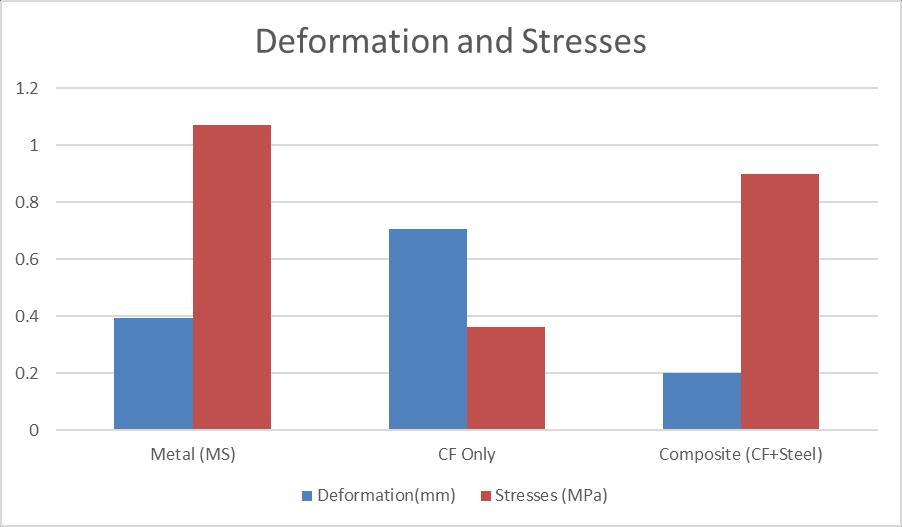
The results highlight that each material has unique advantages.Steelisoptimalforstiffnessandstrength,while carbonfiberexcelsinapplicationswhereweightreductionis critical.Thecompositematerial offersa balancedsolution, leveraging both the stiffness of steel and the flexibility of carbonfiber.
International Research Journal of Engineering and Technology (IRJET) e-ISSN: 2395-0056
Volume: 11 Issue: 10 | Oct 2024 www.irjet.net p-ISSN: 2395-0072
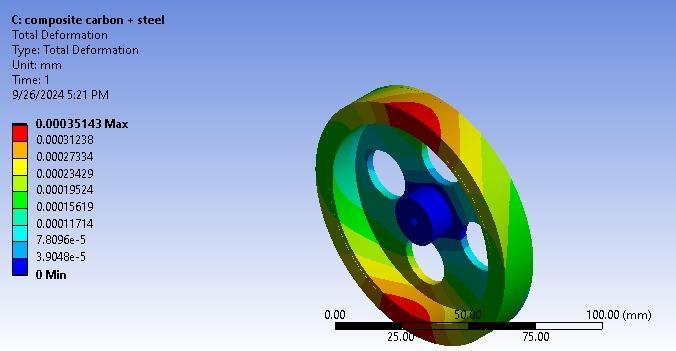
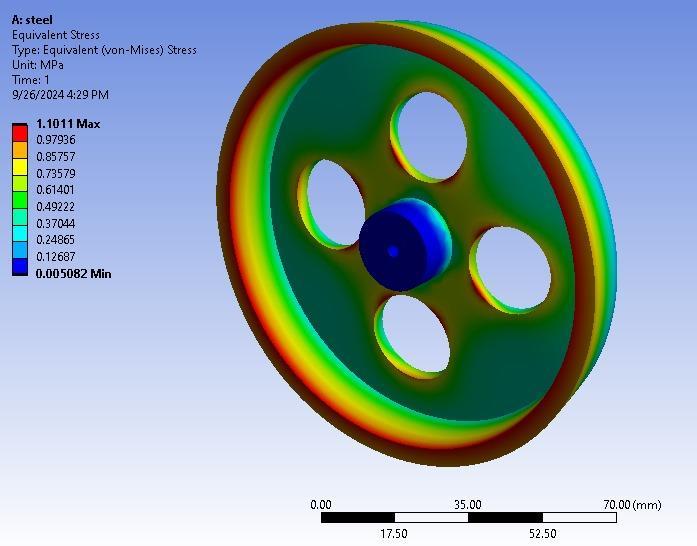
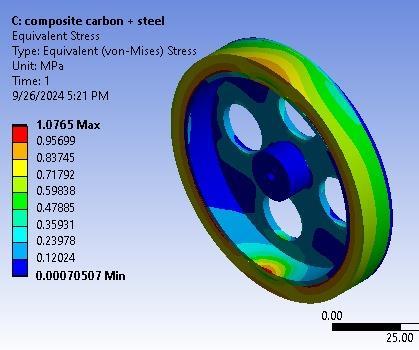
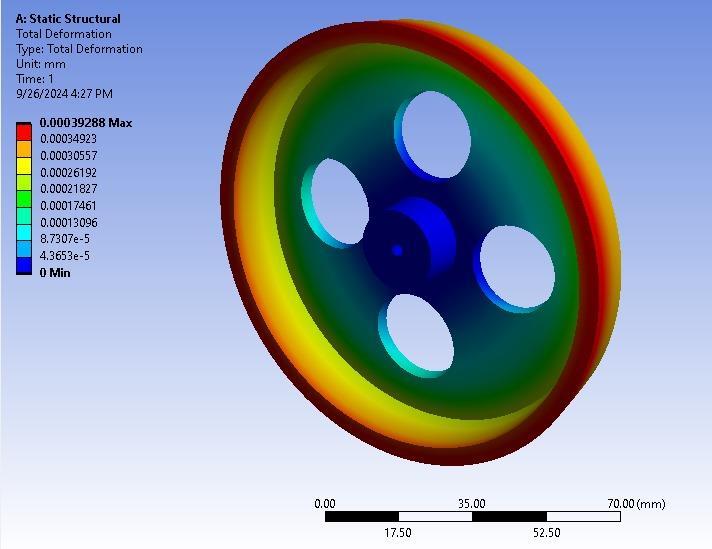
Stresses of all materials are less than material yield and ultimatetensilestrengthandhenceitismaterialaremeeting staticanalysisacceptancelimit.
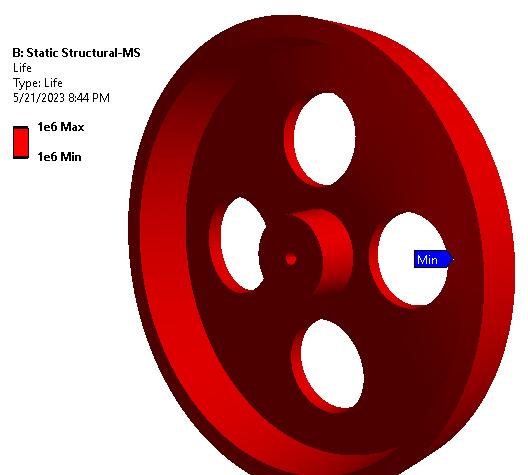
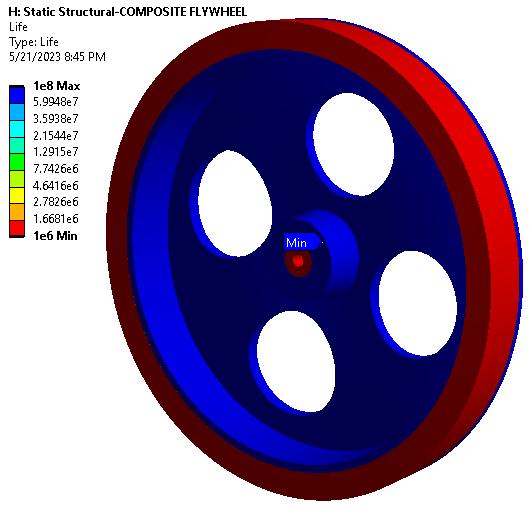
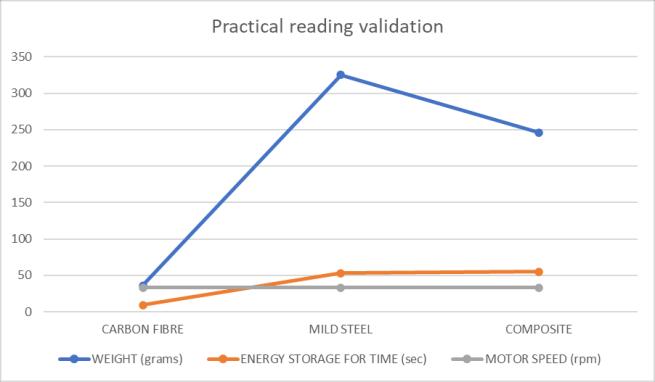
-2:Practicalreadingvalidation.
International Research Journal of Engineering and Technology (IRJET) e-ISSN: 2395-0056
Volume: 11 Issue: 10 | Oct 2024 www.irjet.net p-ISSN: 2395-0072
Table -1: PRACTICALVALIDATIONREADINGS
Thecompositeflywheel,weighing246grams,achievedthe longest rotational time of 55 seconds at a motor speed of 2000RPM(33.33RPS),outperformingbothcarbonfiber(36 grams,9.2seconds)andmildsteel(325grams,53seconds). Whilethecarbonfiberflywheelwasthelightest,ithadthe shortestrotationtime,indicatinglessenergyretentiondue to low inertia. The mild steel flywheel, though heavier, stored energy for longer. The composite flywheel demonstratedthebestbalanceofweightandperformance, making it the most efficient for energy storage and lightweightapplications.
The analysis of carbon fiber, mild steel, and composite flywheels revealed distinct advantages and limitations in termsofenergystorageandefficiency.Carbonfiber,while offeringthelightestweightandhigheststrength-to-weight ratio, showed the shortest energy storage time due to its lower inertia. Mild steel demonstrated the longest energy retention,thankstoitshighmassandinertia,butatthecost of significantly higher weight. The composite flywheel provided the best balance, achieving prolonged rotational timewhilemaintainingamoderateweight.Thus,composite materialsofferthemostpromisingsolutionforapplications requiringbothenergyefficiencyandweightreduction
[1] A. P. Punde and G. K. Gattani, "Analysis of Flywheel," InternationalJournalofModernEngineeringResearch (IJMER),[Online].Available:www.ijmer.com.
[2] Patel,P.J.,&Sorathiya,A.S.(2015).Designanalysisand weight reduction of car flywheel using finite element analysis.InternationalJournalofAdvanceEngineering and Research Development, 2(5), 1550. https://doi.org/10.2348-4470
[3] Bawane,S.G.,Ninawe,A.P.,&Choudhary,S.K.(2018). AnalysisandOptimizationofFlywheel.[IRJET].
[4] Sudipta Saha, Abhik Bose, G. Sai Tejesh, S.P. Srikanth. "Computer Aided Design & Analysis on Flywheel for Greater Efficiency." International Journal of Advanced
Engineering Research and Studies, vol. I, issue II, JanMar2012,pp.299-301.E-ISSN2249–8974.
[5] Patil,D.,&Patil,G.S.(2017).NonLinearAnalysisAnd Optimization Of Flywheel. International Research JournalofEngineeringandTechnology(IRJET),04(02), 925.ISSN:2395-0056.Retrievedfromwww.irjet.net
[6] A. V. K. S. Kumar, V. K. Saxena, and D. Kumar, "Design andanalysisofcompositeflywheelforimprovedenergy storage,"JournalofCompositeStructures,vol.90,no.3, pp. 314-322, Mar. 2015. DOI: 10.1016/j.compstruct.2014.10.002.
[7] Y.Yao,B.Zhao,andH.Wang,"Finiteelementanalysisof composite flywheels for energy storage applications," IEEETransactionsonEnergyConversion,vol.29,no.4, pp. 1165-1174, Dec. 2014. DOI: 10.1109/TEC.2014.2312334.
[8] M. Amiri and S. M. Hashemi, "Performance analysis of high-speed composite flywheels for energy storage systems,"JournalofAppliedEnergy,vol.148,pp.157166,June2015.DOI:10.1016/j.apenergy.2015.03.062.
[9] C.L.Martin,P.Q.Kane,andA.J.Girard,"High-efficiency flywheel systems using composite materials," Proceedings of the IEEE Power and Energy Society General Meeting, Boston, USA, pp. 1-8, Jul. 2016. DOI: 10.1109/PESGM.2016.7741370.
[10] N. S. Lawes, K. J. Hughes, and P. Bailey, "Design and simulation of composite flywheels for hybrid electric vehicles," IEEE Transactions on Transportation Electrification,vol.3,no.4,pp.578-587,Dec.2017.DOI: 10.1109/TTE.2017.2699239.