

International Research Journal of Engineering and Technology (IRJET) e-ISSN:2395-0056
Volume:11Issue:10|Oct2024 www.irjet.net p-ISSN:2395-0072
AYURVEDIC PLANT IDENTIFICATION USING DEEP LEARNING
Saranya A1 , Sowntharya S2, Vaishnavi Deshmukh R3 , Kanagadharani K4
1 Assistant Professor, Vivekanandha College of Engineering for Women, Tiruchengode, Tamilnadu (India), 2,3,4 Student Of Vivekanandha College of Engineering for Women, Tiruchengode, Tamilnadu (India).
Abstract This project aims to leverage the capabilities of Deep Learning (DL), specifically ResNet50 and VGG19 models, to address the complex task of classifying medicinal plants. Conventional methods of plant identification often fall short in providing real-time, precise, and comprehensive information about these invaluable botanical resources. The DL-based system developed here aims to accurately classify medicinal plants based on images, offering users detailed information on their medicinal properties. Incorporating factors like age restrictions, gender-specific considerations, and pregnancy restrictions, the model provides essential guidelines for safe and effective plant utilization. Additionally, it offers insights into usage methods and recommended dosages for each identified medicinal plant. By merging advanced DL techniques with botanical expertise,thisprojectaimstocreatearobust tool for precise plant identification and informed utilization, promoting a more accessible and knowledgeableapproachtonaturalhealthcare.
Keywords Deep Learning Neural Network, Convolutional Neural Network, SVK, Random Algorithm,ProbabilisticNeural Network
I. INDRODUCTION
In a world where the healing properties of medicinal plants play a vital role in natural healthcare, the accurate identification and understanding of these botanical treasures are essential. Deep Learning (DL), a subset of Artificial Intelligence (AI), offers a cutting-edge solution to thechallengeofclassifyingmedicinalplants.Inthisproject, weleveragethepowerofDLmodels,specificallyResNet50 and VGG19, to create a sophisticated system that not only identifiesmedicinalplantswithprecisionbutalsoprovides in depth information on their medicinal contents, age restrictions, gender specific considerations, pregnancy restrictions, mode of use, and recommended dosage. [1.1] The Problem: The vast array of medicinal plants poses a formidable challenge in precise identification and comprehensive information retrieval. Conventional methodsoftenlacktheaccuracyandefficiencyrequiredfor real-time and detailed analysis, hindering the widespread and informed use of these invaluable botanical resources forhealthcarepurposes.InnovativeApproach:Wepropose an innovative approach solely based on Deep Learning, utilizing state-of-the-art models ResNet50 and VGG19. By
training these DL models on extensive datasets containing images of various medicinal plants, our goal is to create a powerful system that accurately classifies plants and provides a wealth of information on their medicinal attributes. [1.2] Key Objectives: • Plant Identification: Implement ResNet50 and VGG19 DL models to achieve preciseandefficientclassificationofmedicinalplantsbased solely on images, ensuring reliability in identification. • Medicinal Content Analysis: Extract and present detailed information on the medicinal contents of each identified plant, offering insights into their therapeutic benefits. • Guidelines for Use: Incorporate age restrictions, genderspecificconsiderations,andpregnancyrestrictionsintothe DL model, providing users with essential information for the safe and effective use of medicinal plants. • Mode and Dosage Recommendations: Utilize DL to offer insights into therecommendedmodesofuseandappropriatedosagefor each detected medicinal plant, ensuring adherence to best practices for optimal health outcomes. [1.3] Impact: This pioneering project aims to revolutionize the identification and utilization of medicinal plants by relying solely on the powerofDeepLearning.Throughthisinnovativeapproach, we seek to empower individuals and healthcare professionals alike, enabling them to harness the healing potentialofmedicinalplantswithprecisionandconfidence, thuscontributingtoahealthierandmoreinformedsociety.
II. LITERATURE REVIEW
1. Real-Time Identification of Medicinal Plants using Machine Learning Techniques
C. Sivaranjani, L. Kalinathan, R. Amutha, R. S. KathavarayanandK. J.JegadishKumar et.al.This research tackles lighting variability in plant leaf segmentation for species identification by employing an enhanced vegetation index, ExG-ExR. Unlike traditional methods relying on fixed thresholds, ExG-ExR's inherent zero threshold adapts to diverse lighting backgrounds, effectively isolating plant regions. Leveraging color and texture features, a Logistic Regression classifier achieves 93.3% accuracy in species classification. This innovative strategy exhibits robust performance, overcoming challenges posed by lighting variations in plant identification.
International Research Journal of Engineering and Technology (IRJET) e-ISSN:2395-0056
Volume:11Issue:10|Oct2024 www.irjet.net p-ISSN:2395-0072
2. Automatic Classification of Medicinal Plant Species Based on Color and Texture Features
L.D.S.Pacifico,L.F.S.Britto,E.G. Oliveiraand T.B. Ludermir, et.al. This study addresses the challenges in accurately identifying medicinal plant species for traditional medicine purposesusingmachinelearning and computervision.Despitethewidespreaduseoftraditional medicine,existingrecognitionsystemsoftenlackaccuracy. Theresearchintroducesanewmedicinalplantdatasetand proposes a comprehensive automatic recognition system employing five machine learning classifiers. Results show classifiers achieve over 97% accuracy, indicating the efficacyof theapproachin precise medicinal plant species identification.
3. AI Based Indigenous Medicinal Plant Identification
A.Paulson and S.Ravishankar et.al. This research employs Convolutional Neural Networks (CNN), including pretrained models VGG16 and VGG19, to identify indigenous ayurvedic medicinal plant species, addressing concernsforhealthcareprofessionals,government,andthe public. Its applications extend to medical research, particularly in identifying rare plant species, and remote areas where drones capture plant images. With a dataset featuring leaf images of 64 medicinal plants from Kerala, CNN achieves 95.79% accuracy, while VGG16 and VGG19 outperform basic CNN, achieving 97.8% and 97.6% accuracies respectively, demonstrating the efficacy of pretrainedmodelsinleafidentification.
4. Medicinal Plant Species Detection using Deep Learning
K. Kavitha, P. Sharma, S. Gupta and R. V. S. Lalitha, et.al. This research employs Convolutional Neural Networks (CNN), including pretrained models VGG16 and VGG19, to identify indigenous ayurvedic medicinal plant species, addressing concerns for healthcare professionals, government, and the public. Its applications extend to medical research, particularly in identifying rare plant species, and remote areas where drones capture plant images. With a dataset featuring leaf images of 64 medicinal plants from Kerala, CNN achieves 95.79% accuracy, while VGG16 and VGG19 outperform basic CNN, achieving 97.8% and 97.6% accuracies respectively, demonstrating the efficacy of pretrained models in leaf identification..
5. Identification of selected medicinal plant leaves using image features and ANN
R. Janani and A. Gopal, et.al. The proposed method addresses the challenge of proper medicinal plant identification and the urgency to protect endangered species. By focusing on leaf images, shape, color, and texture features are extracted for training an Artificial Neural Network (ANN)classifier.Thekey emphasislies in selecting efficient input features to achieve high accuracy
with minimal computational complexity. Through testing variouscombinationsof image features on 63 leaf images, themethodachievesanimpressiveaccuracyof94.4%with justeightinput features.Thisapproachoffersa promising solution for leaf identification systems requiring minimal inputandcomputationaltime.Theimplementationutilizes MATLAB's image processing and neural network toolboxes.
6. Medicinal Plant Species Classification Using Neural Network Classifier
A. P. Saikia, P. V. Hmangaihzuala, S. Datta, S. Gope, S. Deb and K. R. Singh, et.al. The paper addresses the crucial needforaccurateclassificationofmedicinalplants,crucial forvariousapplications.Utilizingmorphological,color,and texture features, the study discusses the classification of six medicinal plant species. The dataset comprises 90 leaf images from Assam, India. Features were evaluated both individually and in combination for classification using a Back Propagation Neural Network (BPNN) classifier. Remarkably, the proposed method achieves a high accuracy of 98.88% across the six plant varieties, demonstrating its effectiveness in identifying leaves with diversefeatures.
7. Medicinal plant leaf information extraction using deep features
S. Prasad and P. P. Singh, et.al. In this paper, we propose a novel approach for medicinal plant species identification using deep convolutional neural networks (DCNNs). By transferring knowledge from object identification, raw plant leaf images are transformed into deep features, leading to improved recognition accuracy. The method incorporates an efficient leaf acquisition techniqueandutilizesdevice-independentcolorspacesfor featurecomputation,followedbyPCAsubspaceprojection for optimization. Experimental results on two different plantleafdatasetsdemonstratetherobustnessandefficacy oftheproposedapproach.
8. Ayurvedic Plants Identification based on Machine Learning and Deep Learning Technologies
R. S and V. M.N, et.al. The plant kingdom is essential for human life, providing oxygen, food, medicine, and more. Recognizing medicinal plants is crucial for preserving their benefits for future generations. Leaves and flowers are key features in identifying medicinal plants, as they contain potent medicinal properties. This study focuses on classifying local medicinal plants using leaf images. Experimentation involves 100 species, each with 15 different species, totaling 1500 images. The proposed algorithm achieves an impressive accuracy of 98.7%, showcasing its effectiveness in medicinal plant classification.
International Research Journal of Engineering and Technology (IRJET) e-ISSN:2395-0056
Volume:11Issue:10|Oct2024 www.irjet.net p-ISSN:2395-0072
9. Identification of Medicinal Plants by Visual Characteristics of Leaves and Flowers
A. D. A. D. S. Jayalath, T. G. A. G. D. Amarawanshaline, D.P.Nawinna,P.V.D.NadeeshanandH.P.Jayasuriya,et.al Correct identification of medicinal plants is crucial in Ayurveda medicine to prevent adverse effects. Human expertstraditionallyrelyon visual features and aroma for plant identification. Automating this process using image processing and machine learning can enhance accuracy. This paper demonstrates high accuracy in identifying rare medicinal plants through a database of scanned images, including both front and back sides of leaves and flowers. Unique feature combinations are used for leaf classification,resultinginidentificationratesofupto98% across10testedplants
10.Medicinal Plant identification in the wild by using CNN
T. Nguyen Quoc and V. Truong Hoang, et.al Plant identification based on deep learning received many attention and effort from the research community with many promising results. It becomes an active trend in the recent years. We apply Convolutional Neural Network (CNN) to recognize Vietnamese medicinal plant images in this paper. Different frameworks are evaluated such as: VGG16, Resnet50, InceptionV3, DenseNet121, Xception and MobileNet. The highest accuracy reached by Xception with 88.26%. We might think this approach will greatly contribute to the discovery and conservation of valuable medicinalplants.
COMPARITIVE STUDY OF ALGORITHMS
Title of the Paper Methodology Findings Research Gap
Study On Identification and Classification Of Medicinal Plants SVK, Random Algorithm Used different Algorithms like SVK, KNN, and RandomForest Slow training of Datasets. Identification Ayurvedic Medicinal Plants by Image Processingof Leaf Samples. Deep Learning Neural Network, CNN Comparing various Machine Learning algorithms to find the best accuracy. They heavilyon theinternet andare unableto function effectively withoutit.
Identification Of Medicinal Plants and Their Usage by Using Deep Learning Deep Learning Neural Network, CNN
Createdamodel MNN (Medicinal Neural Networks) which is trained withthedataset, and collected manually. Leaves sample tested were 8259 out of which 1010 leaves samples were not identified
ASmart Studyon Medicinal Plants
Identification and Classification usingImage Processing.
Probabilistic Neural Network, Convolutional Neural Network.
Focuses on differentexisting modelsforplant classification. Comparison of Classification Method. No idententifi -cationand classificatio -nmodel were purposed for medicinal plant detection.
III. SYSTEM ANALYSIS
3.1
EXISTING SYSTEM
This research addresses the issue of lighting variability in plant leaf segmentation for species identification through the utilization of an enhanced vegetation index called ExG-ExR. Unlike traditional methods that rely on fixed thresholds, ExG-ExR's zero threshold adapts to diverse lighting backgrounds, effectively isolating plant regions. By leveraging color and texture features, a Logistic Regression classifier achieves an impressive accuracy of 93.3% in species classification. This innovative strategy demonstrates robust performance,successfullyovercomingchallengesposedby lightingvariationsinplantidentification.
3.2
DISADVANTAGES
1. Complex Implementation: Implementing the ExGExR index and the Logistic Regression classifier may increase the complexity of the system. This complexity couldrequire additional resources, expertise,andtime for developmentanddeployment.
2. Resource Intensive: The computational requirements of computing the ExG-ExR index and processing color and texture features may be demanding, particularly for real-time applications or when dealing withlargedatasets.Thiscouldlimitthesystem'sefficiency, especiallyondeviceswithlimitedprocessingpower.
3. Sensitivity to Environmental Conditions: While the ExG-ExR index is designed to adapt to diverse lighting backgrounds, extreme environmental conditions such as extreme shadows or glare might still pose challenges for accurateplantsegmentationandspeciesidentification.
4. Limited Generalization: The system may struggle to generalize well to new environments or species not adequatelyrepresentedinthetrainingdata.Thislimitation could reduce the applicability of the system across differentgeographicalregionsorbotanicalcontexts.
5. Maintenance and Updates: Keeping the system upto-date with new species or environmental changes may
International Research Journal of Engineering and Technology (IRJET) e-ISSN:2395-0056
Volume:11Issue:10|Oct2024 www.irjet.net p-ISSN:2395-0072
require continuous efforts in data collection, model retraining, and software updates, adding to the overall maintenanceoverhead.
3.3 PROPOSED SYSTEM
The proposed system leverages Deep Learning (DL) techniques, specifically ResNet50 models, for the classification of medicinal plants. It addresses the limitations of conventional methods by providing realtime, precise, and comprehensive information about medicinalplantsbasedonimageanalysis.Thesystemaims to accurately classify medicinal plants and offer detailed information on their medicinal properties, including factors such as age restrictions, gender-specific considerations, and pregnancy restrictions. It provides essential guidelines for safe and effective plant utilization, including insights into usage methods and recommended dosages for each identified medicinal plant. By merging advanced DL techniques with botanical expertise, the system aims to create a robust tool for precise plant identification and informed utilization, promoting a more accessible and knowledgeable approach to natural healthcare.
3.4 ADVANTAGES
1.Real-time and Precise Identification: The DL-based system offers real time and precise identification of medicinal plants, overcoming the limitations of conventional methods which may be time-consuming and lessaccurate.
2. Comprehensive Information: Users are provided with comprehensive information about medicinal plants, including their medicinal properties, age restrictions, gender-specificconsiderations,andpregnancyrestrictions. Thisensuressafeandeffectiveplantutilization
3. Guidelines for Usage: The system offers essential guidelinesforthesafeandeffectiveutilizationofmedicinal plants, including insights into usage methods and recommended dosages. This helps users make informed decisionsaboutplant-basedhealthcare.
4. Integration of Botanical Expertise: By merging DL techniques with botanical expertise, the system combines thestrengthsofbothfieldstocreatearobusttoolforplant identification and utilization. This ensures the accuracy andreliabilityoftheinformationprovided.
5. Promotion of Natural Healthcare: The system promotes a more accessible and knowledgeable approach to natural healthcare by empowering users with accurate informationaboutmedicinalplantsandtheirusage.
IV. SYSTEM DESIGN
4.1 Architecture of ResNet50
Inputlayer:TheinputlayerofResNet50takesanimage of size 224 x 224 x 3 as input. The 3 represents the RGB colorchannelsoftheimage.

Figure 4.1 Architecture
Components used in this architecture:
1. Convolutional layers: Convolutional layers are the buildingblocksofconvolutionalneuralnetworks(CNNs),a typeofdeeplearningalgorithmthatiscommonlyused for image processing tasks. Convolutional layers are designed to extract features from the input image by applying a series of convolutional filters to the image. Each convolutional filter is a small matrix of weights that is appliedtoalocalregionoftheinputimage.Thefilterslides over the entire image, producing a feature map that highlightspatternsandedgesintheimage.Theweightsof the filterarelearned during the trainingprocess,allowing thenetworktoautomaticallylearnthebestsetoffiltersfor thegiventask.Byapplyingaseriesofconvolutionalfilters totheinputimage,convolutionallayersareabletoextract featuresfromtheimageandproduceasetoffeaturemaps thatcanbeusedasinputtothenextlayerofthenetwork.
2. Batch Normalization: Batch normalization is typicallyappliedaftertheconvolutionalorfullyconnected layers in a neural network but before the activation function.Itisawidelyusedtechniqueindeeplearningand has been shown to improve the performance of many types of neural networks. Faster convergence, Improved generalization, and Regularization are some benefits of batchnormalization.
3. Relu Activation: It is an activation function commonly used in neural networks. It is a simple and effectivewaytointroducenonlinearityintotheoutputofa neuron.Thefunctionisdefinedas:ReLU(x)=max(0,x).In other words, the output of the ReLU activation function is equaltotheinputiftheinputispositive,and0iftheinput isnegative.
4. Max Pooling: It is used to reduce the spatial dimensions of the feature maps produced by the convolutional layers while retaining the most important information. Which can help to reduce the computational cost of the network and prevent overfitting. By selecting
International Research Journal of Engineering and Technology (IRJET) e-ISSN:2395-0056
Volume:11Issue:10|Oct2024 www.irjet.net p-ISSN:2395-0072
themaximumvalueineachwindow,theoperationretains the most important features in the input feature map, whilereducingthenoiseandtheeffectofsmallvariations.
5. Flatten layers: The layer converts the output of the previous layer into a 1D vector, which is then fed into the fullyconnectedlayer
6. Fully Connected Layers: Also known as dense layers areatypeofneuralnetworklayerwhereallneuronsinthe layerare connectedtoeveryneuronin the previous layer. These layers are typically used as the final layers in a neural network and are responsible for making the final predictions,whereeachneuroninthelayerreceivesinputs from all neurons in the previous layer. The output of 24 eachneuron isthen computedasa weighted sum of these inputs,followedbyanactivationfunction.
7. Identity Block: Anidentityblockisthebasicbuilding block of the ResNet50 architecture, and it is used to maintain the same dimension of the input and output. An identity block consists of three convolutional layers, each followed by batch normalization and ReLU activation functions. The input is added to the output of the third convolutionallayer.
8. Global Average Pooling: Reduce the spatial dimensions of the output tensor to a vector by applying global average pooling. This operation computes the average of each feature map, resulting in a feature vector withthesamenumberofchannelsasthenumberoffilters inthelastconvolutionallayer.
9. Projection block: A projection block is used when the input and output dimensions are different. This block includes a convolutional layer with a stride of (2, 2) to downsampletheinput,andaconvolutionallayerwitha(1, 1)filtersizetochangethedepthoftheinputtomatchthe output.
V. SYSTEM IMPLEMENTATION
5.1 MODULE DESCRIPTION
5.1.1 Data Collection:
Creating a comprehensive data collection module for identifying Ayurvedic plants involves gathering detailed information across multiple domains to ensure accuracy, usefulness, and ethical integrity. Firstly, botanical information forms the foundation, requiring meticulous documentation of each plant's scientific classification, including genus, species, and any subspecies or varieties, along with common names in various languages. Morphological characteristics such as leaf shape, flower color, and stem type aid in accurate plant identification. Medicinal properties are of paramount importance, necessitating the identification and cataloging of active compounds and chemicals present in each plant.
Understanding the therapeutic properties, such as antiinflammatory, antioxidant, or antimicrobial effects, is crucial.TraditionalusesinAyurvedaandotherindigenous medicinal systems must be meticulously documented, including historical and cultural significance, traditional preparation methods, and conditions or ailments treated using the plant. Geographical distribution data is essential for understanding the natural habitats and ecological requirements of each plant species. Information on native regions, climatic preferences, and ecological factors influencinggrowthhelpsinassessingcultivationfeasibility and conservation strategies. Insights into cultivation and harvesting techniques are vital for sustainable utilization of Ayurvedic plants. This includes information on growth habits (annual, perennial), propagation methods (seeds, cuttings), ideal soil and environmental conditions, and appropriate harvesting techniques and timing. Safety considerations are paramount, given the potential toxicity or side effects associated with some plants. Integration of findingsfromscientificresearchandclinicaltrialsprovides empirical validation of traditional knowledge and helps bridge the gap between ancient wisdom and modern evidence-basedmedicine.Thisinvolvescatalogingrelevant research studies supporting medicinal claims and clinical trialsevaluatingefficacyandsafety.Organizingthedatain a structured manner, implementing user-friendly interfaces, and ensuring regular updates are essential for accessibility and relevance. Ethical considerations, includingrespectingintellectualpropertyrights,obtaining necessary permissions for data usage, and adhering to legalframeworksgoverningplantidentificationandusage, mustunderpintheentireprocess.Insummary,developing a data collection module for identifying Ayurvedic plants requires a multidisciplinary approach that synthesizes botanical expertise, medicinal insights, cultural heritage, and technological innovation while upholding ethical principlesandlegalstandards.
5.1.2 Preprocessing
In the Ayurvedic plant identification project, the application of Residual Neural Networks (ResNet) stands as a pivotal approach to enhancing the precision and efficacy of plant recognition endeavors. However, before thedata can be effectivelyutilized bytheResNetmodel, it undergoes a series of preprocessing steps aimed at refining its quality and suitability. The initial phase involves the meticulous collection of a diverse array of Ayurvedic plant images, capturing variations in lighting conditions, backgrounds, orientations, and sizes to ensure the dataset's representativeness. Subsequently, this datasetismeticulouslypartitionedintodistinctsubsetsfor training, validation, and testing, ensuring the model's performance is rigorously evaluated across different data splits.Followingthis,theimagesareuniformlyresizedtoa predetermined resolution, typically 224x224 pixels, using interpolation techniques like bilinear or bicubic interpolation to ensure compatibility with the ResNet
International Research Journal of Engineering and Technology (IRJET) e-ISSN:2395-0056
Volume:11Issue:10|Oct2024 www.irjet.net p-ISSN:2395-0072
architecture. Moreover, normalization techniques are applied to standardize the pixel values across the dataset, ofteninvolvingthesubtractionofmeanvaluesanddivision by standard deviations. This normalization process enhances the model's stability and convergence during training by reducing the impact of variations in pixel intensity. Furthermore, the categorical labels associated witheachimage,denotingtheAyurvedicplantspecies,are encoded into numerical representations using techniques such as one-hot encoding or label encoding. One-hot encodingtransformscategoricallabelsintobinaryvectors, while label encoding assigns unique integer identifiers to each category. Overall, the data preprocessing pipeline orchestrates a systematic sequence of transformations tailored to optimize the data's compatibility with ResNet architectures, thereby laying a robust foundation for subsequent model training and evaluation in Ayurvedic plantidentificationtasks.
5.1.3 Development and training of a CNN ResNet model:
The utilization of Convolutional Neural Networks (CNNs) and specifically Residual Neural Networks (ResNet)holdsimmensepotentialinthefieldofAyurvedic plantidentification.Thismoduleoutlinesthedevelopment and training process of a CNN ResNet model tailored for accurately identifying Ayurvedic plants based on their images.ModelArchitectureSelection:ThechoiceofResNet architecture is based on its proven effectiveness in handling deep networks while mitigating the vanishing gradient problem. ResNet's residual connections facilitate thetrainingofdeepernetworksbyallowingthegradientto flow directly through the network, enabling the model to learn more complex features. Data Preparation: The dataset curated for training the CNN ResNet model comprises images of Ayurvedic plants collected from varioussources.Theseimagesarepreprocessedasperthe established pipeline, including resizing, normalization, data augmentation, and label encoding. The resulting datasetis divided into training, validation, and testsets to facilitate model evaluation. Model Deployment: The trained CNN ResNet model is deployed for real-world applications, where it can be integrated into mobile apps, web platforms, or embedded systems for on-device inference. Deployment considerations include model optimizationforinferencespeedandmemoryfootprint,as well as ensuring robustness to variations in input images and environmental conditions. The development and training of a CNN ResNet model for Ayurvedic plant identification represent a significant advancement in leveraging deep learning for botanical research and healthcare applications. By harnessing the power of CNNs and ResNet architectures, this module facilitates accurate and efficient identification of Ayurvedic plants, contributing to the preservation of traditional knowledge andtheadvancementofherbalmedicine.
5.1.4 Model Evaluation and Deployment Module:
TheModelEvaluationandDeploymentModuleinthe Ayurvedic plant identification project involves two critical stages:evaluationofthetrainedCNNResNetmodelandits subsequent deployment for real-world applications. Evaluation begins with meticulous assessment of the model's performance using a separate test dataset, computing metrics like accuracy, precision, recall, and F1score, alongside analyzing confusion matrices to identify classification errors. Visual inspection of misclassified images provides additional insights into the model's weaknesses. Following rigorous evaluation, the model is deployed across various platforms such as mobile apps, web applications, or embedded systems, enabling on device inference. Deployment considerations include optimization for inference speed and memory usage, compatibility with different hardware platforms, and mechanisms for model updates and maintenance. Continuous monitoring and feedback mechanisms are established to ensure the model's reliability and effectiveness in real-world scenarios, contributing to the advancement of Ayurvedic medicine and botanical researchwhilepreservingtraditionalknowledge.
5.2 ALGORITHM
5.2.1
CNN Architecture
CNN is a deep learning model which can be used for processing data that has a grid. It is a mathematical construct that is composed of three types of layers. The first two layers’ convolution and pooling layers perform the 10-feature extraction whereas the third, the fully connected layer maps the extracted features into the final output. The convolutional layer is composed of a stack of mathematical operations, such as convolution which is a specialtypeoflinearoperation.Indigitalimages,thepixel valuesarestoredin2Dformatandthekernelisusedasthe optimizable feature extractor that can be applied to each imageposition. Thekernelcanbeoptimizedinsuchaway thatthedifferencebetweenoutputsandactualoutputscan be minimum, and backpropagation and gradient descent can be used for it. CNN is a highly efficient algorithm at presentthatcanbeusedforimageprocessing.CNNworks by extracting features from the images. Any CNN consists ofthefollowing:
a. Theinputlayerwhichisagrayscaleimage.
b. The Output layer which is a binary or multi-class labels.
c. Hidden layers consisting of convolution layers, RLU (rectifiedlinearunit)layers,thepoolinglayers,andafully connectedNeuralNetwork.
International Research Journal of Engineering and Technology (IRJET) e-ISSN:2395-0056
Volume:11Issue:10|Oct2024 www.irjet.net p-ISSN:2395-0072
5.2.2 Convolution Layer
This layer is the first layer that is used to extract the variousfeatures30fromtheinputimages.Inthislayer,the mathematical operation of convolution is performed between the input image and a filter of a particular size MxM. By sliding the filter over the input image, the dot product is taken between the filter and the parts of the input image with respect to the size of the filter (MxM). A convolutional layer is the main building block of a CNN. It contains a set of filters (or kernels), parameters of which are to be learned throughout the training. The size of the filters is usually smaller than the actual image. Each filter convolves with the image and creates an activation map. The primary purpose of Convolution in the case of CNN is toextractfeaturesfromtheinputimage.
5.2.3 Pooling Layer:
In most cases, a Convolutional Layer is followed by a PoolingLayer.Theprimaryaimofthislayeristodecrease the size of the convolved feature map to reduce computational costs. This is performed by decreasing the connections between layers and independently operating on each feature map. Depending upon the method used, there are several types of Pooling operations. In Max Pooling,thelargestelementistakenfromthefeaturemap. AveragePoolingcalculatestheaverageoftheelementsina predefined-sized Image section. The total sum of the elements in the predefined section is computed in Sum Pooling. The Pooling Layer usually serves as a bridge betweentheConvolutionalLayerandtheFCLayer.
5.2.4 Max Pooling:
Max pooling is a pooling operation that selects the maximum element from the region of the feature map covered by the filter. Thus, the output after the maxpooling layer would be a featuremap containing the most prominentfeaturesofthepreviousfeaturemap

5.2.5 Fully Connected Layer:
TheFullyConnected(FC)layerconsistsoftheweights and biases along with the neurons and is used to connect theneuronsbetweentwodifferentlayers.Theselayersare usually placed before the output layer and form the last
few layers of a CNN Architecture. 11 In this, the input image from the previous layers is flattened and fed to the FC layer. The flattened vector then undergoes a few more FC layers where the mathematical function's operations usually take place. In this stage, the classification process beginstotakeplace.

5.2 Fully Connected Layer
5.2.6 Dropout:
Usually, when all the features are connected to the FC layer, it can cause over fitting in the training dataset. Over fittingoccurswhenaparticularmodelworkssowellonthe training data causing a negative impact on the model’s performance when used on new data. To overcome this problem,adropoutlayerisutilizedwhereinafewneurons are dropped from the neural network during the training processresultinginareducedsizeofthemodel.

Figure5.3Dropout
5.2.7 RESNET 50:
ResNet stands for Residual Network and is a specific type of convolutional neural network (CNN). ResNet-50 is a 50-layer convolutional neural network (48 convolutional layers, one MaxPool layer, and one
International Research Journal of Engineering and Technology (IRJET) e-ISSN:2395-0056
Volume:11Issue:10|Oct2024
averagepoollayer).Residualneuralnetworksareatype of artificial neural network (ANN) that forms networks bystackingresidualblocks.
1. Architecture:
ResNet-50 is a deep convolutional neural network architecture composed of 50 layers, hence the name.It consists of convolutional layers along with one MaxPool layer and one average pooling layer. The architecture includesskipconnectionsorresidualconnections,which allow the gradient to propagate more effectively during training.
2. Residual Blocks:
ResNet-50isconstructedusingresidual blocks,each of which contains multiple convolutional layers. These residual blocks enable the network to learn residual functions instead of directly learning underlying functions,makingtrainingeasier.
3. Skip Connections:
Skipconnectionsallowthegradienttobypasscertain layers, helping to mitigate the vanishing gradient problem. In ResNet-50, these connections add the input of a layer to its output before applying a nonlinearity (e.g.,ReLUactivationfunction).
4. Training:
ResNet-50 is typically trained using mini-batch gradientdescent,avariantofstochasticgradientdescent. Duringtraining,thenetwork'sweightsareupdatedusing backpropagation,wherethegradientofthelossfunction with respect to the network weights is calculated and usedtoadjusttheparameters.Hyperparameterssuchas learningratearetunedusingtechniqueslikegridsearch tooptimizemodelperformance.
5. Application:
ResNet-50 has been widely adopted for image classification tasks due to its superior performance. It has been applied in various domains including object detection, image segmentation, and medical image analysis. In the context of medicinal plant classification based on leaf images, ResNet-50 can accurately classify plant species by analyzing input images and producing probability distributions over different plant classes. 6. Impact: ResNet-50's introduction marked a significant advancement in deep learning, enabling the training of much deeper neural networks with improved performance.Itssuccesshasinspiredfurtherresearchin deep neural network architectures, leading to the development of more sophisticated models for various tasks in computer vision and beyond. The ResNet-50 architecturecanbebrokendowninto6parts:
www.irjet.net p-ISSN:2395-0072
1.InputPre-processing
2.Cfg[0]blocks
3.Cfg[1]blocks
4.Cfg[2]blocks
5.Cfg[3]blocks
6.Fully-connectedlayer

VI. SYSTEM TESTING
Systemtes
ecomputer-basedsystem.Eachtestishavingits own purpose, and all work should verify that all system elements have been properly integrated and perform allocated functions. This helps us to rectify a problem if occurs in our proj tingandimplementationisactuallya series of different tests whose primary objective is to fully exerciseth ect. This helps us to do various testing depending upon the project such as security testing, validationtesting,integrationtesting,unittestingetc...
Testing methodologies
By verifying the system one can verify the proper function of the system. The primary purpose is to fully exercisethecomputerbasedsystem.Althougheachtesthas different purpose, all the work should verify that all the system elements have been properly integrated and performtheallocatedfunction.Thetypesofsometestsare listedbelow.
International Research Journal of Engineering and Technology (IRJET) e-ISSN:2395-0056
Volume:11Issue:10|Oct2024 www.irjet.net p-ISSN:2395-0072
White box testing:
This method that uses the control structure of the procedural designtoderivetestcases. Withthis white box testing it is able to test all the independent paths are examinedorexercisedwiththeirtrueandfalse.Italsouses theexternaldatastructuretoensuretheirvalidity.
Black Box Testing:
This testing method focus on the functional requirementsofthesoftware.Thisteststhefullyfunctional conditions of the program. This is used likely uncover the errors than the white box testing. It finds the errors in the following parts: Incorrect of missing functions, Interface errors, Errors in data structures or external database access.
Comparison Testing:
Thisisamethodthatawayofalternatesoftwareexactly as the existing one is developed by another team and this will be very useful in critical situations. This new software is tested with the identical inputs as the previous one to checkwhetheritsatisfiestheexistingtermsandconditions.
Security Testing:
This is used to verify the protection mechanisms built into the system that protect it from illegal penetration. Penetration spans a broad range of activities because of hackers who attempt to penetrate systems for sport and disgruntledemployeeswhowanttodestroysomedetails.
Unit Testing:
Thistestfocusesonsystemindividuallyensuringthatit functions properly as an individual unit according to solve the requirements of the particular module. This enable to correctanddetecterrorsthistestingisalwaysa whitebox orientedoneandtheprocessmaybeinparallel.
Validation Testing:
validationtestingsucceedswhenthesoftwarefunctions inagoodmannerasexpectedbythecustomer.
VII. CONCLUSION & FUTURE WORK
7.1
CONCLUSION
Inconclusion,thisprojectrepresentsasignificantstride towards bridging the gap between traditional herbal knowledgeandmoderntechnologythroughtheapplication of Deep Learning (DL) methodologies. The utilization of ResNet50 and VGG19 models has proven instrumental in addressing the inherent challenges ofclassifying medicinal plants. The limitations of conventional methods for identification and information retrieval have been overcome by our DL-based system, providing real time,
accurate, and comprehensive details about these botanical resources. The incorporation of age restrictions, genderspecificconsiderations,andpregnancyrestrictionsintothe model adds a layer of sophistication, offering users invaluableguidelinesforthesafeandeffectiveutilizationof medicinal plants. This not only enhances user safety but also contributes to the responsible promotion of herbal remedies within diverse demographic contexts. In the broadercontext,theoutcomesofthisprojectholdpromise forpromotingamoreaccessibleandinformedapproachto natural healthcare. As we continue to unlock the potential of DL in the realm of medicinal plant classification, we envisionafuturewheretheconvergenceoftechnologyand traditional wisdom leads to a harmonious integration of naturalremediesintomodernhealthcarepractices.
7.2 FUTURE WORK
Future endeavors will focuson refining and expanding the capabilities of our module to better serve the needs of researchersandbotanistsinmedicinalplantstudies.Efforts will be directed towards enhancing the accuracy and relevanceofthemodulethroughcontinuousupdatestothe training dataset, integration of multimodal data, and development of domain-specific models. Additionally, the deploymentoffield-readysolutionsandcollaborationwith indigenous communities will be prioritized to ensure practical usability and cultural sensitivity. Exploration of drug discovery applications will also be pursued to unlock the therapeutic potential of medicinal plant compounds identified by the AI module. Through these initiatives, we aim to advance the field of medicinal plant research and contribute to the development of innovative healthcare solutions.


International Research Journal of Engineering and Technology (IRJET) e-ISSN:2395-0056
Volume:11Issue:10|Oct2024 www.irjet.net p-ISSN:2395-0072
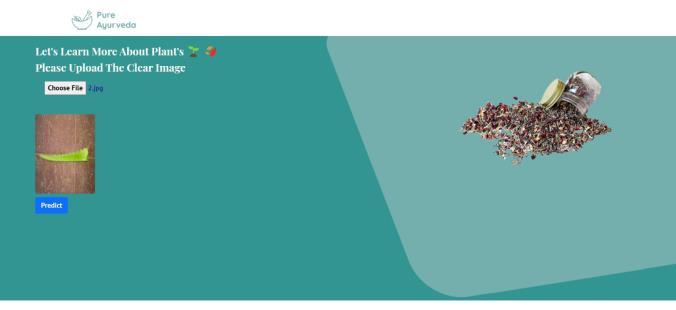
7.3 Display the User Uploaded Image

7.4 Displaying Prediction
REFERENCES
[1] J. Abdollahi, "Identification of Medicinal Plants in Ardabil Using Deep learning : Identification of Medicinal Plants using Deep learning," 2022 27th International Computer Conference, Computer Society of Iran (CSICC), Tehran,Iran,IslamicRepublicof,2022,pp.1-6
[2] R. Janani and A. Gopal, "Identification of selected medicinal plant leaves using image features and ANN," 2013 International Conference on Advanced Electronic Systems(ICAES),Pilani,India,2013,pp.238-242
[3]A.D.A.D.S.Jayalath,T.G.A.G.D.Amarawanshaline,D. P. Nawinna, P. V. D. Nadeeshan and H. P. Jayasuriya, "IdentificationofMedicinalPlantsbyVisualCharacteristics ofLeavesandFlowers,"201914thConferenceonIndustrial and Information Systems (ICIIS), Kandy, Sri Lanka, 2019, pp.125-129
[4] K. Kavitha, P. Sharma, S. Gupta and R. V. S. Lalitha, "Medicinal Plant Species Detection using Deep Learning," 2022 First International Conference on Electrical, Electronics, Information and Communication Technologies (ICEEICT),Trichy,India,2022,pp.01-06,
[5] T.Nguyen Quoc and V.Truong Hoang,"Medicinal Plant identificationinthewildbyusingCNN,"2020International ConferenceonInformationandCommunicationTechnology Convergence(ICTC),Jeju,Korea(South),2020,pp.2529[6] S. Prasad and P. P. Singh,"Medicinal plantleaf information extractionusingdeepfeatures,"TENCON2017-2017IEEE Region 10 Conference, Penang, Malaysia, 2017, pp. 27222726
[7]A.P.Saikia,P.V.Hmangaihzuala,S.Datta,S.Gope,S.Deb and K. R. Singh, 48 "Medicinal Plant Species Classification Using Neural Network Classifier," 2021 6th International Conference on Communication and Electronics Systems (ICCES),Coimbatre,India,2021,pp.1805-1811
[8] Y. Sharrab, D. Al-Fraihat, M. Tarawneh and A. Sharieh, "Medicinal Plants Recognition Using Deep Learning," 2023 International Conference on Multimedia Computing, Networking and Applications (MCNA), Valencia, Spain, 2023,pp.116122,
[9] C. Sivaranjani, L. Kalinathan, R. Amutha, R. S. Kathavarayan and K. J. Jegadish Kumar, "Real-Time Identification of Medicinal Plants using Machine Learning Techniques," 2019 International Conference on Computational Intelligence in Data Science (ICCIDS), Chennai,India,2019,pp.1-4
[10]R.SandV.M.N,"AyurvedicPlantsIdentificationbased on Machine Learning and Deep Learning Technologies," 2022 Fourth International Conference on Emerging Research inElectronics,Computer ScienceandTechnology (ICERECT),Mandya,India,2022,pp.1-6