
Polyurea Uses in the Construction Industry
Ruchi Anil Patil1 , Prof. Priyanka Patil2
1Ruchi Anil Patil: Student, Dept. of Construction Management, MIT College of Management, Pune, Maharashtra, India
2Prof. Priyanka Patil: Professor, Dept. of Construction Management, MIT College of Management, Pune, Maharashtra, India
Abstract - Polyurea coatings have become an essential technology in the construction industry due to their remarkable properties such as rapid curing, durability, chemicalresistance,andwaterproofing.Theyarewidelyused to protect surfaces, structures, and infrastructure from wear and tear, which minimizes downtime and enables shorter construction schedules. These coatings are ideal for roofing, basements, and water containment systems as they create a flawless, waterproof barrier. They are also suitable for chemical processing plants, industrial facilities, and containment areas due to their exceptional chemical resistance.Moreover,theirflexibilityallowsthemtowithstand temperature fluctuations without fracturing, making them ideal for extreme climate regions. Polyurea coatings can be applied to various substrates, creating a seamless, uniform finish. They are also used in industrial and marine settings to protect steel structures from corrosion. These coatings offer customization options for decorative and architectural purposes and can be designed for slip-resistant safety. Their longer service life reduces maintenance costs, makingthem a cost-effective solution for the construction industry
Key Words: Polyureacoating,RapidCuringEtc.
1. INTRODUCTION
Polyureacoatingsarewidelyusedinindustriessuchas construction,automotive,andmarineduetotheirdurability, fast curing time, and versatility. These coatings, including polyurea,polyurethane,andpolyurethane-polyurearesins, serve as effective anti-corrosive and anti-wear agents, protectingagainstabrasion,tearing,andscratches.Theycan be applied on various surfaces, including metal, wood, concrete,andplastics,offeringbothdecorativeandspecific mechanicalproperties.Additionally,polymerslikepolyurea are utilized as cover layers for armored vehicles, ballistic shields,loadingareas,andwaterproofsurfaces,whilealso providing vibration and sound absorption capabilities. To enhancethepropertiesofpolyureacoatings,modifications with glass fabric and hemp fiber are employed. The applicationprocessinvolves sandblasting ortheuseof an epoxyresin-basedintermediatelayer.Inthisstudy,anepoxy resin intermediate layer was utilized, and the primer was modifiedwithglassfabricandhempfibertoimproveimpact resistance and vibration absorption. Samples with and without the polyurea layer were prepared to assess the influenceofeachconstituent.Naturalfibers,suchashemp
fiber, were chosen for their low density and ability to dampen acoustic waves, making them commonly used as fillers in vehicle interior composite elements within the automotive industry. However, it is important to consider the temperature limit as a technological constraint in the naturalfiber-reinforcedcompositesindustry,asitcanlead tofiberdegradation.
The study aimed to determine the adhesion force of polymeric coatings to steel bases, compare the impact resistance of multilayer coatings, and investigate the influenceofthecoatingonstaticmechanicalpropertiesand fatiguelifetime. Themost widelyusedstrategyfor fatigue lifetime improvement is strengthening metallic structures using CFRP (carbon fiber reinforced polymer) patches. Polyurea, also known as polyurea elastomer, is a modern constructionmaterialwithextraordinaryproperties,suchas high durability and strong resistance to atmospheric, chemical,andbiologicalfactors.Polyureacoatingsareused toprotectsteelstructuresagainstcorrosionfromexposure to saltwater and other corrosive elements. They provide customization options for decorative and architectural purposes,includingcolor,texture,andthickness.Theycan also be designed to be slip-resistant, enhancing safety in areas where traction is crucial. Polyurea coatings have a longerservicelifethanothercoatingsystems,resultingin reducedmaintenancecosts.Inconclusion,polyureacoatings haverevolutionizedtheconstructionindustrybyprovidinga robustandversatilesolutionforprotectiveanddecorative applications.Theirexceptionalproperties,suchasdurability, rapidcuring,andresistancetochemicalsandenvironmental factors,makethemaninvaluableassetinconstructinglonglasting,resilient,andsafestructures.
Polyurea is a highly durable and elastic material that is createdthroughareactionofpolyamineandisocyanate.It consistsofachain-typestructurewith"n"moleculesthatare strongly combined, giving it its exceptional properties. Originallyusedinballisticsystemsanddevicesforitsenergy absorption capabilities, polyurea has found numerous applicationsintheconstructionfield.Itiscommonlyusedas a hydro-isolation coating for industrial floors and as a strengthening coating for steel and concrete. This elaborationfocusesonpresentingpolyureaasaconstruction material,consideringbothitsadvantagesanddisadvantages. Additionally, it summarizes the current research on the materialandexploresfuturedirectionsandareasofuse
International Research Journal of Engineering and Technology (IRJET) e-ISSN: 2395-0056 Volume: 11 Issue: 01 | Jan 2024 www.irjet.net p-ISSN: 2395-0072 © 2024, IRJET | Impact Factor value: 8.226 | ISO 9001:2008 Certified Journal | Page39
***

1.2. AIM
This study on polyurea coatings aims to comprehensively understand the properties, applications, and potential benefitsofthisversatilecoatingmaterial.
1. Characterization of Material Properties: Understanding the fundamental properties of polyurea, including its mechanical, thermal, chemical,andadhesion properties, isa key aimof suchstudies.Thischaracterizationprovidesinsights into the material's suitability for various applications.
2. ApplicationTechniquesandMethods:Researchers aimtoexplorethedifferentapplicationtechniques andmethodsforpolyureacoatings,includingspray application, hand application, and various equipment used. A comprehensive study can help identifythemosteffectiveapplicationmethodsfor differentscenarios.
3. PerformanceEvaluation:Researchersoftenaimto evaluate the performance of polyurea coatings in variousenvironmentalandoperationalconditions. Thismayinvolvetestingtheirdurability,resistance to abrasion, chemical resistance, and ability to withstandextremetemperatures.
4. WaterproofingCapabilities:Manystudiesfocuson thewaterproofingpropertiesofpolyureacoatings. Theaimistoassesstheireffectivenessinpreventing water infiltration in applications such as roofing, basements,andwatercontainmentsystems.
5. Corrosion Protection: For applications involving metal substrates, researchers aim to assess the corrosion protection capabilities of polyurea coatings, particularly in marine and industrial settings.
6. Environmental Impact: Understanding the environmental impact of polyurea coatings is a growing concern. Studies aim to evaluate their sustainability, potential for VOC (volatile organic compound)emissions,andlong-termenvironmental effects.
7. CustomizationOptions:Researchersaimtoexplore the customization optionsavailable withpolyurea coatings,suchascolor,texture,andthickness.This provides insights into the versatility of these
coatings for various applications, including decorativeandarchitecturaluses.
8. Cost-Effectiveness: Studies may aim to assess the cost-effectiveness of using polyurea coatings in comparison to alternative coating materials. This evaluationcanhelpprojectplannersandengineers make informed decisions regarding budget allocations.
9. SafetyConsiderations:Researchcanaimtoidentify safetyconsiderationswhenworkingwithpolyurea coatings, particularly in terms of handling, ventilation, and potential health hazards during application.
10. ComparativeAnalysis:Aimsofstudiesofteninclude comparing polyurea coatings to other coating materials to understand their advantages and disadvantagesindifferentscenarios.
11. InnovationsandAdvancements:Keepingpacewith thelatestadvancementsinpolyureatechnologyisan essential aim of research. Researchers aim to identify new formulations,application techniques, andemergingtrendsinthefield.
Thestudyaimstoprovideacomprehensiveunderstandingof polyureacoatings,theirapplications,andtheirsuitabilityfor various industries, aiding in informed decision-making in constructionandindustrialsettings.
1.3. SCOPE
Thefutureofpolyureacoatingsintheconstructionindustry ispromising,withsustainabilitybeingakeyfocus.Research intolow-VOCformulationsandrecyclablematerialsiscrucial for advancements in UV degradation resistance, flexibility, andchemicalresistance.Nanotechnologyintegrationisalso growing, enhancing UV resistance, hardness, and selfcleaningcapabilities.TheInternetofThings(IoT)mayleadto smart coatings with embedded sensors for real-time monitoring. Customization options in color, texture, and designareexpectedtoexpand.Polyureacoatingscanaddress issues surrounding aging infrastructure repair and rehabilitation, providing innovativesolutions for restoring andprotectingcriticalinfrastructure.Polyureacoatingsare expectedtobecomemoreefficientandpreciseinthefuture, with automation and robotics expected to play a more significantroleinsprayapplication.
Hybridcoatingswithuniqueproperties,suchasself-healing polyurea,arebeingdevelopedtoaddressminordamagesand prolongstructures'lifespan.Thesecoatingsareparticularly usefulinnicheareaslikeculturalheritagesitesandhistoric buildings. The global expansion of polyurea coatings is expected to drive innovation and standardization, while stricter environmental regulations will necessitate stricter standardsforfuturecoatings.
Thefutureofpolyureacoatingsinconstructionismarkedby innovation, sustainability, and expanding applications.
International Research Journal of Engineering and Technology (IRJET) e-ISSN: 2395-0056 Volume: 11 Issue: 01 | Jan 2024 www.irjet.net p-ISSN: 2395-0072 © 2024, IRJET | Impact Factor value: 8.226 | ISO 9001:2008 Certified Journal | Page40
2 LITERATURE REVIEW
Polyurea is a polymer material which offers dynamic properties resulting from the specific structure of the material. Considerabletests,aswellasdevelopedscientific procedures,whichallowforunequivocalstatementsabout thepropertiesofthepolymerstructurematerial,havebeen performedinrecentyears.
1. Yij.-Thestudyexaminedthebehaviorofasingle polyurea sample and three polyurethane samples under compressive force using a Hopkinson pressurebarsystem,revealinganon-linearstressstrainrelationshipsignificantlyinfluencedbystrain rate.
2. Sarve SS.- Sarva SS. et al. conducted a study on polyurea and polyurethane behavior at various strain rates. They used various testing methods, includingaZwickscrewdrivemechanicaltesterfor lowstrainrates,anenhancedservo-hydraulicaxial testing machine for medium strain rates, and two configurations of the Hopkinson pressure bar for highstrainrates.
3. S.N.Raman-S.N.Ramanandcolleaguesconducted a study on a polyurea sample to gather data for calibrating a material model in software using a finite elements model like ANSYS® AUTODYN®, emphasizingtheimportanceofpolyurea.
4. D.Mohotti-D.Mohottietal.conductedexperiments onpolyureasamplessubjectedtohighstrainrates using the INSTRON® VHS 8800 device. They proposed a novel model called Rate Dependent MooneyRivlin(RDMR)topredictnonlinear,hyperelasticpolyureabehavior.Themodelrequiresonly onesetofmaterialparametersforaspecificstrain rate and automatically calculates values for other parametersfordifferentstrainrates.Thismodelis expectedtosimplifysimulationsandhavepotential applicationsinfiniteelementmethods.
5. Arunkumar T. - Arunkumar T. et al. conducted a studyonpolyureaadhesiontosteelusingAISI1018 steel due to its strength, elasticity, and high mechanical characteristics. They applied varying thicknesses of polyurea coatings to steel samples, sprayingthematadistanceof50mmfromthesteel. The study aimed to understand the interaction between polyurea and various materials and the impactoftemperatureonthesubstance'sproperties and structure. The research aimed to provide insights into the properties and structure of polyurea.
6. ThirumalM.-ThirumalM.etal.'s2010studyfound that adding oxidized phosphorus to polyurea and epoxyresinsignificantlyimprovedthermalstability
andfireresistance.Triphenylphosphatewasfound tobemosteffectiveinenhancingfireresistancein polyurea.
Year Progress
1981 DevelopedforautomotiveRIMParts
1987 PolyureaSpraytechnologyintroducedby Texaco
1988 FirstcommercialusageasaFieldCoating
1993 SeveralFormulatorsenterthemarket
3. METHODOLOGY
Polyureaelastomericcoating,usedsincethelate1980s,isa remarkableproductforconstructionduetoitsexceptional tensilestrengthandabilitytomovewiththesubstrateupto 90%. It creates a seamless, high-abrasion liner that can withstandharshenvironmentsandischemicallyresistant,UV tolerant,andresistanttoH2Sgases.
APPLICATIONMANNER–
Theapplicationofpolyureaontheisolatedsurfaceisavery complexprocess. Itconsistsofthreetechnologicalstages: preparationofthesurface,mixingofthecomponents,and application.
1. SurfacePreparation–
Surfacepreparationiscrucialforapplyingmaterial,ensuring thesurfaceisclean,dry,andfreefromcontaminantslikeoil and grease. If contamination is detected, blast cleaning or sand-blast cleaning may be necessary. Chemical agents shouldbeusedtoremoveoilstainsorothercontaminants. Primingpaintscanenhanceadhesion.Thesestepsensurethe materialcoatingissecurelyattachedtothesurface,impacting theresultingmaterialquality.Surfacepreparationisthemost criticalstageintheprocess.
2. Mixingthecomponents-
Polyurea is a two-component composite material that requiresasuitableapparatustocreateoptimaltemperature and pressure conditions. The blending occurs in a heated environmentusingaspecializedpneumaticorelectricdevice. Accurate mixing and dosing are crucial for successful polyurea spray application, as they ensure the proper applicationofthecompositematerial.
The spraying parameters, including temperature and pressure, must be closely monitored and matched to the manufacturer's specifications in the Product Data Sheet (DPS). Continuous monitoring of component volume and weightratiosisalsocrucialforensuringthehighestquality polyureacoatingoutcome.
3. Coatingapplication–Themixtureisappliedonadust-freesurface,withtwolayers ofcoatingapplied,onedirectlyontothesurfaceandtheother perpendiculartoit,toensurecompleteimpermeabilityand absenceofseamsorjoints.
International Research Journal of Engineering and Technology (IRJET) e-ISSN: 2395-0056 Volume: 11 Issue: 01 | Jan 2024 www.irjet.net p-ISSN: 2395-0072 © 2024, IRJET | Impact Factor value: 8.226 | ISO 9001:2008 Certified Journal | Page41 Advanced formulations, customization options, and smart coatingswillcontributetotheirversatilityandsustainability.
4. Deviceforsprayingpolyureacoatingsystem–
The system employs aggregates machines, capable of generatingpressurebetween120and210barandheating resin to temperatures between 650C and 800C. These complex machines have real-time monitoring controls for pressureandtemperature,withnumeroussensorsplacedin keypartsforoperatorcontrol.
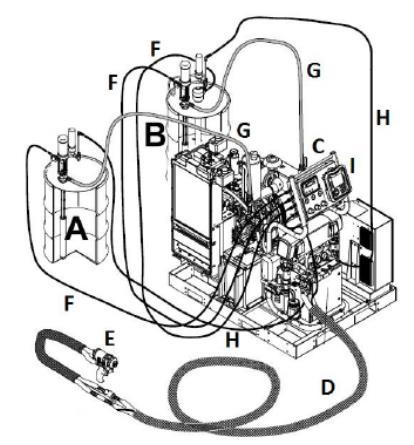
Thediagramdepictsasetofmachinesforsprayingpolyurea coatingorfoams,includingacombustionengine,electricity generator,andaircompressor,enablingreal-timecontrolof mixtureparameters.
A–barrelwithPolyaminatecomponent,
B–barrelwithpolyisocyanatecomponent,
C–reactorfeeder(theplacewherehigh-pressurepumps withheatersusedtoprovideAandBingredientsare located)
D-heatedhose(ahoseequippedwithheatersusedfor maintaininganappropriatetemperatureofthe ingredients),
E-spraygun(adevicewhereingredientsAandBare mixedandtheninstantlysprayedontothesurfaceatavery highpressure),
F-hosesprovidingair(thehosesprovidingairforthe pumpsandthestirrer),
G-hosesprovidingtheingredientsAandBtothereactor feeder,
H-recirculationducts(usedformovingingredientsAand Baroundheaters),
I-Maincontrolmoduleofthedevice.
The polyurea coating application process is complex and requiresmanufacturerstoprovideproductdatasheetsand manuals.Thesedocumentsprovidedetailedinformationon mixture parameters, surface preparation, and application systems.
1. Curing-Polyureacoatingscurequickly,sometimes in seconds or minutes. Follow the manufacturer's instructions for curing and make sure the environment is suitable for curing, including temperatureandhumidity.
2. QualityControl-Checkthecoatingfordefectslike pinholes, air bubbles, or inconsistencies. Fix any
problems right away. Also, measure the coating's thickness to make sure it meets the required standards.
3. Topcoat (Optional) - A topcoat can be added to improve UV resistance, colour retention, or other properties, depending on the application and performanceneeds.
4. CleanUp - Cleansprayequipmentandtoolsright afterusewiththesuggestedsolventsandcleaning methods.
5. Safety - During the entire process, make sure to followsafetyguidelines.Thisincludeswearingthe right personal protective equipment (PPE) and ensuring there is proper ventilation in enclosed spaces.
Polyurea coating application varies based on product and project needs, necessitating manufacturer instructions, projectconditions,andprofessional trainingforsuccessful application
4. ADVANTAGES OF POLYUREA COATING
Polyurea coatings present numerous benefits that render them a favored option for a diverse array of applications across various industries. The following are the primary advantagesofpolyureacoating.
1. Exceptional durability –Polyurea coatings have gained recognition for theirexceptional durability and remarkable resistance to wear, abrasion, and impact.Thesecoatingsexhibitanimpressiveability toendureheavytrafficandendureharshconditions, rendering them highly suitable for environments thatdemandtheutmostperformance.
2. Rapid curing time - Polyurea coatings exhibit an exceptionallyrapidcuringtime,frequentlyranging from mere seconds to minutes. This expeditious curingprocessfacilitatespromptprojectfinalization, therebyminimizingdowntimeandcurtailinglabor expenses.
3. Waterproofingproperties-Polyureacoatingsexhibit exceptional efficacy as waterproofing agents, effectivelyestablishinganunbrokenandimpervious shield against moisture. These coatings find widespreadapplicationinroofing,foundation,and containment scenarios, effectively thwarting the infiltrationofwater.
4. Chemical resistance - These coatings are highly resistanttovariouschemicals,makingthemidealfor use in chemical processing plants, industrial facilities,andcontainmentstructures.
5. Versatility-Polyureacoatingsareusedondifferent surfaceslikeconcrete,steel,wood,andmore.They
International Research Journal of Engineering and Technology (IRJET) e-ISSN: 2395-0056 Volume: 11 Issue: 01 | Jan 2024 www.irjet.net p-ISSN: 2395-0072 © 2024, IRJET | Impact Factor value: 8.226 | ISO 9001:2008 Certified Journal | Page42
are used in construction, industrial maintenance, automotive,marine,andotherindustries.
6. Customization - Polyurea coatings offer the flexibility to tailor colour, texture, and thickness, enabling architects and builders to meet their specific design and aesthetic goals. This customization allows for the accomplishment of bothfunctionalandvisualobjectives.
7. Corrosion protection -Polyurea coatings shield structuresandequipmentfromcorrosioninharsh environmentslikemarinestructuresandchemical facilities. They form a protective barrier that prolongsthelifespanoftheseassets.
8. Reduced maintenance -Polyurea coatings possess exceptional durability and exhibit remarkable resistance to wear and damage, thereby necessitating only minimal maintenance. Consequently,thischaracteristicleadstosubstantial costsavingsoveranextendedperiodandanotable reductionindowntime.
9. Seamlessfinish-Polyureacoatingsofferaseamless and high-build finish, thereby mitigating the potentialforcoatingfailureatseamsorjoints.This seamless characteristic significantly enhances the overallperformanceofthecoating.
10. Environmentalconsideration-Numerouspolyurea coatingsexhibitminimalvolatileorganiccompound (VOC)emissions,renderingthemecologicallysound andsecureformanipulation.Thesecoatingsadhere toenvironmentalregulations,ensuringcompliance withprevailingstandards.
5. DISADVANTAGES OF POLYUREA COATING
1. Cost-Polyureacoatingsarepricierthantraditional coatings, especially for small projects. The cost of materials, equipment, and skilled applicators can make polyurea coatings less cost-efficient for smaller-scaleprojects.
2. Skillsandequipmentrequirements-Usingpolyurea coatingsrequiresspecialtoolsandtrainedworkers. ItcanbehardforsmallerconstructionfirmsorDIY projects to find the right equipment and skilled labor.
3. Shortpotlife-Polyureacoatingsdryquickly,which isgoodinsomeways,butitcanalsobeaproblem because they don't stay workable for long after mixing.Thismeanstheyneedtobeappliedfastand efficiently, which might not be possible for big or complicatedprojects.
4. Temperature and humidity sensitivity - Polyurea coatingsareaffectedbytheenvironment.Theyneed specific temperature and humidity levels to be applied correctly, which means they may not be suitableforcertainclimatesorbadweather.
Adhesiontocertainsubstrates-Polyureacoatingsstickwell to many surfaces, but they may not stick as well to some surfacesiftheyarenotpreparedproperly
6. POLYUREA IS A GREEN PRODUCT
Polyurea coatings are environmentally friendly, highstrength,andenvironmentallyfriendly,providingprotection against threats to human life, environment, and infrastructure.
1. Polyurea is an eco-friendly material for many reasons.Thosereasonsareasfollows:
2. LowVOCEmission-Polyureacoatings,withminimal VOC emissions, are environmentally friendly and complywithairqualityrules,reducingtheriskofair pollutionandhealthissues.
3. Reduce Waste - Polyurea coatings are usually applied as a liquid that dries fast. This helps to minimize waste since very little material is left unusedorthrownawaywhileapplyingit.
4. Longevityanddurability-Polyureacoatingslasta longtimeandprovidegreatprotectiontothesurface they cover. Because of this, there is less need for maintenance, repairs, or replacements. This helps saveresourcesandenergyinthelongrun.
7. USES OF POLYUREA IN THE CONSTRUCTION INDUSTRY
1. WaterProofing
a. Roofing:Polyureacoatingsareusedonrooftopsto createaseamlessandsuper-effectivewaterproof
b. layer. They shield against water seepage and increasethelifespanoftheroof.
2. FoundationandBasements:Polyureacoatingsstop moisture from entering foundation walls and basementfloors,makingthemdryandlivable.
3. Secondary containments - Polyurea coatings are used to make secondary containment systems for tanks,pipes,andchemicalstorageareas.Theycreate a strong barrier that prevents leaks, which helps protecttheenvironmentincaseofchemicalspillsor leaks.
4. Parking garages - Polyurea coatings are used on parkinggaragedeckstoshieldthemfromvehicles, de-icing chemicals, and moisture. They boost the strengthofthestructureandprolongitslifespan
5. Bridge Protection - Polyurea coatings protect bridges from corrosion due to moisture, de-icing agents, and environmental factors. They offer durableprotectionforimportantinfrastructure.
International Research Journal of Engineering and Technology (IRJET) e-ISSN: 2395-0056 Volume: 11 Issue: 01 | Jan 2024 www.irjet.net p-ISSN: 2395-0072 © 2024, IRJET | Impact Factor value: 8.226 | ISO 9001:2008 Certified Journal | Page43
6. Infrastructurerehabilitation-Polyureacoatingsare usedtorepairandprotectaginginfrastructuresuch as bridges, tunnels, and wastewater treatment plants.Theyenhancethestrengthandlongevityof thesestructures.
7. Concrete Protection- Polyurea coatings safeguard concretesurfacesfromdamagecausedbywearand abrasion.Theyareutilizedonconcretefloors,decks, andwallsinindustrialfacilities,parkingstructures, andothersimilarsettings
8. CONCLUSION
Polyurea coatings are a valuable asset in the construction industry due to their exceptional durabilityand resilience, whichcanwithstandharshenvironmentalconditions,wear and tear, chemical exposure, and heavy traffic. They offer quickprojectcompletion,reducingdowntimeandlaborcosts, making them suitable for various construction needs. Polyurea coatings can be customized in terms of color, texture, and thickness, allowing architects and builders to achievespecificdesignandaestheticgoals.Theyalsoprovide aprotectiveshieldagainstcorrosion,extendingthelifespan of structures and equipment. Polyurea coatings require minimalmaintenance,leadingtolong-termcostsavingsand reduceddowntime.Theyareenvironmentallyfriendlyand safe to handle, with many having low VOC emissions. Reflective polyurea coatings can reduce heat absorption, reducing cooling costs in urban environments. They are suitableforvariousapplications,includingroofing,flooring, tank linings, bridge protection, and architectural enhancements. Proper application and maintenance contributetothedurabilityandperformanceofconstruction projects
REFERENCES
[1] S. N. Raman, T. Ngo, J. Lu, P. Mendis, Experimental investigationonthetensilebehaviorofpolyuriaathigh strainrates.MaterialsandDesign50(2013)pp.124 –129
[2] Mohotti, M. Ali, T. Ngo, J. Lu, P. Mendis, Strain rate dependent constitutive model for predicting the material behavior of polyurea under high strain rate tensileloading.MaterialsandDesign53(2014)pp.8308371989.
[3] ArunkumarT.,S.Ramachandran,AdhesionBehaviourof PolyureaCoatingonMildSteel.InternationalJournalof AppliedEngineeringResearchISSN0973-4562Volume 10,Number1(2015)pp.1143-1149
[4] ArunkumarT.,ThermalandFire-RetardantBehaviourof Polyurea,InternationalJournalofAppliedEngineering Research ISSN 0973-4562 Volume 10, Number 11 (2015)pp.10159-10162
International Research Journal of Engineering and Technology (IRJET) e-ISSN: 2395-0056 Volume: 11 Issue: 01 | Jan 2024 www.irjet.net p-ISSN: 2395-0072 © 2024, IRJET | Impact Factor value: 8.226 | ISO 9001:2008 Certified Journal | Page44