
International Research Journal of Engineering and Technology (IRJET) e-ISSN:2395-0056
Volume: 11 Issue: 10 | Oct 2024 www.irjet.net p-ISSN:2395-0072

International Research Journal of Engineering and Technology (IRJET) e-ISSN:2395-0056
Volume: 11 Issue: 10 | Oct 2024 www.irjet.net p-ISSN:2395-0072
1M-Tech Student, Dept. Of Civil Engineering, RSR- RCET, Bhilai (CG), 490024,India
2Assistant Professor Dept. Of Civil Engineering, RSR- RCET, Bhilai (CG), 490024,India
3Assistant Professor Dept. Of Civil Engineering, RSR- RCET, Bhilai (CG), 490024, India
Abstract- The main task of structural engineers is to determine a structure's behavior in the presence of horizontalforces.Tallstructuresneedtobestrongenough to resist horizontal pressures brought on by tremors and wind. Shear walls are utilized to enhance the structure's rigidity to counteract horizontal forces. A device called a tunedmassdamperisfastenedtoastructureandismade up of a mass, a spring, and a damper. Its purpose is to reduce the dynamic response of the structure. Response Spectrum Analysis will look at the employment of tuned mass dampers and shear walls in different places in a G+20 multi-story residential building. In a multi-story structure with G+20, base shear and the maximum allowabledisplacementareexaminedinthiswork.Seismic zones established by IS 1893 in India, Etabs 2018, a popularFEMintegratedsoftware,isusedforthestudyand modellingofthecompletestructure.Thisprojectusestype II (medium soil) soil to do a dynamic analysis for an unsymmetrical construction layout in four zones. The findings indicate that the structure with tuned mass damper and shear walls (i.e., model 3) will exhibit better resultsintermsofallseismicparameterswhencompared to the structures without shear walls (i.e., model 1) and withshearwalls(i.e.,model2).
Keyword: Bare frame, shear wall, tunable mass damper, ETABS,high-risebuilding.
1.INTRODUCTION
Because of the fast-growing industrialization and population boom of the 21st century, there is an increasing need for building construction, which presents an intense challenge for engineers to analyze, create, and design new types of structures, particularly in seismic zones. These natural catastrophes will be extremely difficult for civilization to handle and will have a significant impact. Therefore, engineers must build seismic-resistant buildings in this zone to counteract the seismic power and minimize its impact as much as possible in order to deal with this. Although no construction can be completely earthquake resistant as we all know by creating it, the power of the seismic forcesmaybereduced,minimizingtheharmtopeople.
These days, high-rise structures, commonly referred to as skyscrapers,arehighlysoughtafterbecauseoftheirmany advantages,whichincludethe capacitytomaximizespace whiletakinguplittleland.They'realsoreallylovely.These buildings are very challenging to design, and building them requires engineers to overcome several challenges. Although a number of factors are taken into account during the design process, the main goal of this project is to use a shear wall with damper to create a 21-story structure and compare the results to a standard building of the same height that has both a shear wall and a damper. The building design made use of the following structuralelement,whichwillbecoveredingreaterdepth later.Thecomponentsthatareutilizedinthisprojectare
● Shearwall
● tunemassdamper
The following goals have guided the work that has been done:
1. A 21-story structure was modeled and its seismic load assessedinETABS.
2. To ascertain the behavior of a construction having a shearwall.
3. Shear wall and tuned mass damper analysis of the structure.
4. For each of the aforementioned three scenarios, a comparative analysis of base shear, storey displacement, fundamental natural period, frequency, and storey drift hasbeenconductedfordistinctseismiczones.
A shear wall is a structural element used to resist lateral forces, such as those caused by wind or seismic activity. Typically made of reinforced concrete or masonry, shear walls are designed to provide stability and strength to a building,preventingexcessiveswayingandensuringitcan withstandvariousloads.
International Research Journal of Engineering and Technology (IRJET) e-ISSN:2395-0056
Volume: 11 Issue: 10 | Oct 2024 www.irjet.net
They are often located in strategic positions within a building, such as near stairwells or elevator shafts, to maximize their effectiveness. Proper design and placement of shear walls are crucial for maintaining the overallsafetyandintegrityofthestructure.
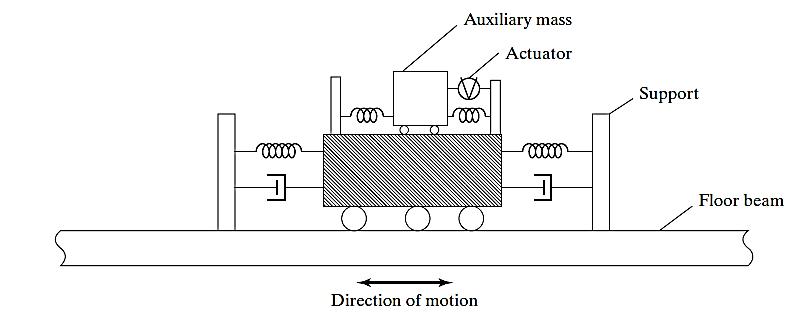
Spring, mass and damper are the components of a tuned mass damper (TMD), a passive control system that is fastened to a structure to lessen the dynamic response of the structure. Steam is released from the structure by the damper's inertia force. It is a commonly used vibration management technique in mechanical engineering systems.Becausethemethodisquickandeasy,Recently,a number of hypotheses have been put out to lessen vibration in civil engineering projects. The intrinsic frequencyofthesecondarymassdamperisoftenmatched to that of the primary structure to give optimal response. The TMD will resonate out of phase with the structural motion when that frequency of the structure is activated. The relative motion that is created between them causes the excess energy in the structure to be transformed into secondarymassandultimatelydischarged
2. METHODOLOGY
Methods of analysis:
Numerous research techniques exist, all with differing levels of precision. The kind of loads exerted externally, thewaythestructurebehaves,orthematerialsusedinthe structure,andthekindofstructuralmodelthatisapplied, all of which can be used to categorize the research procedure. Utilizing external action and behavioral frameworkcanhelpfurthercategorizetheresearch.
● Thepushoveranalysis,
● thecorrespondingstaticmethodprocedure,
● thelineardynamicanalysis,
● theresponsespectrumapproach,
● theelastictimehistoryapproach,
● thenonlinearstaticanalysis,
p-ISSN:2395-0072
Technique
Statementofproblem

Analysisanddesign

Manual


Software
TunedMass Absorber ShearWall


Bare Frame BareFrame withShear wall


Etabs
BareFramewith shearwallandtune massdamper


Base Shea r
Frequency


Story displacement Fundamental time period

Building Properties and specification: In the context of designingandanalyzingaG+20building(astructurewith ground plus 20 floors), it is essential to outline the structural properties and specifications that define its design, safety, and performance. Below is an overview of the common building properties and specifications for a high-rise structure in terms of materials, dimensions, loadingconsiderations,andseismiccompliance.
TotalNumberofFloors:Groundfloor+20floors
● Height of Each Floor typically, 3.0 to 3.5 meters per floor, making the total height of the building approximately60-70meters.
● Building Footprint: Depends on the architectural design, generally ranging from 600 to 1200 squaremetersperfloor.
● Use:Residential,commercial,ormixed-use.
International Research Journal of Engineering and Technology (IRJET) e-ISSN:2395-0056
Volume: 11 Issue: 10 | Oct 2024 www.irjet.net p-ISSN:2395-0072
Table 1: propertiesandspecificationofmembers.
S.NO. Specification Size
1 Sizeofplane(Xand Y) 12.070mx10.110m,
2 height of Floor to floor(m) 3.00m
3 Total height of the (G+20)building 63.000m
4 TypesofSoil Medium
5
6
7 Thicknessofwall 0.2000m
8 SlabThickness 0.1500m
9 Concrete and steel grade M25,Fe500
10 Types of soil ( as perIS1893(part1): 2002 Type II Medium rocky soil 11 Response Reduction Factor (R) 5.00 12 Factor 1.200 13 Seismic Zone Factor 0.100, z16.00,.24.00,.36.00 (ZoneII,III,IVand V)
14 Summationofload By IS:1893 (part 1) : 2016
A structural system refers to the arrangement of various structural elements in a building or structure that work togetherto support loadsand ensure stability. Thechoice of a structural system significantly influences the performance, safety, and aesthetics of the building. Here aresomecommontypesofstructuralsystems.
Foundation:
Type: Raft foundation or pile foundation, depending on soilconditions.
Depth:Generally,between2to3metersbelowtheground levelforraftfoundationsanddeeperforpiles.
Columns: RCC (Reinforced Cement Concrete) columns designedtosupportaxialloadsandresistbending.
Column Sizes:Varybasedonstructuralload,buttypically 450mmx600mmto600mmx900mmforahigh-rise.
Beams: RCC beams spanning between columns, supportingfloors.
Beam Sizes: Generally, 230mm x 450mm or larger dependingonspanandload.
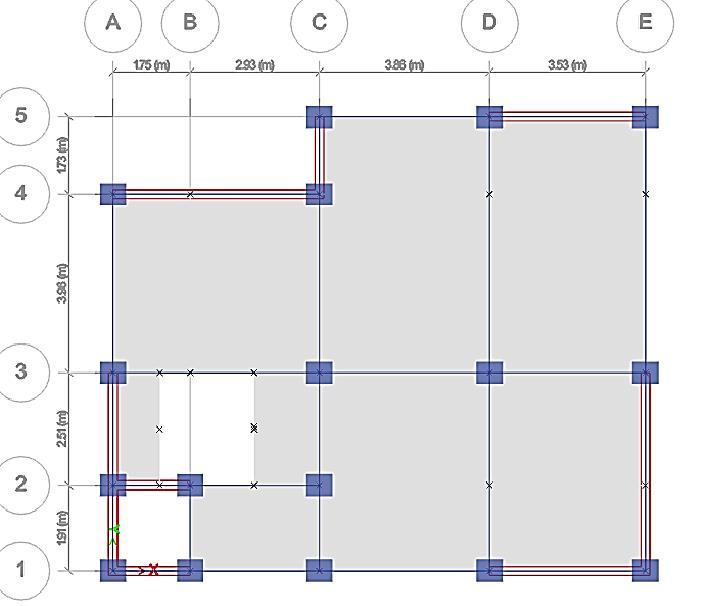
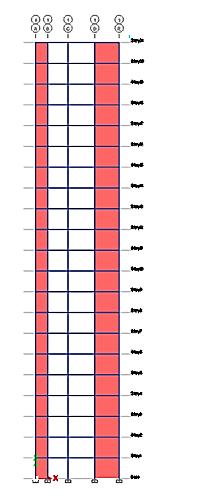
4.1 Plan View of Building
0.150m 116 Load Applied Dead Load Calculated as per Self Weight Live Load 3KN/m2
Seismic Load Asper IS 1893(part1) :2002
Floor Finish KN/m2
2Model(1)G+20Residentialbuildingmodel'splan viewwithoutashearwall
International Research Journal of Engineering and Technology (IRJET)
Volume: 11 Issue: 10 | Oct 2024 www.irjet.net
International Research Journal of Engineering and Technology (IRJET) e-ISSN:2395-0056
Volume: 11 Issue: 10 | Oct 2024 www.irjet.net p-ISSN:2395-0072
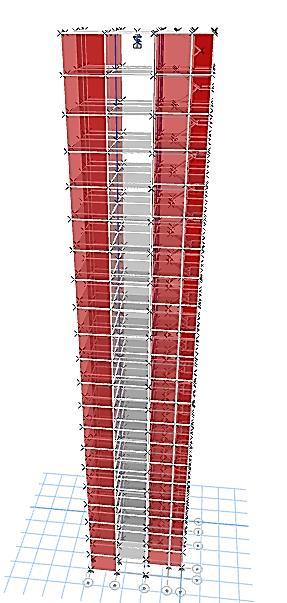
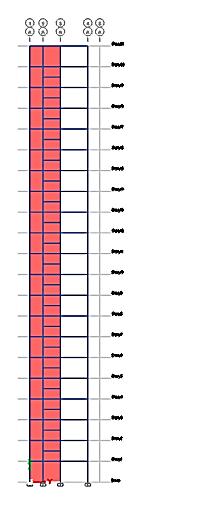
Fig. 6 AnisometricviewoftheresidentialbuildingG+20.
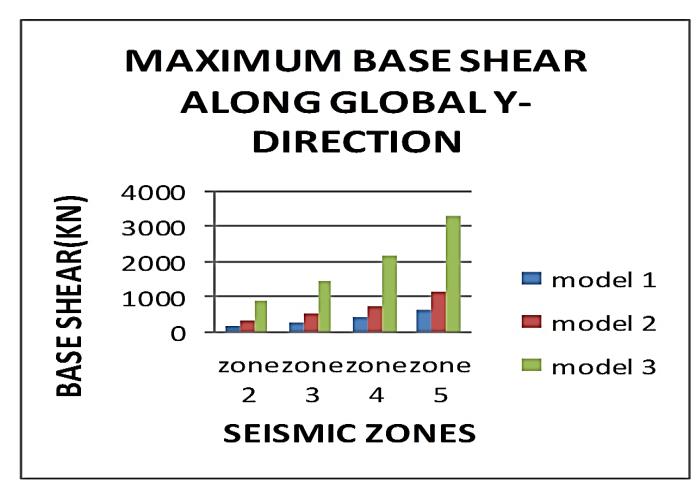
Fig. 7 UniversalX-AxisMaximumBaseShear.
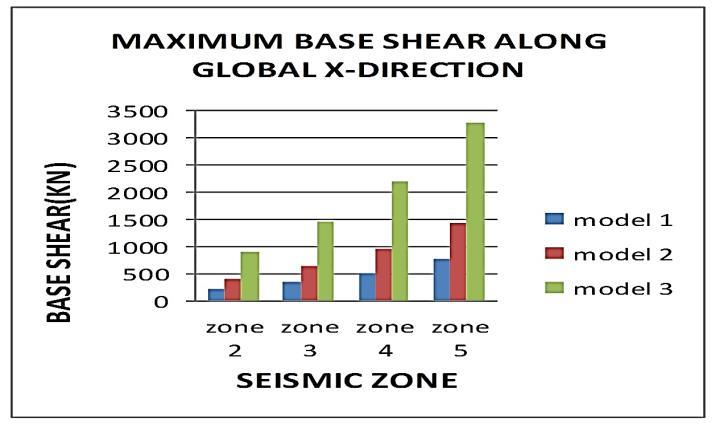
Fig. 8 Baseshearfordifferentseismiczone.
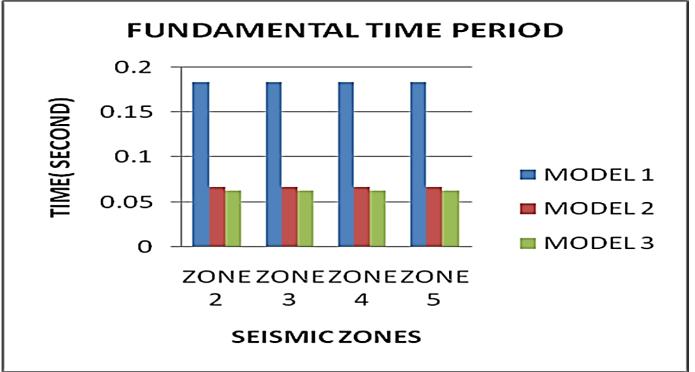
Fig. 9 Timefordifferentseismiczone
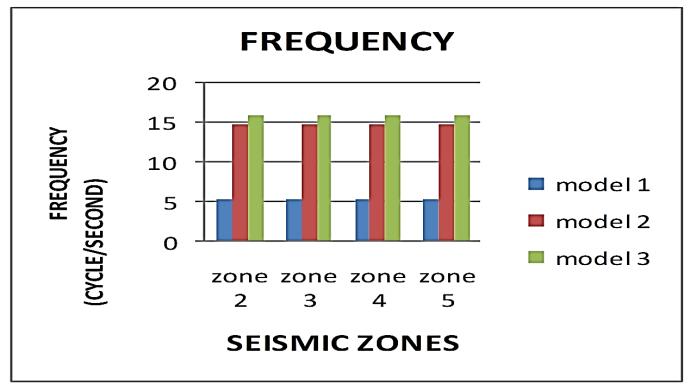
Fig. 10 Frequencyfordifferentseismiczone.
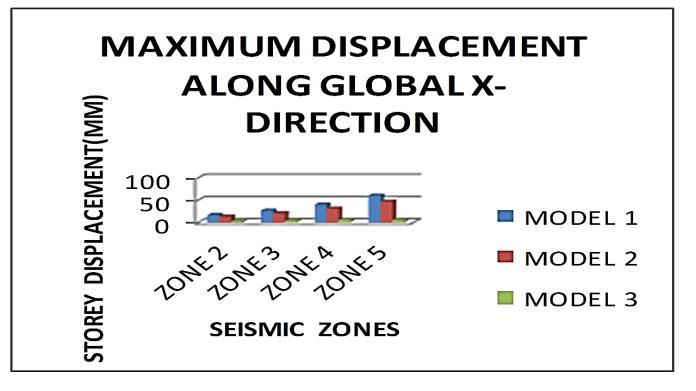
Fig. 11 StoryDisplacementfordifferentseismiczone.
8.315
International Research Journal of Engineering and Technology (IRJET) e-ISSN:2395-0056
Volume: 11 Issue: 10 | Oct 2024 www.irjet.net p-ISSN:2395-0072
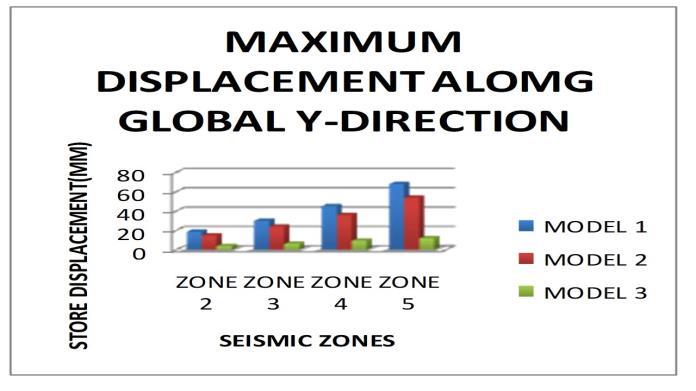
12 MaximumStoryShiftalongtheY-axis.
5. Description of the Model: AModelwithoutabsorberandshearwall,Model(1)
B. The shearing wall approach, model (2) C.shearwallsandabsorbermodel:Model(3):
1. Because it draws greater lateral stresses than a shear wallwithoutadamper,thebaseshearofashearwallwith a damper is much higher than that of the other variants, although the base shear of a frame is lower because the structureweighsless.(infigures7and8).
2.Thebuilding'stimeperiod,asreportedinIS1893:2016 (Part-1),is1.67swithoutinfills.Thistimeperioddoesnot coincide with any of the time periods shown in Fig. 9, indicatingthatthestructureissafefromresonanceeffects. AsseeninFigure9.
3. Figures 11 and 12 show the viewpoint from above. It was found that the building's storey displacement decreases with decreasing building height. Because it counters more forces than other types, the frame has a larger storey displacement; the shear wall with damper hastheshortestdisplacement.
The maximum displacement values in seismic zone V are greater than those in seismic zones II, III, IV, and V for all scenarios(models1,2,and3).Thisimpliesthatcreatinga structure with uniform stiffness could reduce displacement.
In terms of maximum displacement and base shear, the building with shear walls and a tuned mass damper (i.e., model 3) produced better results, confirming the notion that buildings with uniform stiffness produce better results
As to IS 1893:2016 (Part-1), the building's time period of 1.67sdoesnotalignwithanyofthetimeperiodsdepicted
in Fig. 9, signifying that the structure is safe from resonanceeffects.
[1]S.AkhilAhamadandK.V.Pratap,“Dynamicanalysisof G + 20 multi storied building by using shear walls in various locations for different seismic zones by using Etabs,” Mater. Today Proc., no. xxxx, 2020, doi: 10.1016/j.matpr.2020.08.014.
[2]Z.Zhang,J.Ou,D.Li,andS.Zhang,“Optimizationdesign of coupling beam metal damper in shear wall structures,” Appl. Sci.,vol.7,no.2,2017,doi:10.3390/app7020137.
[3] D. R. Pant, M. Montgomery, and C. Christopoulos, “Analytical Study on the Dynamic Properties of Viscoelastically Coupled Shear Walls in High-Rise Buildings,” J. Eng. Mech.,vol.143,no.8,p.04017047,2017, doi:10.1061/(asce)em.1943-7889.0001247.
[4]V.More,V.Patil,andS.Takkalaki,“DynamicAnalysisof RCC Frame Structures with and Without Viscous Damper Having Different Aspect Ratio,” vol. 6, no. 10, pp. 64–70, 2019.
[5] R. Chen and G. Xing, “SEISMIC analysis of high-rise buildings with composite metal damper,” MATEC Web Conf., vol. 31, pp. 1–5, 2015, doi: 10.1051/matecconf/20153111002.
[6] B. Islam, “Optimization of Tuned Mass Damper Parameters Using Evolutionary Operation Algorithm,” 15th World Conf. Earthq. Eng.,no.1998,2012.
[7] C. C. Lin, L. Y. Lu, G. L. Lin, and T. W. Yang, “Vibration control of seismic structures using semi-active friction multipletunedmassdampers,” Eng. Struct.,vol.32,no.10, pp. 3404–3417, 2010, doi: 10.1016/j.engstruct.2010.07.014.
[8] N. A. Alexander and F. Schilder, “Exploring the performance of a nonlinear tuned mass damper,” J. Sound Vib., vol. 319, no. 1–2, pp. 445–462, 2009, doi: 10.1016/j.jsv.2008.05.018.
[9]K.K.F.Wong,“Seismicenergydissipationofstructures withtunedmassdampers,” Wind Earthq. Eng. - Proc. 10th East Asia-Pacific Conf. Struct. Eng. Constr. EASEC 2010,vol. 3,no.2,pp.231–236,2006.
[10]I.Saidi, aD.Mohammed,E.F.Gad,J.L.Wilson,andN. Haritos, “Optimum Design for Passive Tuned Mass Dampers Using Viscoelastic Materials,” Aust. Earthq. Eng. Soc. 2007 Conf.,pp.1–8,2007.
[11] K. C. S. Kwok and B. Samali, “Performance of tuned mass dampers under wind loads,” Eng. Struct., vol. 17, no.
International Research Journal of Engineering and Technology (IRJET) e-ISSN:2395-0056
Volume: 11 Issue: 10 | Oct 2024 www.irjet.net p-ISSN:2395-0072
9,pp.655–667,1995,doi:10.1016/0141-0296(95)000356.
[12] N. Chouw, “Behaviour of soil-structure system with tuned-mass dampers during near-source earthquakes,” 13th World Conf. Earthq. Eng.,no.1686,2004.
[13]A.GhoshandB.Basu,“Effectofsoilinteractiononthe performance of tuned mass dampers for seismic applications,” J. Sound Vib., vol. 274, no. 3–5, pp. 1079–1090,2004,doi:10.1016/j.jsv.2003.09.060.
[14]C.LiandY.Liu,“Activemultipletunedmassdampers forstructuresunderthegroundacceleration,” Earthq. Eng. Struct. Dyn., vol. 31, no. 5, pp. 1041–1052, 2002, doi: 10.1002/eqe.136.
[15] D J Carson, “Seismic Evaluation of the Historic EastMemorial Building Retrofitted with Friction Dampers, Ottawa,Canada,” 15th World Conf. Earthq. Eng.,2012.
[16] IS 456, “Concrete, Plain and Reinforced,” Bur. Indian Stand. Dehli,pp.1–114,2000.