
International Research Journal of Engineering and Technology (IRJET) e-ISSN:2395-0056 p-ISSN:2395-0072

Volume:11Issue:10|Oct2024 www.irjet.net


International Research Journal of Engineering and Technology (IRJET) e-ISSN:2395-0056 p-ISSN:2395-0072
Volume:11Issue:10|Oct2024 www.irjet.net
Prof Vikas Gaikwad1
,
Vaishnavi Bilambe
2 ,
Sanika Patil
3 , Yashavant Patil4 , Diksha Waghale5
1Professor, Department of Artificial Intelligence & Data Science, Shree Ramchandra College of Engineering, Pune, India
*2*3*4*5Student, Department of Artificial Intelligence & Data Science, Shree Ramchandra College of Engineering, Pune, India
Abstract - This study introduces an automated attendancesystemthatusesfacialrecognitiontechnologyto improve the efficiency and accuracy of attendance tracking. Developed on a Raspberry Pi, the system uses Python programming in conjunction with sophisticated image processing techniques and pattern recognition algorithms, suchasconvolutionalneuralnetworks(CNNs),toaccurately detectfacialfeatures.ThesystemusestheYOLOv8(YouOnly Look Once version 8) model, which enables real-time object detection, allowing the system to quickly and accurately identify faces. By taking and analyzing facial images, the system recognizes and logs student attendance without the need for physical communication. In addition to reducing administrative work, this technology successfully stops proxy attendance, which occurs when a student signs in under a phonyidentity. Because the systemoperates inrealtime, attendance is immediately recorded as soon as kids enter the classroom, cutting down on delays and freeing up teachers to concentrate on instruction rather than managing attendance. Furthermore, doing away with tangible inputslikesign-inpapersencourages a contact-less method, which is crucial in the health-conscious world of today. SQL is used for data administration in order to provide effective storage and convenient access to attendance information. Using HTML, CSS, and JavaScript, the front end is constructed to provide administrators and teachers with an easy-to-use interface. This facial recognitionattendancesystemisflexibleandexpandablefor use in a variety of settings outside of the classroom, such as offices and conferences. In conclusion, it is a useful tool for efficient attendance management since it increases accuracy, decreases manual labor, and encourages active involvement.
Key Words: Convolutional Neural Networks (CNN), Raspberry Pi, facial recognition technology, automated attendance system, real-time object identification, SQL (Structured Query Language), YOLOv8 (You Only Look Once version 8), & User Interface.

Despite the modern world's advancements in technology, many educational institutions still maintain classroom attendance using antiquated techniques such manually calling out roll numbers or gathering student signatures. In addition to being time-consuming, these conventional approaches are prone to mistakes, including inaccurate data entry, absenteeism, and the prevalent problem of proxy attendance, in which one student indicates the presence of another. A more dependable and effective method of monitoring student attendance is essential, considering the strong correlation between attendance and academic achievement. As a result, educational institutions must use updated systems that simplify the attendanceprocedureanddoawaywith theshortcomings of the current approaches. Advances in artificial intelligence (AI) and image processing have led to the emergence of facial recognition technology. Compared to other systems, face recognition, a biometric technology thatrecognizespeoplebyexaminingtheirfacialtraits,has anumberofbenefits.Facialrecognitionisamorehygienic andlong-lastingoptionthanfingerprintscannersorRFIDbased systems because it doesn't require physical touch. Real-time, precise facial recognition, even with big datasets, is now possible thanks to recent advancements inAIandimageprocessingtechnology,whichmakesitthe perfect option for automating attendance in educational settings. The goal of this research is to create an automated attendance system that uses facial recognition technologytoimproveaccuracyandefficiency.Thesystem makes use of Python programming, the OpenCV library, and a Raspberry Pi, a low-cost and small single-board computer. A popular tool for real-time computer vision is OpenCV.Asstudentsentertheclassroom,thesystemtakes pictures of them, uses face recognition to identify them, and automatically records their attendance. Attendance is recorded automatically as soon as a student's face is identified. In educational settings, facial recognition technology has several benefits. First of all, it does away with the necessity of interacting physically with the system,whichisextremelycrucialforpreservinghygiene,

Volume:11Issue:10|Oct2024 www.irjet.net
International Research Journal of Engineering and Technology (IRJET) e-ISSN:2395-0056 p-ISSN:2395-0072
especially in the wake of a pandemic. In addition, compared to more conventional techniques like calling rolls or gathering signatures, the approach saves time by recording attendance in a couple of seconds. Additionally, since the technology can only identify pupils who are physically present in the classroom, facial recognition greatly lowers the possibility of proxy attendance. A crucial component of this system is the Raspberry Pi, which offers an affordable yet potent platform for putting real-time facial recognition into practice. It is a sensible choice for educational institutions with tight resources becauseofitsaffordability.Thesystemmaybetailored to different classroom settings because to the flexibility and customization made possible by the combination of OpenCVandPython.Thesystemcanbereadilymaintained and upgraded over time because to Python's widespread use and large library. To sum up, the creation of a facial recognition-based automated attendance system is a big step toward updating attendance control in educational settings.Thesuggestedsystem,whichisbasedonPython, OpenCV, and Raspberry Pi, provides a dependable, effective, and affordable solution that can improve accuracy, lessen human labor, and avoid proxy attendance allofwhichwilleventuallyhelpstudentsand teachers.
Creating and Designing an automated facial recognition system to improve accuracy and security in attendance management by streamlining attendance monitoring, reducing administrative burden, and doing away with proxyattendance.
1. Automated Attendance System: Replace manual attendancemonitoringtechniqueswithanautomated system that makes use of facial recognition technology. By reducing the need for manual procedures, this solution simplifies attendance trackingforbothteachersandstudents.
2. High Accuracy and Real-Time Updates: To guarantee accurate and dependable attendance tracking, use sophisticated facial recognition algorithms. Teachers and administrators can instantly obtain the most recentattendanceinformationthankstothesystem's real-timeupdates.
3. Decreased Manual Effort: By automating the attendance process, you can do away with the requirement for manual roll calls or signature collection. This frees up teachers to concentrate on teachingbydrasticallycuttingdownontheamountof time spent on administrative work and attendancerelatedduties.
4. Preventing Proxy Attendance: Make sure that only pupils who are physically present in the classroom are marked as present to improve security. By preventing instances of proxy attendance, the use of strong facial recognition validation promotes accuracyandfairnessinattendancerecords
5. Improved Classroom Management: Make attendance
rep
ssroom administration, keeps accurate and wellorganized data, and boosts institutional efficiency in genera orts quickly and easily accessible to teachers and administrators. The technology facilitates improved cla l.
2. LITERATURE
Ghalib Al-Muhaidhri and Javeed Hussain's 2019 paper, "SmartAttendanceSystemusingFaceRecognition,"which was published in the International Journal of Engineering Research & Technology, presents a technologically advanced method for automating attendance procedures. The OpenCV library, the Local Binary Pattern Histogram (LBPH) method, and a Raspberry Pi 3B+ processor unit are used in the system to recognize faces. By using facial recognition to confirm each person's identification, this design makes it possible to register attendance in a quick andeasymannerwhiledrasticallyloweringthenumberof proxy attendance cases. Despite being more efficient than manual methods, this methodology nevertheless has several drawbacks. For example, in low-light conditions, the system's detection abilities can deteriorate, making it challenging to precisely identify people. Furthermore, it cantakealotoftimeandresourcestocapturehigh-quality facialphotosforeveryuserduringthefirstsetup.
AnotherdistinctideawasintroducedbyXuanHuyNguyen, Duy Dieu Nguyen, Minh Son Nguyen, Tung Than at the 2021 NAFOSTED Conference on Information and Computer Science named as "Automated Attendance System in the Classroom Using AI and IoT,". This study investigates how real-time facial recognition for student attendance tracking in smart classrooms can be facilitated by Artificial Intelligence (AI) and Internet of Things (IoT) technologies. Using embedded devices placed throughout theclassroom,thesystemusesAI-drivenimageprocessing algorithms to recognize and detect faces. Through the integrationofIoTconnection,thesystemoffersa dynamic and automated approach to attendance management by continuously monitoring students throughout the session. Notwithstanding the benefits, the system is limited by the embeddeddevices'computationalcapacity,whichmaynot beabletosustainhighaccuracywhenhandlingmanyfaces at once. This restriction may cause delays in recognition, especially in schools with more students or where the hardwarespecificationsofthedevicesarelower.
International Research Journal of Engineering and Technology (IRJET) e-ISSN:2395-0056
Volume:11Issue:10|Oct2024 www.irjet.net
In 2023, P. Sai Vasantha Lakshmi, Reddy Kumaraswamy, and Advin Manhar submitted their third paper, "Smart Attendance Management System Using Geo-Fencing and MachineLearning,"intheInternationalJournalofCreative Research Thoughts. By combining facial recognition and geofencingtechnologies,thisstudyexpandsontheidea of automated attendance and guarantees a location-based authentication system. The system uses GPS information to determine whether users are inside a certain geographic area and uses facial recognition algorithms to confirmusers'identities.Byensuringthatattendancemay only be recorded from within the designated area, this dual-check technique improves security and reduces fraudulentactivity.ButtheprecisionofGPSsignals,which can fluctuate, is crucial to the system's operation and can occasionally result in tracking inaccuracies. Additionally, usersmighttrytoaltertheirlocationinformationinorder togetaroundthegeo-fence,whichwouldputthesystem's dependabilityatrisk.
It is clear from combining these studies that although facial recognition-based attendance systems present viable ways to improve security and decrease manual labor, they still have drawbacks like environmental influences,devicerestrictions,andpossibleweaknessesin location-based tracking. These problems show that more study is required to increase accuracy in a variety of scenarios, strengthen system resilience, and investigate othersecuritymeasures.
3.1.
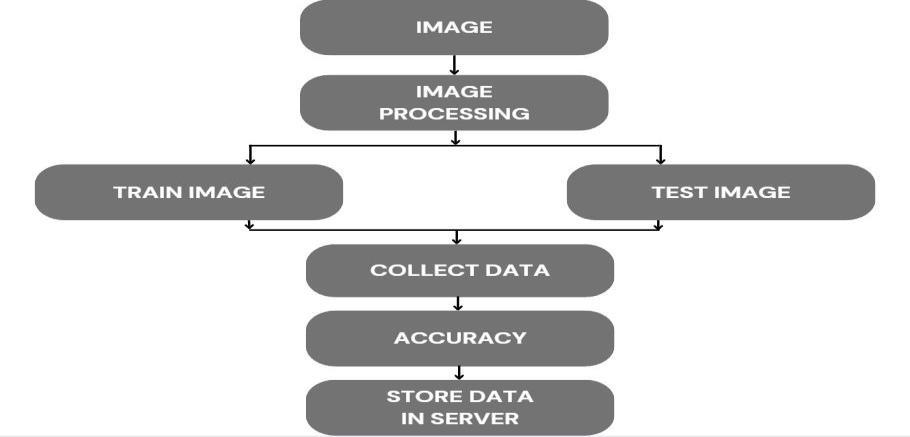
The flowchart describes the essential procedures for machine learning-based picture recognition and categorization. The first step is to collect images from sensors,cameras,anddatasets.Afterbeinggathered,these photos undergo an important step in image processing to improve their quality. In order to highlight significant elements like edges, forms, or textures all of which are necessary for precise classification this stage eliminates noiseandextraneousdata.
Train Image and Test Image are the two branches into whichtheworkflowdividesafterprocessing.Themachine learning model is trained to identify various classes using a sizable collection of tagged photos during the Train Image phase. The model continually learns to increase its accuracy by recognizing patterns and connections among the features taken from these photos. The model's ability to generalize to new, unseen data improves with the diversityandlabelingofthetrainingdata.
A different set of photos that were not included in the trainingprocessisused in theTestImage phaseto assess the model's performance. In addition to helping to avoid
p-ISSN:2395-0072
overfitting,whichoccurswhena model performs well on trainingdatabutpoorlyonreal-worldsituations,thisstep guarantees that the model can correctly categorize fresh data.
The system then proceeds to Collect Data, where data is collected from the testing and training stages. This data contains important metrics that are used to evaluate the overallperformanceofthesystem,suchastheproportion ofcorrectversuserroneousclassifications.
Next,themodel'saccuracyisdetermined,andifnecessary, additional metrics like precision and recall are also computed. Lastly, all information and findings are saved onaserverforlateruse,enablingongoingmodellearning and development. The image recognition system will continue to be effective, flexible, and scalable thanks to thismethodicalapproach.
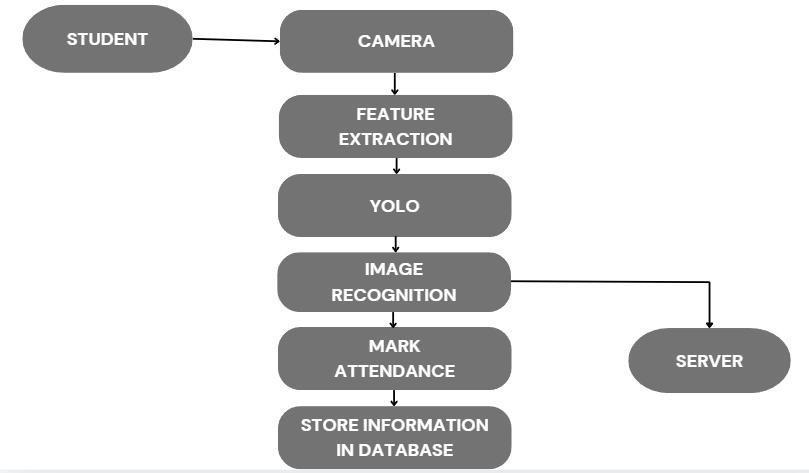
1. Camera: The first step involves the camera taking a live picture of the student approaching the attendancesystem. The informationof theimagehas beenacquiredinthisstep.
2. Feature Extraction: The system carries out feature extraction once the camera takes the picture. The technology recognizes distinctive face traits at this level, including the student's eyes, nose, and facial contours, which are crucial for identification. The model will subsequently compare these extracted traitstoidentifytheuser.
3. YOLO (You Only Look Once): The YOLO algorithm is thenfedthefeaturesthatwereretrieved.Areal-time object detection system called YOLO analyzes the pictureandusesadatabaseofknownfacestoidentify
the student's face. Even with live video broadcasts, thisstageguaranteespromptandpreciserecognition.
Volume:11Issue:10|Oct2024 www.irjet.net
4. Image Recognition: The system verifies the student's identification by comparing the extracted features with the recorded data after YOLO processes the image. The system marks attendance if the student's facematchesarecordinthedatabase.
5. Store Data in Database: The last stage is to store the
attendan on ce information i sa n a database or server. This comprises the date, time, and status (present or absent) of the student as well as their identifying informati. For later use or reporting, the data is storedina fe,accessiblemanner.
The automatic facial recognition system intended for attendance tracking relies heavily on the Convolutional Neural Network (CNN) algorithm. CNNs are highly suited for facial recognition jobs since they are sophisticated deep learning algorithms designed to handle structured griddata,especiallyphotos.ACNN'sskeletonismadeupof many important layers that collaborate to act and assess the graphical information. Convolutional layers are the first step, in which the network subjects the input images to a number of contaminants or kernels. These filters are made to pick up on important characteristics including textures, forms, and edges. Feature maps, which are representations of the important elements of the image, such as unique facial traits that are essential for identification, are produced as the filters move over the picture.Layer pooling Through a procedure known as down-sampling,theselayersareinchargeofloweringthe feature maps' dimensionality. In addition to reducing the computingeffort,thismakesthenetworkmoreresilientto small fluctuations, including illumination shifts or mild visual distortions. Pooling layers assist the CNN in
concentrating on the crucial components required for successful facial recognition by keeping only the most noticeable aspects. The fully connected layers, which process the improved features extracted from the earlier layers for classification, are the next part of the architecture. These layers compare the identified face traits to a database of student photos that has been saved within the framework of your attendance system. This comparison guarantees a trustworthy marking procedure by enabling the system to precisely match a student's face with their matching attendance record.The fact that CNNs canlearnontheirownisoneofthemanyamazingbenefits of using them in your system. The CNN continuously improves its comprehension of face features as it examines a greater number of facial picture datasets over time, increasing its precision in identifying and distinguishing between people. In dynamic settings like schools, where students may exhibit a range of appearancesduetothingslikechangesinhairdo,attire,or even the use of accessories, this self-learning capability is especially helpful.Additionally, the CNN improves the speedandaccuracyoffaceidentificationwhenpairedwith theYOLOv8 model for real-timeobjectdetection.Students may be quickly identified as they enter the classroom thankstoYOLOv8'sabilitytodetectnumerous itemsin an image at once. The time-consuming and frequently inaccurate manual attendance procedures are eliminated thanks to this capability, which guarantees that attendance is recorded promptly and precisely. The automated method enhances the overall educational experienceinadditiontostreamliningattendancetracking. Teachers can spend more time instructing and interacting with pupils if they have less administrative work to do. Additionally, a more structured and effective learning environment is promoted by doing away with manual attendance tracking.In conclusion, adding CNNs to your facial recognition attendance system greatly improves scalability, efficiency, and delicacy. This technology provides a contemporary answer to age-old attendance issues by utilizing cutting-edge deep learning algorithms andreal-timedetectionmodels,openingthedoortobetter classroom management and increased student involvement.
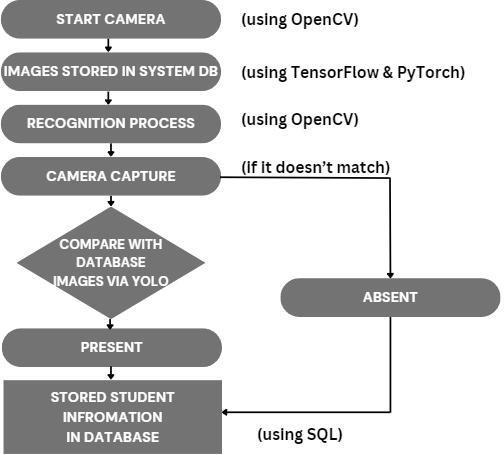
The "Attendance Genie" solution automates attendance management by integrating a number of AI and computer vision tools. In order to record live video frames, the system first turns on the camera using OpenCV. TensorFlow and PyTorch frameworks are used to handle the system's database, where these recorded images are stored. The input is then analyzed using a facial recognition procedure that also makes use of OpenCV.Images are continuously taken by the system and comparedtothedatasetthathasbeenstored.Theperson
International Research Journal of Engineering and Technology (IRJET) e-ISSN:2395-0056
Volume:11Issue:10|Oct2024 www.irjet.net
ismarkedasabsentbythesystemifthetakenpicturedoes not correspond to any records that are currently in existence.Ifamatchisdiscovered,thestudent'sexistence is verified using YOLO (You Only Look Once), a real-time object detection technique. If confirmed, the system recordsthestudent'sattendanceandusesSQLtosavethe datainthedatabase.
5.1. System Architecture
1. Turns on the Camera: The system begins by filming pupilsenteringaclassroominrealtime.
2. Retrieves Facial Information: After processing video input, the system retrieves facial information for identificationpurposes.
3. Facial Recognition: TensorFlow/PyTorch is used to run a recognition algorithm by comparing extracted datawithstoredstudentphotos.
4. YOLO validation: To guarantee precise real-time validation in the event that a match is discovered, YOLOisemployed.
5. Attendance Recorded: After a successful recognition, SQL is used to enter the attendance data into the database.
6. NoMatchFound:Thestudentismarkedasabsentby thesystemifthereisnomatch.
5.2. Predicted Result
The predictive outcome of the system is an accurate, efficient, and automated process for tracking attendance. The system begins by activating the camera to capture real-time footage as students enter the classroom. After extracting facial data, the facial recognition algorithm
p-ISSN:2395-0072
comparesitwithpre-stored images.Ifa matchisfound,it validates the result using the YOLO model and records attendance into the database. In case of no match, the system marks the student as absent. This process eliminates manual intervention, enhances accuracy, and ensuresreal-timeattendancemanagement.
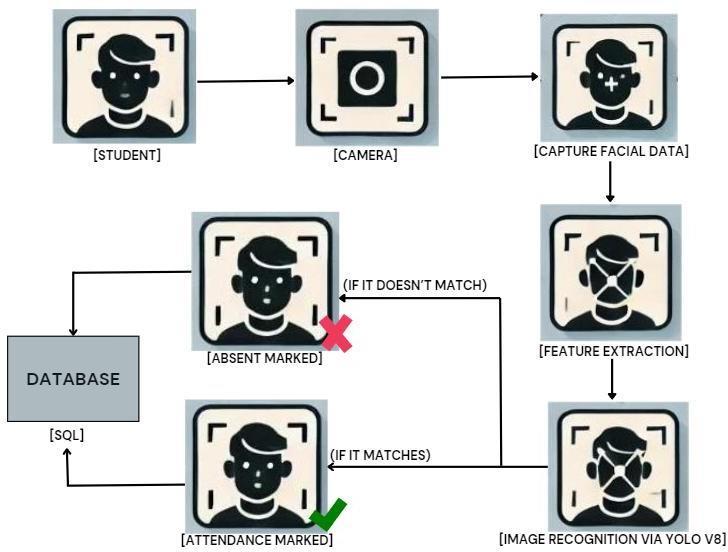
Fig-4:PredictedResult
To address the drawbacks of traditional attendance techniques like roll calls and sign-in sheets, the development of an automated attendance system utilizing facial recognition technology represents a significant advancement. This creative method not only improves accuracybutalsosimplifiestheprocedure,makingitmore effective and intuitive. Utilizing the capabilities of a Raspberry Pi, Python programming, and state-of-the-art image processing methods, such as convolutional neural networks (CNNs), this system guarantees precise and dependable facial feature detection for attendance monitoring. The system's overall performance is further improvedbythefastandaccuratefaceidentificationmade possible by the integration of the YOLOv8 model for realtime object detection. Facial recognition technology streamlines the process and reduces administrative work by automating attendance tracking and doing away with the necessity for face-to-face interaction. By successfully preventingproxyattendance,thismethodmakessurethat only the real people in attendance are signed in. The system's real-time functionality guarantees that attendance is swiftly recorded as soon as students enter theclassroom,cuttingdown ondelays andgivingteachers more time to concentrate on instruction rather than administrative tasks. The effective storage and simple accesstoattendancerecordsthatcomewithusingSQLfor data management also make it possible to preserve records and retrieve them when needed. The system is easy to use and adaptable to many situations because to thefront-endinterface,whichwascreatedwithHTML,CSS,
Volume:11Issue:10|Oct2024 www.irjet.net
International Research Journal of Engineering and Technology (IRJET) e-ISSN:2395-0056 p-ISSN:2395-0072
and JavaScript to ensure that educators and administratorscaninteractwithitnaturally.Inadditionto beinguseful ineducational settings,thisfacialrecognition attendance system may find use in conferences, workplaces, and other contexts where precise and effectiveattendancetrackingiscrucial.
1) G. Al-Muhaidhri; J. Hussain, “Smart Attendance System Using Face Recognition,” International Journal of Engineering Research & Technology (IJERT),Vol.8,Issue12,2019.ISSN:2278-0181.
2) S. Kadry; K. Smaili, “A Design and Implementation of A Wireless Iris Recognition Attendance Management System,” ISSN 1392 – 124X Information Technology andControl,Vol.36,No.3,2007.
3) Ekstrom, Michael P., *Digital Image Processing Techniques,*Vol.2,AcademicPress,2012.
4) Docs.opencv.org. (2018). “OpenCV: Introduction to OpenCVPythonTutorials.”
5) nevonProjects.(2018).“FaceRecognitionAttendance System Project.” [Online] Available at: http://nevonprojects.com/face-recognitionattendance-system/[Accessed17Oct.2018].
6) Engr.uconn.edu.(n.d.).“RaspberryPiBasics.”
7) MalikU.,“ImageProcessingusingOpenCV,”Journalof Computer Vision and Image Processing, 2020; 3(1):15-28.
8) MinaeeS.;AbdolshahS.;KhademiKalantariN.,“Deep Learning-Based Face Recognition: A Survey,” Pattern Recognition,2020;107.
9) Hicham El Mrabet; A. Ait Moussa, “IoT-School Attendance System Using RFID Technology,” International Journal of Interactive Mobile Technologies,Apr.2020.
10) T. Raut; S. Kulkarni; M. Hatwar; S. Waratkar; A. D. Wankhade, “Real-time Student Attendance System UsingFaceRecognition,”Ijirt.org.
11) K. Vishal; B. R. Keertiraj; N. K. Dubey; M. R. Pooja, “Face Recognition Based Attendance System,” Ijert.org. Available at: https://www.ijert.org/research/face-recognitionbasedattendance-system-IJERTV9IS060615.pdf.
12) Y.V.S.S.AvinashKumar;CH.VenkataLakshmi;G.B. Harish; Pattan Abdulla Khan, “Face Recognition
Based Attendance System,” Ijert.org. Available at: https://ece.anits.edu.in/Project.
13) Maurizfa; T. Adiono, “Smart Attendance Recording Device Based on Fingerprint Identification,” 2021 *International Symposium on Electronics and Smart Devices,June2021.
14) Seng Chun Hoo; Haidi Ibrahim, “Biometric-Based AttendanceTrackingSystemforEducationSectors:A Literature Survey on Hardware Requirements,” JournalofSensor,Sep.2019.
15) SurajRaj;SaikatBasu,“AttendanceAutomationUsing Computer Vision and Biometrics-Based Authentication - A Review,” Lecture Notes on Data Engineering and Communications Technologies, Jun. 2021.
16) D. D. Nguyen; T. T. Than; X. H. Nguyen; M. S. Nguyen, “Automated Attendance System in the Classroom Using Artificial Intelligence and Internet of Things Technology,” 2021 8th NAFOSTED Conference on InformationandComputerScience(NICS),2021,DOI: 10.1109/NICS54270.2021.9700991.
17) M. H. M. Kamil; N. Zaini; L. Mazalan; A. H. Ahamad, “Online Attendance System Based on Facial Recognition with Face Mask Detection,” Multimedia Tools and Applications,* Vol. 82, No. 22, pp. 34437–34457,2023.
18) P.S.V.Lakshmi;R.Kumaraswamy;A.Manhar,“Smart Attendance Management System Using Geo-Fencing and Machine Learning,” International Journal of Creative Research Thoughts (IJCRT), Vol. 11, Issue 6, 2023.ISSN:2320-2882.
19) Bussa S.; Mani A.; Bharuka S., “Smart Attendance System Using OpenCV Based on Face Recognition,” JournalofIntelligentComputing,2023;120:83-96.
20) Ramya N.; Manasa D.; Naveed SK., “Face Recognition for Automated Attendance Management,” Journal of IntelligentComputing,2023;120:69-82.