
International Research Journal of Engineering and Technology (IRJET) e-ISSN: 2395-0056
Volume: 11 Issue: 10 | Oct 2024 www.irjet.net p-ISSN: 2395-0072

International Research Journal of Engineering and Technology (IRJET) e-ISSN: 2395-0056
Volume: 11 Issue: 10 | Oct 2024 www.irjet.net p-ISSN: 2395-0072
A. Saketh Reddy1 , U. Nagaraju1 , M. Kalyan2
1M.E student, Department of Civil Engineering, Chaitanya Bharathi Institute of Technology, Hyderabad, Telangana, India - 500075
2Assistant Professor, Department of Civil Engineering, Chaitanya Bharathi Institute of Technology, Hyderabad, Telangana, India - 500075 ***
Abstract – Curing is the most important factor which influences the hardening of concrete It is carried out to maintain the moisture content and continue the hydration process in concrete which ensures the concrete in gaining its designed strength. Water is used as the conventional curing process since a long time. Due to high demand in concrete in modern era urban civilization, adopting water curing can be difficult in many areas and poses many challenges in nature/environment. Hence, many different methods are considered for curing process. Even river sand has become a huge demand and also leads to reduction of riverbeds, in the given situation robo-sand came as a solution which can be environmentally friendly substitute as fine aggregate.
The current study investigates the how curing compound PEG-400 have an influence in concrete where robo-sand is used as fine aggregate. The experiments are conducted on high strength concrete grades say, M70 and M80 using GGBS and alccofine as cementitious substitutes, with varying dosages of PEG-400. Compression test, Split Tensile test, flexural strength test are different mechanical tests are conducted on concrete.
Key Words: PEG-400, Robo-sand, High-Strength concrete, GGBS,Alccofine
1.INTRODUCTION
Concrete is made by blending aggregates and binding material together. It has been in use since many ages and over course of period different materials are used in makingconcrete.Todevelopthestrengthanddurabilityof concrete,curingiscarriedoutforconcrete.Watercuringis mostusedcuringmethodsincealongtime.Waterscarcity is a huge problem in many areas hence different curing methods are adopted like using chemical curing agents, light weight aggregates, bio admixtures...etc. In previous studiesitisprovedthatusingofdifferentcuringagentsin concrete have enhanced different properties of concrete. In modern urbanization, high performing concrete are of huge demand in high rise structures. By using different supplementarycementitiousmaterialsinconcretehelpsin gaining high strength at early stage and some materials likeggbshelpsinmaintaininglaterstrengththathelpsthe
concretelastlong.UsingSCM’sinconcretewillalsohelpin reducing carbon footprint and use of microfines in concrete aid to improving hydration reaction and build condensedbinderpaste.Asstatedearly,thegrowinghighrise buildings, demand for fine aggregates will also be greater.Robosandcameasbettersubstituteofriversand as fine aggregate which can be available cheaper than river sand. Studied has shown that there is no compromise in concrete properties when robo sand is usedasfineaggregate.
1.1 Scope and objectives
The scope of this experimentation is to finding the influenceofinternalcuringagentPEG-400inhighstrength concrete while replacing the river sand with robo sand as fineaggregate.
2.1. Cement: OrdinaryPortlandCement(OPC)53gradeis usedhaving3.15specificgravityisused.
2.2. GGBS: GGBS specific gravity of 3 and bulk density of 1350kg/m3complyingwithIScodeisused.
2.3. Microfine: Alccofine-1203 microfines with 2.86 specificgravity having particlesize rangingfrom2.5 to10 micronsisused.
2.4. Fine Aggregate: Robo-sandwith2.66specificgravity, 2.6% water absorption which is of zone-II as per IS: 3832016isused
2.5. Coarse Aggregate: Differentsizesofcoarseaggregate are used. 20mm and 12.5mm size having specific gravity 2.74and0.6%waterabsorptioncomplyingasperIS:383.
2.6. Self-curing agent: Polyethylene glycol (PEG-400) is usedascuringagenthaving1.125specificgravitywhichis transparent in appearance. Different dosages of PEG-400 say,0.5%,1%,1.5%byweightofcementitiouscontentare usedfortheexperiment.
International Research Journal of Engineering and Technology (IRJET) e-ISSN: 2395-0056
Volume: 11 Issue: 10 | Oct 2024 www.irjet.net p-ISSN: 2395-0072
2.7. Super-Plasticizer: Auramix-400 is based on polycarboxylic ether polymer used as super plasticizer whichhelpsinworkability(flow)ofconcrete.Ithasspecific gravity1.05.
3.MIX PROPORTION
MixdesignsarecarriedaccordingtotheIS:10262-2019.
Mix Design 1 M70
Totalcementitiouscontent=690kg/m3
Cement=450kg/m3
GGBS=200kg/m3
Alccofine=40kg/m3
Fineaggregate=591kg/m3
Coarseaggregate,20mm=604kg/m3
Coarseaggregate,12.5mm=402kg/m3
Water=170kg/m3
Superplasticizer=4.83kg/m3 w/cratio=0.25
Mix Design 1 M80
Totalcementitiouscontent=750kg/m3
Cement=450kg/m3
GGBS=250kg/m3
Alccofine=50kg/m3
Fineaggregate=600kg/m3
Coarseaggregate,20mm=543kg/m3
Coarseaggregate,12.5mm=316kg/m3
Water=180kg/m3
Superplasticizer=5.25kg/m3 w/cratio=0.24
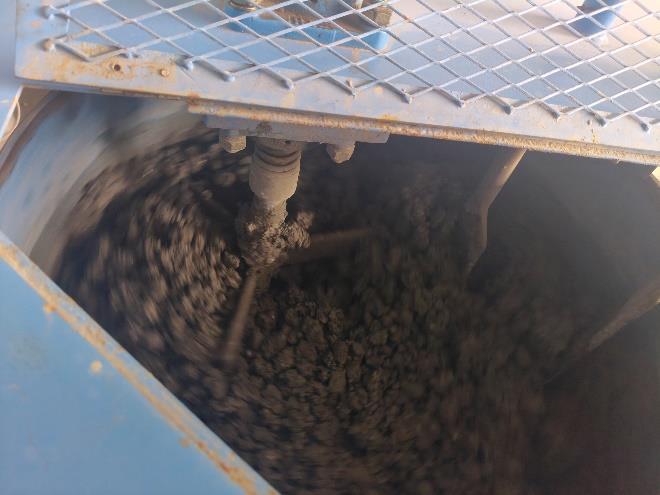
3.EXPERIMENTS AND RESULTS
3.1. Workability
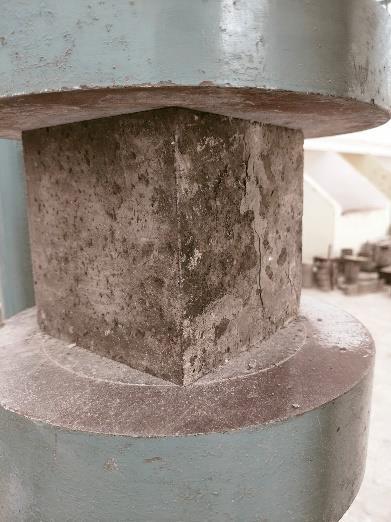
3.2. Compression Test
International Research Journal of Engineering and Technology (IRJET) e-ISSN: 2395-0056
Volume: 11 Issue: 10 | Oct 2024 www.irjet.net p-ISSN: 2395-0072
[1] Younis, M.O., Amin, M. and Tahwia, A.M., 2022. Durability and mechanical characteristics of sustainable self-curing concrete utilizing crushed ceramicandbrickwastes. Case Studies in Construction Materials, 17,p.e01251.
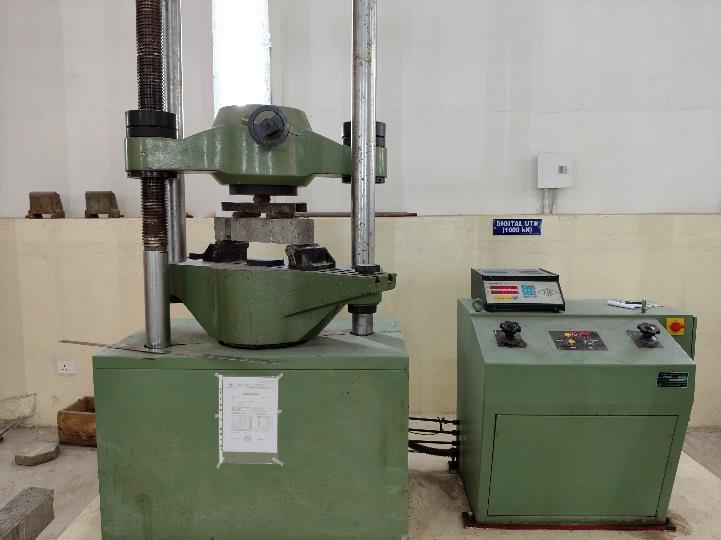
3.4. Flexural strength Test Fig – 4 Flexuretest
[2] ShaikRofa, P.R., 2021. Experimental Investigation on Robo Sand Concrete. Turkish Journal of Computer and Mathematics Education (TURCOMAT), 12(3), pp.58185823.
[3] Pravarly, M.M. and Mahesh, S., 2017. Characteristic of High Performance Concrete by using ROBO Sand and Fly ash. International Journal of Scientific Engineering and Technology Research, 6(6),pp.1015-1022.
[4] Kumar, K.N. and Bhikshma, V., 2023, November. Mechanical Properties of Ultra-High Strength Fiber Reinforced Concrete M80-M150 Made with Indian Materials with Ambient Curing Regime. In Second International Conference on Emerging Trends in Engineering (ICETE 2023) (pp. 264-274). Atlantis Press.
[5] Sagar, B. and Sivakumar, M.V.N., 2020. An experimental and analytical study on alccofine based high strength concrete International Journal of Engineering, 33(4),pp.530-538.
[6] Chand, M.S.R., Giri, P.S.N.R., Kumar, P.R., Kumar, G.R. and Raveena, C., 2016. Effect of self curing chemicals in self compacting mortars. Construction and Building Materials, 107,pp.356-364.
4.CONCLUSIONS
Bleeding of concrete is reduced with the increase ofPEG-400percentage.
Using different sizes of coarse aggregates has helpedingoodflowofconcrete.Wheresmallsize aggregates can fill between the large size aggregateswhichminimizesthevoidsinconcrete.
With the increase of self-curing agent PEG-400, theworkabilityofconcreteisincreased.
The super plasticizer Auramix-400 gives a good non-viscous flow in concrete and also assisted in increasingthestrengthofconcrete.
It is found out that 1% dosage of PEG-400 gives the maximum strength in mechanical property testsconducted.
Hence, 1% dosage of PEG-400 can be said as the optimumdosage.
[7] Amin,M.,Zeyad,A.M.,Tayeh,B.A.andAgwa,I.S.,2021. Engineering properties of self-cured normal and high strength concrete produced using polyethylene glycol and porous ceramic waste as coarse aggregate. Construction and Building Materials, 299,p.124243.
[8] PG, M.C. and Shaik, F., Experimental Investigations on M80 Grade Concrete Using Supplementary CementitiousMaterials.
[9] Gopala Krishna Sastry, K.V.S. and Kumar, P.M., 2018, March. Self-curing concrete with different self-curing agents.In IOP Conference Series: Materials Science and Engineering (Vol.330,p.012120).IOPPublishing.
[10] Malagavelli, V. and Rao, P.N., 2010. High performance concrete with GGBS and ROBO sand. International journal of engineering science and technology, 2(10), pp.5107-5113.
[11] Neeharika, M. and Kumar, A.D., 2023. Ultrahigh PerformanceofConcreteusingManufacturedSand.In IOP Conference Series: Earth and Environmental Science (Vol.1130,No.1,p.012014).IOPPublishing.