
International Research Journal of Engineering and Technology (IRJET) e-ISSN:2395-0056
Volume:11Issue:10| Oct2024 www.irjet.net p-ISSN:2395-0072

International Research Journal of Engineering and Technology (IRJET) e-ISSN:2395-0056
Volume:11Issue:10| Oct2024 www.irjet.net p-ISSN:2395-0072
Dr. P. Durgadevi1 , G. Himanshu Dutt2 , A.V.V. Lokesh Varma3 , Muhammad Rishan4
Asst. Professor1 , Student2 , Student3 , Student4
Department of Computer Science and Engineering1 , SRM Institute of Science and Technology, Chennai, India1
Abstract The incorporation of machine learning algorithms has transformed the disease detection approaches on the scene of modern healthcare, especiallyin situations wheresymptomsserve ascritical diagnostic clues. Adaptable In this work, the CNN algorithm is used as the primary analytical tool, which investigates the field of diagnosing human diseases based on their images symptoms. Because it is adept at processing a wide variety of symptom data and is known for its ensemble learning methodology, it is a great choice for CNN finding complex patterns in challenging data sets. The algorithm captures the subtleties of symptom-disease correlations by combining numerous decisions trees and also ensures resistance and adaptabilityacrossarangeofdrugsconditions.
The study highlights how the system can cope with largedimensionsdata, enabling thedetection ofnuances and context-specific symptoms patterns. The results show that CNN significantly improves diagnosis accuracy, which facilitates the identification of early diseases and rapid therapy. The results highlight the accuracy of the algorithm while emphasizing its accuracy the potential to revolutionize healthcare practices by providing doctors data-driven statistics. The implications of this work go far beyond diagnoses; open thedoor to theday whendeep learning algorithms, especially CNN, will be essential for proactive and individualized treatment. Combining computing power with medical knowledge creates opportunities for more tuning the disease, improving patient outcomes, streamlining treatments and a shift in the focus of medicine towards personalization and preventive therapy.
Keywords — CNN, HAM10000 dataset, Skin disease diagnosis Image-based classification, Dermatology, Melanocytic nevi (NV) Melanoma (MEL), BasalCellCarcinoma(BCC),Actinic Keratoses(AKIEC)
Advances in machine learning, particularly convolutional neural networks (CNNs), have revolutionized the field of medical diagnostics, including the identification of skin diseases.Unliketraditionaldiagnostictechniques,whichrely heavilyonhumanexpertiseandcanbepronetoerrordueto variabilityinjudgement,machinelearningalgorithmsoffera moreconsistentandaccuratealternative.Byanalyzinglarge datasetsofmedicalimages,CNNscandetectsubtlepatterns, textures, and features in skin lesions that the human eye mightmiss.
These models can distinguish between different skin conditions such as melanocytic nevi, dermatofibroma, melanoma, vascular lesions, and basal cell carcinoma with remarkable accuracy. CNNs excel in extracting high-level features from raw image data, automating the diagnostic process and increasing its reliability. The use of CNNs in healthcare has the potential to significantly improve patient outcomes. Early detection of skin diseases, especially malignant forms such as melanoma, can lead to early interventions,reducedmortalityandimprovedprognosis.
Additionally,CNN-basedsystemscan bedeployedinremote orunderservedareaswhereaccesstodermatologyexpertise is limited, providing scalable solutions to global health problems. In addition, CNNs can be integrated into mobile applications and wearable devices, enabling real-time monitoring of skin conditions. This democratizes healthcare by empowering patients to take an active role in managing theirhealth.Thesesystemscanalsoassistdermatologistsby serving as a second opinion and increasing the overall accuracyofdiagnosesand treatmentplans. Insummary,the application of CNN in the diagnosis of skin diseases is a transformative development in medical technology. It reduces the likelihood of human error, provides faster and more accurate results, and offers the potential for early detection, ultimately contributing to better patient care. As research in this field continues to expand, CNN-based diagnostics ispoisedtoplayakeyroleinshapingthefuture ofhealthcare.
International Research Journal of Engineering and Technology (IRJET) e-ISSN:2395-0056
Volume:11Issue:10| Oct2024 www.irjet.net p-ISSN:2395-0072
Advances in machine learning, particularly convolutional neural networks (CNNs), have revolutionized medical diagnostics, including the identification and classification of skindiseases.Dermatologydiagnosishastraditionallyrelied heavily on the expertise of clinicians, whose judgment may vary based on experience, human error, and other factors. Machine learning algorithms, especially CNN, have introduced more consistent, accurate and reliable methods for diagnosing various skin diseases. CNN and Image-Based Diagnosis CNNs are a type of deep learning algorithm designed to analyze visual data, making them particularly suitable for tasks involving medical images. In the case of skin disease identification, CNNs are trained on large datasets of dermoscopic images, allowing them to detect subtledifferencesinskinlesionpatternsthatthehumaneye might miss. These models can effectively differentiate between different skin conditions such as melanocytic nevi, dermatofibroma, melanoma, vascular lesions and basal cell carcinoma. CNNs automate the diagnostic process by extracting high-level features from image data, such as texture, color, and shape, without the need to manually create features as required by traditional methods such as support vector machines (SVMs) or k-nearest neighbors ( KNN).
This ability to learn features directly from raw image data makesCNN a robusttoolforskindiseaseidentification with high accuracy and consistency. Improving patient outcomes The application of CNN in healthcare, particularly in dermatology, has the potential to significantly improve patient outcomes. Early detection is critical for many skin conditions, especially melanoma, which can be fatal if not caught early. CNN's ability to analyze dermoscopic images and detect early-stage malignancies has led to improved earlyinterventionthatcanreducemortalityandimprovethe overall prognosis of patients. Additionally, CNN-based systems can extend the reach of dermatology expertise to remoteandunderservedareas.
In regions where access to dermatologists is limited, CNNpowered diagnostic tools can offer a scalable solution to allow more individuals access to accurate skin disease detection. This could be a game-changer for global healthcare,whereskincancerratesarerisingandhealthcare resources are unevenly distributed. Integrating CNN into mobile and wearable devices One of the most promising aspects of CNNs is their potential integration into mobile applications and wearable devices. Real-time skin condition monitoring using smartphone cameras or wearable sensors enables continuous monitoring of skin changes, allowing
patientstotakeanactiveroleinmanagingskinhealth.These apps can prompt users to seek medical help early if abnormal skin conditions are detected, thereby preventing theprogressionofseriousdisease.Inaclinicalsetting,CNNpowered tools can serve as a second opinion for dermatologists.By reducing diagnostic errorsandproviding additionalinsights,CNNscanincreasetheoverallaccuracyof diagnoses and treatment plans, ultimately leading to better patient care. Transfer learning and pre-trained models A common problem in medical image analysis is the availabilityoflarge,labeleddatasets.
In response, researchers have embraced transfer learning, which allows pre-trained CNN models (trained on large, general-purposedatasetssuchasImageNet)tobefine-tuned for specific tasks such as skin disease classification. Pretrained models such as InceptionV3, ResNet50 and EfficientNet have shown remarkable success in identifying skin diseases. For example, EfficientNet models, especially B4andB5,werefoundtobeeffectiveinclassifyingdifferent types of skin cancer. These models allow researchers to harness the power of deep learning even when data is limited or unbalanced, greatly improving classification accuracyandreducing thetimeneeded to train new models from scratch. Multimodal approaches and file models Another interesting development in CNN-based diagnostics is the integration of multimodal data that combines dermoscopic and clinical images with patient metadata (eg, age,sex,history).Thisapproachimprovesthemodel'sability to accurately classify skin diseases by providing a more comprehensive understanding of the patient's condition. EnsemblemethodsthatcombinemultipleCNNarchitectures such as DenseNet and NASNet have also been used to improve accuracy. These models work together to produce more robust predictions, reducethe risk of misclassification andensureahigherlevelofdiagnosticaccuracy.
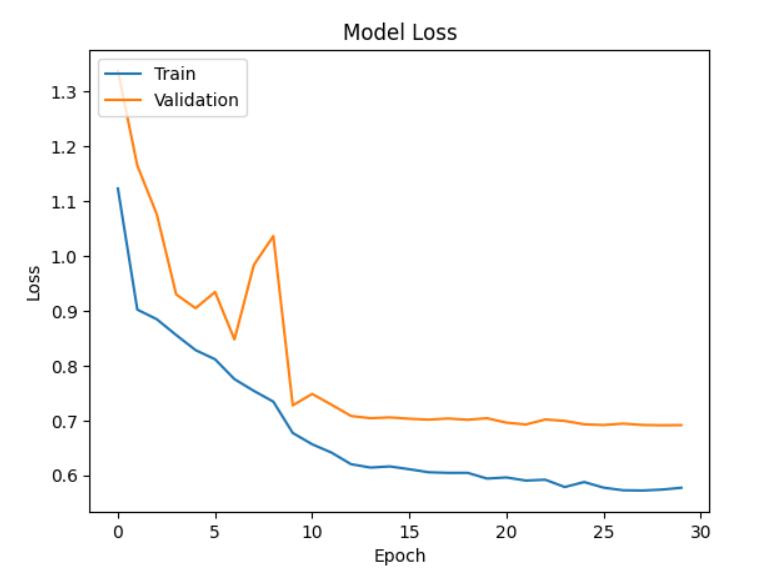
Overcoming the challenges: congestion and small datasets Despite these advances, challenges remain. One of the main problems with CNN-based models is overfitting, especially when the dataset is small. Overfitting occurs when a model performswellontrainingdatabutfailstogeneralizetonew, unseendata.Techniquessuchasdataaugmentation,dropout layers, and regularization are commonly used to mitigate this. These strategies help prevent the model from memorizingthetrainingdataandensurebetterperformance on test datasets. In addition, some CNNs have difficulty processing spatial information efficiently. This led to the exploration of graph-based networks that incorporate both spatial and spectral data, offering a more comprehensive approach to image analysis and improving the model's ability to generalize to different types of skin lesions.
International Research Journal of Engineering and Technology (IRJET) e-ISSN:2395-0056
Volume:11Issue:10| Oct2024 www.irjet.net p-ISSN:2395-0072
Emerging CNN Architectures As the field advances, proprietary CNN architectures are being developed specifically for skin disease classification. For example, Ahn et al. presented a zero-distortion convolutional autoencoder designed to preserve local image properties and reduce overfitting.Thisarchitectureimprovesthemodel'sabilityto generalizewhilemaintaininghighaccuracyindiscriminating skin diseases. In addition, lightweight CNN models are presented to address the need for real-time diagnostics in mobile and low-resource environments. These models are optimized for speed and efficiency without sacrificing accuracy, enabling the deployment of CNN-based diagnostic systemsinavarietyofhealthcaresettings.
The proposed architecture uses a convolutional neural network (CNN) algorithm for image processing to identify specific dermatological diseases, including benign keratosislike lesions (BKL), basal cell carcinoma (BCC), vascular lesions (VAC), melanocytic nevi (NV), and others. By targetingaspecificsubsetofdiseases,theCNNmodelcanbe tuned to provide more efficient and accurate results The specificityoftheanalyzeddiseasesensuresthatthemodelis optimized to detect the nuances and subtle differences between these specific conditions, making it highly specializedfordermatologicaldiagnostics
Dataset: HAM10000 The HAM10000 dataset used in this architecture is one of the most comprehensive datasets for skin disease classification. Contains over 10,000 dermoscopic images of various types of pigmented skin lesions Each image in the dataset is labeled with a corresponding diagnosis, making it an ideal resource for trainingdeeplearningmodelssuchasCNNs.Thediversityof skin conditions represented in HAM10000, including both benignandmalignantlesions,allowstheCNNtolearnfroma wide variety of dermatological cases, further increasing the generalizability of the model Learning functions with CNN Unliketraditional machine learning approachesthat require manual feature extraction (such as shape, color, and texture analysis), CNNs excel by learning directly from raw image data
This ability to bypass the need for explicit feature engineering makes CNNs versatile and powerful. The network automatically identifies relevant features that distinguish different skin lesions based on input data, reducing the need for human intervention and domainspecific knowledge Hierarchical structure of learning CNNs use a hierarchical structure where each successive layer learns increasingly complex and abstract features from the
input image. Initial layersfocus oncapturing basic elements suchasedges,texturesandshapes.Astheimagedatamoves through deeper layers of the network, the model begins to recognize more complex patterns and higher-level features that are unique to certain dermatological conditions. For example: Early layers can detect simple patterns such as sharp edges or color gradients of a lesion. Intermediate layers begin to identify more abstract patterns, such as irregularityinshapeorcolordistributioninthelesion.
Deeper layers focus on specific visual characteristics indicative of certain skin conditions, such as ulceration in basal cell carcinoma or symmetry in benign nevi. This progressive learning allows the CNN to capture both local features(smalldetailssuchastexturesandcolorvariations) and global features (the overall shape and structure of the lesion),makingthemodelhighlyeffectiveinidentifyingskin diseases. Model efficiency Focusing on specific dermatological conditions allows CNN to optimize the learning process and achieve a high degree of accuracy and efficiency. Because the model is trained to discriminate between a well-defined set of diseases, it is better able to discriminate between closely related conditions (eg, distinguishing between benign keratosis-like lesions and melanoma).
This specificity helps minimize the likelihood of misclassification, which is critical in clinical settings where an accurate diagnosis directly affects patient outcomes. Generalization and adaptability Although the model is designed to target specific skin diseases, the generalization of the architecture can be extended to recognize other dermatological conditions if additional data are provided. CNNs are highly adaptable, meaning that with further training and fine-tuning, this architecture could potentially be extended to detect other types of skin lesions or even other forms of medical imaging data such as X-rays or CT
scans.LocalandglobalinformationcollectionOneofthekey advantagesofusingCNNsinimage-baseddiagnosticsistheir abilitytocapturebothlocalandglobalinformation.
The CNN architecture processes image data in small areas (local features) while taking into account the overall structure (global features) of the image. This makes CNNs particularly suitable for complex image classification tasks, such as skin disease identification, where both small details (e.g.,textureirregularities)andbroaderpatterns(e.g.,lesion symmetry or asymmetry) are crucial for diagnosis. For example:InBCC(basalcellcarcinoma),localfeaturessuchas border irregularities and the presence of ulceration are critical for diagnosis. In NV (melanocytic nevi), it plays a significantroleinidentifyingbenigncharacteristicsofglobal
International Research Journal of Engineering and Technology
Volume:11Issue:10| Oct2024 www.irjet.net p-ISSN:2395-0072
symmetryandcolordistribution.Bycombiningbothlevelsof analysis,CNNsprovidecomprehensiveimageunderstanding andimprovediagnosticaccuracy.
Potential for clinical use The proposed CNN-based architecture has enormous potential for integration into the clinical environment. By automating the diagnostic process, it can help dermatologists identify skin conditions more quickly and accurately, thereby speeding up the overall diagnostic workflow. In particular, the model's ability to detect malignancies such as melanoma at early stages could lead to earlier interventions and significantly improve patient outcomes. In addition, the adaptability of the model to mobile platforms or cloud systems enables real-time diagnostics in remote or underserved areas. This could democratize access to high-quality dermatology care, especially in areas where professional dermatology services arenotreadilyavailable.
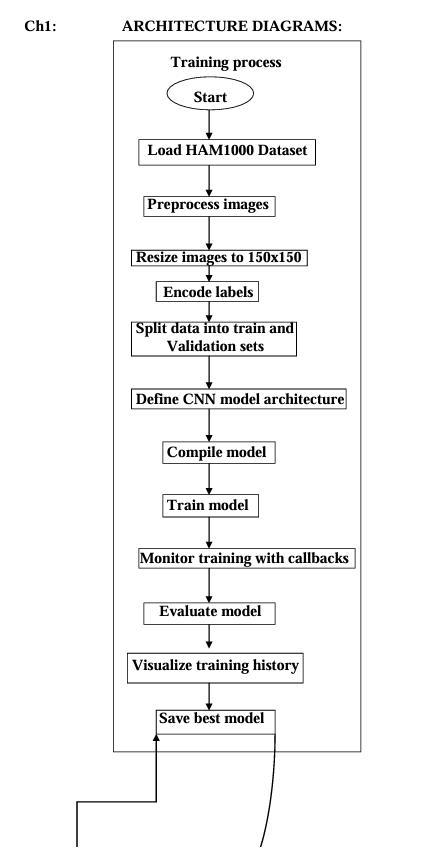
Fig.1:ArchitectureDiagram
International Research Journal of Engineering and Technology (IRJET) e-ISSN:2395-0056
Volume:11Issue:10| Oct2024 www.irjet.net p-ISSN:2395-0072
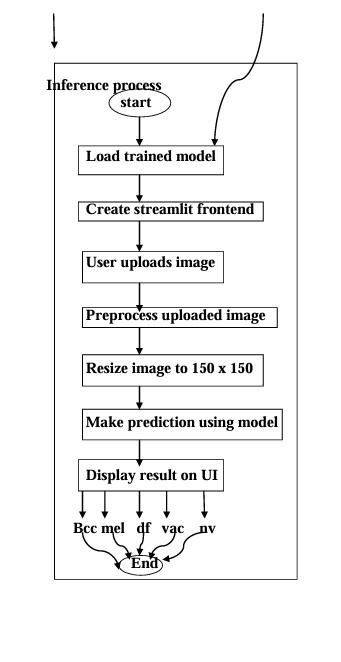
Fig.2:ArchitectureDiagramContinuation

International Research Journal of Engineering and Technology (IRJET) e-ISSN:2395-0056
Volume:11Issue:10| Oct2024 www.irjet.net p-ISSN:2395-0072
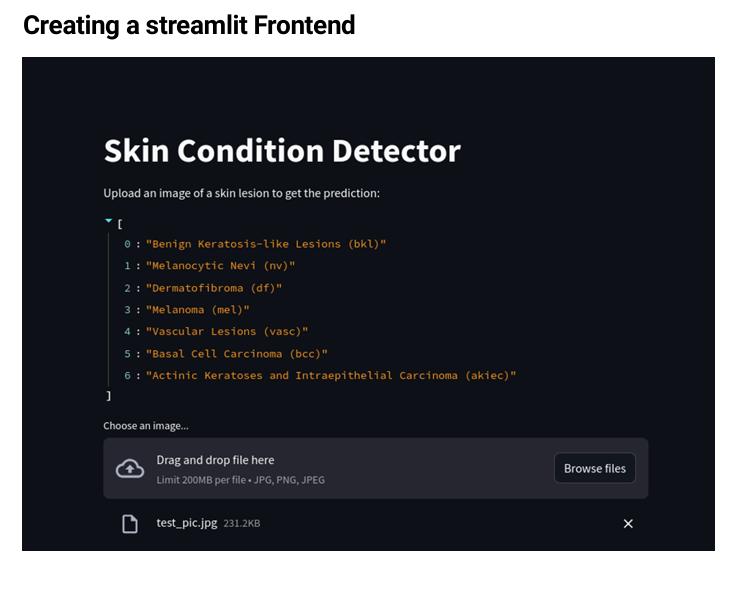
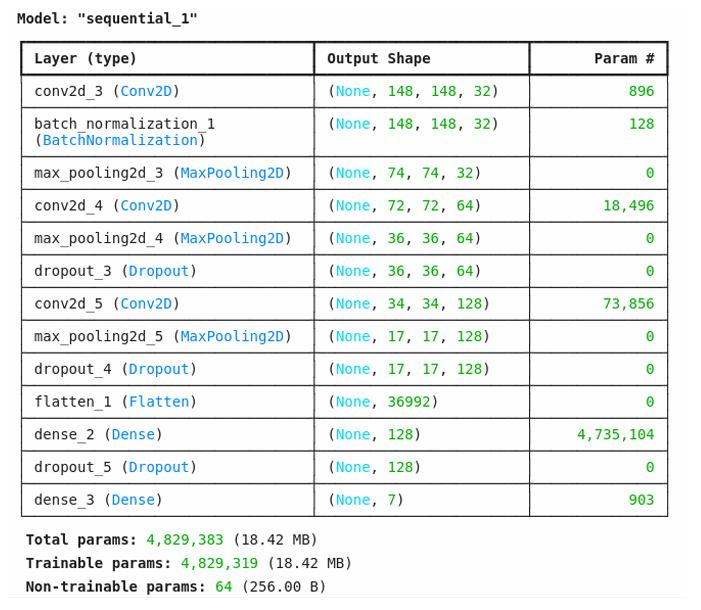
Fig.3:Input
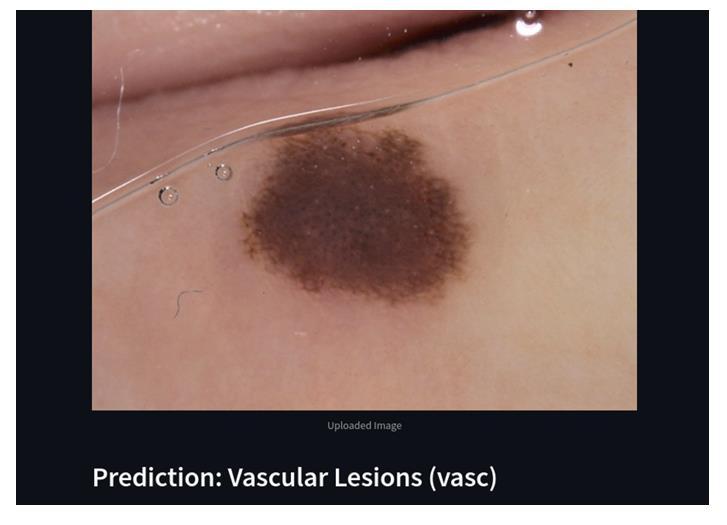
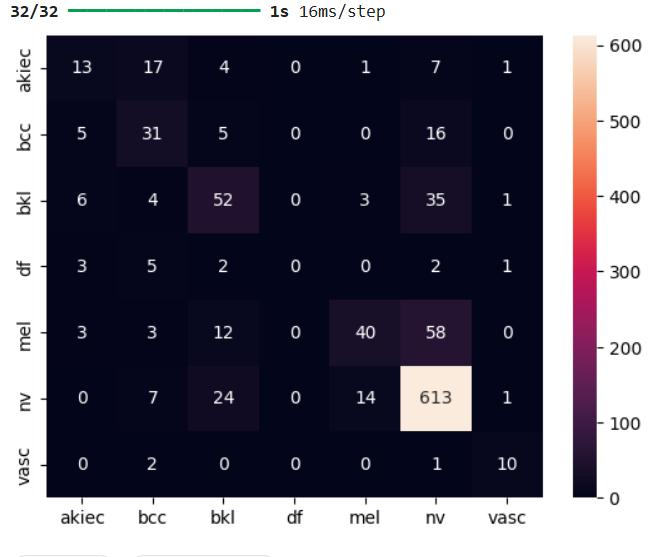
Fig.4:Output
IV. CONCLUSION
This project successfully demonstr
In summary, this project demonstrates the successful application of a CNN model for skin disease classification based on medical images. The model's ability to accurately classify skin lesions into seven categories, along with its performance on unseen data, highlights its strong generalization ability. With potential clinical applications and integration into digital health platforms, this project demonstratesthetransformativeimpactofdeeplearningon skin disease diagnosis, improving diagnostic accuracy and accesstoqualityhealthcare.
[1] M.A. Kassem, K.M. Hosny and M.M. Fouad, ''classification of skin lesions into eight classes for ISIC 2019 using a deep convolutional neural network and transfer learning,’’IEEEAccess,vol.8,pp.114822–114832,2020.
[2] H. Alquran, I. A. Qasmieh, A. M. Alqudah, S. Alhammouri, E. Alawneh, A. Abughazaleh and F. Hasayen, “Melanoma skin cancer detection and classification using a support vector machine,” in Proc. IEEEJordan Conf. Appl. Electr.
Ing. became the chairman. Count. Technol. (AEECT), October2017,pp.1–5.
[3] N. K. A. Abbadi, “Detection of psoriasis using skin color and texture function,'' J. Comput. Sci., vol. 6, No. 6, pp. 648–652,June2010.
[4]M.A.Khan,K.Muhammad,M.Sharif,T.Akram,andV.H.C. D. Albuquerque, “Multi-class detection of skin lesions and classification via teledermatology,’’ IEEE J. Biomed. Health information., St. 25, No. 12, pp. 4267–4275, December2021.
[5] S.H. Krishnan, C. Vishwa, M. Suchetha, A. Raman, R. Raman, S. Sehastrajit and D. E. Dhas, “Comparative performance of deep learning architecture in the classification of diabetic retinopathy,'' Int. J. Ad Hoc UbiquitousComput.,Vol.1,No.1,p.1,2023.
ively classify skin lesion images into seven different categories, demonstrating the power and effectiveness of CNN-based deep learning in medical image analysis. By utilizing a complex dataset such asHAM10000,themodelisabletolearntheuniquefeatures of each type of disease and generalize this knowledge to classify unseen images, making it
ates skin disease classification using a Convolutional Neural Network (CNN) model. The trained model can effect highly valuable in realworldmedicaldiagnosis.
[6] Q.Sun,C.Huang,M.Chen,H.Xu,andY.Yang,''Classification of skin lesions using additional patient information,” BioMedRes.Int.,Vol.2021,pp.1–6,April2021
[7] M.Suchetha, N.S.Ganesh, R.Raman and D.E.Dhas, “Region of Interest based predictive algorithm for faster detection of subretinal hemorrhage R-CNN,’’ Soft Comput., vol. 25, No. 24, pp. 15255–15268, December 2021.
© 2024, IRJET | Impact Factor value: 8.315 |
International Research Journal of Engineering and Technology (IRJET) e-ISSN:2395-0056
Volume:11Issue:10| Oct2024 www.irjet.net p-ISSN:2395-0072
[8]S.Das,K.Khabanda,M. Suchetha,R.Raman,andE. Dhas, ``Deep learning architecture based on segmented pool imagefeaturesforclassificationofdiabeticretinopathy,’’ Biomed. Signal process. Management, St. 68, July 2021, articlenone.102600.
[9] P. Kharazmi, M.I. AlJasser, H. Lui, Z.J. Wang and T.K. Lee, “Automatically detection and segmentation of vascular structures of skin lesions seen in dermoscopy with application to the classification of basal cell carcinoma,” IEEE J. Biomed. Health Informat., Vol. 21, No. 6, pp. 1675–1684,November2017.
[10] M. Shamsul Arifin, M. Golam Kibria, A. Firoze, M. AshrafulAminiandH.Yan,``Diagnosisofdermatological diseases using color skin images,'' in Why. Mach International Conf. Learn. Cybern., Vol. 5, July 2012, pp. 1675–1680.
[11]V.Anand,S.Gupta,D.Koundal,S.R.Nayak,J.Nayakand S. Vimal, “Multiclass skin disease classification using a transferlearningmodel,”Int.J.Artif.Intel.Tools,Vol.31, No.2,March2022,articlenone.2250029.
[12] R. Muthalagu, M. M. Musheer, K. Nandhini, and N. Saranraj,“Typeskindiseaseidentificationusingmachine learning using Python,’’ Int. J. Sci. Ing. became the chairman. Develop. Res., vol. 6, No. 3, pp. 498–503, March2021.
[13] V. R. Allugunti, ‘‘A machine learning model for skin disease classification using a convolutional neural network,'' Int. J. Comput., Program. Database Manage., vol.3,No.1,pp.141–147,January2022.
[14] M.Q. Khan, A. Hussain, S.U. Rehman, U. Khan, M. Maqsood,K.Mehmoodand M.A.Khan,“Classificationof melanoma and nevus in Digital Imaging for Skin Cancer Diagnosis,’’IEEEAccess,vol.7,pp.90132–90144,2019.
[15] X. Zhang, S. Wang, J. Liu, and C. Tao, “Toward better diagnosis skin disease by combining deep neural networkandhumanknowledge,”BMCMed.Information. Decide.Making,Vol.18,No.S2,pp.69–76,July2018.
[16] C.-Y. Zhu, Y.-K. Wang, H.-P. Chen, K.-L. Gao, C. Shu, J.-C. Wang, L.-F. Yan, Y.-G. Yang, F.-Y. Xie and J. Liu, “A framework based on deep learning to work on the diagnosis of multiple skin diseases in a clinical setting,” FrontiersMed.,Vol.8,April2021,articlenone.626369.
[17] S. Inthiyaz, B.R. Altahan, S.H. Ahammad, V. Rajesh, R.R. Kalangi, L.K.Smirani, M.A.Hossain and A.N.Z.Rashed,''Detection of Skin Diseases using deep learning,'' Adv. Ing. became the chairman. Softw., vol. 175,2023,art.none.103361.
[18]M.Cullell-Dalmau,S.Noé,M.Otero-Viñas,I.MeićandC. Manzo, "A convolutional neural network for skin lesion classification: Understand." fundamentals through hands-on learning,” Frontiers Med., vol. 8, March 2021, art.no.644327.
[19]A.Krizhevsky,I.Sutskever,andG.E.Hinton,``ImageNet Classificationwithdeepconvolutionalneuralnetworks,'' Commun.ACM,Vol.60,No.6,pp.84–90,May2017.
[20]R. D.Seeja andA. Suresh,“Segmentation of skinlesions based on deep learning and classification of melanoma using support vector machine (SVM),'' Asian Pacific J. Cancer Prevention, vol. 20, No. 5, pp. 1555–1561, May 2019.
[21]S.S.Samsudin,H.Arof,S.W.Harun,A.W.A.WahabaM.Y. I. Idris, “Skin lesion classification using empirical multiresolution modus decomposition and local binary pattern,'' PLoS ONE, vol. 17, No. 9, September 2022, articlenone.e0274896.
[22] P.N.Srinivasu,J. G. Sivasai, M.F. Ijaz, A.K. Bhoi, W. Kim, and J.J. Kang, “Skin Disease Classification Using Deep Learning Neural Networks s MobileNet V2 and LSTM,’’ Sensors,vol.21,No.8,p.2852,April2021.
[23] P. Musa, F. A. Rafi, and M. Lamsani, “Review: Contrast Constrained Adaptive histogram equalization (CLAHE) methods to facilitate facial application recognition”, in Proc. 3rd Int. Conf. Information. Count. (ICIC), October 2018,pp.1–6.
[24] M.A. Kassem, K.M. Hosny, R. Damaševičius and M.M. Eltoukhy,“Machinelearning anddeeplearningmethods forskinlesion classificationand diagnosis: Asystematic review,''Diagnostics,vol.11,No.8,p.1390,July2021.
[25] S. Joseph and O. O. Olugbara, “Effects of Preprocessing onPerformancesegmentationskinlesionsofprocesses,'' Diagnostics,vol.12,No.2,p.344,January2022[
26] D. Z. Karim and T. A. Bushra, “Detection of lung cancer from histopathology logical images using convolutional neural networks,'' in Proc. IEEE Region 10 Conf. (TENCON),December2021,pp.626-631.
International Research Journal of Engineering and Technology (IRJET) e-ISSN:2395-0056
Volume:11Issue:10| Oct2024 www.irjet.net p-ISSN:2395-0072
[27] A. Agarwal, A. Issac, M. K. Dutta, K. Riha, and V. Uher, “Automated Skin lesion segmentation using K-means clustering from a digital dermoscope images,'' in Proc. 40th Int. Conf. Telecommun. Signal process. (TSP), July 2017,pp.743–748.
[28] F. Adjed, S. J. Safdar Gardezi, F. Ababsa, I. Faye, and S. ChandraDass,"Fusionofstructuralandtexturalfeatures formelanomarecognition,"IETCount.Vis.,Vol.12,No.2, pp.185–195,March2018.
[29]N.Codella,V.Rotemberg,P.Tschandl,M.EmreCelebi,S. Dusza, D. Gutman, B. Helba, A. Kalloo, K. Liopyris, M. Marchetti, H. Kittler, and A.Halpern, “Analysis of skin lesions towards melanoma detection 2018: A challenge organized by the International Skin Imaging Collaboration(ISIC)'"2019,arXiv:1902.03368.
[30] A. G. C. Pacheco and R. A. Krohling, “The influence of patientsonclinicalinformationonautomaticskincancer detection,'' Comp. Biol. copper., St. 116, 2020, art. no. 103545.
[31] S. Benyahia, B. Meftah, and O. Lézoray, “Based on multiple feature extraction on deep learning for skin lesionclassification,''TissueCell,vol.74,February2022, articlenone.101701.
[32]S.Qian,K.Ren, W.Zhang,andH.Ning,“Classificationof skin lesions using CNNs with multilevel attentional clustering and class-specific loss esteemed,” Calc. Methods Programs Biomed., vol. 226, November 2022, Art.no.107166.
[33] S. Maqsood and R. Damaševičius, ``Multiclass localization of skin lesions and classification using deep learning-based feature fusion and selection framework for smart healthcare,'' Neural Netw., vol. 160, pp. 238–258,March2023.
[34] A.N.Omeroglu, H.M.A.Mohammed, E.A.Oral and S.Aydin,''Anovel an attention-based soft multimodal deeplearningframeworkformulti-labelclassificationof skinlesions,''Ing.Appl.Artif.Intel.,Vol.120,April2023, Art.no.105897.
[35] P. Tang, X. Yan, Y. Nan, S. Xiang, S. Krammer, and T. Lasser, “FusionM4Net: A Multistage Multimodal Learning Algorithm for More classification designation of skin lesions,'' Med. Image Anal., vol. 76, February 2022,Art.no.102307.
2024, IRJET | Impact Factor value: 8.315 |