
International Research Journal of Engineering and Technology (IRJET) e-ISSN: 2395-0056
Volume: 11 Issue 10 | Oct 2024 www.irjet.net p-ISSN: 2395-0072

International Research Journal of Engineering and Technology (IRJET) e-ISSN: 2395-0056
Volume: 11 Issue 10 | Oct 2024 www.irjet.net p-ISSN: 2395-0072
Shilpa.Chippalakatti1* Dr. C.H.Renumadhavi2* Dr. Andhe Pallavi3*
1Department of Electronics and Communication, Sir M Visvesvaraya Institute of Technology, Affiliated to Visvesvaraya Technological University, Bengaluru, Karnataka
2Department of Electronics and Instrumentation, RV College of Engineering, Affiliated to Visvesvaraya Technological University, Bengaluru, Karnataka
3Department of Artificial Intelligence and Machine Learning, RNS Institute of Technology, Affiliated to Visvesvaraya Technological University, Bengaluru, Karnataka ***
Abstract - Brain tumor disease refers to any Brain irregularity causing its damage. There are several kinds of Brain ailments. Benign growths arerarelylifethreateningand can be removed by specialists. Brain malignant tumorisone of the world's leading causes of cancer death. Identifying malignant growth tissue is a troublesome and tedious task. This research aims to optimize the latest YOLOv8 model to improve its detection of small Images and compare it with another different version of YOLO models. Toachievethisgoal, we used the classical deep learning algorithm YOLOv8 as a benchmark and made several improvements and optimizations. There is significantly less information and statistical analysis presented related to cholangiocarcinoma and hepatoblastoma. This research focuses on the image analysis of these two types of cancer. The framework's performance is evaluated using 2871 images, and a dual hybrid model is used to accomplish superb exactness. The first is the SID (Small Image Detection) dataset [11], a collection of images specifically curated and annotated for small Image detection tasks. Small Image detection aims to identify and highlight an image’s most visually distinctive Images or regions. The second one is the bacterial colony dataset [12], which is a collection of images specificallyfocusedonbacterial colonies grown in a laboratory setting. Theaftereffectsofboth neural networks are sent into the result prioritizethat decides the most ideal choice for image arrangement. The technique entails extracting characteristics from the start and combining them with residual and pre-trained weights. This deep learning YOLOv8 system demonstrates the concept of illuminating elements of a pre-trained deep neural network's decision-making processbyanexamination ofinnerlayersand the description of attributes that contribute to predictions.
Key Words: Brain Tumor Detection, YOLOv8 Algorithm Deep Learning, Discrete Wavelet Transform (DWT).
1.INTRODUCTION
Computerizedimagehandlingusesprocessingtodealwith advanced images by using an advanced PC. Many issues emerge in the current framework, for example, giving countlessfaultyrates,over-segmentingtumorregions,high timecomplexity,low exactness,anditisa troublesome to deal withconstructionsofhighinconsistencywitha lotof disturbancesthathappenduringdivision.
Imagedetectionisanessentialtaskinthecomputervision field, which is widely used in real-time video analysis, automatic driving, and intelligent security. Before 2014, traditionaltargetdetectionalgorithmsrequiredextracting featuresmanually,whichwastime-consumingandunstable. TheSOTAalgorithmDPM[1]detectoratthattime,although inferencespeedwasfasterthanothersandcouldadaptto slightdeformation,couldnotadjusttolarge-scalerotation andshowedlowrobustability.Thedynamicshapemethod anddeeplearningYOLOv8calculationsinvolverecognizing inappropriate sources of info and furnish definite results with an identical viable allowance, such as recognizing a wide range of Brain problems in solitary handling. The topologyofmedicalimagingmethodologiesispresentedin Fig.1.Hepaticcarcinoma(HCC)isthesubsequentreasonfor malignant growth deaths around the world, and it is the most normal essential cause of hepatocellular disease in individuals. Unlike other diseases, the incidence of HCC is rising [2]. YOLOv8 are useful in detecting and analyzing quickly and dependably the HCC in individuals, bringing aboutbetter results[3].As thequalityandaccessibility of cross-sectionalimaginghaveexpanded,therequirementfor intrusive demonstrative biopsies has diminished, driving imaging to a more fundamental position with an evident status, especially in essential Brain malignancies [4]. The Brain is likely the most often examined organ, and metastasesareprocessesthataidinthedetection,diagnosis, andmanagementofhepaticdisorders.
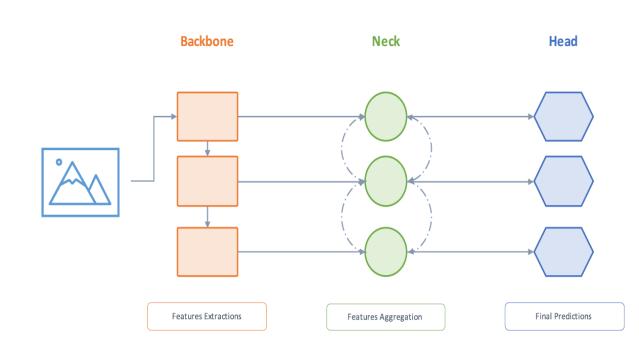
Fig -1:ThearchitectureofYOLOconsistsofabackbone, neck,andhead[11].
International Research Journal of Engineering and Technology (IRJET) e-ISSN: 2395-0056
Volume: 11 Issue 10 | Oct 2024 www.irjet.net p-ISSN: 2395-0072
AIcalculationshaveincreasedradiologicalproficiencyand have the potential to overcome any challenges in the radiologicalclassificationofvariousinfections.Torecognize images, fully YOLOv8 do not require recognizable confirmation of explicit radiological qualities, and, unlike otherAImethods,theymayevendisclosefeaturesthatdo not exist in radiological practice [14]. Velocity-bounded Booleanparticleswarmoptimization(PSO)isusedtochoose better features from brain malignant development data. When implemented in a hepatic CAD framework, the proposedtechniqueselectsthebestcharacteristicsutilised to classify hepatoma and cholangiocarcinoma as life threateningandhemangiomaandfocalnodularhyperplasia (FNH)asinnocuous.YOLOv8hassomedifficultiesindealing withsmallanddensetargetsandispronetotheproblemsof misseddetectionandoverlappeddetection,especiallywhen the size of the Image is smaller than 8*8. YOLOv8 uses a predefineddetectionhead,whichisinsufficienttodetectthe details of small targets, while it is easy to produce overlappingdetectionframesfordensetargets[15].
1.TodetectdiseasefromthemedicalimageslikeMRI using theYOLOv8algorithm
2. To evaluate of the accuracy, precision, recall and specificityofthemodel.
3.Tocompareoftheresultsfromtheexistingmodelingand provingourmodelprovidesbestaccuracy,precision,recall andspecificitycomparetoothermodels.
Steven Smiley et.al [1] ThisreserachisabouttheCentersfor DiseaseControlandPrevention(CDC).Heartdiseaseisthe primarycauseofdeathintheUnitedStatesformostracial and ethnic groups, as well as for both men and women. It coststhenationbillionsofdollarsandtakesthelivesofmore than one person every minute, as well as over 500,000 Americansannually.Therefore,thepurposeofthisarticle is toinvestigateawiderangeofpotentialsupervisedMachine Learning (ML) algorithms for heart illness diagnostic modeling.
Syed Nawaz Pasha1 et.al [2] This essay focuses on cardiovascular disease, also known as coronary sickness, whichisoneoftheveryseriousandsevereillnessesinboth India and world wide. According to estimates, cardiac illnessesaccountfor28.1%offatalities.In2016,itwasthe primarycauseofaconsiderablenumberofdeaths,withover 17.6milliondeathsattributedtoit.Forthesediseasestobe properly diagnosed and treated in a timely manner, a precise,reliablepredictionsystemisnecessary.Numerous academicsdoextensiveresearchutilizingavarioustypesof
machinelearningalgorithmstoanticipateheartillnessusing variousdatasetsthatcontainnumerousfactorsthatleadtoa heartattack.
Mohd Ashraf et.al [3] Thisstudyfocusesonheartdisease, whichisthe primaryconcernformedical professionals.It has been noticed that medical staff need assistance in determiningapatient'sriskofexperiencingaheartattack. Recently, a great deal of work has gone into creating an automatedhelpsystemthatcandetermineanindividual's risk of suffering a heart attack. Scientists discovered they may make a contribution to certain significant interdisciplinary subjects, including medical science, with the emergence of computer science. The potential of any particular algorithm is not adequately represented by the singledatasetthatwasusedtoevaluatemachinelearning techniques.Theyalsoexhibitafewofthemoresignificant anomalies, such accuracy and manual data set preprocessing. In this research, we propose to develop an automated system for heart attack prediction using Deep NeuralNetworkapproaches.
Awais Mehmood1 et.al [4] This study focuses on cardiac problems,whicharecurrentlytheworld'sbiggestcauseof death.ThisisasevereproblemingrowingeconomiesinAsia andAfrica.Inadditiontohelpingpeopleavoidheartattacks, early identification of heart disease allows medical personnel to determine the primary risk factors for heart attacks and take preventative action before a patient has one. In this study, we introduce a new approach called CardioHelpthatestimatestheprobabilitythatapatienthas cardiovasculardiseaseusingconvolutionalneuralnetworks (CNNs),a deep learningtechnique.Thesuggestedmethod modelstemporaldatabyutilizingCNNtopredictHFearly on. By generating the dataset on heart disease and comparing the results with the most recent approaches available, we were able to acquire good results. Experimental results show that the proposed technique outperformstheexistingmethodsintermsofperformance assessmentmetrics.Theachievedaccuracyoftheproposed approachis97%.
P Kalpana1 et.al [6] Thispaperfocusonthesymptomsof heart disease in the first stage and stop it, given the increased increase in stroke rate at the tender level. It’s funny for the average man to show the more expensive electrocardiogram questions every day. Because of this, there should be a favorable consensus in the area at a consistenttimewhentheriskofheartdiseaseispredicted. Forthisreason,wewanttocreateanAssistantinthenursing frameworkthatcanpredicttheriskofheartdiseasedueto key indicators such as age, gender, and heart rate. Neural codes for learning neural codes are well tested to be the most reliable and robust, and as a result, included in the predictedcorrelation.
Harshit Jindal1 et.al [7] This paper emphasis on heart diseases are increasing at a rapid rate and it's very
International Research Journal of Engineering and Technology (IRJET) e-ISSN: 2395-0056
Volume: 11 Issue 10 | Oct 2024 www.irjet.net p-ISSN: 2395-0072
Important and concerning to predict any such diseases beforehand.Thisdiagnosisisadifficulttaski.e.itshouldbe performed precisely and efficiently. The research paper mainly focuses on which patient is more likely to have a heartdiseasedepending onvariousmedicalattributes.We prepared a heart disease prediction system to predict whether the patient is likely to be diagnosed with a heart diseaseornotusingthemedicalhistoryofthepatient.We usedvariousalgorithmsofmachinelearningsuchaslogistic regressionandKNNtopredictandclassifythepatientwith heartdisease.
3.1 Flow of the system
Adatabaseof2871imagesiscollected,andthenfor featureextractionpurpose,awavelettransformisused(flow of the classifier is shown in Fig. 3). Then, to reduce the dimensionality of the features, PCA is used. The after statisticalparametersarebeingextractedtoobtainaresult fromtheclassifier.

Flowofthesystem.
3.2 Proposed architecture model
Adual hybrid model isutilized to achieve greatprecision. Theaftereffectsofbothneuralnetworksarethenconveyed totheresultprioritizerwhosettlesonanofficialchoiceof imagedescription.Intheeventthattheaftereffectsofboth neuralnetworksarecomparable(whichis,forthemostpart, thecase),then,atthatpoint,thesameoutcometurnsinto the end product. The diagrammatic representation of the proposedsystemarchitectureispresentedinFig.4.
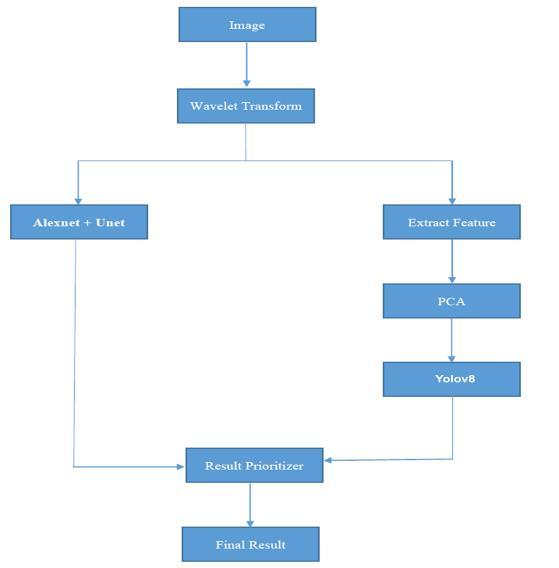
Fig.3: Proposedarchitecturemodel.
Alex Net + U-Net: Before the picture is fed into a hybrid (AlexNet and U-Net) neural network model, it first undergoes a wavelet treatment. We therefore obtain a categorizationoutcome.
3.3.1
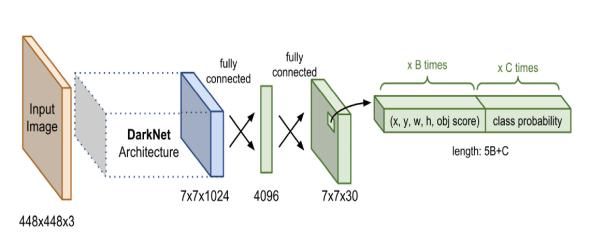
Thebackboneandheadofaconvolutionalneuralnetwork are the two fundamental components of the YOLOv8 architecture,whichisanimprovementoverearlieriterations of the YOLO algorithm [8]. A revised Currently, CS architecturethatconsistsofthirty-fiveconvolutionallayers andusescross-stagefractionalconnectionstoenhancethe transferofdatabetweenlayersservesasthefoundationof YOLOv8. The bounding boxes, item evaluations, and probabilitiesofclassesofrecognizedImagesareanticipated by the YOLOv8 head, which is made up of a number of convolutional layers followed by fully connected layers. A noteworthy aspect of YOLOv8 is the inclusion of an apparatusforself-attention[9]inthenetwork’shead.This featureenablesthemodeltoconcentrateonvariousareasof theimageryandchangethevalueofelementsaccordingto relevance. Another noteworthy aspect of YOLOv8 is its capacity to recognize Images on many scales, which is accomplished via a characteristic hierarchy network [10]. The model can reliably recognize things of various sizes insideanimagebecausetothenetwork’snumerouslayers that detects Images at various scales. Figure 4 displays a typicalYOLOv8modelstructure.
Volume: 11 Issue 10 | Oct 2024 www.irjet.net p-ISSN: 2395-0072
3.3.2. Head
To address the limitations of traditional methods, regression-based approaches have emerged as a research focus in the field of three-dimensional human pose estimation. These methods leverage deep learning techniquestolearnthemappingrelationshipfromimagesto poseandshape,enablingdirectregressionof humanpose and shape. This method uses deep neural networks and a largeamountoftrainingdatatogetestimationresultsthat aremoreaccurate.InYOLOv8,the“head”partreferstothe top-levelhierarchicalstructureoftheneuralnetworkmodel, whichisliableforprocessingthefeaturemapafterfeature extractionfromthebasiclevel[11].Specifically,the“head” part of YOLOv8 mainly includes three key components: detection layers, up sample layers, and route layers. The detectionlayersareliable forconvertinginputfeaturemaps intodetectionboundingboxes.Upsamplelayersareusedto increasetheresolutionofthefeaturemap.Theup-sampling layerismainlyusedtoincreasethemodel'sperception of small-sized Images. The route layer is used to connect featuremapsofdifferentlevels.Itcanconnecttheprevious layer’sfeaturemapwiththeearlierlayer’sfeaturemap to obtainfeaturemapswithdifferentscalefeatureinformation [12]. This multi-scale feature fusion helps the model to detectImagesofdifferentsizesandtypes.
3.3.3. Deficiency and optimizer
InstandardImagedetectiontasks,theproblemofmissing detectionorpoordetectioneffectoftenoccurswhenthere are small Images in the data set. The reason is stated as follows:TheYOLOv8modelhasdetectionheadsbydefault, whichcanperformmulti-scaledetectionoftargets.Among them,P3/8correspondstoadetectionfeaturemapsizeof 80*80, which is utilized for recognizing items larger than 8*8;P4/16relatestoadetectionfeaturemapsizeof40*40, whichisappliedtorecognizeitemslargerthan16*16;and P5/32correspondstoarecognitioncharacteristicsmapsize of20*20,whichisusedtoidentifyitemslargerthan32*32, asillustratedbelow:
Updated head: detecting small Images
1 [-1, 1, nn.Unsample, [None, 2, ‘nearest’]]
2 [[-1, 6], 1, Concat, [1]] # cat backbone P4
3 [-1, 3, C2f, [512]] # 12
5 [-1, 1, nn.Upsample, [None, 2, ‘nearest’]]
6 [[-1, 4], 1, Concat, [1]] # cat backbone P3
7 [-1, 3, C2f, [256]] # 15 (P3/8-small)
9 [-1, 1, Conv, [256, 3, 2]]
10 [[-1, 12]. 1, Concat, [1]] # cat head P4
11 [-1, 3, C2f, [512]] # 18 (P4/16-medium)
13 [-1, 1, Conv, [512, 3, 2]]
14 [[-1, 9], 1, Concat, [1]] # cat head P5
15 [-1, 3, C2f, [1024]] # 21 (P5/32-large)
16 [[15, 18, 21], 1, Detect, [nc]] # Detect(P3, P4, P5)
Thenitemergesinstinctivelythattheremaybeaproblemof poor capability for detecting tiny Images whose sizes are smaller than a particular scale or one of the dimensions (widthandheight)isnotlargeenough.Thisstudyintroduces atinyImagedetectionlayer(160*160detectionfeaturemap foridentifyingtargetsabove4*4,forexample)toenhance thedetectionperformanceofsmalltargets.Toachievethis improvement, we maintain the original results in the Backbone part but adjust the model structure of the head part,seebelow:
Optimizer:New detection head
1[-1,1,nn.Upsample,[None,2,‘nearest’]]
2[[-1,2],1,Concat,[1]]#catbackboneP3
3[-1,3,C2f,[128]]#18(P2/4-xsmall)
3.5 Dataset
Generallyspeaking,wetotallyapplytwodifferentdatasetsto test the performance of our network. The first is the SOD (SmallImageDetection)dataset[11],acollectionofimages specificallycuratedandannotatedforsmallImagedetection tasks.SmallImagedetectionaimstoidentifyandhighlightan image’s most visually distinctive Images or regions. The images in such dataset are scaled to 640*640 and the averagesizeofImagesisabout25*25.Wetrainthisdataset with multiple models with epochs = 30, image size = 640,
International Research Journal of Engineering and Technology (IRJET) e-ISSN: 2395-0056
Volume: 11 Issue 10 | Oct 2024 www.irjet.net p-ISSN: 2395-0072
and batch size = 3. The second one is the bacterial colony dataset [12], which is a collection of images specifically focusedonbacterialcoloniesgrowninalaboratorysetting.It is commonly used in microbiology and bioinformatics researchtostudybacterialgrowthpatterns,analysescolony characteristics,anddevelopautomatedcolonyrecognition andclassificationalgorithms.Theimageinsuchadatasetis scaled to 1280*1295. Various large-size bacteria (about 10*10) and tiny-size bacteria (about 2*2) constitute each image. We train this dataset with multiple models with epochs=15,imagesize=640,andbatchsize=10.
4.1
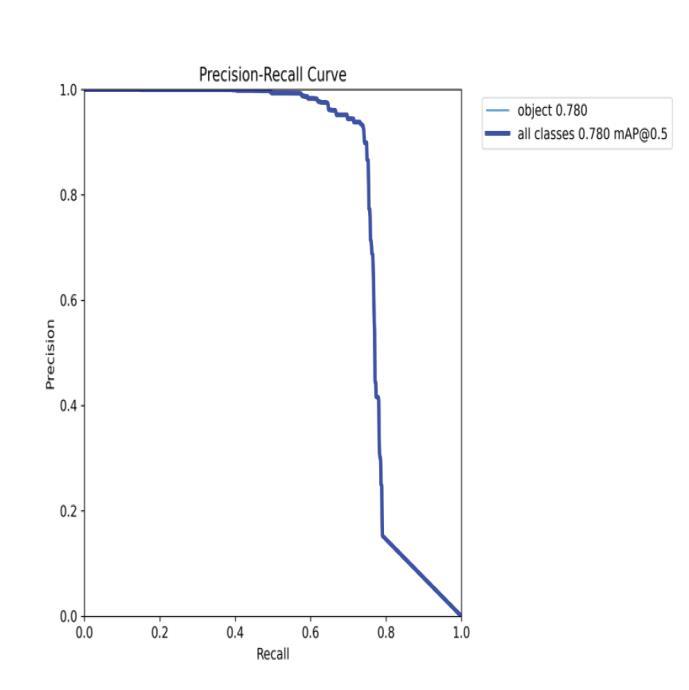
The recall rate, precision, and mAP are three essential criteria in medical Image detection. Therefore, this paper emphasizestheimportanceofcomparingthesemetricsto evaluatethepursuanceofImagedetectionmodels.Therecall ratereferstothefractionofactualImagesinanimagethat themodelcorrectlydetected.Precisionrelatestothefraction of detected Images correctly identified and not falsely detected.mAP(meanaverageprecisionat50%Intersection OverUnion)isawaytosummarizeprecisionandrecallover multipleclassesinImagedetectiontasks,providingaholistic viewofamodel’sperformance.TheP-Rcurveofourmodel isinFigure5.
TheYOLOv8nnetworkunderwentaseriesofoptimizations, and the subsequent results have been encouraging. Upon comparing the optimized network with the original YOLOv8n model, its performance metrics showed a clear enhancement.VisualcomparisonwithYOLOv8isinFigure5.
Acomparisonofwidelyusedmetrics.Specifically,whenthe improvedmodelwastrainedontheSODdataset,amarked improvement in both prediction accuracy and training velocity was observed, most notably during the initial 5 epochs.Theoptimizednetwork’sfinalprecisionis92.4%,a 4%improvementovertheoriginalnetwork.Thebestrecall rateincreasedby4%to73.4%afteroptimizingtheYOLOv8n network. After adding the detection head, the mAP50 increased from 74.2% to 78.4%. This means that the optimized network can predict the Image’s location more precisely.Itisworthemphasizingthattheseenhancements were not just confined to the accuracy metrics, they also appearedinthetrainingspeed.Intheinitialfiveepochs,the mAP50oftheoptimizednetworkisabout10%higherthan theoriginalnetwork.Concurrently,precisionandrecallrates surged quicker in the optimized network, further accentuatingitsadvantagesovertheoriginalversion.Dueto the computational power limitations and the number of trainingepochs,theenhancementstothenetworkarenot significant. The authentic images of the SOD dataset are 1280*1295 pixels. However, to reduce the amount of calculation,theimageswerecompressedto640*640pixels.
Therefore,theimprovementwasnotnoticeable.Besides,the training loss and the validation loss didn’t show any improvement.Theoptimizednetworkseemstohavesome deficiencies when it is applied to different datasets. The optimized network does not show improvement when trainedonthebacterialcolonydataset.Thisneedsfurther exploration because of the small quantity of datasets and training time.
Compared with the former version of the YOLO network, therearemoresignificantimprovements.Aftertraining15 epochs on SOD dataset, the recall rate of the YOLOv5n is 65.5% and the optimized YOLOv8n achieved the rate of 72.4%, which is more obvious. The improvements in precision and mAP are also higher than the previous comparison. This is partly due to the YOLOv8n’s performanceitself.TheoriginalYOLOv8nnetwork’straining speedisalmostthesameasthatofYOLOv5nandYOLOv3. Therefore,itprovesthatthetrainingspeedofthenetwork hadindeedincreased,intheearlytrainingstate.However, whenitcomestothenetworkloss,theoptimizedYOLOv8n networkhadevenhigherlossesthantheformerversionof theYOLOmodel.
To improve the pursuance of YOLOv8, this paper adds a detectionheadtotheheadofthemodelwhilekeepingthe structureofthebackbone.Asaresult,themodifiedmodel canfindsmallImagesassmallas4*4pixels.Comparedtothe original YOLOv8 model, our model shows a 4.2% higher precision rate and 4.0% higher recall rate in the task of detectingbacterialcoloniesandariseof9.2%withregardto mAP. In fact, the model can detect almost every colony visually,whichmeansthemodelachievesourprimarygoal, namely counting anything. The experiment proved that
International Research Journal of Engineering and Technology (IRJET) e-ISSN: 2395-0056
Volume: 11 Issue 10 | Oct 2024 www.irjet.net p-ISSN: 2395-0072
addingaspecifieddetectionheadcanimprovetheabilityof YOLOv8todetectsmallImages.However,ifthisworkadds too many detection heads, it’s likely to slow down the training and inference process, which is an underlying drawback of our method. There are a few types of Brain malignant growths. The malignant growths of cholangiocarcinomaandhepatoblastomaareconsideredin this study. The framework's performance is evaluated utilizing 2871 images. A dual hybrid model is used to accomplishincredibleprecision.Theresultsofbothneural networksaresenttotheresultprioritizer,whichsettleson anultimateconclusiononimageorder.Assumingthatthe aftereffectsofbothneuralnetworksarecomparative(which is by and large the case), then, at that point, the same outcometurnsintotheendproduct. Futureworkcanfocus onthesegmentationofcancertissuesin3Dmedicalimages.
[1]Stevensmiley“DiagnosticforHeartDiseasewithMachine Learning “Jan 12 , 2020, https://towardsdatascience.com/diagnostic-for-heartdisease-with-machine-learning-81b064a3c1dd
[2]Syed Nawaz Pasha1, Dadi Ramesh2, Sallauddin Mohmmad3, A. Harshavardhan2 and Shabana “Cardiovascular disease prediction using deep learning techniques “OP Conference Series: Materials Science and Engineering, Volume 981, International Conference on Recent Advancements in Engineering and Management (ICRAEM-2020)9-10October2020,Warangal,IndiaCitation SyedNawazPashaetal2020IOPConf.Ser.:Mater.Sci.Eng. 981022006
[3] Mohd Ashraf, M. A. Rizvi and Himanshu Sharma “Improved Heart Disease Prediction Using Deep Neural Network“Volume8No.2April-June2019pp49-54
[4]AwaisMehmood1,MunwarIqbal1,ZahidMehmood2,Aun Irtaza1,MarriamNawaz1,TahiraNazir1,MominaMasood1 “Prediction of Heart Disease Using Deep Convolutional Neural Networks “Received: 6 May 2020 / Accepted: 2 November 2020 © King Fahd University of Petroleum & Minerals2021
[5]DengqingZhang,1,2YunyiChen,3YuxuanChen,3Shengyi Ye,1,2 Wenyu Cai,1,2 Junxue Jiang,1,2 Yechuan Xu,1,2 Gongfeng Zheng,1,2 and Ming Chen1,4 “Heart Disease Prediction Based on the Embedded Feature Selection Method and Deep Neural Network“ Received21 Aug 2021 Revised07Sep2021Accepted16Sep2021Published29Sep 2021
[6] PKalpana1,SShiyamVignesh1,LMPSurya1,VVishnu Prasad“PredictionofHeartDiseaseUsingMachineLearning “JournalofPhysics:ConferenceSeries1916(2021)012022
[7] Harshit Jindal1, Sarthak Agrawal1, Rishabh Khera1, RachnaJain2andPreetiNagrath2“Heartdiseaseprediction usingmachinelearningalgorithms“IOPConferenceSeries: Materials Science and Engineering, Volume 1022, 1st International Conference on Computational Research and DataAnalytics(ICCRDA2020)24thOctober2020,Rajpura, India
[8]A.Das,U.R.Acharya,S.S.Panda,S.Sabut,Deeplearning YOLOv8 YOLOv8 based Brain cancer detection using watershed transform and Gaussian mixture model techniques,CognitiveSystemsResearch, 54:165–175,2019.
[9] X. Dong, Y. Zhou, L. Wang, J. Peng, Y. Lou, Y. Fan, Brain cancerdetectionusinghybridized fullyYOLOv8 based on deep learning YOLOv8 YOLOv8 framework, IEEE Access (Special Section on Deep learning YOLOv8 YOLOv8 Algorithms for Internet of Medical Things), 8: 129889–129898,2020.
[10]H.Fujitaetal.,Anintroductionandsurveyofcomputeraided detection/diagnosis (CAD), [in:] International Conference on Future Computer, Control and Communication,pp.200–205,IEEE,2010.
[11] M. Gletsos, S.G. Mougiakakou, G.K. Matsopoulos, K.S. Nikita,A.S.Nikita,D.Kelekis,AComputer-aideddiagnostic system to characterize CT focal Brain lesions: design and optimization of a neural network classifier, IEEE Transactions on Information Technology in Biomedicine, 7(3):153–162,2003.
[12] M. Gletsos, S.G. Mougiakakou, G.K. Matsopoulos, K.S. Nikita,A.S.Nikita,D.Kelekis,Classificationofhepaticlesions fromCTimagesusingtexturefeaturesandneuralnetworks, [in:] 2001 Proceedings of the 23rd Annual EMBS InternationalConference,Istanbul,Turkey,pp.2748–2751, 2001.
[13] F. Gorunescu, S. Belciug, M. Gorunescu, R. Badea, Intelligentdecision-makingforBrainfibrosisstadialization basedontandemfeatureselectionandevolutionary-driven neuralnetwork,ExpertSystemswithApplications, 39(17): 12824–12832, 2012, https://doi.org/10.1016/j.eswa.2012.05.011.
[14] S.Gunasundari, M. Suganya Ananthi, Comparisonand evaluationofmethodsforBraintumorclassificationfromCT datasets, International Journal of Computer Applications, 39(18):46–51,2012.
[15] S. Gunasundari, S. Janakiraman, A study of textural analysis methods for the diagnosis of Brain diseases from abdominalcomputedtomography,InternationalJournalof ComputerApplications,74(11):7–12,2013.
International Research Journal of Engineering and Technology (IRJET) e-ISSN: 2395-0056
Volume: 11 Issue 10 | Oct 2024 www.irjet.net p-ISSN: 2395-0072



Shilpa Chippalakatti is workingasaAssistantProfessorin the Electronics and CommunicationDepartment,SirM Visvesvaraya Institute of Technology, Bangalore. She has completedherMTechinVLSIand Embedded System and persuing her PhD in the area of machine learningatRVCEBangaloreunder VTU.Area ofspecializationliesin Embedded System, VLSI, Digital ImageProcessing.Shehas12years ofteachingexperienceand2years of industrial experience. Her articles have appeared in several internationalconferences.Shecan be contacted at email id: shilpachippalakatti_ec@sirmvit.ed u

Dr.C H Renu Madhavi is Associate Professor and Head of Electronics and Instrumentation Department in RVCE, Bangalore. ShehascompletedherPhDinBio MedicalImageProcessing.Shehas 35 years of teaching experience and7yearsofresearchexperience. Her area of specialization lies in Biomedical Engineering, VLSI, Embedded System, Digital Image Processing. She has 32 InternationalJournalpublication,7 International Conference publication and 3 National Conferencepublication.Shecanbe contacted at email id: renumadhavi@rvce.edu.in

Dr. Andhe Pallavi is Professor&HeadofDepartmentat RNSIT, Bangalore. She has 27 of teaching experience and22 years of research experience She holds herPhDdegreeinElectricalEngg from VTU. Her area of specialization includes network analysis, signals and systems, microcontrollers,microprocessors, DSP, advanced DSP, IOT, RF and microwave, RTOS, VLSI testing, Remote sensing and telemetry, advanced control system, AIML
algorithms etc. She haspublished more than 60 papers in International Journal and Conference. She can be contacted atemailid:pallavi_ap@yahoo.com