
International Research Journal of Engineering and Technology (IRJET) e-ISSN: 2395-0056
Volume: 11 Issue: 10 | Oct 2024 www.irjet.net

International Research Journal of Engineering and Technology (IRJET) e-ISSN: 2395-0056
Volume: 11 Issue: 10 | Oct 2024 www.irjet.net
Mayur Padule1 , Shivansh Sambre2 , Prasad Choudhary3
p-ISSN: 2395-0072
123B.tech Computer Engineering, Ajeenkya D.Y Patil University, Pune ,Maharashtra, India
Abstract - Researchinstitutionsaroundtheworldarestill searching for a sophisticated mechanism to improve a vehicleequippedwithsystemsthatdonotrequirehuman involvementin driving. This is especiallytrue for vehicles designed for transportation and correspondence in urban commutertraffic.Ensuringthegreatestpossiblesafetyfor the driver and bystanders is the primary objective to be achieved.Inaddition,transportationcostsshouldbereduced asmuchaspossiblesothatthedrivercanenjoytherideand drivewithoutstress.Autonomouscarsshouldbeimproved forthebenefitofpeople(walkingandotherwise)insteadof puttingtheirlivesindanger.Thispapernotonlydescribes all the important algorithms required during the development process of autonomous vehicles, but also discussespossiblefutureapplicationsofthesealgorithms.
Keywords algorithms,autonomousvehicle,Tesla, automationlevel,importantaspects.
I. Introduction
Ourdailylifeisaffectedbynewmechanicalinnovations,and transportationisnolongerararity.Thesediscoverieshave made us aware of the possibility of autonomous vehicles, such as the development of autonomous vehicles (AV) to reducethefrequencyoftrafficaccidents,thehighestenergy consumption,theamountofdamageandobstruction,andto increasethetransparencyofthetransportationsystem.Even though there is a very high probability that autonomous vehicleshavebeenaroundforsometime.Theastronomical costhaspreventedthedevelopmentfromreachingitsfull potential. Nonetheless, creative efforts have increased rapidly,helpingtoincreaseAV'schancesofsuccess.
Theconceptoftheautonomousvehiclewasdevelopedinthe 1500s,hundredsofyearsbeforethefirstautomobile.Inthe 1500s, Leonardo da Vinci developed a chariot that could movewithoutbeingpulledorpushed.Highlyloadedsprings provided propulsion while a predefined guidesteered the carriage in a specific direction. This device is sometimes referredtoasthemostfamousrobotin history.
Thefirstremote-controlledcarwithnooneinthedriver's seatwasintroducedtotheworldpublicin1925,justbefore the turn of the century. A self-driving car model that took electromagnetic fields into account was presented to the public in 1939. In 1958, this model became a reality. A
modifiedvehicleequippedwithcamerasin1961,theability todetectandadheretogroundlinesgrewrapidly.
In1977,Japanupdatedtheidealcamerabyincorporatinga PCtransferinformationbasetomanagephotostakenwhile driving. As a result, the world's most famous self-driving vehiclewasdeveloped.in1990,CarnegieMellonUniversity begandevelopingself-drivingcarsthatuseneuralnetworks forimageprocessingandsteering.
In 1995, the VaMP experimentalvehiclecoveredadistanceofmorethan1,000 kilometerswithouthumanassistance,makingitthefirstselfdrivingvehiclecapableoftraversingawidearea.
To regulate the earlier EMS -Vision independence framework, data from bifocal camera frames (45 and 15 degrees)setupontwo-axisstageswereutilized.Themost advanced EMS -Vision framework, which utilizes a threecameraframework,iscompletelyfocusedonquickdriving, perception of anticipated hazards at greater and lesser distances,landscapeskew,andthecapacitytostudyspatial design.
EMS vision used the following:
● Roadnetworkdiagram;
● "static"elementsonthemapthatservedascontrol pointsormilestones;
● factualinformation(e.g.,roadwaywidth).
● Identificationofobjects(markers)
● recordingthelocationofobjectsinspace(areaand direction).
Recording information about the weather while driving required the use of the HTC (Homogeneous Coordinate Transformation)calculationandthecreationofascenetree withtheseelements(thecomponentsconnectingthescene tree represented the objects' proximate positions.). In addition,therearedynamicunitsforcontrollingthevehicle to keep track of important objects (so that the expert modulescanfocusonthem),andafocuseddynamicunit.
International Research Journal of Engineering and Technology (IRJET) e-ISSN: 2395-0056
Volume: 11 Issue: 10 | Oct 2024 www.irjet.net p-ISSN: 2395-0072
Inadditiontothebasicmodules,therearespecialmodules for
1. Roadrecognition-Thesystemrecognizestheroad, butalsobuildsamodelofconnectedpartsanduses ittodeterminethelocationofthevehicle.
2. Weighing Control - The saccadic movements for objecttrackingareperformedbyatwo-hubrotary headunderthecontroloftheweighingcontrol
3. Route-Thismoduledeterminesvariousroutesto thetarget,includingmovementstartandendtimes, route length, and estimated travel capacity (preparation phase). The focus unit makes the decision after receiving the results of the calculations
4. Vehicle control (steering) - This section, after analyzingthedatafromthedynamicunits,performs criticalsteering,forwardsteeringandcalculationof instantaneousstandards.
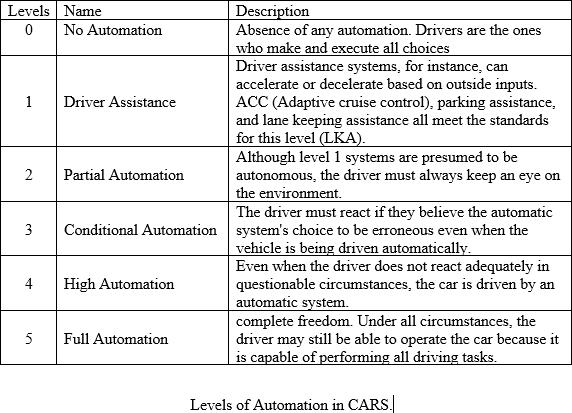
LEVELS: According to SAE International, there are five levels of taxonomy in automation (Society of automotive)
Level 0:
denotes that the vehicle is typically driven by a human. Vehiclesinthisclassmaycontain dynamicsafetyfeatures like emergency braking on demand and forward collision warning,butthesefeaturesonlyprovidevisibleoraudible alarmsandneveractuallycontrolthevehicle.
Level 1
Vehiclescouldincludeflexibletripcontrolorpathkeeping assistance.Thesesecurityfeaturesarecapableofprovidinga little amount of direction, speed acceleration, or slowing down input. Nonetheless, avoiding accidents is their main concern.
Independence entails a few dynamic security features working together to relieve the driver of some of their driving duties. For example, the vehicle may maintain a constantspeedinitsintendeddirectionoftravelandbekept clear of encroaching cars using local cameras and radar sensors. You'll locate some of the current self-driving frameworks at this level, including Tesla's Autopilot and CadillacSuperCruise.somethingimportantTorecall:While operatingaLevel2vehicle,thedrivermustremainfocused.
3
Incertainsituations,avehicletakesoveralldrivingcontrols, allowing the driver to focus elsewhere. These conditions could be geofenced zones or certain interstate types. In unfavorable weather, the car will probably be unable to driveitself.
Level 4
Self-driving cars can adapt to different lane and weather patterns. Level 3 limits are eased, and the hypothetical vehicleoperateswithessentiallynodriverinvolvement
No of the type of street or weather outside, the vehicle always drives. This police car represents the self-driving industry'sultimatevision,butthereisstillalongwaytogo
TheTeslaModelSfrom2014offeredpartialmechanization (Second Level). The product at the time permitted independent driving down the street, path modifications, andon-requestdepartingeventhoughthevehicle(ModelS) wasnotyetfullyself-regulating.
Forinstance,Ford,Mercedes,Audi,andNissancouldprovide computerizationatthattime,inadditiontoTesla(notmany manufacturers).
The quantity of potential outside events, visual variation (landscape, season, and time of day), and numerous internationaltrafficregulations(forinstance,left-orrighthandtraffic,streetsigns,andotherfactorsallplayarolein theprogrammingofanentirelydriverlessvehicle.Theclaim that any image processing and testing calculation can be appliedinadifferentautomotivesettingisnotalie.Inany case,thenumberoftechniquesthatcanbeutilizedislimited by computer power. These techniques include camera, LASER,GPS,infrared,lidarandothers.
International Research Journal of Engineering and Technology (IRJET) e-ISSN: 2395-0056
Volume: 11 Issue: 10 | Oct 2024 www.irjet.net p-ISSN: 2395-0072
Thefollowingimportantfactorsshouldbeconsideredwhen evaluatingthecalculations:
A. Identification of the environment from camera images
The richest and most important source of data in the interactionofclimateIDareimagesfromcameras.
Modernapproachestoimageanalysisthatmakeuse ofAI(machinevision)enablethediscriminationofcertain types of objects, such as people, street signs, and cars in complicated images. Machine vision is used to identify explicit(predefined)visualhighlights:localization ofroads, obstacles, moving objects and distance measurement Simultaneous localization and mapping ( SLAM) enables precisedeterminationoftheclient'spositioninrelationto theenvironment.Withoutpriorknowledgeofthelocation, SLAMdeterminesonlineboththedirectionofthestageand the area of all tourist attractions. To the scenario of calculations with images, in which scales are to be considered and kept in each case with the camera image. Taking into account the tourist destinations, a three-layer climateguideiscreatedandtheapproachSLAMisusedfor calculation
B. Detection of the environment by means of sensors
In addition to cameras, radar sensors (which are independent of weather, residues or contaminants) and moreexpensivelasersensors,lidarsarealsoused.
Thetwomainsensorsusedinpracticeforweatherdetection areRADAR(RadioDetectionandRanging)andLIDAR(Light Detection and Ranging). Radar has long been used in the automotiveindustrytodeterminethespeed,distance,and directionofobjects.
Thepermanenceoftheconditionsisnotdelicate.Theuseof radar and lidar is related to climate planning and calculationsofSLAM,wheretheproblemofdistinguishing landmarksintheimagedoesnotoccur,buttheyareheavier and more expensive. Lidar also provides more accurate results(estimates).
Ultrasonicsensors,suchasthoseattachedtovehicleguards (departure sensors), are a slightly less sophisticated and thereforelessexpensivegroupofdevicesthatcanbeusedto determinethedistancetoadeterrent
C. Detection and tracking of moving objects (DATMO)
When using camera, radar and lidar images, the DATMO (DetectionAndTrackingofMovingObjects)calculationcan beused.
Detectable indications of strange occurrences outdoors, whichmaybefrequentandoccuranywhereandmaybeof concern,shouldberesolvedinasafemanner.
ROUTE PLANNING ALGORITHMS : Choosingacourse (route) to the optimum location is likely to be the independent vehicle's first decision and is often based on distance, trip duration, or estimated fuel consumption. LimitationsoftheBellman-Fordcalculationincludetheneed tocharacterizetheedgesofnon-negativeloads;theDijkstra calculationcanbeusediftheroadgeographyisknown;the 1968.A*calculation,alongwithitsmodifications,isthemost commonly used configuration. In either case, the sensors from GPS and the topographic position data are used to locateone'svehicleandchooseacoursealongthe(known) guidance path. There are also configurations that use the imagesemanticsand3Dlidarinformationasaguide.
TESLA : Todetectobjects onthe road,manyautomakers useneuralnetworks,butTeslareliesmoreonthetechnology and employs a single, enormous neural network. It is a "transformer" that receives data from eight cameras simultaneously.
Tesladoesnotuselidar,amoreexpensivetypeof sensor that can sense the world in three dimensions, in contrasttomanyotherbusinessesdevelopingself-driving cars.. Instead, it uses a neural network algorithm to sift through data from the cameras and radar to understand scenes. The method requires additional computing power becauseitmustusethecameraimagestoreconstructamap of the environment, rather than relying on the sensors to capturetheimagedirectly.
ThecompanyfocusedonAIcrispswhenitbecame clearthatitsgraphicsprocessingunits(GPUs)werebetter suitedtorunninglargeneuralnetworksthantheCPUsthat areattheheartofgeneral-purposecomputers.Tesla'sselfdriving Autopilot system is powered by a special AI chip calledD1,whichthecompanyhasdescribedindetail.
IMAGE RECOGNITION /CAPTION : Imagerecognition usesneuralnetworksrefinedfrommillionsofactualdriving photos.Inthisway,itisdeterminedfromwhichcameraeach imageoriginates:
● cars(trucks,motorcycles,vans,etc.)
● People
● Trafficcones
● garbagecans
● Stopsignsandstoplines
International Research Journal of Engineering and Technology (IRJET) e-ISSN: 2395-0056
Volume: 11 Issue: 10 | Oct 2024 www.irjet.net p-ISSN: 2395-0072
● Trafficsignals(andtheircolors)
● Travellanelines(andtypesofmarkings)
● Whatisadrivablesurfaceandwhatis"off-road"?
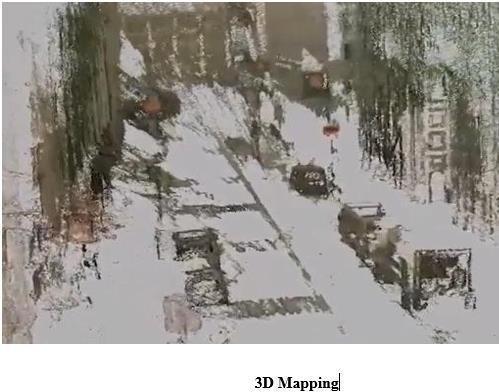
3D MAPPING : Theyusealleightcamerastocreatea3D model of the vehicle's environment by analyzing how the positionsofobjectsinthefootagechangeovertime.
PATH PREDICTION : They have neural networks that havebeentaughttopredictfuturebehavior.
TAKE ACTION : Originally,Autopilotonlyorienteditselfto lane markings and calculated a safe distance to steer and brake automatically. While these behaviors do not technicallyrequireneuralnetworks,asotherfunctionswere added (lane changes, responding to traffic lights and stop signs,exitingandavoidingtrafficcones),Autopilotbeganto relyonneuralnetworkstomakedecisions.Alargepartof this training involves observing when the driver takes controlandcomparingthedriver'sbehaviortowhatthecar wouldhavedoneinthatsituation.
CADILLAC SUPER CRUISE : Super Cruise's capabilities havebeenrecognized.Yetithasbeencriticizedforitssevere limitations. Super Cruise uses a combination of lidar map data,high-precisionGPS,cameras,andradarsensors,and alsoincludesadriverattentionsystemthatkeepsaneyeon the driver to ensure that the individual paying attention. Currently,thereisonlyoneCadillacmodelthatoffersthis feature. Users of Super Cruise do not need to keep their handsonthesteeringwheel,incontrasttoTesla'sAutopilot semi-automatic driving assistance system. However, they stillhavetolookstraightaheadattheroad.
Autonomous vehicle systems use a variety of methods to detecttheenvironment,includingsensorsandalgorithms.It will be a long time before fully autonomous vehicles are widelydeployedonthehighways.Thisprocesswillleadto
changes in traffic regulations, liability issues in accidents causedbyautonomousvehicles,andmoraldilemmas.
1. Dosovitskiy A, Ros G., Codevilla F.: CARLA: An Open Urban Driving Simulator. 2017. http://proceedings.mlr.press/v78/dosov itskiy17a/dosovitskiy17a.pdf[Retrieved:12.09.208]
2. Krishnan S., Govind A. R., RamakrishnanR.: A Look at Motion Planning for Avs atan Intersection. 2018. https://arxiv.org/pdf/1806.07834.pdf [Retrieved: 12.09.2018].
3. ZhangB.:ELONMUSK:In2yearsyourTeslawillbeable to drive from New York to LA and find you. 2016. https://finance.yahoo.com/news/elon- musk-twoyears-car-202858960.html[Retrieved:30.08.2018]
4. https://www.cadillac.com/content/dam/cadillac/na/us /english/index/ownership/technology/supercruise/pdf s/Consumer_Reports_Article.pdf