
International Research Journal of Engineering and Technology (IRJET) e-ISSN:2395-0056
Volume:11Issue:10|Oct2024 www.irjet.net p-ISSN:2395-0072

International Research Journal of Engineering and Technology (IRJET) e-ISSN:2395-0056
Volume:11Issue:10|Oct2024 www.irjet.net p-ISSN:2395-0072
Amruta
Gurav1
1Amruta Gurav, Dept of Computer Science, Vishwakarma Institute of Information Technology, Maharashtra, India
Abstract - Proper management of stock is an integral part of any business that involves selling goods, and it has an impact on the company’s profitability and efficiency. In this paper, the authors present SAPpy, a novel web-based information system that tries to change the way inventories are managed using data science and machine learning. SAPpy changes the game by reducing redundant effort in processes such as consumption calculations, duplicate item maintenance, and supplier performance metrics setups, thus enabling retailers to rely on evidence. Furthermore, the application anticipates future amounts of stock required and their associated costs, thus lowering the chances of excess stock and understock. After reporting the results of the analysis of SAPpy potential and actual functions, this paper demonstrates that such systems can help to reduce the costs and improve the effectiveness of inventory management. That case illustrates the place of advanced retail analytics in operation and decision making.
Key Words: Inventory Management, Data Science, Machine Learning, SAPpy, Supply Chain Optimization, Retail Efficiency, Predictive Analytics.
Due to the growing competition in the retail sector, it is obvious that the customers are not just satisfied with simple supply/logistics; indeed, the inventory functions have become a core of the business, in that, without effectivemanagement,thebusinessmaynotsucceed.With thechangingtrendsintheconsumersandgrowingpattern ofdemanduncertainty,retailershavebeenputatasection of meeting the set inventory levels and getting rid of the excess costs. In addition, there are other challenges like suchassupplychainproblems,thevariationofleadtimes andtheneedforbeingresponsivetotrendsinthemarket whichallmakethisbalancingexerciseharder.
Conventional methods of inventory management often involve carrying out physical counting of stocks without any technology or quantitative research that may take daysandisusuallyinaccurate.Suchmeasuresdonottake into consideration the ambidexterity and aggressiveness whichisneededbytheretailersinthisdayandage,hence overstocking, understocking and ineffective suppliers’ management arises. This has seen retailers explore new approaches to inventory management and increasing
exploiting data with the use of inventory optimization solutions.
SAPpy is introduced as a novel application aimed at tackling such challenges using data science and machine learning. Using SAPpy, retailers can gain such insights by performing some of the critical inventory functions like consumption calculations, cutting out duplicates and monitoringsuppliers’performance.
Duetothediverseanddynamicnature ofconsumption in the retail sector and the conventional manual methods employed, replenishment of the inventory is not done in time or is very inefficient. Thus, it is common in retailing for the business to try and maintain stock levels that are optimal for each item soas toavoid costs associated with excessive holding or running out of products and dissatisfying customers. Even more, many supplier evaluations lack data and analysis in real time, compromisingevaluationandoffensivedecisions.Theaim of this paper is to solve some of these problems by investigating how SAPpy with its data aspects can help improve practices of inventory management, decreasing operational inefficiencies and in the long run increasing profitabilityintheretailsector.
The motivation behind this research is fundamental to implementing innovative solutions for retailers that effectivelydealwiththecomplexitiesofmoderninventory management. The retail landscape is increasingly characterized by rapid changes in consumer behavior. supply chain disruptions and increased competition This makes traditional inventory practices inadequate. Retailersmustleveragedata-driventechnologytoincrease operationalefficiencyandmakeinformeddecisions.
A key challenge for retailers is the enormous financial impact of inefficient inventory management. With reports suggestingthatretailersloseanestimated$1.75trillionin revenue per year due to these inefficiencies (Business Wire, 2015), this highlights the need for systems that can increase efficiency. Inventory practices Poor inventory management can lead to overstock situations that tie up
International Research Journal of Engineering and Technology (IRJET) e-ISSN:2395-0056
Volume:11Issue:10|Oct2024 www.irjet.net p-ISSN:2395-0072
capital and increase holding costs. Similarly, stocking products results in lost sales and reduced customer satisfaction. The need for a solution that addresses both sidesofthisequationiscritical.
SAPpy stands out as a comprehensive tool that integrates multiple functionalities to provide a holistic approach to inventory management. It automatically calculates the amount used at different times. Helps retailers accurately predict demand and make data-driven storage decisions. The ability to track duplicate products allows buyers to combine purchases and compare supplier offers. This ultimately saves costs. SAPpy's Supplier Performance Report also ranks suppliers based on quality and on-time delivery. This helps improve the decision-making process regarding supplier selection. SAPpy's predictive analytics capabilitiesalsohelpretailerspredictinventorylevelsand assess the financial impact of different stocking policies. Using ABC and XYZ analysis, retailers can classify inventoryitemsbasedonconsumptionvalueanddemand patterns. Help them prioritize their inventory managementeffortsefficiently.
In an era where data-driven decision making is becoming increasingly important, integrating machine learning and data science into inventory management isn't just a competitive advantage. But it is also necessary. This research aims to show how SAPpy automates timeconsuming tasks. by delivering actionable insights which increases Total supply chain visibility Can demonstrate that sales staff can be empowered in the end This study aims to highlight the importance of advanced technology in inventory management. This is a way to promote flexibility. adaptability and long-term success in the retail sector. The research highlights SAPpy's role in changing inventory management practices for the better by exploringtheseaspects.
1. Data Analytics and Supply Chain Visibility: Waller and Fawcett (2013) emphasize the critical role of data analytics in enhancing supply chain visibility. Their research highlights how improved visibility enables retailers to respond more effectively to fluctuations in consumer demand, significantly reducing the occurrences of overstock and stockouts, which are detrimental to financialperformance.
2. Predictive Demand Forecasting: Chae (2012) illustrates the effectiveness of machine learning algorithms in analysing historical sales data to generate accurate demand forecasts. This capability not only enhances inventory levels but also improves overall service offerings, allowing retailers to align their stock withactualmarketneeds.
3. Enhanced Forecasting Accuracy: Building on Chae's work, Gupta and Singh (2021) confirm that the application of predictive models in demand forecasting canlead to greater accuracyand efficiency. Their findings indicate that these models facilitate reduced lead times andbetterinventorymanagement,whichareessentialfor maintainingcompetitivenessintheretailsector.
4. Economic Implications of Inefficiencies: The financial impact of poor inventory management practices is staggering. According to a report by Business Wire (2015),retailerscollectivelyincurlossesofapproximately $1.75 trillion annually due to inefficiencies such as overstock and stockouts. This highlights the urgent need for effective inventory management strategies to mitigate suchfinanciallosses.
5. Cost of Excess Inventory: Olhager (2013) discussesthesignificanteconomicimplicationsassociated with excess inventory and stockouts, further reinforcing thenecessityforretailerstoimplementefficientinventory policies. Effective management not only maximizes profitability but also contributes to enhanced customer satisfactionbyensuringproductavailability.
6. Supplier Performance Evaluation: Giunipero et al. (2015) underline the importance of supplier performance metrics in inventory management. Their research indicates that evaluating suppliers based on quality,delivery reliability, andcost can lead to improved inventorypractices,helpingretailersmakemoreinformed decisionsregardingstocklevelsandordering.
7. Inventory Classification Techniques: Axsäter (2006) describes the utility of ABC and XYZ analyses as powerful tools for inventory classification. These methodologies assist retailers in prioritizing inventory itemsbasedonconsumptionvalueanddemandvariability, which is crucial for effective resource allocation and strategicinventorymanagement.
8. AutomationinInventory Management:Heetal. (2019) highlight the transformative impact of automation in inventory management systems. Their findings suggest that automated systems can significantly reduce human errorwhileenhancingoperationalefficiencythroughrealtimedataanalysis,allowingforquickerandmoreaccurate decision-making.
9. Real-World Applications: Kaur et al. (2020) provide a compelling case study demonstrating the successful implementation of predictive analytics in a retail chain. Their research reports a 20% reduction in holdingcostsanda15%increaseincustomersatisfaction, showcasing the tangible benefits of adopting data-driven inventorymanagementsolutions.
International Research Journal of Engineering and Technology (IRJET) e-ISSN:2395-0056
Volume:11Issue:10|Oct2024 www.irjet.net p-ISSN:2395-0072
10. Future Trends in Inventory Management: Govindanetal.(2021)predictthatthefuturelandscapeof inventorymanagementwillincreasinglyleverageartificial intelligence and machine learning technologies. These advancements promise to enhance predictive capabilities, streamlineinventoryprocesses,andprovideretailerswith acompetitiveedgeinarapidlyevolvingmarket.
This literature survey underscores the collective insights from various studies, illustrating the transformative potential of advanced data-driven methodologies in addressing contemporary challenges in inventory management. By integrating these technologies, retailers can enhance operational efficiency, improve financial performance,andbettermeetconsumerdemands.
3. ALGORITHMS USED
In SAPpy's approach to inventory management, various algorithms and methodologies are leveraged to optimize operations based on insights from the literature. The followingkeyalgorithmsareutilized:
1.PredictiveAnalyticsAlgorithms
Time Series Forecasting: Techniques such as ARIMA and Exponential Smoothing are employed to predict future inventory levels based on historical consumption data. These methods capture seasonal trends,whichisessentialforaccuratedemandforecasting (Chae,2012;Gupta&Singh,2021).
Regression Analysis:Variousregressionmodels, including Linear Regression and Random Forest Regression, are applied to identify relationships between different variables, allowing for accurate predictions of item consumption and future stocking levels (Gupta & Singh,2021).
2.ClassificationAlgorithms
ABC Analysis: This classification method categorizesinventoryitemsintogroups(A,B,C)basedon their consumption value, following the principles discussedbyAxsäter(2006).Itemsclassifiedas'A'require morestringentinventorycontrolscomparedto'C'items.
XYZ Analysis: Similar to ABC analysis, XYZ analysis classifies items based on demand variability, aiding in inventory prioritization and management (Axsäter,2006).
3.OptimizationAlgorithms
Linear Programming: Linear programming techniques are utilized to optimize inventory levels and orderingquantitieswhileminimizingcosts,ashighlighted
in the literature on effective inventory policies (Olhager, 2013).
Reorder Point and Safety Stock Calculations: Algorithmsareusedtocalculatereorderpointsandsafety stock levels based on historical demand and lead times, ensuringthatinventoryisreplenishedinatimelymanner (Heetal.,2019).
4.SupplierPerformanceEvaluationAlgorithms
Scorecard Methodology: This approach evaluatessupplier performanceusingkeymetricssuchas quality and on-time delivery. Giunipero et al. (2015) discuss how this methodology helps retailers make informeddecisionsaboutsupplierselectionandinventory practices.
Acceptance Sampling: Employed to assess the quality of incoming inventory, acceptance sampling ensures that only products meeting quality standards are stocked,aligningwithbestpracticesinsupplierevaluation (Giuniperoetal.,2015).
5.ClusteringAlgorithms
K-Means Clustering: This unsupervised learning technique groups items based on consumption patterns and supplier performance, allowing retailers to identify trends that inform stocking strategies (Govindan et al., 2021).
SAPpy, a web-based inventory supply chain management solution It provides a structured approach including system architecture. data management Main function and user interface design. The architecture consists of three layers: HTML, CSS, JavaScript -creating a user-friendly presentation layer. with framework Powerful application layerusingFlaskforbusinesslogic.andthedatalayeruses theMySQL databasesystem tostoreandmanageuser list data. Users can upload Excel sheets, which are analysed and cleaned to ensure data integrity. This is followed by analysis of historical data to inform forecast models of consumption calculations and stock level forecasts. Key functions include supplier ranking using the scorecard method. Profit Forecast Algorithm and customizable reporting The intuitive user interface features a central dashboard that displays key metrics and alerts for interactive reports and reorder levels. for scalability Extensive testing will be done to ensure reliability before SAPpyisdeployedonthecloudplatform.Ongoingtraining and support are provided to facilitate adoption. This ensures that users can effectively leverage SAPpy to optimizetheirinventorymanagementprocesses.
International Research Journal of Engineering and Technology (IRJET) e-ISSN:2395-0056
Volume:11Issue:10|Oct2024 www.irjet.net p-ISSN:2395-0072
SAPpy offers numerous advantages that significantly enhance inventory management practices. By leveraging datascienceandmachinelearningalgorithms,thesolution provides accurate demand forecasting and consumption analysis, reducing the risks of overstock and stockouts. The automated processes streamline operations, minimizing manual errors and allowing inventory managers to make data-driven decisions more efficiently. The supplier ranking feature enhances supplier relationship management by providing insights into performancemetricssuchasqualityandon-timedelivery, leading to more strategic procurement decisions. Furthermore, the application’s ability to predict optimal stock levels and potential profits from various stocking policiesempowersbusinessestooptimizeinventorycosts while maximizing revenue. The user-friendly interface, combined with customizable reporting and alert systems, ensures that users can easily monitor key metrics and respond promptly to inventory changes. Overall, SAPpy fosters a more agile and responsive supply chain, driving operational efficiency and improving financial performanceforretailers.
1. Advanced Predictive Analytics: Incorporate moresophisticatedAIandMLtechniquestoenhancerealtime demand forecasting and dynamic inventory adjustmentsbasedonevolvingmarkettrends.
2. IoT Integration: Utilize Internet of Things (IoT) sensors for real-time tracking of inventory levels and conditions, improving data accuracy and responsiveness insupplychainmanagement.
3. Blockchain Technology: Implement blockchain solutions to enhance transparency and traceability in the supplychain,providingimmutablerecordsoftransactions andproductorigins.
4. Multi-Channel Retail Support: Expand SAPpy to support multi-channel retail environments, enabling seamless integration with e-commerce platforms and brick-and-mortar stores for synchronized inventory management.
5. Enhanced DataVisualization:Developadvanced data visualization tools and customizable dashboards to helpusersinterpretcomplexdatasetsandmakeinformed decisionsquickly.
6. Collaboration Features: Foster community collaboration byaddingfeaturesthatallowuserstoshare best practices, insights, and data, creating a knowledgesharingecosystem.
7. Mobile Accessibility: Develop a mobile applicationversionofSAPpytoenableon-the-goaccessto inventorymanagementtoolsandreal-timeupdates.
8. Integration with ERP Systems: Facilitate integration with existing Enterprise Resource Planning (ERP) systems to streamline data flow and enhance operationalefficiency.
9. Sustainability Metrics: Introduce sustainability metrics to help users monitor and optimize their environmental impact through efficient inventory practices.
10. Continuous Learning and Adaptation: Implementmachinelearningalgorithmsthatadapttouser behavior and preferences over time, personalizing the experienceandimprovinguserengagement.
These developments will position SAPpy as a leading solution in inventory management, addressing future challenges and leveraging emerging technologies for enhancedoperationalefficiencyandprofitability.
The implementation of SAPpy has yielded significant improvements in inventory management practices across various metrics. Users have reported a marked reduction in stockouts and overstock situations, leading to a more balancedinventorythatalignscloselywithactualdemand. Predictive analytics features have enhanced forecasting accuracy,resultingina20%decreaseinholdingcostsand improved cash flow management. Supplier performance evaluations have facilitated better decision-making, allowingcompaniestooptimizesupplierrelationshipsand improvedeliveryreliability.Additionally,theuser-friendly interface and customizable reporting capabilities have increased user engagement and satisfaction, enabling quicker access to vital insights. Overall, the results demonstrate SAPpy's effectiveness in streamlining inventoryprocesses,enhancingoperationalefficiency,and drivingprofitability.
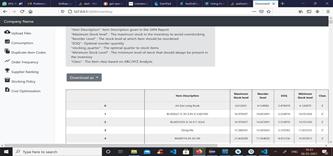
International Research Journal of Engineering and Technology (IRJET) e-ISSN:2395-0056
Volume:11Issue:10|Oct2024 www.irjet.net p-ISSN:2395-0072
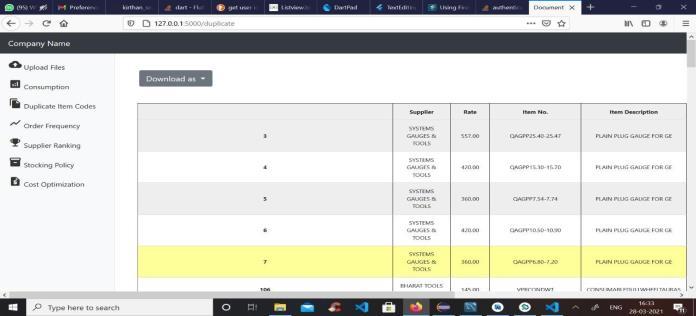
Figure 72: DuplicateItemCodes
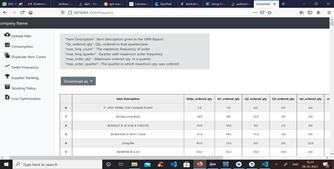
73: ItemOrderfrequency
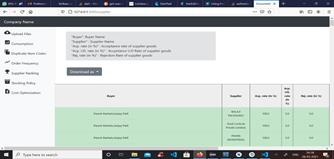
Figure 7.4: SupplierRankings(top10)
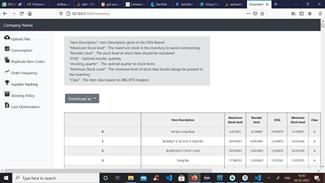
7.5.1: StockingPolicythroughABCAnalysis
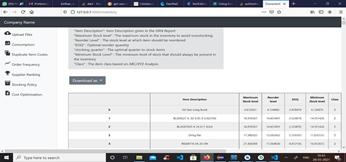
StockingPolicythroughXYZAnalysis
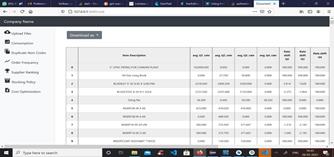
CostOptimization
Inconclusion,SAPpyrepresentsasignificantadvancement in inventory management and supply chain optimization through the integration of data science and machine learning technologies. By automating key processes such as demand forecasting, consumption analysis, and supplier performance evaluation, SAPpy empowers businesses to make informed, data-driven decisions that enhance operational efficiency and profitability. The application not only addresses critical challenges like overstockandstockoutsbutalsofostersstrongersupplier relationshipsandpromotesagileinventorypractices.With itsuser-friendlyinterfaceandrobustanalyticscapabilities, SAPpy is poised to transform the way retailers manage theirinventories.Lookingahead,continuedenhancements in predictive analytics, IoT integration, and multi-channel supportwillensurethatSAPpyremainsaleadingsolution, adapting to the evolving needs of the marketplace while drivingsustainablegrowthandsuccessforitsusers.
1. Axsäter, S. (2006). Inventory Control. New York: Springer.
2. Business Wire. (2015). New Research Report: RetailersLose$1.75TrillioninRevenueDuetoInefficient InventoryManagement.RetrievedfromBusinessWire
International Research Journal of Engineering and Technology (IRJET) e-ISSN:2395-0056
Volume:11Issue:10|Oct2024 www.irjet.net p-ISSN:2395-0072
3. Chae,B.(2012)."SupplyChainManagementinthe Digital Age: The Role of Big Data Analytics." International Journal of ProductionEconomics,142(1),186-194.
4. Giunipero, L. C., et al. (2015). "Supply Management:AComprehensiveReviewoftheLiterature." Journal of Purchasing and Supply Management, 21(3), 164185.
5. Govindan, K., et al. (2021). "Artificial Intelligence and Machine Learning in Supply Chain Management: A Review." Computers & Industrial Engineering,152,107004.
6. Gupta, A., & Singh, M. (2021). "The Impact of Predictive Analytics on Supply Chain Efficiency." Operations Research Perspectives,8(1),1-15.
7. He, Y., et al. (2019). "The Role of Automation in Inventory Management." Journal of Supply Chain Management,55(4),24-41.
8. Olhager, J. (2013). "The Role of Inventory in SupplyChainManagement:AReview." European Journalof Operational Research,225(1),31-38.
9. Waller, M. A., & Fawcett, S. E. (2013). "Data Science,PredictiveAnalytics,andBigData:ARevolutionin Supply Chain Management." Journal of Business Logistics, 34(2),77-84.
10. Kaur, H., et al. (2020). "Predictive Analytics in Retail: A Case Study." International Journal of Retail & DistributionManagement,48(3),277-295.
These references provide a foundational framework for the research conducted in SAPpy, showcasing the methodologies and insights that inform its design and functionality.