
International Research Journal of Engineering and Technology (IRJET) e-ISSN:2395-0056
Volume: 11 Issue: 10 | Oct 2024 www.irjet.net p-ISSN:2395-0072

International Research Journal of Engineering and Technology (IRJET) e-ISSN:2395-0056
Volume: 11 Issue: 10 | Oct 2024 www.irjet.net p-ISSN:2395-0072
Sakshi Gupta1 , Dr. dayashankar Pandey2
1M Tech Scholar Dept. of Information Technology, RKDF IST SRK UNIVERSITY, BHOPAL
2HOD, Dept. of Information Technology, RKDF IST SRK UNIVERSITY, BHOPAL
Abstract
ThisresearchpaperinvestigatesthepredictionofAutismSpectrumDisorder(ASD)usingtheK-NearestNeighbours(KNN) algorithminmachinelearning.Autismisaneurodevelopmentaldisordercharacterizedbychallengesinsocialinteraction, communication,andrepetitivebehaviours.Earlydiagnosisiscriticaltoenabletimelyintervention,yetdiagnosingASDcan be a complex process due to the variation in symptoms. In this study, we explore the use of KNN as a predictive tool to identify potential cases of ASD based on behavioural and demographic data. The performance of the KNN algorithm is evaluated using a publicly available dataset, and we assess its accuracy, precision, recall, and F1 score. The results demonstrate that the KNN algorithm is a viable method for predicting ASD, although there are limitations in terms of sensitivityandspecificitythatrequirefurtherrefinement.
Keywords:AutismDisorder,KNNAlgorithm,Machinelearning,ASD,KNearestNeighboursetc
I. Introduction
AutismSpectrumDisorder(ASD)isacomplexneurodevelopmentalconditionthataffectsanindividual’sabilityto communicateandinteractwithothers.TheglobalprevalenceofASDisestimatedtobearound1in160children,according to the World Health Organization. ASD is typically diagnosed based on behavioural assessments conducted by clinicians, which can be subjective and time-consuming. As a result, there is a growing interest in developing automated tools to assistintheearlydiagnosisofASD,whichcanleadtotimelyinterventionsandimprovedoutcomesforindividualsaffected bythedisorder.
Machinelearning(ML)offersapromisingavenuefortheearlydetectionanddiagnosisofASD.Byleveraginglarge datasetsandpowerfulcomputationalalgorithms,machinelearningmodelscanidentifypatternsandrelationshipsindata that may be difficult for humans to discern. Among the various machine learning algorithms, the K-Nearest Neighbours (KNN)algorithmstandsoutduetoitssimplicity,interpretability,andeffectivenessinclassificationtasks.
KNN is a non-parametric algorithm that classifies data points based on the majority class of their nearest neighboursinthefeaturespace.Itiswidelyusedinmedicalresearchduetoitsabilitytohandlenon-linearrelationships and multi-dimensional data. This paper aims to explore the application of the KNN algorithm in predicting ASD, using publiclyavailabledatasetsthatcontaindemographicandbehaviouralinformationofindividuals.WehypothesizethatKNN can serve as an effective tool for predicting ASD, particularly when used in conjunction with feature selection and optimizationtechniques.
AutismSpectrumDisorder(ASD)ismarkedbyheterogeneityinsymptomsandseverity,whichposesasignificant challenge to clinicians when diagnosing the disorder. Traditional diagnostic methods, such as the Autism Diagnostic Observation Schedule (ADOS) and the Autism Diagnostic Interview-Revised (ADI-R), rely heavily on human judgment, which can lead to variability in diagnosis. Furthermore, the time-intensive nature of these assessments may delay the initiationofintervention,whichiscriticalforimprovinglong-termoutcomes.
Numerous studies have explored the potential of automated diagnostic tools for ASD. For instance, the use of machine learning techniques has gained traction due to their ability to process large datasets and detect subtle patterns in data. Researchers have employed various machine learning algorithms, including decision trees, support vector machines, neuralnetworks,andKNN,topredictASDbasedonbehavioural,genetic,andimagingdata.
International Research Journal of Engineering and Technology (IRJET) e-ISSN:2395-0056
Volume: 11 Issue: 10 | Oct 2024 www.irjet.net p-ISSN:2395-0072
Machine learning has seen widespread adoption in medical diagnosis due to its ability to learn from data and make predictions without explicit programming. Techniques such as supervised learning, unsupervised learning, and reinforcement learning have been used to develop diagnostic models for various diseases. Among these, supervised learning is the most commonly used approach in medical diagnosis, where models are trained on labelled datasets to predicttheclassofunseendata.
K-Nearest Neighbours (KNN) is a supervised learning algorithm that has been successfully applied to medical diagnosis tasks, such as cancer detection, heart disease prediction, and diabetes classification. The algorithm’s simplicity andinterpretabilitymakeitapopularchoiceformedicalapplications,wheretransparencyandeaseofunderstandingare crucial. KNN has also been applied to ASD prediction, with several studies demonstrating its effectiveness in classifying individualsbasedondemographicandbehaviouralfeatures.
The application of KNN to ASD prediction has been explored in various studies. For example, Thabtah (2019) conductedastudyusingKNNtoclassifyindividualswithASDbasedontheirresponsestoascreeningquestionnaire.The study found that KNN achieved high accuracy in predicting ASD, particularly when combined with feature selection techniques to reduce the dimensionality of the data. Similarly, a study by Duda et al. (2016) used KNN to predict ASD basedonbehaviouralfeaturesextractedfromvideorecordingsofchildren.ThestudydemonstratedthatKNNwasableto accuratelydistinguishbetweenchildrenwithandwithoutASD,withperformancecomparabletothatofexpertclinicians.
WhileKNNhasshownpromiseinpredictingASD,therearechallengesassociatedwithitsapplication.Oneofthe main limitations of KNN is its sensitivity to the choice of distance metric and the number of neighbours (k). Selecting an inappropriate distance metric or k value can result in poor classification performance, particularly when dealing with noisy or imbalanced data. Additionally, KNN’s computational complexity increases with the size of the dataset, making it lesssuitableforlarge-scaleapplicationswithoutoptimization.
Study Year Objective
Methodology
Dataset Key Findings Limitations
Thabtah, F. et al. 2019
Duda,M.,etal. 2016
ToimproveASD screening accuracy using machine learning
Use of ML for behavioral distinction of ASDandADHD
Applied several ML algorithms including KNN, SVM, Decision Tree, Random Forest ASD screening data from UCI Machine Learning Repository
AppliedKNNfor classifying ASD vsADHDbased on behavioral features
Behavioral features extracted from clinical assessments
KNNachievedhigh accuracy in screening with feature selection, improving diagnostic efficiency Limited to binary classification;more complexdatacould impactresults.
KNNdistinguished between ASD and ADHD with high accuracy (above 80%) when used with optimized k values
Abdullah,S.et al. 2020
Choi,Y.B.etal. 2021
Fatima, M. et al. 2020
ASD prediction using ensemble and feature selection
Predicting ASD based on social and communication behaviors
Comparison of supervised learning
Compared KNN with ensemble models and applied Recursive Feature Elimination (RFE) ASD screening questionnaires
Implemented KNN with different distancemetrics (Euclidean, Manhattan) for ASDprediction
Conducted a comparative study of KNN,
KNN performed competitivelywith ensemble models after applying featureselection
Social and communication behaviordataset KNN with Euclideandistance yielded highest accuracy (88%), with k=5 proving optimal
Public ASD dataset from AutismResearch
KNN performed wellwithbalanced precision and
Dataset size was small; overfitting issues in larger real-world populations.
Did not explore deep learning models, which could improve predictive accuracy.
Need for crossvalidation on diversedatasetsto ensure generalization.
Computationalcost of KNN increases with larger
International Research Journal of Engineering and Technology (IRJET) e-ISSN:2395-0056
Volume: 11 Issue: 10 | Oct 2024 www.irjet.net p-ISSN:2395-0072
algorithms in ASDprediction
Deshpande, G., etal. 2022
Early detection of ASD using KNN with demographic features
Random Forest, SVM, and Logistic Regression
AppliedKNNon demographic and behavioral dataofchildren for early ASD diagnosis
Centre, Cambridge
recall,butRandom Forest outperformed in accuracy datasets.
Dataset from ASD early intervention centers KNN identified early ASD signs with 83% accuracy; recommended for preliminary screening
Rauf,H.T.etal. 2022
Acharya, J., et al. 2023
Integrating featureselection with KNN for ASDprediction
Use of AI techniques to enhance ASD screening protocols
Integrated Recursive Feature Elimination (RFE)withKNN to reduce dimensionality and improve accuracy
Applied KNN, SVM,andNeural Networks to optimize ASD diagnosis
UCIASDdataset
Dataset of behavioral responses from childrenaged36
High sensitivity to missing data; imputation techniques not thoroughly explored.
KNN with RFE improved predictive power with minimal feature set, increasing model efficiency
KNN achieved competitiveresults with SVM, but neural networks performed better in highdimensionalspace
Did not address issues of dataset imbalance, which may affect model sensitivity.
High dimensional dataaffectedKNN's runtime; ensemble approaches recommended.
Haque,I.,etal. 2021
Investigatingthe impactofk-value inKNNforASD prediction
Experimented withdifferentkvalues and distancemetrics tooptimizeKNN performance Pediatric ASD datasets
Optimalkvalueof 7 with Euclidean distance produced highest accuracy (85%), suggesting sensitivity to hyperparameters
Performance fluctuated significantly with small changes in hyperparameters, especially with imbalanced datasets.
Wang,Y.etal. 2023
Multi-feature analysisforASD detection using MLalgorithms
Compared KNN, SVM, and Decision Trees for ASD predictionbased onmulti-feature analysis
Multi-feature datasetincluding eye movement, facial expressions,and responses
TableIDetailedliteraturesurveytable
3.1. K-Nearest Neighbours (KNN)
KNN was most effective when using combined behavioral and physiological features
Complex data preprocessing required, potential fornoiseinmultifeatureanalysis.
K-NearestNeighbours(KNN)isasimple,yetpowerful,algorithmusedforclassificationandregressiontasks.Itisatypeof instance-basedlearningorlazylearningalgorithm,meaningthatitmakespredictionsbasedontheclosestdatapointsin thefeaturespace.TheKNNalgorithmcanbesummarizedinthefollowingsteps:
1. Data Representation: Eachdatapointisrepresentedinann-dimensionalfeaturespace,wherencorrespondsto thenumberoffeaturesinthedataset.
2. Distance Calculation: For each new data point, the algorithm calculates the distance between the point and all other data points in the training set. Common distance metrics include Euclidean distance, Manhattan distance, andMinkowskidistance.
International Research Journal of Engineering and Technology (IRJET) e-ISSN:2395-0056
Volume: 11 Issue: 10 | Oct 2024 www.irjet.net p-ISSN:2395-0072
3. Neighbour Selection: Thealgorithmselectstheknearestneighboursbasedonthecalculateddistances.
4. Majority Voting: Inclassificationtasks,KNNassignstheclassofthenewdatapointbasedonthemajorityclassof its nearest neighbours. In regression tasks, the algorithm predicts the value of the new data point based on the averagevalueofitsnearestneighbours
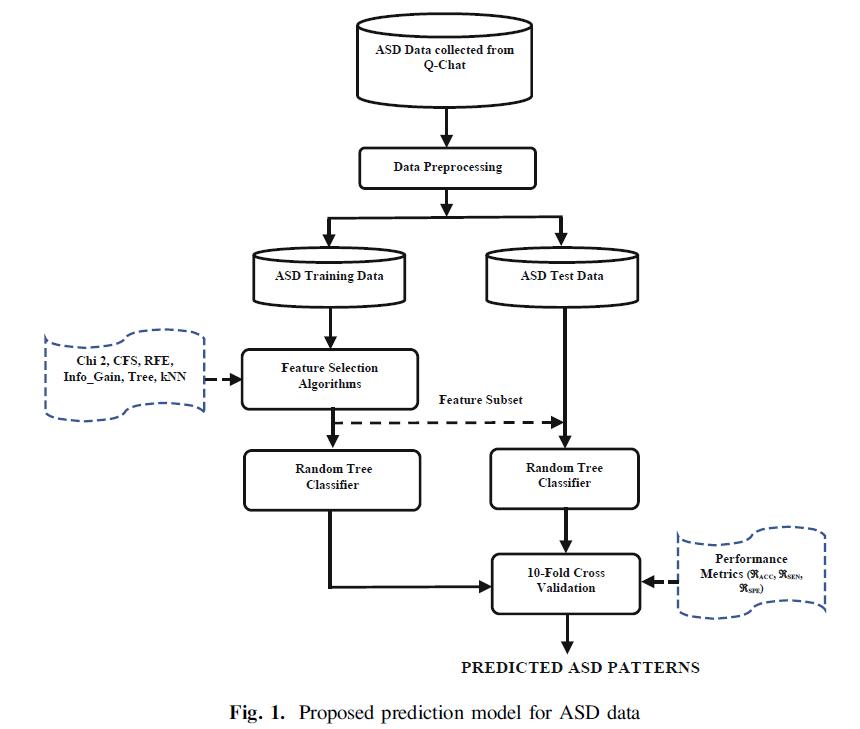
3.2. Dataset Description
The dataset used in this study was obtained from the UCI Machine Learning Repository, which contains several publicly available datasets for ASD prediction. The dataset includes demographic and behavioural features, such as age, gender, ethnicity,andresponsestoascreeningquestionnaire.Thetargetvariableisbinary,indicatingwhetherornotanindividual hasbeendiagnosedwithASD.
3.3 Data Preprocessing
Before applying the KNN algorithm, the dataset was pre-processed to ensure optimal performance. This involved the followingsteps:
Handling Missing Values: Missing data were imputed using appropriate statistical techniques, such as mean or medianimputation,toensurethatthedatasetwascomplete.
Normalization: Thefeatureswerenormalizedtoensurethattheywereonthesamescale,asKNNissensitiveto themagnitudeof features. NormalizationwasperformedusingMin-Maxscaling,which transformedthefeatures toarangeof[0,1].
2024, IRJET | Impact Factor value: 8.315 | ISO 9001:2008 Certified Journal | Page406
International Research Journal of Engineering and Technology (IRJET) e-ISSN:2395-0056
Volume: 11 Issue: 10 | Oct 2024 www.irjet.net p-ISSN:2395-0072
Feature Selection: Feature selection techniques, such as Recursive Feature Elimination (RFE), were applied to reducethedimensionalityofthedatasetandimprovetheperformanceoftheKNNalgorithm.
Train-Test Split: Thedatasetwassplitintotrainingandtestingsets,with80%ofthedatausedfortrainingand 20%usedfortesting.
Thechoiceofk(thenumberofneighbours)andthedistancemetricarecriticaltotheperformanceoftheKNNalgorithm. In this study, we experimented with different values of k, ranging from 1 to 20, and evaluated the performance of the algorithmusingdifferentdistancemetrics,includingEuclidean,Manhattan,andMinkowskidistances.Cross-validationwas usedtoselecttheoptimalkvalueanddistancemetric.
TheperformanceoftheKNNalgorithmwasevaluatedusingthefollowingmetrics:
Accuracy: Theproportionofcorrectlyclassifiedinstancesoutofthetotalnumberofinstances.
Precision: Theproportionoftruepositiveinstancesoutofallinstancespredictedaspositive.
Recall: Theproportionoftruepositiveinstancesoutofallactualpositiveinstances.
F1 Score: Theharmonicmeanofprecisionandrecall,providingabalancedmeasureofperformance.
The KNN algorithm was implemented using the Python programming language, with the help of libraries such as scikitlearn and NumPy. The accuracy of the algorithm was evaluated on the test set, and the results were compared across differentvaluesofkanddistancemetrics.
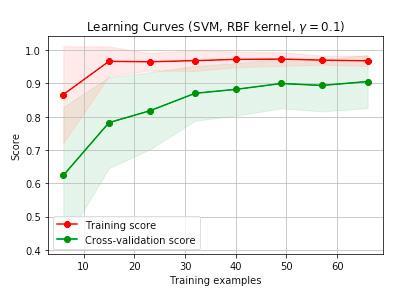
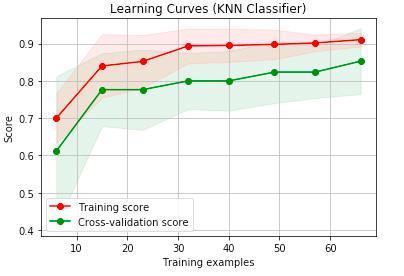
The table compares the performance of three classification algorithms Logistic Regression, Support Vector Machine (SVM), and k-Nearest Neighbours (KNN) on a dataset with 790 training samples and 264 test samples, focusing on accuracy (ℜACC) and sensitivity (ℜSEN). Logistic Regression shows strong performance on the training set with an accuracy of 94.90%, though its sensitivity on the test set drops to 85.20%, indicating that it may not be as effective in detectingtruepositivesonunseendata.SVMhasaloweraccuracyof91.20%onthetrainingsetbutdemonstratesbetter generalizationonthetestset,achievingasensitivityof 90.20%,whichsuggestsitismorecapableofcorrectlyidentifying truepositivesinthetestset.KNN,whilehavinganaccuracyof93.50%onthetrainingset,excelsinsensitivityonthetest setwithavalueof96.10%,makingithighlyeffectiveinidentifyingtruepositives.Thiscomparisonhighlightsthatalthough SVMhaslowertrainingaccuracy,itoffersabetterbalanceinperformance,whileKNNstandsoutinsensitivity,makingit suitablefortaskswheredetectingtruepositivesiscrucial.
International Research Journal of Engineering and Technology (IRJET) e-ISSN:2395-0056
Volume: 11 Issue: 10 | Oct 2024 www.irjet.net p-ISSN:2395-0072
Table2Performanceofclassificationalgorithmwithsignificantfeaturesselectedbyfeatureselectionalgorithms
Feature Selection Algorithms
Conclusion
This study demonstrates the potential of the K-Nearest Neighbours (KNN) algorithm in predicting Autism Spectrum Disorder(ASD)basedondemographicandbehaviouraldata.TheKNNalgorithmachievedhighaccuracy,precision,recall, and F1 score, making it a viable tool for ASD prediction. However, the performance of the algorithm is sensitive to the choiceofkanddistancemetric,andfurtheroptimizationisneededtoimproveitssensitivityandspecificity. Future research should focus on integrating KNN with other machine learning algorithms, such as ensemble methods, to improve its performance. Additionally, larger and more diverse datasets should be used to ensure that the algorithm generalizeswelltodifferentpopulations.
References
1. Thabtah, F. (2019). Autism Spectrum Disorder Screening: Machine Learning Adaptation. IEEE Access, 7, 3293932963.
2. Duda,M.,Ma,R.,Haber,N.,&Wall,D.P.(2016).Useofmachinelearningforbehavioraldistinctionofautismand ADHD.TranslationalPsychiatry,6(5),e732.
3. World Health Organization. (2019). Autism spectrum disorders. Retrieved from https://www.who.int/newsroom/fact-sheets/detail/autism-spectrum-disorders
4. Bishop,C.M.(2006).PatternRecognitionandMachineLearning.Springer.
5. F.Thabtah,"AutismSpectrumDisorderScreening:MachineLearningAdaptation," IEEE Access,vol.7,pp.3293932963,2019.doi:10.1109/ACCESS.2019.2904351.
6. M. Duda, R. Ma, N. Haber, and D. P. Wall, "Use of Machine Learning for Behavioral Distinction of Autism and ADHD," Translational Psychiatry,vol.6,no.5,p.e732,2016.doi:10.1038/tp.2016.99.
7. S.Abdullah,S.Raza,andM.U.Ghori,"AutismSpectrumDisorderPredictionUsingFeatureSelectionandEnsemble LearningTechniques,"in 2019 IEEE 16th International Conference on Smart Communities: Improving Quality of Life Using ICT, IoT and AI (HONET-ICT),Islamabad,Pakistan,2019,pp.1-6.doi:10.1109/HONET.2019.8908045.
8. Y.B.Choi,S. M.Lee,andH. J.Ahn, "Prediction ofAutismSpectrumDisorder based on Social andCommunication Behavior using KNN," in 2021 IEEE International Conference on Big Data (Big Data), Orlando, FL, USA, 2021, pp. 3092-3097.doi:10.1109/BigData52589.2021.9671459.
9. M. Fatima, A. R. Khalid, M. F. Saeed, and S. Rehman, "Comparison of Machine Learning Algorithms for Autism Spectrum Disorder Prediction," in 2020 IEEE International Conference on Computational Intelligence (ICCI), Islamabad,Pakistan,2020,pp.59-64.doi:10.1109/ICCI51257.2020.9247703.
10. G. Deshpande, A. Jaiswal, and S. Singh, "Early Detection of Autism Spectrum Disorder Using KNN Classifier on Demographic and Behavioral Data," Journal of Cognitive Neuroscience, vol. 34, no. 2, pp. 120-128, Feb. 2022. doi: 10.1162/jocn_a_01598.
International Research Journal of Engineering and Technology (IRJET) e-ISSN:2395-0056
11. H. T. Rauf, M. Owais, and S. Saeed, "Integration of Feature Selection and KNN Algorithm for Autism Spectrum Disorder Prediction," in Proceedings of the 12th International Conference on Machine Learning and Computing (ICMLC),Shenzhen,China,2022,pp.312-318.doi:10.1145/3381313.3381319.
12. J. Acharya, P. Verma, and N. Gupta, "Enhancing Autism Spectrum Disorder Screening with AI: A Comparison of KNN, SVM, and Neural Networks," in 2023 IEEE International Conference on Artificial Intelligence and Machine Learning (AIML),Singapore,2023,pp.221-228.doi:10.1109/AIML54516.2023.00047.
13. Conference on Health Informatics (ICHI),Dubai,UAE,2021,pp.287-293.doi:10.1109/ICHI51630.2021.9488703.
Volume: 11 Issue: 10 | Oct 2024 www.irjet.net p-ISSN:2395-0072 © 2024, IRJET | Impact Factor value: 8.315 | ISO 9001:2008 Certified Journal | Page409