
International Research Journal of Engineering and Technology (IRJET) e-ISSN: 2395-0056
Volume: 11 Issue: 10 | Oct 2024 www.irjet.net p-ISSN: 2395-0072

International Research Journal of Engineering and Technology (IRJET) e-ISSN: 2395-0056
Volume: 11 Issue: 10 | Oct 2024 www.irjet.net p-ISSN: 2395-0072
Nandan N1 , Umesha D K2 , Priya M K3
1 Lecturer, Department of CS&E, Government Polytechnic, Arakere, Karnataka, India
2 Lecturer, Department of CS&E, Government Polytechnic, Soraba, Karnataka, India
3 Lecturer, Department of CS&E, Government Polytechnic, Ramanagara, Karnataka, India ***
Abstract - Automation of the drip irrigationsystem willsolve the problem of the water wastage, man power and increase productivity but it will also raise many problems like emitter clogging the drip emitter causes the plant to dried out, pipe breakage causes the loss of water, wireless sensor network implemented in the farm has issues such as data loss in network, short range data transmission, and more power consumption at sensor nodes. The problem with the emitter clogging can be predicted by using the flow sensor and the pressure sensor, whenever there is clogging in the emitter which automatically increases the pressure at the end of pipe and measured using the pressure sensor in terms of bars and flow rate decrease will be detected using the flow meter sensor. The pipe breakage is predicted when the pressure decrease below the normal threshold pressure. Node MCU (ESP8266) is used to create the wireless sensor networkwhich creates a high speed and secure network compared with Zigbee and Bluetooth. The Wi-Fi network avoids the data loss while sending data from the sensor nodes tocoordinator node. Wireless sensor nodes are secure with high data transmission rate and long range data transmission.
Key Words: Emitter Clogging; Pipe breakage; Node MCU; Wi-Fi;
1.INTRODUCTION
Theagriculturewas started thousands of years back. Agriculture provides the major contribution to the Indian Economy.Agricultureisthebasicsourceofrevenueformore than60percentofIndia’spopulation. Agricultureprovides 50percentofemploymenttothecountrieslaborforce.The 18 per cent of Gross domestic product (GDP) of India is accounted from agricultural sector. Water source for agriculture in India is from rainfall, ground water, canal irrigation. Due to lack of rainfall or insufficient rainfall or uncertainty in rainfall is difficult to depend on the rainfall only.Groundwatersourceisdecliningstepbystepbecause of the lack ground water recharging process. Canals are mainly base on the river water source which in turn connected with rainfall. Increase demand for the food productsduetoexponentialgrowthofpopulationinIndia. Creatingworkforceforlargerpopulationisdecliningdueto the irregular rainfall or unseasonal rainfall because of this reason predicting the rainfall is becoming difficult to the farmers those who are mainly depend on the rainfall.
Farmingprofitabilityisdecliningstepbystepbecauseofthe absence of water resource and labor. To reduce wastage water resource and labor has lead expanded requests on automatingapplicationsinthefieldofagriculturetoreduce thepower,waterandimprovestheyield.Variousparameters are inculcated for the drip irrigation system automation. Systemnodeincorporatessensorstonodelikesoildampness sensor,Atmospherichumiditysensor,temperaturesensor, soilpHsensor.Wirelesssensornetworkfordatacollectionat various specified points on the farm field. Using remote advancements in the field of cultivating have a ton of specializedchallenges,for example, improving batterylife, long distance data transmission,secure data transmission, transferspeedofsystem,datamisfortune,datatransmission rateandminimalcost.
Automation is done mainly to save the water resource for future and minimize the man power automation on drip irrigationcomes into picture. Automationconcentratedon thesavingwaterbyprovidingthenecessaryamountofwater to each plant on the farm. The watering to plant is done timelybasedonthesoilmoisture,detectingthetrespasserto thefarmfield,cropgrowthviewingusingcamera,soilquality and acidity information to apply fertilizers. Automation makesefficientwaterresourceutilizationforthefarmfield. Thisdripirrigationautomationisalsohavingproblemlike emitterblockageduetochemicalused,hardnessofthewater source,biologicalfactoranddust,pipebreakageduetothe exposuretosunlightbecomebrittleandbreakseasilyordue to trespasser or animals. Wireless sensor nodes consume more power even on the idle condition makes frequent changingofthebatteryforthenodes.
Basicallyinternetofthingsworksbasedonthesensors.There aredifferentsensorsavailableonthemarketforcollecting thedata.Themajorusedsensorsforagriculturearethesoil moisturesensorforfindingthesoilwetnesstomakedecision ofmotortoON/OFF.Temperatureandhumiditysensordata isusedtogetthecurrentweatherconditiononthefarmfield. Passiveinfraredsensorisusedfindthetrespassertothefarm field. PH sensor is helped to collect the acidity data of the farm field. NPKisused get the quality ofthesoil basedon whichfertilizersareappliedtothefield.
The Wireless sensor network is implemented on the farm fieldtogetthesensorfiguresfromthedifferentpartofthe
International Research Journal of Engineering and Technology (IRJET) e-ISSN: 2395-0056
Volume: 11 Issue: 10 | Oct 2024 www.irjet.net p-ISSN: 2395-0072
farmfieldtomakethedecisioncorrectlyoraccurately.There aremanyissuesontheoncreatingthesensornetwork.The trafficonthenetworkismainlydependsonthenumberof nodesinstalledinthefieldandtopologyofthenetworkused forexamplestartopologycausesmoredatalossthanmesh topology, the node placement on the field, line of sight, strength of signal is main factor for network stability. The sensor nodes and control node or base node network is createdusingdifferenttechnologylikeBluetooth,Zigbee,WiFi, GSM, or LoRa. The best suited depend the farm environmentcondition.
Intheirstudy,Zhangetal.(2023)proposedanapproach based on machine learning, which uses pressure and flow rate data to detect clogging in emitters. A random forest model developed by the researchers was found toachieve 95% accuracy in identifying clogged emitters [2]. A new acousticsensorsystemhasbeendevelopedbyLietal.(2022) inordertodetectchangesinwaterflowsoundsasaresultof cloggingandidentifythecause.Asaresultoftheselaboratory tests,thismethodhasshownpromisingresults,resultingin an 88% detection rate in laboratory tests [3]. In a studyby Gonzalez-Perea et al. (2021), IoT sensors and fuzzy logic algorithms were combined to create a real-time clogging detection system that could be used in real-time. By comparingtheirapproachwithtraditionalthreshold-based methods, they were able to reduce the number of false positivesby30%[4].Chenetal.Third,(2023)proposedtouse adistributedfiberopticsensingapproachcombinedwiththe dynamicoddsratioanalysismethodasasolutiontodetect andlocalizepipebreakages.Forexample,theirmethodwas abletolocateleaksalonga1-kmpipelengthwithin1mofan actualbreak [5] .
Kumar and Singh (2022) established an algorithm that enables the detection of very fine leaks and rupture by pressurewaveanalysis.ReadingtheAkademiavideos,their systemachieveda92%leakdetectionrateforleaksaslowas 1% of the total flow rate. [6]. Martínez et al. In their work, Esakki Balasubramanian et al., (2021) presented a multisensor fusion (pressure, flow and soil moisture data) approach.Thesystemwasabletodetectpipebreakageswith anaccuracyof97%inallthecombinationsoffieldconditions evaluated [7].Wangetal.AhybridofIoTsensorsandedge computing was used todevelopa fully-fledgedmonitoring system by (2023). These clogging and breakage were simultaneously monitored by a system of theirs, with an accuracyrateof94% [8].Alvesetal.(2022) Asecuredata collectionandanalyticsblockchainmechanismforirrigation large-scaleplatforms.(Rightarrow)Resultedinbetterquality data and longer-term analysis of system degradations [9] Rodriguez-Diaz et al. It then somewhat broadly examined dronethermalsensingtechnologyin2024thatcouldbeused todetectclogging,butalsotoidentifyifapipewasbroken. Although still in preliminary stages, this approach carries
potentialforfastandcumulativeinvestigationofsystemsat the finest scale [10]. Kim et al. A study Researched the CapabilitiesofQuantumSensorsforExtremelyAccurateFlow Measurements.Othernewproductsfocusonearlydetection: onefour-personstartuphasjustcompletedaprototypethat candetectchanges in flowas small as0.01%, whichcould drasticallyimproveearlywarningtime [11]
Automation of drip irrigation system is implemented usingLPC2148microcontroller,andnodescapableofsensing soil moisture, temperature and humidity data. The connection between the mobile user and the farm is established using HC05 Bluetooth module. The communication is established only when the user present within the reachable region from the sensor nodes [12] . MicrocontrollerusedistheATmega328pArduinoUNOand soilmoisturesensorforcolletingthewetnessofthearea.The communication between the mobile application and farm field is done using Bluetooth module. Here Bluetooth terminal is used for the interaction [13]. Wireless sensor networkconsistingofthenodecreatedusingArduinoUNO with addition sensing capabilities like soil dampness, temperatureandhumidity.Thenetworkisestablishedusing the Bluetooth (HC05), the communication established betweenthenodesusingtheP2Pcommunication,capableof singlenodecommunicationwiththecoordinatornodeata givenparticulartime [14] .
The sensor node and coordinator node in WSN is connected with the help of Bluetooth modules. Bluetooth nodes consume less power for data transmissionanddata receiving between the nodes. Network is with the higher data transmission rateandbandwidth forlarger data. The point to point communication between the nodes makes other nodes to linger for data transmission and network consistsoflessnumberofsensornodes.Thisincursdelayin thenetwork,itissuitableforsmalldistancedataexchange andasitoperatingunderRFsoitnotmuchsecured.
Automated drip system is implemented with wireless sensor network on farm field includes number of wireless sensornodeeachnodeisprovidedwithcapabilityofsensing data with air moisture sensor, soil dampness sensor, temperature sensor. Sensor nodes are designed using ATmega32microcontroller.Herethecoordinatornodeisthe PCandcommunicationbetweenthePCandsensornodesis establishedusingtheZigbeemodule.GSMmoduleisusedto send the data to cloud database and mobile application. Systemiscontrolledusingmobilephoneapplicationremotely [15].TheZigbeewirelesssensornodesarecreatedtosensethe farmfieldphysicaldatalikemoisture,humidity,temperature. Thenodesupdatethedatatothenetworkbasestationwhich takesthedecisionofturnON/OFF themotorbasedonthe physicaldatavaluessensedfromthefarmfield [16].Thedrip automationnetworkisconstructedusingdifferentnodesas coordinatororbasenode,sensornodeorsendernodeand theserverisdesignusingraspberrypi.Thecommunicationis establishedbetweenthereceivingnodeandthesensingnode
International Research Journal of Engineering and Technology (IRJET) e-ISSN: 2395-0056
Volume: 11 Issue: 10 | Oct 2024 www.irjet.net p-ISSN: 2395-0072
isdonebyusingtheRFtransceiver.Itwillsendthedataof thesensorgatheredbysensornodestoacoordinatornode [17] .
The Zigbee wireless network is suitable to create a personalareanetwork(PAN)consumesminimumpowerand havinglowbandwidth.TheZigbeenetworknodesarehaving betterbatterylifeasitoperatesatlowpowerandlowdata transferrate.TheZigbeedatatransmissionislesssecurethan with Wi-Fi network. The data loss ismore inthe network; HenceZigbeeiscalledaslowpowerandlossynetworkwhich hinderssubsequentnetworks.
The system collects the sensor data like soil moisture, temperature,humidityandpHvalueswiththehelpoftheWiFi based microcontroller called ESP8266 module. The implementedsystemonthefieldalsoincorporatestheIDS systemthatsendsmessagetofarmerwhenintrudersonthe fieldandalsoupdatesfarmeraboutthecropfieldeverytime whenchangeshappenedonthefield [18].Thesystemsolves the problem of manual field work by introducing the wateringoftheplantsautomaticallydoneandthecomplete information about the farm field can be obtained using android application. The sensors data like temperature, wetness, and humidity are received by the Arduino UNO microcontroller and sends the data to the server using ESP8266 Wi-Fi module [19]. The system implements the efficient water management in an automated irrigation system. The scattered wireless sensor network nodes are createdusingLPC2148microcontroller,ithascontrolnode andwebserver.Everysensormoteplacedinthefarmfield having soil-moisture sensor, temperature sensor and humiditysensors.TheWSNnodesarepoweredwiththehelp ofbattery.Controlnodegathersthesensordatawiththehelp oftheRFtransceiver.Controlnodetransfersthesensordata to a database using Wi-Fi module. With the help of web application user is able to control motor remotely by consideringdatasuchassoilmoisturelevel,temperatureand humidity [20] .
WirelesssensornetworkconstructedusingWi-Fimodule is capable of send the images and video files within short distance of 100mt range. When compare to Bluetooth and Zigbee Wi-Fi Network provides high bandwidth and data rate.SetupofWi-Finetworkiseasyandthesensingmotes are connected tothe Wi-Firouter andsends data securely when compared than Zigbee and Bluetooth. Wi-Fi sensor nodes consume more power for data transmission and receiving and also in idle state. When distance increase in turnincreasesthepowerconsumption,leadstobatterydrain quickly.
TheautomationofdripcontrollingisdoneusingtheGPRS feature of the GSM module. The present farm condition is updatedusingGSMmodule.Basedontheuserrequirement anSMSissenttotheusermobiletochecktheconditionofthe soilmoistureonthefarmlandtosavethemanpowermanual checking.Thesoilmoistiscontinuouslycheckedtosavethe
waterwastageandprovidenecessarywateringtotheplants. The motor is turn ON/OFF by sending SMS to the control nodewhichactivatedmotorthroughrelaymodule [21].The system implementation is done using 16F877 microcontrollerforcomputation.Thefarmfielddataissends the user using GSM module. The microcontroller is programmed in such way that upper and lower threshold valueofthesoilmoistureisfixedandifthesoilmoistvalues belowthatoflowerthresholdvaluethemotorstartsandif the soil moist values above the upper threshold value the motor gets stopped. The LCD display is used to check the valuesphysically [22].Thesmartdripisimplementedusing theARMmicrocontrollerforcomputationalongwithsensors suchassoilmoist,temperatureandhumidity.Thesesensors data are collected the controller and computation is done based on the prefixed soil moisture threshold value and irrigate the farm using the condition. The modules are attachedwithGSMmoduletosendthedatatouserregular updatingonthefarmactivitieslikestarttimeofmotorand endtimeofmotor,powerconsumption [23]
Usergetstheinformationfromthefarmfieldeasilyand faster as it directly connected to the network tower. GSM moduleimplementationcostincreasesonincreasingnodes. Powerconsumptionofnodesismoreonsignalsearchandon weaksignalstrength.Itisnotsuitablefortheareahavingno networkorweaknetworksignal.
Long range smart drip irrigation is implemented using LoRa Based Wireless sensor network or LoRaWAN. LoRaWANisaMACprotocolusedforWAN.Thesystemwith internetprovidesthecapabilityoflongdistancedatatransfer withthelowpowerconsumption.LoRaWAN worksonthe secondlayerandthirdlayeroftheOSImodel.LoRaWANis implementing on top of ISM radio band. Network has End Device called Mote – it is battery operated low powered communicating device. TheGateway works asantenna for receivebroadcastsfrommoteandviceversa.TheNetwork Server maps the messages from motes to the correct Application,andbacktomotes.TheApplicationisapartof software runs on a network server. The Uplink means a message to an application from device and the downlink meansamessagefromadevicetoanapplication [25] .
LoRaWAN nodes are works with low power with long with enhanced battery life for years based computation method.Thedatatransmissionbetweenthenodesispossible up to 10kms considering correct line of sight other constraints.LoRatechnologyisbestsuitedfortheapplication sufficient with the low data rate. As LoRa operates on unlicensed ISM (open frequency) get intervention on that frequencymakestolowerdatarateandmorelatency.
The automated system proposed is designed and developed to prevail over the limitations of the existing system. The emitter clogging is predicted by using the
International Research Journal of Engineering and Technology (IRJET) e-ISSN: 2395-0056
Volume: 11 Issue: 10 | Oct 2024 www.irjet.net p-ISSN: 2395-0072
pressuresensor.Asperlawofpressure,pressureincrease whenthereisblockageinpipeduetoreducethechannelsize or outflow size of pipe by using this concept when ever blockage is the emitter the pressure at the end increase indicatestheemitterclogging.Similarlypressuredecreases when there is breakage of pipe due to leakage in pipe or brokenpipebyusingthisconceptwheneverbreakageinthe pipe the pressure at the end decreases indicates the pipe breakage in the row or column. The nodes are communicating in secure manner by using Node MCU (ESP8266)module.ThemotoristurnON/OFFbasedonthe set upper and lower threshold values. The power consumptionatthenodesisreducedbytakingnodestodeep sleepmodeforcertainperiodoftimeandwakesupatthis timeitwillcollectthesensorvalueofsoilmoisture,pressure, temperatureandhumiditytothefirebaseclouddatabase.The samewillbereflectedontheandroidapplicationusingbythe user. The notification of the emitter clogging and pipe breakagewillbeindicatedintheandroidapplication.
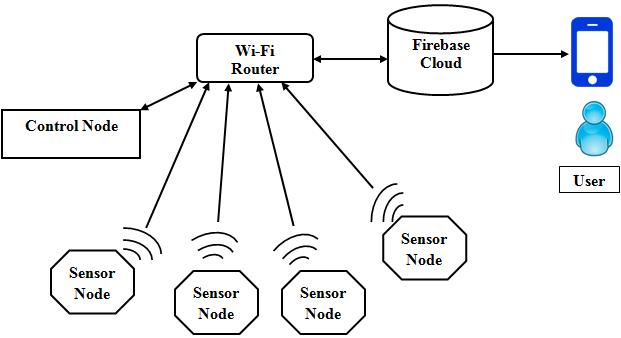
Theautomatedirrigationsystemarchitectureconsistsof the control node, sensor nodes, Wi-Fi router and Firebase cloud. The sensor nodes collect the moisture value and pressurevalueandupdatethedatatoFirebasecloudthrough theWi-Firouterasshowninthefigure1.Thecontrolnode fetchthedatalikemoisturevalue,motorstateandpressure valueusingthesedataitwilldecidetheirrigationofthecrop land.TheFirebasecloudgetsthedataandupdatetocontrol node and user mobile application to make decision and notificationoffieldstatus.Usergetstheemitterblockageor pipe broken notification on application can address the problemimmediatelytosaveplantortosavethewater.
Thecontrolnodeupdatesthetemperatureandhumidity datatotheFirebasecouldandfetchthepressurevalue,motor statusandmoisturevaluefromtheFirebasecloudasshown in the figure 2. The data is updated to the server every 30minsonceandfetchthedataatthesametime.Thissaves theenergyofthenodetwicetheintermsofextendedbattery life.Based on thesoil moisture and motorstate the motor gets ON/OFF controlling done with control node automatically.Controlnodeworkswith5VDCsupplyandthe
ESP8266willgotosleepmodefor30minsandsavehalfthe batterylife.Itwakesupforlessthanasecondandfetchthe data fromthecloudandtake decision toturn ON/OFF the motor.
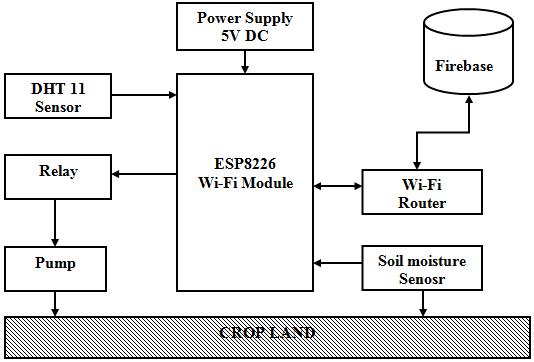
Figure 2: Control Node Architecture
Thesensornodesupdatethesoildampnessandpressure valuetotheFirebasecouldasshowninthefigure3.Thedata isupdatedtotheserverevery30minsonce.Thissavesthe energyofthenodedoubletheintermsofextendedbattery life.Based on thesoil moisture and motorstate the motor gets ON/OFF controlling done with control node automatically.Sensornodeworkswith5VDCsupplyandthe ESP8266willgotosleepmodefor30minsandsavehalfthe batterylife.Itwakesupforlessthanasecondandsendsthe data to the cloud. The pressure sensor attached to node worksat3.3VDCandvaluesisinanalogformat.Thepressure dataiscollectedattheendoftheeachrowpipeline.Thesoil moisturesensorattachedtothenodeworksat3.3VDCand dataisinanalogformat.Allthesensornodesareconnecting totheFirebasecloudthroughtheWi-Firouterinstalledon thefarmfield.
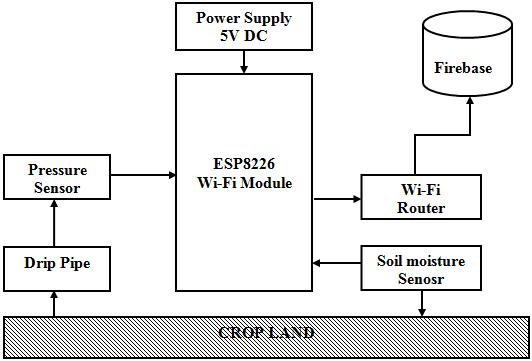
Figure 3: Sensor Node Architecture
International Research Journal of Engineering and Technology (IRJET) e-ISSN: 2395-0056
Volume: 11 Issue: 10 | Oct 2024 www.irjet.net p-ISSN: 2395-0072
Algorithm -1: Motor_state( )
1. Initializethesetupwithproperpowersupply
2. Readthesoilmoisturevalue(SMV)
3. If Soil_Moisture_Value>Upper_Threshold_Value
SufficientwatersoTurnOFFmotor
4. ElseIfSoil_Moisture_Value<Lower_Threshold_Value
5. Else
RequirewatersoTurnOFFmotor
GoToStep_2
6. EndElseIf Procedurestops.
Algorithm -2: User_alert( )
1. Initializethesetupwithproperpowersupply
2. Readthewaterpressurevalue(WPV)
3. If Water_Pressure_Value>Upper_Threshold_Value
Sendalertnotificationtouser“EmitterisBlocked”
4. ElseIfWater_Pressure_Value<Lower_Threshold_Value
5. Else
Sendalertnotificationtouser“PipeisBroken”
GoToStep_2
6. EndElseIf
7. Procedurestops.
Algorithm -3: Update_database( )
1. Initializethesetupwithproperpowersupply
2. WaitforsetperiodofTime
3. If thevaluesreadfromsensors
Updatethevaluesondatabase
4. EndIf
GoToDeepSleepmodeforsetperiodtime
5. GoToStep_2
6. Procedurestops.
4. CONCLUSIONS
Automated drip irrigation system now capable of predicting the emitter clogging and pipe breakage in an efficientwaytosavethefarmerfromlosscropandrevenue. The emitter clogging prediction helps to famer from early dryingofplantswithoutsufficientwater.Thepipebreakage orleakagepredictionsavesthewastageunnecessarywater andlackwatertoplants.Thesystemiseasyforinstallationas Wi-Fimoduleautomaticallyconnectstotherouterandsend the data from the nodetocoordinator inturntothecould server. The user gets the information through the android applicationsoitmakeseasyforhimtowatchthestatusofthe farm remotely and if any problem in the farm like emitter cloggingorpipebreakagehecanimmediatelyaddresstoit thatmakesworksimple.Wirelessnodesareondeepsleep modesavesthe50%ofthepowerthatenhancethebattery lifetotwice.
[1] Nandan N, Dr. K. Thippeswamy “A Secure intelligent Drip Irrigation System – Using IoT, Cloud and Mobile Application” International Research Journal of EngineeringandTechnology(IRJET)e-ISSN:2395-0056 Volume:05Issue:03|Mar-2018.
[2] Zhang, L., Wang, Y., & Chen, X. (2023). “Machine learning-based detection of emitter clogging in drip irrigation systems”. Agricultural Water Management, 258,107226.
[3] Li, H., Gao, R., & Liu, J. (2022). Acoustic-based emitter cloggingdetectionforsmartirrigation.Sensors,22(15), 5692.
[4] Gonzalez-Perea,R.,CamachoPoyato,E.,Montesinos,P., & Rodríguez Díaz, J. A. (2021). IoT and fuzzy logic for improving efficiency in water and energy use of pressurized irrigation networks. Agricultural Water Management,244,106527.
[5] Chen, Y., Zhang, M., & Liu, Y. (2023). Distributed fiber opticsensingforpipebreakagedetectioninirrigation systems.JournalofSensors,2023,1234567.
[6] Kumar,A.,&Singh,R.(2022).Pressurewave-basedleak detection algorithm for irrigation pipelines. Irrigation Science,40(2),173-186.
[7] Martínez, J., Martínez, R., & Escrivá, G. (2021). Multisensorfusionforrobustpipebreakagedetectionindrip irrigation. Computers and Electronics in Agriculture, 181,105959.
[8] Wang, X., Liu, Y., & Wu, H. (2023). IoT-based comprehensivemonitoringsystemforautomateddrip irrigation. IEEE Internet of Things Journal, 10(12), 11234-11245.
[9] Alves, F., Santos, L., & Queiroz, D. (2022). Blockchainenabled data management for large-scale irrigation networks. Computers and Electronics in Agriculture, 200,107209.
[10] Rodriguez-Diaz,J.,Camacho-Poyato,E.,&Montesinos,P. (2024). Drone-based thermal imaging for irrigation systemfaultdetection.PrecisionAgriculture,25(1),7892.
[11] Kim,S.,Park,J.,&Lee,C.(2023).Quantumsensorsfor ultra-preciseflow measurementin irrigationsystems. NatureNanotechnology,18(7),743-748.
[12] Swapnil Thakare “Automated System Based on Android Cell Phone for Modernization of Irrigation” International Journal of Engineering Research and
International Research Journal of Engineering and Technology (IRJET) e-ISSN: 2395-0056
Applications (IJERA) ISSN: 2248-9622 NATIONAL CONFERENCEonDevelopments,Advances&Trendsin EngineeringSciences(NCDATES-09th&10thJanuary 2015)
[13] AparajithaS,SwathijaR,HarithaK,SubashkaRameshS S “Smart Irrigation System Using Bluetooth Module andarduino” Vol-4Issue-22018IJARIIE-ISSN(O)-23954396.
[14] Ashwini B V “A Study on Smart Irrigation System UsingIoTforSurveillanceofCrop-Field” International Journal of Engineering & Technology, 7 (4.5) (2018) 370-373year2018.
[15] Shikha,Vibha “Automated Irrigation System using ZigBee – GSM” International Journal of Innovative ResearchinScience,EngineeringandTechnologyVol.5, Issue5,May2016.
[16] DhawanS.ThakurAditiSharmaDileepKumarSharma “A Low Cost Design & Monitoring Of Automatic Irrigation System Based On ZigBee Technology” International Journal of Engineering Research & Technology (IJERT) Vol. 2 Issue 5, May - 2013 ISSN: 2278-0181.
[17] Chetan Vinayak Gawali, R.B.Dhumale “ Intelligent Irrigation System based on Wireless Sensor Networks” Proceedings of the 2nd International Conference on Inventive Communication and ComputationalTechnologies(ICICCT2018)
[18] R.Nandhini, S.Poovizhi, Priyanka Jose, R.Ranjitha, Dr.S.Anila “ARDUINO BASED SMART IRRIGATION SYSTEM USING IOT” 3rd National Conference on Intelligent Information and Computing Technologies, IICT’17.
[19] G.NandhaKumar,G.Nishanth,E.S.PraveenKumar,B. Archana “Aurdino based Automatic Plant Watering SystemwithInternetofThings” InternationalJournal of Advanced Research in Electrical, Electronics and Instrumentation Engineering Vol. 6, Issue 3, March 2017.
[20] Sharad Shinde, Vipul Gohil “Automated Irrigation System using WSN and Wi-FiModule” SharadShinde. Int. Journal of Engineering Research and Application ISSN:2248-9622,Vol.7,Issue4,(Part-6)April2017.
[21] Pavithra D. S, M. S .Srinath “GSM based Automatic Irrigation Control System for Efficient Use of Resources and Crop Planning by Using an Android Mobile” IOSR Journal of Mechanical and Civil Engineering (IOSR-JMCE) e-ISSN: 2278-1684,p-ISSN: 2320-334X,Volume11,Issue4Ver.I(Jul-Aug.2014)
[22] R.Subalakshmi, A.AnuAmal,S.Arthireena “GSM Based Automated Irrigation Using Sensors” International JournalofTrendinResearchandDevelopment(IJTRD), ISSN: 2394-9333 National Conference on Emerging TrendsinElectronics,Instrumentation,Automation & Control(ETEIAC)2016
[23] Ms. Darshana Chaware, Ms. Ashwini Raut, Ms. Mrunal Panse, Mr. Aniruddha Koparkar “Sensor Based AutomatedIrrigationSystem” InternationalJournalof EngineeringResearch&Technology(IJERT)ISSN:22780181Vol.4Issue05,May-2015
[24] MaksudjonUsmonov,FrancescoGregoretti “Designand ImplementationofaLoRaBasedWirelessControlfor Drip Irrigation Systems” 2017 2nd International ConferenceonRoboticsandAutomationEngineering.
[25] Luigi Atzori, Antonio Iera, Giacomo Morabito “The Internet of Things: A survey” published in Elsevier sciencedirectyear2009
[26] Ala Al-Fuqaha, Mohsen Guizani, Mehdi Mohammadi, Mohammed Aledhari, Moussa Ayyash “Internet of Things:ASurveyonEnablingTechnologies,Protocols andApplications” DOI10.1109/COMST.2015.2444095, IEEECommunicationsSurveys&Tutorials
[27] Artem Dementyev, Steve Hodges, Stuart Taylor and JoshuaSmith“PowerConsumptionAnalysisofBluetooth LowEnergy,ZigBeeandANTSensorNodesinaCyclic SleepScenario”IEEE2013
[28] Jin-Shyan Lee, Yu-Wei Su, and Chung-Chou Shen “ A Comparative Study of Wireless Protocols: Bluetooth, UWB, ZigBee, and Wi-Fi” The33rdAnnualConference oftheIEEEIndustrialElectronicsSociety(IECON)Nov. 5-8,2007,Taipei,Taiwan.
[29] Kalpana. P. Sangvikar “A Survey on Automatic Irrigation Systems” National Conference on Communication and Image Processing (NCCIP- 2017) International Journal of Science, Engineering and Technology.
[30] NandanN,Dr.KThippeswamy “Astudyonautomated drip irrigation system”, International Journal of Emerging Technologies and Innovative Research (www.jetir.org), ISSN:2349-5162, Vol.6, Issue 4, page no.391-395,April-2019
Volume: 11 Issue: 10 | Oct 2024 www.irjet.net p-ISSN: 2395-0072 © 2024, IRJET | Impact Factor value: 8.315 | ISO 9001:2008