
International Research Journal of Engineering and Technology (IRJET) e-ISSN: 2395 -0056
Volume: 11 Issue: 10 | Oct -2024 www.irjet.net p-ISSN: 2395-0072

International Research Journal of Engineering and Technology (IRJET) e-ISSN: 2395 -0056
Volume: 11 Issue: 10 | Oct -2024 www.irjet.net p-ISSN: 2395-0072
Mr. Nitesh Radadiya1 , Mr. Uchit Patel 2
1Student, Dept. of Mechanical Engineering, U.V. patel college of engineering,Gujarat, India
2Professor, Dept. of Mechanical Engineering, U V patel college of engineering,Gujarat, India
Abstract - Friction stir welded Polypropylene & Al6061 plates with a thickness of 3 mm using welding settings (weld speed and rotational speed). The trials wereplanned using the Taguchi design of experiment approach An increasingly common technique, friction welding (FW) is a set of solidstate joining methods based on friction that may produce highquality welds of different components comprised of similar or different materials. The input parameter choosen rotational speed & welding speed And Output Parameter is Tensile strength. The Taguchi technique recommended allocatingthe factors selected for the experiment using an orthogonal array design. Using the Taguchi method's L9 orthogonal array, nine experiments have been constructed. The signal-to-noise(S/N) ratio and analysis of variance (ANOVA) have been used to examine and optimise the welding settings. Following examination, the most important control factor for tensile strength is identified.
Keywords: FSW, ANOVA, Taguchi method, Minitab.
The process of joining metals by means of heat and pressureisknownaswelding.Weldingisaconstructionor artistictechniquethat,unlikebrazingandsoldering,whichdo not meltthe base metal, creates fusion between materials, most commonly metals or thermoplastics. It is common practice to augment the base metal with a filler material before welding the two together. This creates a pool of moltenmaterial,calledtheweldpool,which,whencooled, formsajunctionthatisjustasstrongasthebasemetalitself. Aweldcanbeformedusingeitherheatorpressurealoneor both. Several different types of energy can be used to conductweldingprocesses.Theseincludegasflames,electric arcs, lasers, electron beams, friction, and ultrasound. The outdoors,underwater,andevenspaceareallviablelocations forwelding.Thehazardsofweldingincludethepossibilityof burns,electricshock,eyeinjury,exposuretoharmfulgases and fumes, and intense UV radiation. One kind of friction welding,FRICTIONSTIRWELDING,willbetheprimarytopic of discussion as we go over the study's classification of weldingprocessesandtheiruses.
I have selected Polypropylene and Al 6061 sheet materialWithThickness3mmforcarriedoutthe experiment.
SelectedTaguchiMethodWithL9OrthogonalArray
Minitab software is used for analyze the experimentaldata
Prepare Friction Stir Welding Job And Find out Microstructure,TensilestrengthofWeldingJob
Examinehowtheweldingprocessparameteraffects the weldshapeand use this work tooptimisethe processparameter.
3. DESIGN OF EXPERIMENT
3.1 Different Techniques of DOE
1. Factorialdesign
2. ResponseSurfaceMethod
3. MixtureExperiments
4. TaguchiDesign
3.2 Objective of Taguchi Method
Toimproveprocessandproductdesign,Taguchiislooking for easily controllable factors and their settings that reduceproductresponsevariabilitywhilemaintaininga desiredmeanresponse.Byadjustingthoseparametersto their sweet spots, we may make the product more resistant to variations in both operating and environmental circumstances. Removing the bed effect rather than the cause of the bed effect allows for more stable and high-quality goods to be obtained during the Taguchiparameterdesignstage.Inaddition,themethod can save money and eliminate wasted goods by systematicallyapplyingitatthepre-productionstage(off line),whichmeansfewertestsareneededto determine cost-effectiveprocessconditions.
Input parameters
FactorA:RotationalSpeed(rev./min)
FactorB:WeldingSpeed(mm/min)
Volume: 11 Issue: 10 | Oct -2024
Output Parameter TensileStrength(MPa)
Table-1: ProcessParameterLevel
Table-2: TaguchiDesignFactor
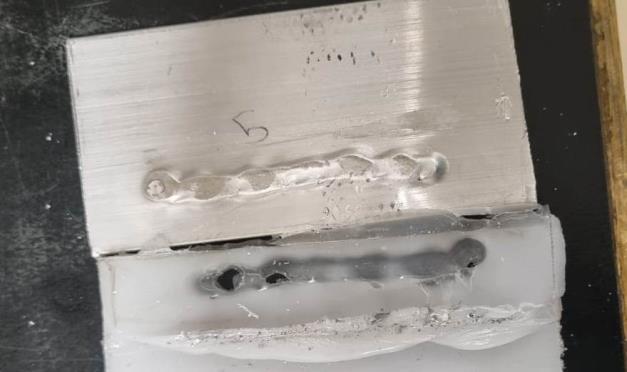
Fig-2: Workpieceafterwelded
Table-3: ResultsTable
4. EXPERIMENTAL WORK AND RESULTS
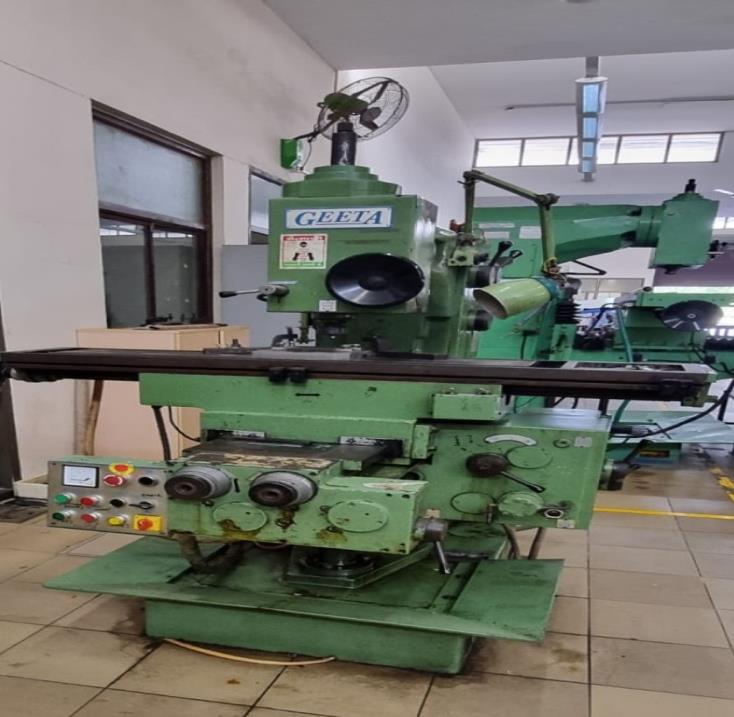
Fig-1: FSWMachineSet-up
Table-4: SNratiofortensilestrength
International Research Journal of Engineering and Technology (IRJET) e-ISSN: 2395 -0056
Volume: 11 Issue: 10 | Oct -2024 www.irjet.net p-ISSN: 2395-0072
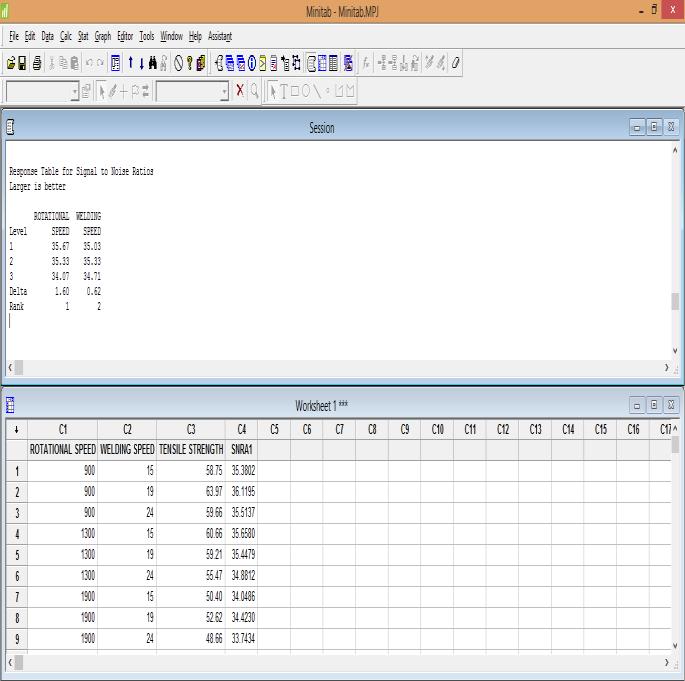
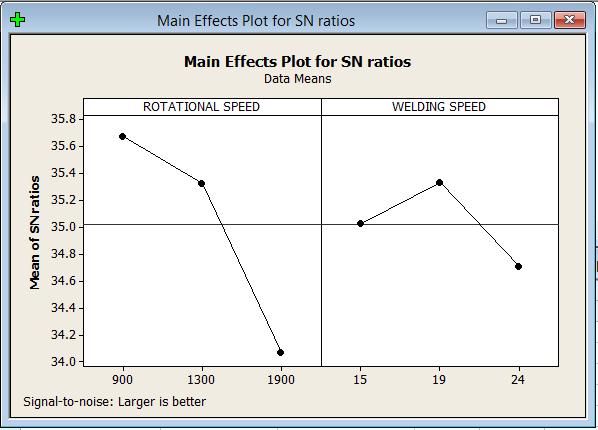
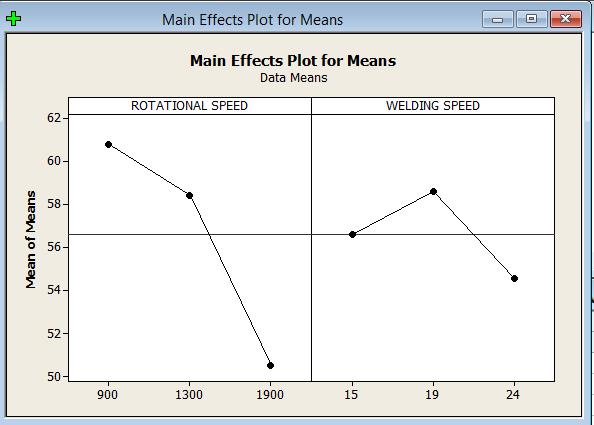
Fig-3: Minitab-16AnalysisTensileStrength
Figure3illustratesthemainplot'simpactontensilestrength for a 3 mm thickness at various rotational and welding speeds.
Theminimaltensilestrengthattainedisatarotationalspeed of 1900 rev/min and a welding speed of 24 mm/min, as shown in Fig. 3. Additionally, at welding speeds of 19 mm/minandrotatingspeedsof900rev/min,themaximum tensilestrengthwasreached.
Thecurrentworkusedparametricanalysistodetermine the tensile strength of Al6061 and polypropylene materials.Inordertoconductexperiments,theTaguchi Method is used to change the rotational and welding speeds for 3 mm thick polypropylene and Al6061 material. The software Minitab 16 was utilised to examinetheexperimentaldata.
After much research, I've determined that the lowest tensile strength can be achieved at 1900 rev/min rotational speed and 24 mm/min welding speed. Additionally, at welding speeds of 19 mm/min and rotating speeds of 900 rev/min, the maximum tensile strengthwasreached.
Rotational speed increase with decrease of tensile strength.
Rotationalspeedismostsignificantcontrolfactortensile strength.
[1] JohnVICTORCHRISTY,Abdel-HamidISMAILMOURAD, MuhammadM.SHERIF,B.SHIVAMURTHY“Reviewofrecent trends in friction stir welding process of aluminum alloys andaluminummetalmatrixcomposites”(2021)
[2] M. Shunmugasundaram , A. Praveen Kumar , L. Ponraj Sankar,S.Sivasankar“Optimizationofprocessparameters of friction stir welded dissimilar AA6063 and AA5052 aluminumalloysbyTaguchitechnique”(2020)
[3] M. Shunmugasundaram , A. Praveen Kumar , N.K. Amudhavalli , S. Sivasankar “Parametric optimization on tensile strength of friction stir butt joints of dissimilar AA6061 and AA5052 aluminium alloys by Taguchi technique”(2020)
[4] AustineD.D’Souza,ShrikanthaS.Rao,MervinA.Herbert “Taguchi method of optimization of process variables for ultimatetensilestrengthoffrictionstirweldedjointofAl-CeSi-Mgaluminiumalloyplates”(2021)
[5] M.R.Adibeig,GhMarami,M.A.Saeimi-Sadigh,L.F.M.da Silva“ Experimentalandnumericalstudyofpolyethylene hybridjoints:Frictionstirspotweldedjointsreinforcedwith adhesive”,(2020)
International Research Journal of Engineering and Technology (IRJET) e-ISSN: 2395 -0056
Volume: 11 Issue: 10 | Oct -2024 www.irjet.net p-ISSN: 2395-0072
[6] C.Elanchezhian, B.Vijaya Ramnath, P.Venkatesan, S.Sathish,T.Vignesh, R.V.Siddharth, B.Vinay, K. Gopinath “Parameter Optimization of Friction Stir Welding Of AA8011-6062UsingMathematicalMethod”,(2014)
[7] ShayanEslami,TiagoRamosa,PauloJ.Tavaresa,P.M.G. P.Moreira “Effectoffriction stir welding parameters with newlydevelopedtoolforlapjointofdissimilarpolymers”, (2015)
[8] GomathisankarM,GangatharanM,PitchipooP“ANovel OptimizationofFrictionStirWeldingProcessParameterson AluminumAlloy6061-T6”(2018)
[9] C. Labesh Kumar , V. Jayakumar , G. Bharathiraja “Optimization of welding parameters for friction stir spot weldingofAA6062withsimilaranddissimilarthicknesses” (2019)
[10] Timothy Odiaka , Stephen A. Akinlabi , Nkosinathi Madushele , Olawale S. Fatoba , Surnir Hassanb, Esther T. Akinlabi “Statistical analysis of the effect of welding parameters on the tensile strength of titanium reinforced mildsteeljointsusingtaguchi’sDoE”(2021)
[11] A. Paoletti, F. Lambiase, A. Di Ilio “Optimization of frictionstirweldingofthermoplastics”(2015)
[12] P. Raj kumar , S. Nandhakumar , S. Seenivasan , R. Chandraprakash“Parametricoptimizationoffrictionstirspot weldedaluminiumAA6063alloyjoints”,(2020)
[13] Manish T. Shete, Ravindra B. Yarasu “Experimental investigation and finite element simulation of friction stir spot welding (FSSW) of high-density polyethylene joints”, (2021)
[14] ShrinivasBalrajUyyala,SreedharPathri“Investigation oftensilestrengthonfrictionstirweldedjointsofdissimilar aluminumalloys”,(2019)
[15] MuminTutar,HakanAydin,CelalettinYuce,Nurettin Yavuz,AliBayram“Theoptimisationofprocessparameters forfrictionstirspot-weldedAA3003-H12aluminiumalloy usingaTaguchiorthogonalarray”,(2014)