
International Research Journal of Engineering and Technology (IRJET) e-ISSN: 2395-0056
Volume: 11 Issue: 10 | Oct 2024 www.irjet.net p-ISSN: 2395-0072

International Research Journal of Engineering and Technology (IRJET) e-ISSN: 2395-0056
Volume: 11 Issue: 10 | Oct 2024 www.irjet.net p-ISSN: 2395-0072
Karanveer Shroff1 , Sunny Kumar Barnwal2 , Anup Sharma2
1 Jamnabai Narsee International School, Mumbai, India. 400049
2 Department of Mechanical Engineering, Indian Institute of Technology Bombay, Mumbai, India. 400076
Abstract - Microprocessorsgeneratesubstantialheatdueto thehighdensityoftransistorsandelectricalresistanceduring operation. As transistor sizes decrease and circuit speeds increase, power consumption remains constant, leading to increased heat generation. This heat can cause thermal throttling, reduced efficiency, and potential damage to the microprocessor. Effective thermal management is crucial to maintain performance and longevity. Common cooling methods include air cooling with heat sinks and fans, and liquid cooling systems that use coolant to transfer heat away fromtheprocessor.Advancedmethodssuchasthermoelectric cooling modules and materials like graphene are also being explored for their superior thermal conductivity. Barrubeeah et al. (2021) highlight the design and optimization of thermoelectric cooling systems for high-power microprocessors, demonstrating their effectiveness when combined with air-cooled finned heat sinks. Aglawe, Yadav, and Thool (2021) review various cooling technologies, emphasizingthesuperiorheatdissipationcapabilitiesofliquid cooling and its importance for future thermal management. They also note the limitations of air cooling in handling high heat loads, making liquid cooling a more promising solution for advanced microprocessors.
Key Words: Microprocessor, Heat Generation, Thermal Management,AirCooling,ThermalConductivity.
Microprocessors generate significant heat due to the high density of transistors and the electrical resistance encountered during operation. As transistors become smallerandcircuitsfaster,thepowerconsumptionremains constant,leadingtoincreasedheatgeneration1.Thisheatcan causethermal throttling, reduced efficiency,and potential damage to the microprocessor2. Effective thermal management is crucial to maintain performance and longevity.
To cool down microprocessors, several methods can be employed.Aircoolingusingheatsinksandfansisthemost common approach. Liquid cooling systems, which use coolanttotransferheatawayfromtheprocessor,aremore efficient for high-performance systems2,3. Thermoelectric coolingmodulesandadvancedmaterialslikegrapheneare alsobeingexploredfortheirsuperiorthermalconductivity.
ThermoelectricCoolingSystems:Barrubeeahetal.(2021) discuss the design and optimization of thermoelectric cooling systems for high-power microprocessors4. Their studyhighlightstheeffectivenessofthermoelectricmodules combinedwithair-cooledfinnedheatsinks.Theoptimized parameterssignificantlyenhancethecooling capacityand efficiency, making it a viable alternative to traditional coolingmethods.
Current Cooling Technologies: Aglawe, Yadav, and Thool (2021) review various cooling technologies, including air cooling,liquidcooling,andheatpipes3.Theyemphasizethe importanceofliquidcoolingforfuturethermalmanagement duetoitssuperiorheatdissipationcapabilities.Thereview alsonotesthelimitationsofaircoolinginhandlinghighheat loads,makingliquidcoolingamorepromisingsolutionfor advancedmicroprocessors.
Temperature-Based Speed Control: Bai and Ku (2008) exploretheuseofmicrocontrollersandIRsensorstocontrol fan speed based on temperature5. This method ensures efficientcoolingbyadjustingthefanspeedaccordingtothe processor's thermal needs, thereby optimizing energy consumptionandmaintainingoptimaltemperatures.
RevolutionaryCoolingInventions:Astudypublishedinthe SmithsonianMagazine(2020)discussesinnovativecooling systems that could revolutionize microprocessor cooling6 Thesesystemsfocusonenhancingthermalconductivityand efficiency,potentiallyaddressingthelimitationsofcurrent coolingtechnologies.Theresearchunderscorestheneedfor continuous innovation to keep pace with the increasing powerandheatgenerationofmodernmicroprocessors.
In this study, a steady-state finite element analysis was conducted on four different cooling fin geometries. Both natural and forced convection were simulated using appropriate parameters. Forced convection was tested at fourdifferentvelocitiesforeachfingeometry.Airandwater wereconsideredseparatelyastheconvectingmediaineach case. The study highlights the relative differences in temperature drop caused by the various fin geometries. Beyondthesurfacearea,thecross-sectionalshapeofthefins playsacrucialroleindeterminingtheeffectiveheattransfer perfin.Theprimaryfocusofthestudyisontheimpactoffin shapeoncoolingefficiency,ratherthanthenumberoffinsor
International Research Journal of Engineering and Technology (IRJET) e-ISSN: 2395-0056
Volume: 11 Issue: 10 | Oct 2024 www.irjet.net p-ISSN: 2395-0072
their packing density on the base, which would require a computationalfluiddynamicsanalysis.
2. Model Description
Forsimulatingthecoolingprocessforamicroprocessorwith fins, a finite element model was created in a commercial solver Abaqus with heat transfer module. A steady state analysiswasperformedwithD3D4meshelements.
Steadystateanalysiswasperformed.Theschematicandfin dimensionsforfourdifferentvariationsaregiveninfigure1. The schematic illustrates four fin design variations, each maintainingconsistentbaseandfinheightdimensions.The firsttwodesignsfeaturecylindricalprotrusionswithradiiof 0.002mand0.004m,respectively.Thethirddesignconsists of rectangular fins spaced 0.004m apart, while the fourth design has more densely packed rectangular fins with a 0.002m gap. These variations are analysed to assess their thermalperformance,asdifferentgeometriesandspacings can significantly influence heat transfer rates. This
comparisoniscrucialforoptimizingthermalmanagementin engineeringapplications,ensuringefficientheatdissipation.
TheeffectoffingeometrywasincorporatedthroughNusselt number calculation7. Corresponding heat transfer coefficients were calculated for four different velocities (0.5m/s,1m/s,1.5m/sand2m/s)fortheforcedconvection simulations.


Initialtemperatureofthefinandthebasewaskeptat100°C, which is usually a thermal threshold for daily use microprocessors.Theboundarycondition atthe base was 100°C.,withthefinssubjectedtoconvectionwitheitherof thefluids.
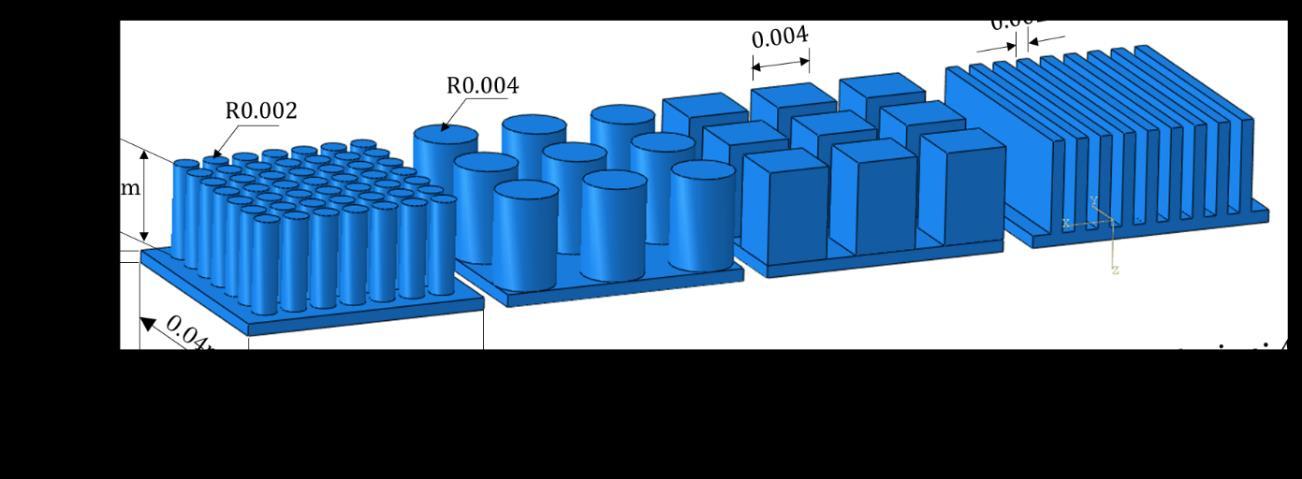
1: Schematicsoffourfindesignvariationsusedinthestudy.Allthedesignshavethesameoverallbaseandthefin heightdimensions.Rstandsforradiusforthefirsttwodesigns.
Figure 2 illustrates a steady-state analysis of fin cooling using natural convection with air and water as the convectingmedia.Thefins,madeofaluminum,areshownin four different designs. Each design is analyzed for its temperaturedistribution,withtemperaturesrangingfrom 312Kto373K.Thetoprowrepresentsfinsincontactwith air,whilethebottomrowshowsfinsincontactwithwater. The color gradient indicates the effectiveness of each fin design in dissipating heat. This analysis is crucial for optimizing cooling performance in applications like electronicscoolingandheatexchangers.
The clear difference between the two figures is due to a relatively much higher heat transfer coefficient value of water. The difference in thermal profiles of the four geometriesispurelyduetotheavailablesurfaceareaforthe coolant. However, the effect of fin geometry can be more utilised through the forced convection mechanism. The natural convection study confirmed the coherence of the currentmodel withphysics, soastomoveahead withthe furtherapproximatedforcedconvectionsimulations.
International Research Journal of Engineering and Technology (IRJET) e-ISSN: 2395-0056
Volume: 11 Issue: 10 | Oct 2024 www.irjet.net p-ISSN: 2395-0072
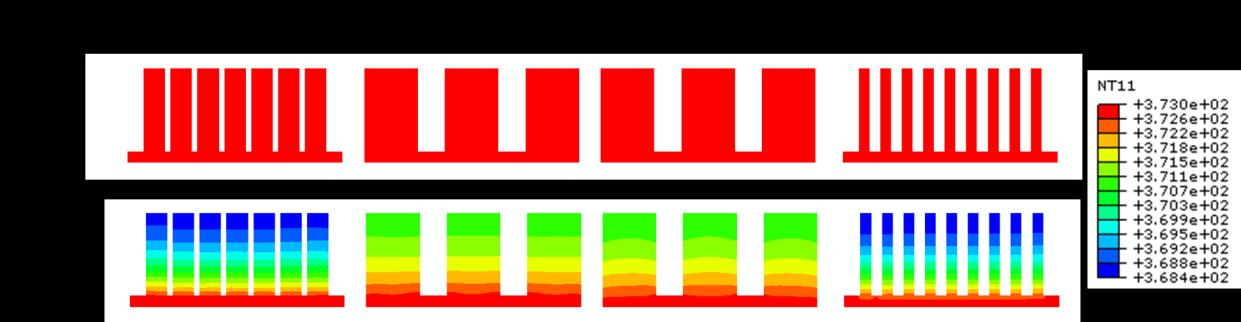
Figure 2: Asteadystateanalysisoffincoolingthroughnaturalconvectionwithairandwaterastheconvectingmedia.The finmaterialhereisaluminium.TemperatureisshowninKelvin.
The figure 3 presents heat transfer coefficients for four differentgeometriesduringforcedconvection.Forairasthe medium, the coefficients are measured at four different velocities,highlightinghowincreasedairflowimpactsheat transfer. For water, the coefficients are measured at a constantvelocityof2m/s.Thiscomparisonisessentialfor
understandingtheefficiencyofeachgeometryindissipating heat under varying conditions. Such data is crucial in designingthermalsystems,ensuringoptimalperformance and energy efficiency in applications like cooling systems andheatexchangers.Thisanalysishelpsengineersselectthe best geometry and medium for specific cooling requirements.
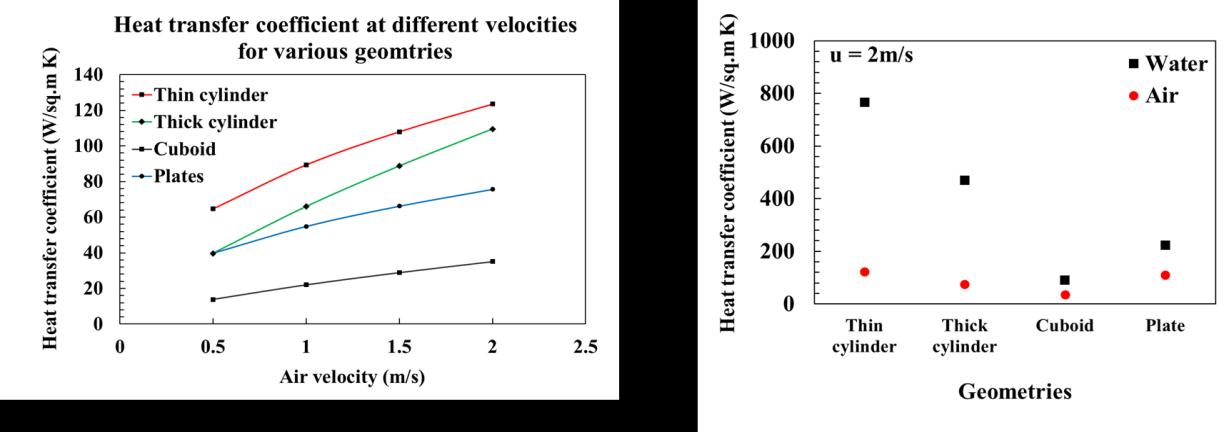
Figure 3: Heattransfercoefficientsforthefourdifferentgeometriesduringtheforcedconvectionwitha)airasthe mediumatfourdifferentvelocities;andb)withwaterasthemediumatthevelocityof2m/s
Thincylindersexhibitthehighestheattransfercoefficients due to their larger surface area-to-volume ratio, which enhances heat dissipation. The streamlined shape also promotesefficientairflow,reducingthermalresistanceand increasingtherateofheattransfercomparedtothickeror more complex geometries. The heat transfer coefficient increaseswithvelocitybecausehigherairspeedsenhance the convective heat transfer process. Faster-moving air reduces the thermal boundary layer thickness around the object,allowingmoreefficientheatexchangebetweenthe surface and the air. This results in a higher rate of heat transferasvelocityincreases.
The Nusselt number calculated in the above analysis was dependent on fin dimensions as discussed in the book by Incropera7. In Fig. 3b, although Nusselt number constants are same, the variation is through the kinematic viscosity andPrandtlnumberwhichaffecttheReynoldsnumberand
subsequentlyNusseltnumber.Water,representedbyblack squares,generallyhashigherheattransfercoefficientsthan air (red circles) across all geometries. The thin cylinder exhibits the highest coefficients, followed by the thick cylinder,cuboid,andplate.Thisindicatesthatwaterismore efficient in transferring heat compared to air at the same velocity.
Waterismoreefficientattransferringheatcomparedtoair due to its higher thermal conductivity and specific heat capacity. This means water can absorb and transfer more heatenergyperunitvolumethanair.Additionally,water's higher density allows for better contact with the surface, enhancing convective heat transfer and making it a more effectivecoolingmedium.
The cuboid performs worse in heat transfer with both air and water due to its geometric shape, which has a lower
International Research Journal of Engineering and Technology (IRJET) e-ISSN: 2395-0056
Volume: 11 Issue: 10 | Oct 2024 www.irjet.net p-ISSN: 2395-0072
surface area-to-volume ratio compared to cylinders and plates. This reduces the contact area available for heat exchange.Additionally,theflatsurfacesandsharpedgesofa cuboidcancreateareasofstagnantfluidflow,leadingtoless efficient convective heat transfer. These factors combined makethecuboidlesseffectiveintransferringheatcompared toothergeometries.
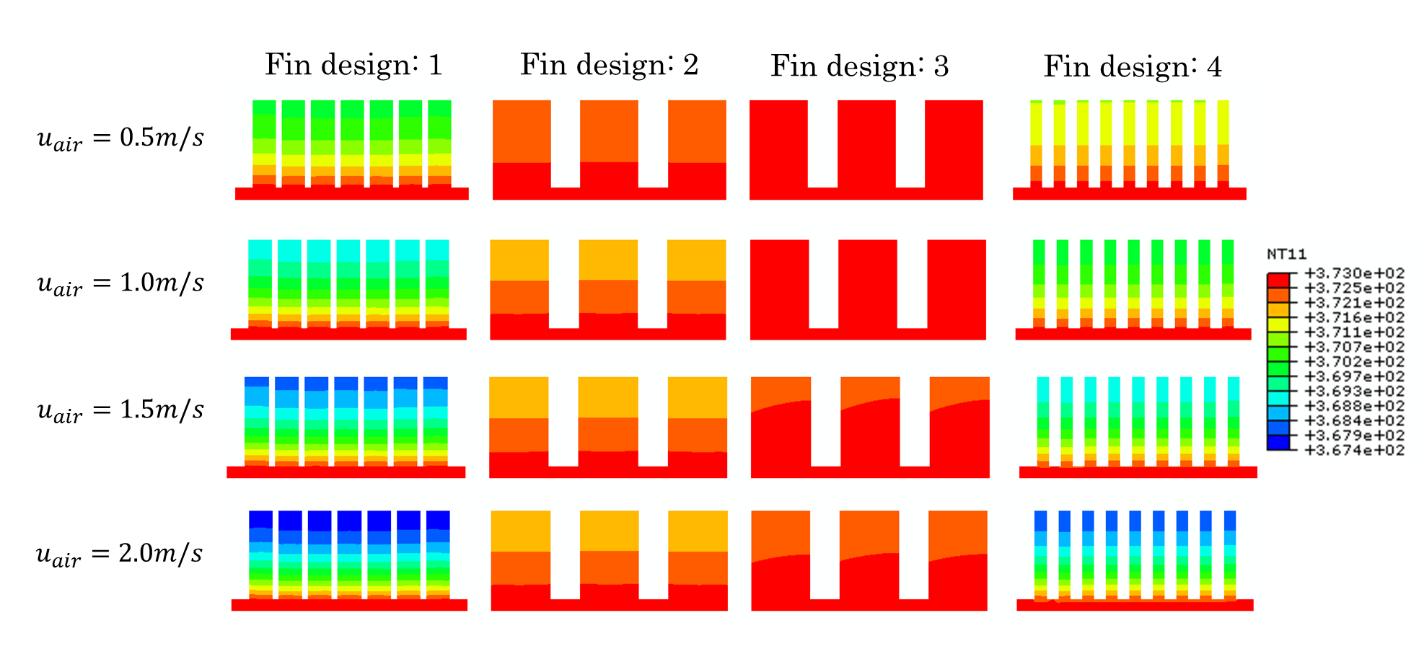
Fig. 4 displays a comparison of thermal cooling for four geometriesatdifferentairvelocities.Theimagepresentsa detailedsteady-stateanalysisoffincoolingthroughforced convectionatfourdifferentairflowvelocities.
The 1st fin design having thinner cylinders was found to have higher cooling rate among the four variations. Fin Design 1 shows a relatively uniform temperature distributionatlowerairflowvelocities,indicatingefficient heat transfer. However, as the velocity increases, the temperaturegradientbecomesmorepronounced,withmuch lowertemperatureattheendofthefins.Design2exhibitsa more consistent performance across all velocities. The temperaturedistributionremainsfairlyuniform,indicating that this design can handle varying air flow conditions effectively.Thismakesitaversatileoptionforapplications requiring stable cooling performance. Design 3 shows significanttemperaturevariationsatlowervelocities,with hotspotsindicatinglesseffectivecooling.However,athigher velocities, the temperature distribution becomes more uniform,suggestingthatthisdesignbenefitsfromincreased air flow. This design might be suitable for high-velocity coolingapplications.
Analysingtheresults,it is evidentthat certain geometries performbetterunderspecificconditions.Forexample,fins with larger surface areas or more intricate designs may
providebettercoolingatlowervelocitiesduetoincreased surface contact with the air. Conversely, simpler designs might perform adequately at higher velocities, where the increasedairflowcompensatesforthereducedsurfacearea.
The material of thermal fins significantly influences their performance, manufacturing ease, and overall cost. High thermal conductivity materials like copper and aluminum are preferred for thermal fins due to their efficient heat transfer capabilities. Copper, with its superior thermal conductivity, offers excellent heat dissipation but is more expensivethanaluminum8,9.Aluminum,whileslightlyless efficientinheattransfer,islighterandmorecost-effective10 .
Manufacturingeaseisanothercriticalfactor.Aluminumis easiertomachineandformintocomplexshapescompared to copper, making it a popular choice for manufacturing fins11.Itsmalleabilityallowsfortheproductionofintricate fin designs that maximize surface area and enhance heat dissipation11. Copper, although more challenging to work withduetoitshardness,providesdurabilityandsuperior thermal performance, which can justify the higher manufacturing complexity in high-performance applications9
Cost considerations are crucial in material selection. Aluminumfinsaregenerallylessexpensivetoproducedue to lower material costs and easier manufacturing processes10. Copper fins, while offering better thermal performance, come at a higher cost both in terms of raw materialandmanufacturing9.Stainlesssteel,anotheroption, offersgoodcorrosionresistanceanddurabilitybuthaslower thermal conductivity and higher costs compared to aluminum8,9
International Research Journal of Engineering and Technology (IRJET) e-ISSN: 2395-0056
Volume: 11 Issue: 10 | Oct 2024 www.irjet.net p-ISSN: 2395-0072
Inthisstudy,fourdifferentfingeometrieswereanalysedfor their cooling efficiency. An approximated simulation for cooling through natural convection was performed using waterandairasthecoolingmedia.Theresultsindicatedthat waterprovidedahighercoolingrate,confirmingthemodel's workability with the approximations (FEM simulations withoutCFD,usingexistingempiricalformulations).Forced convectionsimulationswerealsoconducted,incorporating heattransfercoefficientscorrespondingtoshape-dependent Nusseltnumbers.
The simulations revealed that the fin design with thinner cylinders exhibited the best cooling rate among the four designs. Thin cylinders have the highest heat transfer coefficientsbecausetheirlargersurfacearea-to-volumeratio improves heat dissipation. Their streamlined shape also facilitatesefficientairflow,loweringthermalresistanceand boosting heat transfer rates compared to thicker or more complex shapes.Additionally,the heat transfercoefficient riseswithvelocity,ashigherairspeedsenhanceconvective heat transfer by reducing the thermal boundary layer thickness. These findings highlight the importance of fin geometryinoptimizingcoolingperformance.
[1] Perry,TeklaS."ForgetMoore’sLaw ChipmakersAre More Worried About Heat and Power Issues." IEEE Spectrum,11Oct.2019.
[2] "CPUOverheating–WhatCausesIt&WhatCanYouDo AboutIt?"ValByte.
[3] "A New System for Cooling Down Computers Could Revolutionize the Pace of Innovation." Smithsonian Magazine,16Sept.2020.
[4] Barrubeeah, Mohammed, et al. "Design, Modeling and Parametric Optimization of Thermoelectric Cooling Systems for High Power Density Electronic Devices." InternationalJournalofLow-CarbonTechnologies,vol. 16,no.3,2021,pp.1060–1076.
[5] Aglawe, K. R., R. K. Yadav, and S. B. Thool. "Current Technologies on Electronics Cooling and Scope for FurtherImprovement:ATypicalReview."Proceedings of the International Conference on Industrial and Manufacturing Systems (CIMS-2020), Springer, 2021, pp.389–408.
[6] Bai,andKu."ConstructionofATemperatureControlled FanUsingAMicroprocessor."AJER,2008.
[7] Incropera, Frank P. "Fundamentals of heat and mass transfer."(1996).
[8] VaiaEngineering."FinsHeatTransfer:FinEfficiency& Equation."Vaia,2023.
[9] "How do thermal fins improve heat sinks." Thermal Engineering,2024.
[10] "Aluminum, Copper, and Stainless Steel Finned Tube: WhichisRightforYou?"CHAL,2023.
[11] "An Overview of Heat Sink Design Process: Materials, Manufacturing, and Design Considerations." ProleanTech,2023.
[12] "Types Of Cooling Fins | Fin Efficiency, Applications, Advantages."LearnMech,2023.