
International Research Journal of Engineering and Technology (IRJET) e-ISSN: 2395-0056
Volume: 11 Issue: 10 | Oct 2024 www.irjet.net p-ISSN: 2395-0072

International Research Journal of Engineering and Technology (IRJET) e-ISSN: 2395-0056
Volume: 11 Issue: 10 | Oct 2024 www.irjet.net p-ISSN: 2395-0072
Prakash1 , Dr. Himanshu Agarwal2 , D.S. Mandloe3
1Research Scholar, M. Tech. (Thermal Engg.)
2Professor and Head, Department of Mechanical Engineering
3Assistant Professor, Department of Mechanical Engineering
Jhada Sirha Government Engineering College Jagdalpur, Bastar Chhattisgarh India
Abstract - This is the characteristic of the earth where the temperature of the ground is relatively constant yearround at a depth of approximately 1.5 to 2 meters. The term "earth's undisturbed temperature" refers to this steady state of temperature, which is greater in the winter and lower in the summer. The design of the earth-air heat exchanger (EATHE) is necessary for the efficient use of the earth's heat capacity. Buildings can benefit from the use of EATHE as an efficient passive heating and cooling system. This is essentially a network of pipes made of metal, plastic, or concrete that are buried at a specific depth and through which heat-producing fresh air from the atmosphere flows.
winter and supplying to the building if the temperature is high enough, and vice versa in the summer. Numerous researchers have conducted numerous studies on the planning, modeling, and testing of EATHEs systems to date. Much work has been done over the past two years to create mathematical and analytical models for the analysis of EATHE systems. The CFD analysis of EATHE systems is presented in this review paper study.
Key Words: Earth-air heat exchanger, soil characteristics, thermal performance.
Globally, it is estimated that residential buildings, offices, andcommercial spacesaccountforapproximately40%of total energy consumption and 70% of electricity usage. A significant portion of this energy demand comes from heating and cooling systems in residential, commercial, and industrial sectors. To alleviate the load on active systems that convert renewable energy into thermal or electricalpower,thefirstessentialstepistoimplementan optimal mix of passive design strategies, with passive solardesign beingone ofthe most important.Geothermal energy, recognized as a renewable resource, offers a sustainableandendlessenergysupply.
Traditional heating and cooling systems rely on components like compressors, condensers, and evaporators.Incontrast,anearthtubeheatexchangerisa buried heat exchanger that leverages geothermal energy
***
byabsorbingheatfromthegroundforheatingorreleasing it into the ground for cooling. This innovative use of geothermal energy benefits both heating and cooling inside a building. An earth tube heat exchanger uses a blower to circulate air through the underground loop of pipes, facilitating heat transfer between the air and the ground. This straightforward system reduces both operational costs and electricity consumption by eliminating the need for compressors, condensers, and evaporators, while efficiently harnessing geothermal energyforclimatecontrol.
The concept of thermal inertia has been utilized for heating and cooling purposes since ancient times. Before theChristianera,itwasutilizedbytheancientGreeksand Persians. In more recent times, the Italians created caves for the purposeof precoolingand preheating. These days, air travels through underground pipes that are used for eitherheating,cooling,orbothpurposes.Thetemperature of the earth changes from its surface to a fixed depth, where thermal equilibrium takes place. At that point, the temperature of the earth's interior is known as the undisturbedsubsoiltemperature.
ETHE is positioned at the temperature-fixation point. The ground temperature surrounding ETHE is higher than ambient air in the winter, so the supply air is warmer duringthatseason.Conversely,inthesummer,theground temperaturesurroundingETHEislowerthanambientair, so the supply air is colder. Heat transfer from/to air through ETHE to the ground happens when air enters ETHE.TheeffectivenessofETHEdeterminestheefficiency of the heat transfer process from/to air [1]. In 1826, Thomsonproposedthefirstharmonicmodeltodetermine the temperature of undisturbed soil; Kelvin then developedthismodelinthefollowingways[1].
International Research Journal of Engineering and Technology (IRJET) e-ISSN: 2395-0056
Volume: 11 Issue: 10 | Oct 2024 www.irjet.net p-ISSN: 2395-0072
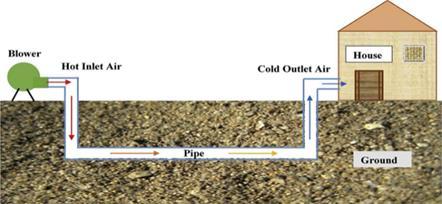
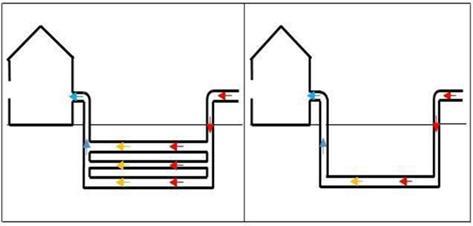
Figure 3. (a)multipletubesand(b)SingletubesETHE
1.2 Classifications of ETHE
(a)ClassificationofETHEAccordingtoThePassageofAir Flow:
I. Open system: Inanopensystem,theoutsideairisfirst heatedorcooledbysubterraneantubes,thenitentersthe building and is heated or cooled by a conventional air conditioner.Openloop,asFig.2-billustrates.
II. Closed system: Inthiscase,heatexchangersareburied horizontally, vertically, or obliquely. Heat is transported fromthesoiltoa heatpump,ortheotherwayaround, by the movement of a heat carrier medium inside the heat exchanger.sealedloop,asdepictedinFigure2-a.
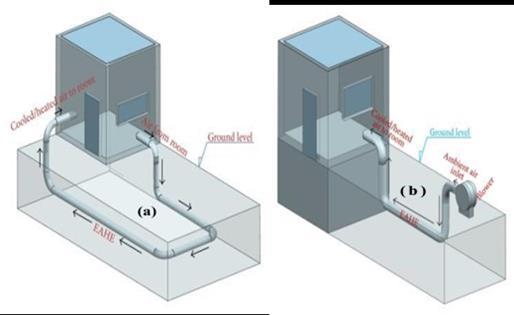
2. EATHE:(a)closedloopand(b)openloop[2]
(b) ETHE Classified according to buried tubes configuration.
1.Themulti-tubesasshowninFig.3-a.
2.SingletubeasshowninFig.3-b.
(c) ETHE classified according to the buried tubes assortment:
1.VerticalETHEasshowninFig.4-a.
2.HorizontalETHEasshowninFig.4-b.
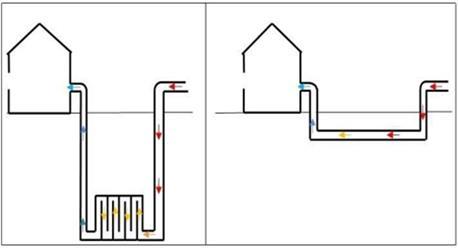
4. (a)Verticaland(b)horizontalETHE[2]
2. Literature Review
A scope study is a review of the literature. It serves as a guide while doing this analysis. It will provide some information regarding the use of CFD for Earth Air Heat Exchanger analysis. Numerous literature reviews have beenconductedsincetheproject'sinception.Theprimary sources for the project guides were books, research journals,andprintedoronlineconferencearticles.
Vikas Bansal, Rohit Misra, Ghanshyam Das Agrawal, Jyotirmay Mathur et al (2009) [3] This paper develops an implicit and transient model based on computational fluid dynamics to forecast the heating capacity and thermal performance of earth-air-pipe heat exchanger systems. The model is created within the simulation application FLUENT. The developed model is verified through experimental studies conducted on an experimentalsetuplocatedinAjmer,WesternIndia.These are their conclusions from the study. For the modeling of the EPAHE system, there is a reasonable degree of agreement between the simulation and experimental results, with a maximum deviation of 2.07 percent. It is discoveredthatasflowvelocityincreases,airtemperature rises decreases. This analysis leads to the conclusion that the buried pipe's material has no bearing on the EPAHE
International Research Journal of Engineering and Technology (IRJET) e-ISSN: 2395-0056
Volume: 11 Issue: 10 | Oct 2024 www.irjet.net p-ISSN: 2395-0072
system's performance. As a result, a less expensive pipe canbeusedinitsconstruction.
Trilok Singh Bisoniya et al (2015)
This paper describes a promising technique called the earth-air heat exchanger (EATHE), which works by preheating the air in the winter and cooling it in the summer, thereby reducing the building's heating and cooling load. The author has used a set of streamlined designequationstocreateaone-dimensionalmodelofthe EATHE systems in this work. Improved heat transfer calculation accuracy is achieved through the use of the earth'sundisturbedtemperature(EUT)methodand,more recently, correlations for the friction factor and Nusselt number. Equations have been developed that allow designerstodeterminetheEATHEsystem'slengthofpipe, pressure drop, convective heat transfer coefficient, and heat transfer. The EATHE system functions better when a longer, smaller-diameter pipe is buried deeper and has a slowerairflowvelocity.
Shashank Srivastava, Ashish Sherma, Ketan Ajay et al (2016) [6] The effectiveness of an earth tube heat exchangermodelbasedonCFDmodelingandsimulationis assessedforvariouspipe/ductgeometries.Theearthtube heat exchanger's cooling potential was found to have increased as a result of the corrugation geometry's eddy formations and increased internal surface area. The current Earth Air Exchanger can undoubtedly perform muchbetterifwecontinueinthisdirection.
Aashish sharma, Shashank Srivastava, Sanjeev Kumar, et al (2017) [7] The EATHE model's performance is estimated for various source/sink mediums using CFD modelingandsimulation.Itwasfoundthatthe earthtube heat exchanger's cooling potential greatly increases. This is because the medium-chosen materials have higher thermal properties. Throughout the section, different mediums display varying temperature drops. It is certain that if we proceed in this manner, the current Earth Air HeatExchangerwillperformfarbetter.
Description of CFD model:
A computer-based simulation technique called computational fluid dynamics (CFD) is used to study fluid flow, heat transfer, and related phenomena like chemical reactions. In this project, flow and heat transfer are analyzed using CFD. The following are some instances of application areas: aerodynamic lift and drag (i.e. aircraft orwindmillblades),combustioninpowerplants,chemical reactions, heating and cooling systems, and even biomedical engineering (which replicates blood flow throughveinsandarteries).Researchanddevelopment,as wellasthemanufacturingofaircraft,combustionengines, and numerous other products, rely on CFD analyses conducted across multiple industries. For many years,
researchers have used computational fluid dynamics (CFD) to study heat and mass transfer. Fluid flow problems can be solved numerically, which is how CFD codes are organized. It offers discretized numerical solutions to partial differential equations controlling heat transfer and airflow. This study used CFD software, FLUENT 6.3, to investigate the intricate airflow and heat transfer processes in an earth-pipe-air heat exchanger system.FLUENTpackageshavecomplexuserinterfacesto inputproblemparametersandviewtheresults,creationit simple to access the solving power of CFD codes. CFD codes in FLUENT contain three main elements: (i) a preprocessor,(ii)asolverand(iii)apost-processor.
Aflowproblemisinputintoa CFDprogramthroughpreprocessing, which includes defining the geometry of the computational domain the region of interest and grid generation,whichdividesthedomainintoseveralsmaller, nonoverlapping sub-domains a grid (or mesh) of cells, controlvolumes,orelements.Additionally,pre-processing includes choosing the physical and chemical phenomena that require modeling, defining fluid properties, and specifyingsuitableboundaryconditionsatcellsthattouch or coincide with the domain boundary. When solving the governing equations of fluid flow and heat transfer, the solveremploysthefinitecontrolvolumemethod.Utilizing graphs, animations, vector plots, contour plots, and other visual aids, the post-processor displays the simulation results.
Utilizing FLUENT, 3-D transient turbulent flow (standard k–emodel)wasconsidered intheCFDsimulations,which were heated to a maximum. With 20 iterations per step, the time step in this transient analysis is 100 s. The CFD analysis utilized a total of approximately 3.8 million control volumes. CFD analysis is performed for two distinct pipe materials, namely. both PVC and mild steel. This CFD study's primary goals were to find out how buried pipe material (PVC and mild steel were the two materials taken into consideration) affected the EPAHE system's performance as well as how air velocity affected it. Air was considered to be incompressible for the purposesoftheresearch.[4]
Thefollowing factorsarecrucial whendesigninganEarth TubeHeatExchanger(ETHE):
1.Tube Material: A number of important characteristics, suchasstrength,corrosionresistance,durability,andcosteffectiveness, must be taken into account when selecting thematerialforETHEpipes.
International Research Journal of Engineering and Technology (IRJET) e-ISSN: 2395-0056
Volume: 11 Issue: 10 | Oct 2024 www.irjet.net p-ISSN: 2395-0072
Table 1. Listoftubematerialshavebeenusedinthepast studies
Authors TypeofTube Materialused
Bansaletal.,
Ascionneetal.,
Sanusietal.,
Aziahetal.,
Jahkaretal.,
References
Ahmedetal.,
PVC,Metallic, Concrete
Polyethylene(PE), PVC,Brick,Clay
Polyethylene(PE), Copper,PVC
HighDensity
Polyethylene (HDPE),Galvanized Iron,Steel
PVC,PE,Concrete, Clay
PVC,Steel,Copper
Serageldinet al.,
2. Tube Length: The surface area of the pipe, which is established by its diameter and length, affects heat transfer.Greatersurfaceareafromalongertuberesultsin a faster rate of heat transfer and increased system efficiency. Optimizing the tube length is crucial because, beyondacertainlength,nomoresubstantialheattransfer takes place. Longer tubes may also result in higher pressure drops, which call for a greater amount of fan energytocounteract.
3. Tube Diameter: Lower diameter tubes generally perform better thermally but have higher pressure drops. Ontheotherhand,agreaterdiameterresultsindecreased airvelocityandlowerheattransferefficiency.
4. Tube Depth: Various factors, such as the composition ofthesoil,moisturecontent,andthermalcharacteristicsof thesoil,affecttheground'stemperature.
5. Nature of Soil:
The seasonally fluctuating inlet temperature and the tunnel-wall temperature, which also depends on the ground temperature, are the foundations of the EATHE performance. Therefore, the temperature and moisture distributionintheearth,inadditiontosurfaceconditions, indirectly affect the thermal performance of the EATHE system. From a thermal perspective, saturated soils are
ideal; deeper levels are therefore preferred as they offer colder winter temperatures and warmer summer temperatures; smaller pipes are more thermally efficient, i.e. they require larger installations and result in greater pressurelosses,buttheyalsoyieldahigherheatexchange perunitvolumeofair.
Table 2. SummaryofSiteCharacteristicsforvarious EATHESystemInstallations
Authors Weather types Locati on Typeof ground heat exchanger Applicat ion Refer ences
Bansal etal.
Jahkaret al.
Jahkaret al.
Ghosal and Tiwari.
Winter Winter Winter and summer Ajmer ,India Ajmer ,India Pilan a Rajast an India Premi ses ITT, Delhi, India
Earthair pipeheat exchanger (EAPHE)
Earth water heat exchanger (EHWE)
Earth water heat exchanger (EHWE)
EATHE
Bansal et al. [3] used experimental and computational fluid dynamics modeling with FLUENT software to investigate the impact of soil thermal conductivity on the thermalperformanceofanearthairtunnelheatexchanger under transient operating conditions in the primarily hot and dry climate of Ajmer, India. According to the findings, the maximum air temperature drops that could be achievedunder EATHE'ssteadystate operation for a 100meter pipe length were 18.4°C, 18.7°C, and 18.4°C, respectively, for soil thermal conductivities of 0°52, 2°0, and 4°0 Wm-1K-1. However, for soil thermal conductivity of 0.52, 2.0, and 4.0Wm-1 K-1, respectively, the maximum air temperature drops under transient conditions varied between18.3°Cand14.0°C,18.3°Cand17.2°C,and18.6°C and 18.0 °C for a 24-hour period of operation. This was caused by increased soil thermal conductivity, which improved the EATHE system's thermal performance even afteralongeroperatingperiod.
International Research Journal of Engineering and Technology (IRJET) e-ISSN: 2395-0056
Volume: 11 Issue: 10 | Oct 2024 www.irjet.net p-ISSN: 2395-0072
Air flow: Several studies were conducted to examine the effects of variable air velocities; the findings are outlined below.Ithasbeendiscoveredthatanincreaseinthemass flow rate of air causes the winter and summertime air temperatures in greenhouses to drop and rise, respectively. This may be caused by the air that has a shorter time in contact with the soil, causing lower thermalexchangeratebetweensoilandair.
Misra et al. [4] To investigate the impact of soil pipe diameter thermal conductivities, flow velocity, and time duration of continuous operation on the thermal performance of the earth air tunnel heat exchanger (EATHEsystem),atransientandimplicitnumericalmodel based on coupled simultaneous heat transfer and turbulent flow was developed. To study the impact on the transient performance of the EATHE system to work in long continuous operation, three different velocities 2.0 m/s, 5.0 m/s, and 8.0 m/s were selected, and the pipe diameter was maintained at 0.1 m for all different flow velocities. The outcome showed that the EATHE system's thermal performancedeclinedasa result of the increased flowvelocity.Thisisbecausemoreheatistransferredfrom the air to the soil per unit of time when the flow velocity increases.
4. Advantages and disadvantages of ETHE
Thefollowing are some advantages of theearth tube heatexchanger:
Itcanoperateinavarietyofsoiltypes.
Theoutlet air temperaturefor fully buried ETHE issolelydependentontheinletairtemperature.
Theinstallation'seaseofuse.
Theworkingfluidisair.
Requireslessmaintenancewithlowercosts.
Does not require it to operate inhigh windconditions.
Nopollution or greenhouse gasesbecause there isn'tasourceofcombustion[5].
Although of these benefits, it has the following disadvantages:
Thecostofinstallationishigh.
Reducedindoor air qualityas a result oftheheat exchanger'scondensationphenomenon and potentialforthegrowthofmicroorganisms.
Non-uniformoutletairtemperature;and
Local climate conditions in the presence of the earth's surface heat exchanger directly affect thethermalperformanceofETHE[5].
Around1.5to2metersbelowthesurface,thetemperature of the earth stays nearly constant. The term "earth's undisturbed temperature" refers to this steady temperature. In the winter, the unaltered temperature of the earth is always higher than the ambient air temperature, and in thesummer,the oppositeis true. The EATHEsystemneedstobedesignedinordertoeffectively use the earth's heat capacity. If the amount of heating or cooling that is achieved is insufficient, the EATHEs' outlet can be connected to a traditional air conditioner. Everywherethereisastrongemphasisonusingcleanand green energy to reduce conventional energy use and CFC emissions. By preheating air for heating various types of buildings in the winter and vice versa in the summer, EATHE systems can significantly reduce energy consumption. As a result, it is crucial to optimize the design, model, and test EATHE systems. Numerous calculation models that mimic the thermo-physical behavior of earth-air heat exchangers can be found in the literature.Awell-designedEATHEcancutatypicalhouse's electricityuseby30%.
EATHE systems, which have been widely used for years, provide reductions in the heating and cooling load of buildings, power consumption, CFC and HCFC consumption, and greenhouse gas emissions. Generally speaking, the EATHE system's thermal performance rises aspipelengthandburialdepthincrease,butperformance tends to decrease as pipe diameter and air velocity increase. Whenit comesto theuseof EATHEsystems,the UnitedStatesandEuropeleadtheglobe.Theperformance of the EATHE system can be further enhanced by combining its hybrid systems with renewable energy sources like solar and wind power. It is possible to draw theconclusionthateffectiveEATHEsystemuse,alongwith practical energy sources and cutting-edge technology, will becrucialtoreducingenergyconsumptionandprotecting the environment both in India and globally. According to theauthors,scientistsandresearchersworkinginthefield of passive heating and cooling of buildings, particularly withtheuseofEATHEsystems,willfindgreatvalueinthis reviewpaper.
[1] Belloufi, Y., Brima, A., Zerouali, S., Atmani, R., Aissaoui, F., Rouag, A., Moummi, N. (2017). ″Numericalandexperimentalinvestigationonthe transient behavior of an earth air heat exchanger in continuous operation mode″. International JournalofHeatandTechnology,35(2):279-288.
[2] Ali, S., Muhammad, N., Amin, A., Sohaib, M., Basit, A., Ahmad, T. (2019). ″Parametric optimization of earthtoairheatexchangerusingresponsesurface method″.Sustainability,11(11):3186.
International Research Journal of Engineering and Technology (IRJET) e-ISSN: 2395-0056
Volume: 11 Issue: 10 | Oct 2024 www.irjet.net p-ISSN: 2395-0072
[3] BansalV,MisraR,AgarwalGDandMathurJ,2013 Transient effect of soil thermal conductivity and durationofoperationonperformanceofEarthAir TunnelHeatExchanger.AppliedEnergy.pp1-11
[4] Rohit Misra, Vikas Bansal, Ghanshyam Das Agrawal, Jyotirmay Mathur, Tarun K. Aseri; CFD analysisbasedparametricstudyofderatingfactor for Earth Air Tunnel Heat Exchanger; Applied Energy103(2013)266–277.
[5] Nasreddine Sakhria et. al (2020). ″Earth to Air Heat Exchanger and Its Applications in Arid Regions - An Updated Review″. TECNICA ITALIANAItalian Journal of Engineering Science, Vol.64,No1
[6] ShashankShirvastava,AshishSharma,KetanAjay; CFDbasedstudyonanEarthpipeheatexchanger withdifferentgeometries(2016)
[7] shish sharma, Shashank Srivastava, Sanjeev Kumar; Heat Transfer analysis of source/sink of an Earth tube heat exchanger by CFD modeling andsimulation(2017)1260-1271.
[8] BansalV,MisraR,AgrawalGDandMathurJ,2009 Performance analysis of earth-airpipe-air heat exchanger for winter heating. Energy and Buildings.pp1151-1154
[9] Ascione F, Bellia L and Minichiello F, 2011 Earthto-air heat exchangers for Italian climates. RenewableEnergy.pp2177-2188
[10] Sanuzi,AliyahNZ,andIbrahimMN,2013Passive groundcoolingsystemforlowenergybuildingsin Malaysia (hot and humid climates). Renewable Energy.pp.193-196
[11] Mohd, Noor A, Aliyah N Z, Sanusi and Aminuddin M, 2014 Materials for earth air pipe heat exchanger (EAPHE) system as a passive ground cooling technology for hothumid climate. International Conference on Emerging Trends in Scientific Research, Pearl International Hotel (KualaLumpur)
[12] Jakhar S, Soni M S and Gakkhar N, 2016 Performance analysis of earth water heat exchanger for concentrating photovoltaic cooling. EnergyProcedia.pp145-153
[13] Ahmed S, Amanullah M, Khan M, Rasul M and Hassan N, 2016 Parametric study on thermal performance of horizontal earth pipe cooling system in summer. Energy Conversion and Management.pp324-337
[14] Serageldin A, Abdelrahman A K and Okawara S, 2016 Earth-Air Heat Exchanger thermal performance in Egyptian conditions: Experimental results, mathematical model, and ComputationalFluidDynamicssimulation.Energy ConversionandManagement.pp25-38
[15] GhosalMK,TiwariG,DasDandPandeyKP,2005 Modeling and comparative thermal performance of ground air collector and earth air heat
exchanger for heating of greenhouse. Energy and Buildings.pp613-621
[16] Jakhar S, Misra R, Soni M and Gakkhar N, 2016 Parametric simulation and experimental analysis of earth air heat exchanger with solar air heating duct. Engineering Science and Technology. pp 1059-1066
[17] Jahkar S, Soni M and Gakkhar N, 2016 Performance analysis of earth water heat exchanger for concentrating photovoltaic cooling. EnergyProcedia.pp145-153