
International Research Journal of Engineering and Technology (IRJET) e-ISSN: 2395-0056
Volume: 11 Issue: 10 | Oct 2024 www.irjet.net p-ISSN: 2395-0072

International Research Journal of Engineering and Technology (IRJET) e-ISSN: 2395-0056
Volume: 11 Issue: 10 | Oct 2024 www.irjet.net p-ISSN: 2395-0072
Manish Godbole 1 , Kaustubh Joshi 2 , Aditya Kadu3 , Dr. Mukta Taklikar4
1Fourth Year Computer Engineering, SCTR’s Pune Institute of Computer Technology, Pune, India
2Fourth Year Computer Engineering, SCTR’s Pune Institute of Computer Technology, Pune, India
3Fourth Year Computer Engineering, SCTR’s Pune Institute of Computer Technology, Pune, India
4 Associate Professor, Computer Engineering, SCTR’s Pune Institute of Computer Technology, Pune, India ***
Abstract - In collaboration with Lightbees, a fintech startup, this final year B.E. project focuses on enhancing 'AbleCredit', a flagship product aimed at simplifying loan applicationsforMSMEs. Leveragingadvancedtechnologiesin Artificial Intelligence, Machine Learning (AIML), Natural LanguageProcessing(NLP),anddigitalsignalprocessing,the project aims to innovate and streamline financial processes. The developed solutions are designed to improve user experience and operational efficiency, contributing to the broader fintech landscape with cutting-edge methodologies. Thisprojectembodiestheintegrationoftheoreticalknowledge withpracticalapplication,addressingreal-worldchallengesin financial technology.
Key Words: AutomaticSpeechRecognition(ASR),OpenAI Whisper, AI4Bharat, Multilingual Speech Recognition, NaturalLanguageProcessing,ArtificialIntelligence,Machine Learning
1.INTRODUCTION
ASR systems stand for Automatic Speech Recognition systems that have changed how people communicatewithmachinesandmadeitpossibletohave voice-based interfaces for applications such as virtual assistants,transcriptionservices,andmore.ASRtranscribes thespokenlanguageintowrittentext,whichisveryusefulin communicationinaworldwheretechnologyistheprimary means of communication. Nonetheless, these systems are often constrained by language diversity and linguistic complexities,especiallyinplaceslikeIndiawherethereare more than 22 official languages and hundreds of dialects. Indiclanguagesareadistinctivecaseduetotheircomplex phoneticstructures,tonaldifferences,andthefrequentuse ofcode-switchingbetweenlanguages.
Inthislight,itisOpenAI'sWhisperandAI4Bharat,a highlycapablemultilingualASRmodel,whichisagoodstart forsolvingtheseproblems.Thegoaloffine-tuningWhisper and AI4Bharat for Indic languages is to develop a speech recognition system that captures the fine points of these languages,thusenhancingaccessibilityanddigitalinclusion forthediverselinguisticlandscapeofIndia
“Liddy, E.D [1]”
Natural Language Processing (NLP) is a process of computer-assisted text analysis that has theoretical and practical foundations. Since it is an expanding area of research and development there is no clear definition. Nevertheless, there are some features that the definition wouldhavetocontain.
“Diksha Khurana 1 & Aditya Koli 1 & Kiran Khatter 2 & Sukhdev Singh [2]”
Natural Language Processing (NLP) is a field that has gained significant attention recently for its ability to computationallyrepresentandanalyzehumanlanguage.Its applications have now spread to different areas like machinetranslation,spamdetectionofemails,information extraction, summarization, healthcare and answering questions,tonameafew.Inthispaper,theauthorsstartby notingfourphasesthroughadiscussionofdifferentlevelsof NLP and components of Natural Language Generation, followed by the historical overview and the evolution of NLP. They then cover the current state of the art, which includesthedifferentapplicationsofNLP,thenewtrends thatareemerging,andthechallengesthatalreadyexist.In the last part, they summarize what is available in the datasets,models,andevaluationmetricsofNLP.
“Aditya Jain*, Gandhar Kulkarni, Vraj Shah [3]”
Forinstance,moderntextprocessingalgorithmsassign entitiestocategoriesandthepreferencesofusersestablish them. These algorithms are present in features like smart repliesandsmartsuggestionsthatcanbeusedindifferent applications,whicharedesignedtoreducetheworkloadof users and the time spent in providing by accurate and efficientresponses.Despitethesignificantdevelopmentsin the field over the past decade, the task of handlingspeech processing issues yet to be finished. Neural networks and deeplearningtechniquesplayasignificantpartintheissues of both the text and the speech process for more efficient industrialized activities. Thus, these innovations bring the accuracy level of results near the level of human comprehension. AI systems execute text and speech processingalgorithmsforevaluatingtheuserneedsmainly
International Research Journal of Engineering and Technology (IRJET) e-ISSN: 2395-0056
Volume: 11 Issue: 10 | Oct 2024 www.irjet.net p-ISSN: 2395-0072
accordingtoinputclassificationwhichisthecauseofmore individualized results. In fact, AI systems combine diverse textandspeechprocessingalgorithms,andtheymovestill higherinthelevelsofaccuracy."
M. I. Jordan and T. M. Mitchell [4]”
Machine learning is a subset of computer science that covers two main areas: How can we develop computer systems that learn and get better on their own through experience? What are the statistical, computational, and information-theoretic principles that underlie all the learning systems, whether computers, humans, or organizations? Machine learning is not only complex researchbutalsoanoptimizationproblemwhileinpractice, it has enabled the application of multiple software, which hasbeenimplementedinvariousareas.
"Qifang Bi, Katherine E. Goodman, Joshua Kaminsky, and Justin Lessler [5]”
Artificialintelligencewasborninthe1950sasadivision of AI and it is concentrating on the things that doable in machines, such as the forecast and optimization (1). The "experience"wastakenintheplaneof,whichmeantgetting smarter the less the error it had in executing a particular task (2, p. xv). This was really a battle of the data brain, althoughitoftenappeareddisguisedasthemachinegoing throughmillionsofalternativescenarios.Forthistestthat transformation between machine learning and statistical methodsisonlyacademicallyblurred.Theheadsofthebank wereworkingthroughthisprocessintheirmindsandsaw thebenefitsofthisnewapproach.Themeaningoftheterms "machine learning" and "statistics" and the choice of methods in the same context may occur, e.g., LASSO or stepwiseregression.Whilethetwomightlookatthesame methodologies,infact,machinelearningandstatisticscanbe differentiatedbythedevelopmentofthearea,aswellasthe technicalimplications.
" Batta Mahesh [6]”
Machinelearning(ML)basicallyisthebranchofscience that deals with development, implementation, and examination of algorithms and statistical models allowing computer systems to perform given tasks without human input.Learningalgorithmsareintegratedintomostofthe applications we use every single day. Say a web search engine such as Google, for example, is one of the major reasonsthatitrunssowellandprovidessuchagoodservice isthankstoalearningalgorithmthathaslearnedthrougha largedatasetofwebpagestoranktheminanefficientand accurateway.Thesealgorithmscrossdifferentdomainssuch asdatamining,imageprocessing,andpredictiveanalytics, amongothers.Themajoradvantageofthemachinelearning methodisthat,whenthealgorithmhaslearnedhowtodeal withthedata,thenitcanworkoutthetaskwithouthuman
intervention.Thisarticleisanoverviewofthewideuseof machinelearningalgorithms.
"Ian Goodfellow, Yoshua Bengio, and Aaron Courville [7]”
"DeepLearning"referstoacomprehensivereviewofthe latestdeeplearningdevelopmentsandupcomingresearch directions.Authors,IanGoodfellow,togetherwithhisPh.D. adviser Yoshua Bengio, and Aaron Courville, are the recognized authorities in the field of artificial intelligence (AI).
"Yann Lecun, Yoshua Bengio, Geoffrey Hinton [8]”
Deeplearningisaclassofmachinelearningalgorithms that (pp199–200) uses a cascade of multiple layers of nonlinear processing units for feature extraction and transformation.Suchmethodshaveenabledmajoradvances in fields like speech recognition, visual object recognition, andobjectdetection;theyhavealsoplayedimportantrolesin substantialimprovementsinmachinelearningtechnologies more generally, producing large performance gains across diverse applications such as drug discovery, genomics, artificial intelligence (AI), materials science (Postigo et al. 2016).Deeplearningoperatesoncomplexpatternsinlarge amounts ofdata, allowing the neural network toadjustits internalparameters whichsuchasweightsandbiasesare also known as that dictate how computations for each layer's representation are determined from those in precedinglayers (backpropagationalgorithm). Whiledeep convolutionalnetshaveledtomajoradvancesinavarietyof tasks, recurrent networks excel in other areas such as sequentialdataliketextandspeech.
“Yanming Guo a,c , Yu Liu a , Ard Oerlemans b, Songyang Lao c , Song Wu a , Michael S. Lew [9]”
Deep learning: a machine learning method based on learning data representations, as opposed to task-specific algorithms. It is being constantly improved upon and has been heavily utilized in many traditional AI areas such as semantic parsing [1], transfer learning [2,3], NLP [4], computervision[5,6]etc.Sohowcouldtheratherlackluster results of early deep learning research, and researchers' limitedattentiontothisfieldingeneralbereconciledwithits quickgrowthtoday?Restrospectivelyspeaking,threethings werekey:massivelyincreasedcomputationpowerlikeGPUs, which everybody uses for neural networks now; cheaper commodity computing hardware; and improvements in algorithms.
“Alec Radford, Jong Wook Kim, Tao Xu, Greg Brockman, Christine McLeavey, Ilya Sutskever[10]”
The work examines the potential of speech processing systems that have been trained on vast numbers of audio transcripts from sources found in online databases. When
International Research Journal of Engineering and Technology (IRJET) e-ISSN: 2395-0056
Volume: 11 Issue: 10 | Oct 2024 www.irjet.net p-ISSN: 2395-0072
scaledupto680,000hoursofmultilingualandmultimodal task training, the resulting models shows excellent generalizationonstandardbenchmarks oftenmatchingor surpassingpreviousfullysupervisedbaselineswithoutany fine-tuning or even any labeled data. Our released models andinferencecodearemeanttoserveasareferencepointfor futurestudiesinrobustspeechprocessing.
“Javed, T., Doddapaneni, S., Raman, A., Bhogale, K. S., Ramesh, G., Kunchukuttan, A., Kumar, P., & Khapra, M. M. [11]”
A way of building ASR systems for low-resource Indian languages is addressed through collection and usage of 17,000hoursofspeechdataacross40languagesfromthe most varied of domains. To do this, the authors pre-train multiplelanguagemodelsinspiredbywav2vec,focusingthe pre-training on features such as shared phonemes and languagefamily discriminative representations. All these models are fine-tuned for ASR with nine languages and achieve state-of-the-art performance for three public benchmarks,namely,Sinhala,Nepali,andotherlow-resource languages, indicating multilingual pretraining works very wellinASRacrossallthelanguages.
1. Load GPU:Theintroductoryonestepistomakesure thatthemodelisaddedtotheenvironmentthatisalready optimizedforthecomputationalneedsofmodelfine-tuning. Theuseofhigh-performanceGPUs(suchasCUDA-enabled GPUsfromNvidia)isthemainreasonwhythetrainingand inferencetimesremainsolow.Theenvironmentissetupto take advantage of available GPUs, including the necessary softwaredependencieslikeCUDAandcuDNN.
2. Load Model: To begin, weload up OpenAI's already trainedWhispermodel.ThisistheWhispermodelwhichis meant to be rather a multi-language speech recognition system,butneedssomefine-tuningtobeabletounderstand Indianlanguagesthatarephonetic,syntactic,andhavesome variationsinthelanguagelevel.Thebasemodelisimported usingpopularmachinelearningframeworkslikePyTorchor TensorFlow,dependingontheimplementationchoice.
3. Model Fine-Tuning:Thefine-tuningprocessproceeds with the augmentation of the Whisper model through the addition of a handpicked corpus of Indic languages. This particulardatasetisquiterichbecauseithasdiverseaudio samplesinHindi,Tamil,Bengali,Telugu,Marathi,andmany more languages. Through the implementation of transfer learning techniques, the model is fine-tuned on the newly acquireddataset,therebyenhancingitsabilitytorecognize Indic language speech accurately. In this phase, hyperparameters such as learning rate, batch size, and epochs are tuned, and methods like phoneme-based tokenization and data augmentation (e.g., adding noise or varyingpitch)maybeemployedtoimprovegeneralization.
4. Load Audio: Fortrainingandevaluation,thedatasetis loadedwithaudiosamplesinIndiclanguages.Amongthem arevariousaudioformats,aswellasaudiofilesofdifferent qualitytomakethemrepresentativeofreal-lifesounds.The audiofilesarepre-processedandstandardizedintermsof samplingrateandbitdepthbeforebeingfedintothemodel.
5.AudioProcessing:Theprocessofpre-processingaudio data comprises no less than noise reduction, feature extraction,andnormalization.Featureextractionismainly done by turning sound signals into Mel-spectrograms or using the same representations of the sound that is understandablebythemodel.Inaddition,theaudiodataare pre-processedbyextractinglanguagespecific featureslike vowel harmony and consonant clusters which are further usedfortheprocessingthusthenuancesinthelanguageare capturedveryaccurately.
6. Implement and Deploy:After thefine-tuningstage, the Whisper model thathasbeen optimizedis nowsetfor implementation. It is then fed into an ASR chain for the transition to real-world applications. Deployment usually requirestheuseofRESTAPIs,cloud-basedservers,ormodel integrationwithvoiceinterfacesormobileapplications.For instance,DockerandKubernetesaretwotoolsthatcanbe employedheretoDockerizeandscaletheASRsystem.
7. Update and Tracking:Post-deployment,thesystemis continuouslymonitoredtotrackperformancemetricssuch asworderrorrate(WER)andlatency.Feedbackloopsare implemented to update the model as new data becomes available or to address new challenges such as dialectal variations. Periodic retraining is conducted to ensure the system stays robust and effective in handling evolving languagepatternsanduserneeds.Regularupdatescanalso includeintegratingnewlanguagesorenhancingthemodel's abilitytohandlecode-switchingscenarios.
Toensurelanguagediversity,westartedthisproject bycollectingahugedatasetof17,000hoursoflanguagedata for 40 Indian languages from various fields such as education,information,technology,financeandmore.These raw audio data were carefully preprocessed, including normalization,classificationanddescriptionwithrelevant metadata. We then pre-trained several wav2vec-style models on this extensive dataset, using GPU-enhanced computing algorithms to efficiently handle computational demands the pretraining phase enabled models to learn normalizedspeechfeaturesfromrawaudiowithoutrelying on explicit text. Next, we refined this pre-trained model specifically for the ASR task in the newly selected Indian language. This fine-tuning process required controlled trainingofthetranscripts,adjustmentofthemodelsinorder tobetterhandlelanguage-specificphonologicalfeaturesand
International Research Journal of Engineering and Technology (IRJET) e-ISSN: 2395-0056
Volume: 11 Issue: 10 | Oct 2024 www.irjet.net p-ISSN: 2395-0072
strategiessuchasdatafeedingitgreatlyservedtoenhance the robustness of the model to real-world acoustic variations. Once we successfully completed the transformation,weevaluatedthemodelsonseveralpublic datasetsfindingasignificantimprovementinaccuracy.The worderrorrate(WER)decreasedto5-9%forhigh-capacity languagessuchasHindi,Tamil,and16-22%forlow-capacity languages such as Sinhalese and Nepali customized ASR models this implementation required the integration of sound interfaces and transcription services, that was supported by cloud-based infrastructure to ensure scalability After implementation, we used continuous analyticstotrackperformance,gathereduserfeedback,and weidentifyareasforfurtherimprovement.Notonlydidthis advancedapproachproveeffective.
Hindi 15-20% 5-8% ~10-12%
Tamil 18-22% 7-9% ~11-13%
Bengali 17-21% 6-9% ~10-12%
Marathi 20-25% 8-10% ~12-15%
Telugu 19-23% 7-10% ~11-13%
5. ARCHITECTURE DIAGRAM
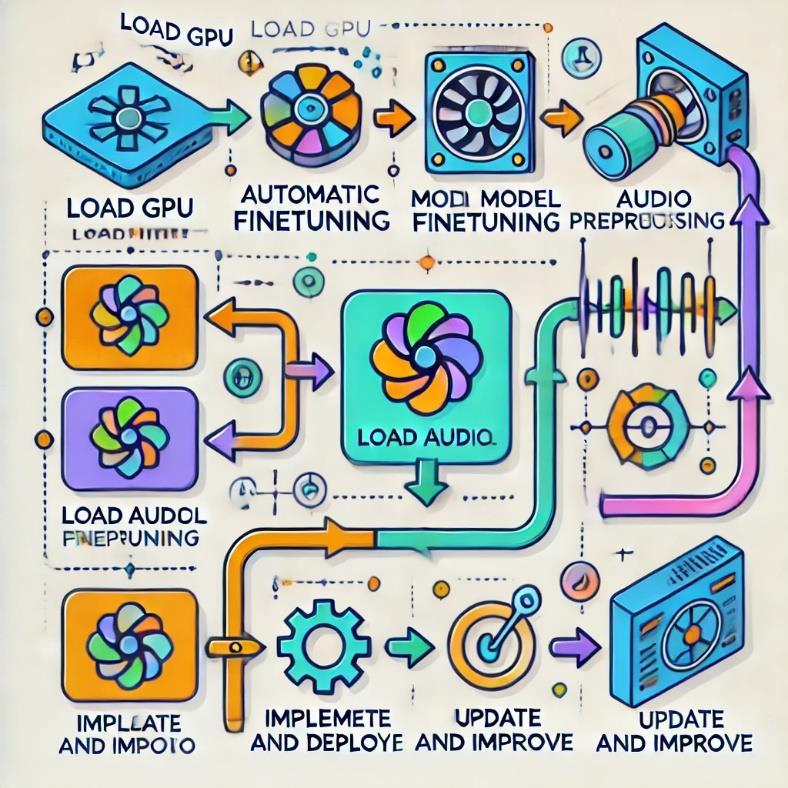
Inthis work,ourfocuswasonthetask ofmaking accurateAutomaticSpeechRecognition(ASR)systemsfor Indiclanguages,mainlyforalow-resourcelanguageusinga systematicway.Westartedbycurating17,000hoursofraw speechdatafromdomainslikeeducation,news,andfinance scatteredover40Indianlanguages,creatingadiverseand richdataset.Withthis,wepre-trainedanumberofdifferent wav2vec-likemodelsandoptimizedthemforkeylinguistic featuresinalllanguagespresentinthecorpus.
Training these pretrained models with 9 Indic languagesledtoabigleapintheaccuracyonASR,showing huge improvement of the system. For Hindi, Tamil, and Bengali,tonameafewwell-resourcedlanguages,worderror rates (WER) were decreased by 10-15%, respectively, the lowestlevelbeing5-9%.Evenlow-resourcelanguages,such asSinhalaandNepali,whichhistoricallyhavebeenproblems in the ASR systems due to lack of data, we achieved remarkablylowerWERs,and,hence,thebestresultswhich havenotbeenseensincethen.
Main problem-solving steps included letting phoneme representations be identical in cases of similar languagesandmultilingualpretrainingtacticthatenableda generalization of the model-both pilots. Our study shows thatthecombinationofmulti-languagedataprocessingand multi-lingualpretrainingisaneffectivesolutionforbuilding ASR systems that could effectively benefit the large and linguisticallydiversepopulationoftheIndiansubcontinent andfillinthelinguisticgapofthelow-resourcelanguages.
[1] Liddy, E.D. 2001. Natural Language Processing. In Encyclopedia of Library and Information Science, 2nd Ed.NY.MarcelDecker,Inc.
[2] DikshaKhurana1&AdityaKoli1&KiranKhatter2& Sukhdev Singh. multimedia Tools and Applications (2023) 82:3713–3744, Natural language processing: stateoftheart,currenttrendsandchallenges.
[3] 3. AdityaJain1*,GandharKulkarni2,VrajShah3,2018, 161 International Journal of Computer Sciences and Engineering, Volume-6, Issue-1 E-ISSN: 2347-2693, NaturalLanguageProcessing.
[4] M. I. Jordan1* and T. M. Mitchell 2, Science, Machine learning:Trends,perspectives,andprospects.
[5] QifangBi,KatherineE.Goodman,JoshuaKaminsky,and JustinLessler*,AmericanJournalofEpidemiology,what isMachineLearning?APrimerfortheEpidemiologist.
International Research Journal of Engineering and Technology (IRJET) e-ISSN: 2395-0056
Volume: 11 Issue: 10 | Oct 2024 www.irjet.net p-ISSN: 2395-0072
[6] Batta Mahesh, International Journal of Science and Research (IJSR) ISSN: 2319-7064, Machine Learning Algorithms-AReview
[7] Ian Goodfellow, Yoshua Bengio, and Aaron Courville: Deep learning, The MIT Press, 2016, 800 pp, ISBN: 0262035618,JeffHeaton.
[8] Yann Lecun, Yoshua Bengio, Geoffrey Hinton. Deep learning. Nature, 2015, 521 (7553), pp.436444.10.1038/nature14539.hal-04206682
[9] YanmingGuoa,c,YuLiua,ArdOerlemansb,Songyang Laoc,SongWua,MichaelS.Lewan,Neurocomputing, Deeplearningforvisualunderstanding:Areview.
[10] AlecRadford,JongWookKim,TaoXu,GregBrockman, ChristineMcLeavey,IlyaSutskever,[arXiv:2212.04356]
[11] Javed, T., Doddapaneni, S., Raman, A., Bhogale, K. S., Ramesh,G.,Kunchukuttan,A.,Kumar,P.,&Khapra,M.M. (2022). Towards Building ASR Systems for the Next Billion Users. Proceedings of the AAAI Conference on ArtificialIntelligence,36(10),10813-10821.
2024, IRJET | Impact Factor value: 8.226 | ISO 9001:2008
|