
International Research Journal of Engineering and Technology (IRJET) e-ISSN: 2395-0056 p-ISSN: 2395-0072
Volume: 11 Issue:10 | Oct 2024 www.irjet.net

International Research Journal of Engineering and Technology (IRJET) e-ISSN: 2395-0056 p-ISSN: 2395-0072
Volume: 11 Issue:10 | Oct 2024 www.irjet.net
Rishya Shringhan Ravichandran
Abstract - The principal objective in manufacturing operations is maximizing output with minimal workforce exertion, ensuring to achieve the desired product and target quality. In manufacturing, the optimization of operation efficiency and productivity of a product is a prevailing issue. To enhance the productivity among several manufacturing units, the motion and time study strategy is employed. This technique is used to determine the most efficient approach for executing repetitive tasks and to accurately measure the time required by an average operator to complete a task within a standardized work environment. In every manufacturing industry, optimizingassembly line configurations is important for productivity augmentation. The objective ofthis paper is to analyze the implementation of motion critically and time study methodologies on 2-station and 3-stationassemblylines and their effects on productivity enhancement. The pre-and post-application of motion and time study techniques have been assessed, presenting a detailed comparison of process outcomes. The findings reveal a remarkable 30.86 % increase in average productivity. Thus, it can be inferred that time study serves as an effective tool for enhancing productivity in manufacturing processes.
Key Words: Productivity Enhancement, Motion and Time Study, Operation Efficiency, Manufacturing Operations
1.
Assembly lines are well-planned production systems designed to accommodate the increase in demands of society. The growing demand for product diversity and shorter product life cycles has led to the replacement of traditional manufacturing methods with well-designed assembly lines. The goal of the system is to achieve highvolumeproductionatacceleratedrates,optimizeefficiency, andensureaguaranteeofstringentqualityguidelines.
An assembly line is an array of workstations that are sequencedstrategicallyalongaconveyormechanism.Each workstation is assigned specific operations within predefined constraints. The bottleneck is the cycle time, definingthe timespanbetweenthetwofinishedunitsorthe maximumallowedtimeforfabricatinganyworkpieceata designated workstation. The effectiveness of product or serviceefficacyistypicallydeterminedthroughdetailedtime studies, adherence to time standards, utilization of work sampling methods, and analysis of operator’s feedback. Thesemethodologieshighlighttheimportanceoftimeasa
fundamental metric in organizational performance and operationalefficiency.
F.W.Taylor[1],theprogenitorofmoderntimeandmotion study methodologies, commenced his time study research in 1881. Despite facing significant criticism initially, the techniquehasprogressivelygainedwidespreadacceptance asafundamentalmethodforworkmeasurementintechnical contexts. Womack et al. (1990) [2] extrapolated from the highly efficacious Toyota Production System, emphasizing thesystematiceradicationofallformsofwastetooptimize operationalefficiency.
Krafcik (1998) [3] elucidates the Japanese manufacturing paradigm championed by Toyota, characterized by a spectrum of methodologies such as Just-In-Time (JIT) inventorysystems,Kaizen-drivencontinuousimprovement, andtheimplementationofqualitycircles.Niebel(1988)[4] positsthattheexclusivemethodforabusinessorenterprise to attain growth and amplify profitability is through the enhancement of productivity across all operational dimensions, including sales, finance, production, engineering, cost management, maintenance, and organizationaladministration.
Imad Alsyouf (2007) [5] demonstrated the impact of a robust maintenance policy on the productivity and profitability of manufacturing processes. Additionally, the studyhighlightedtheinfluenceofproductivitychangeson profitability,distinctfromtheeffectsofuncontrolledfactors such as price recovery. As per Atkinson et al. (1995) [6], productivityisquantifiedastheratioofthemonetaryvalue of outputs (produced goods or services) to the monetary valueofinputresources(includingwages,equipmentcosts,) and similar expenditures utilized in the production process.
S. Vijaya Kumar et al. [7] undertook a study to optimize production planning and process efficiency at an impeller manufacturing facility. The goal was to minimize CNC machining time for impellers, and vital components in centrifugal pumps, employing Overall Equipment Effectiveness (OEE) strategies. Additionally, the author implemented quick changeover techniques to streamline setup times for standardized products using the OEE methodology. The outcome demonstrated a 4.4% performanceboostandasignificant47%reductioninsetup timesforcertainimpellertypes.
Volume: 11 Issue:10 | Oct 2024 www.irjet.net
International Research Journal of Engineering and Technology (IRJET) e-ISSN: 2395-0056 p-ISSN: 2395-0072
OdiorandOyawale[8]conductedacasestudyfocusingon the development and implementation of a time study model in a rice milling firm. The findings reveal that a direct correlationbetweenthemillingtimefora50-kilogramrice bag,thenumberofproductionstages,andthetimeallocated to each stage. The study underscores the importance of employing time study models for effective employee monitoring and control. It also highlights the influence of uncontrollable factors like erratic electricity supply, raw materialshortages,andfrequentmachinebreakdownsdue toagingequipmentonproductivity.PrajapatiD.R[9]applied time and motion study techniques to enhance crane hook forging productivity in a northern Indian industry. Their findingssuggestapotential107%productivityincreasewith properimplementationofthesemethods.
Various researchers have proposed an ideal OEE range, typically falling between 60% and 70% [10] and [11].
Hemant Singh Rajuput et al. [12] utilized time study methodologies in a manufacturing setting, demonstrating that the implementation of Total Productive Maintenance (TPM) can elevate the Overall Equipment Effectiveness (OEE) of shot Peening Machines from 66.4% to 85%.
ParshettySiddheshwar[13]utilizedTimeandMotionstudy techniquestoboostproductioninsmallscaleindustries.By analyzingandadjustingmachiningtimesbasedonstandard timecalculations,productivitysurgedby19.16%.
Abdul Talib Bon [14] applied time and motion study techniquesina rice processing companyinSabah.Thestudy successfully established the standard time for manpower involvedinriceprocessing,reducingitfrom3.39hoursto 3.21 hours, a 5.31% improvement. Data analysis was conducted using Stat Fit and Pro Model software, with recommendationsmadeforalternativespaceutilizationin storage,cleaning,andpackagingareas.AnnHendrichetal. [15]conductedastudyfocusedonaugmentingtheefficiency and effectiveness of nursing care, vital for hospital operationsand ensuring patientsafety. They utilized time andmotionstudymethodologiestometiculouslydocument nursestimeutilization,aimingtopinpointinefficienciesin nursing workflows and unit design. The study highlighted threeprimaryareasforenhancingnursingcare efficiency: optimizing documentation practices, streamlining medication administration procedures, and refining care coordinationprotocols.
Intheongoinginvestigation,timestudymethodologieswere implemented to optimize the productivity of a manufacturingassemblyline.Thisfacilitymanufacturesroof rails and assembles in two workstations for one of the leadingautomotivecompaniesintheUSA.
Timestudyisastandardworkmeasurementapproach extensivelyusedinrepetitivemanufacturingindustries[16].
Procedure :
(i). Select: Identify the specific job or operation to be timed
(ii). Define: Breakdownthetaskintoindividualelements suitableforprecisetiming
(iii). Obtain and Record: Gathercomprehensivedetails abouttheoperator,jobspecifications,methodologies,and workingconditions.Documentallrelevantinformation
(iv). Observe: Monitorthetaskandrecordthetimetaken for each element using a stopwatch or time study software
(v). Extend: Converttheobservedtimeintonormaltime (basictime)byapplyingperformanceratings
(vi). Measure: Evaluate and assess the performance rating and time duration for each element to ensure accuracy
(vii). Compute: Calculatethestandardtimefortheentire operation by summing the normalized times for all elementsandconsideringallowances
(viii). Determine: Establish relaxation and personal allowances to adjust the standard time, ensuring it reflectsrealisticworkingconditions
(ix). Review and Validate: Verify the accuracy and consistencyoftherecordedtimesandcalculatedstandard timethroughrepeatedobservationsandanalysis
(x). Document and Implement: Prepare a detailed report of the time study findings and implement the optimizedstandardtimesintheproductionprocess
Method study entails the systematic documentation and critical evaluation of current and prospective work methods tofostertheadoptionofmoreefficientpracticesandcostsavingmeasures[17].
Procedure:
(i). Selecting the work: Identify the specific work or processtobestudied
(ii). Recording Current Methods: Recordand document theexistingmethodsusedinperformingthework
(iii). Examining the Methods: Analyzeandreviewthe recordedmethodstoidentifyinefficiencies,bottlenecks, andareasforimprovement
(iv). Developing Improved Methods: Brainstormand develop alternative methods or procedures that can improve efficiency, reduce waste, and enhance productivity
(v). Implementing Changes: Test and apply the new methodsorproceduresina controlledenvironmentto assesstheireffectiveness
(vi). Maintaining and Monitoring: Monitorandmaintain the improved methods, gather feedback from workers, and make necessary adjustments to ensure sustained improvementovertime.
Thedesignlayoutshownbelowisanassemblycellofthe roof rail. It’s a 3 station layout that comprises operator 1, operator2,andarobotstation.Figure1showsthe3-station assemblycellwith2operatorsandarobotstation.
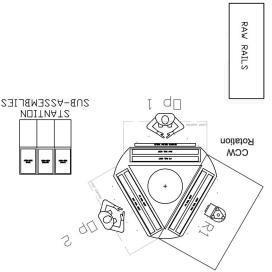
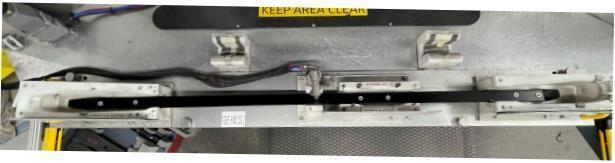

Theoperator 1takestherawroofrail from thestandand fixes on the jig fixture to install a screw to support the stanchionswhichisshowninfigure2.Then,theroofrailis transferredtotheoperator2.Theroofrailstransfertothe next station by rotating the whole table in the counterclockwise direction. The operator 2 fixes the stanchiononallthesideswhichisshowninfigure3.Again, thetablerotatestotherobotstationtoinstalltherivnutsto tightenthestanchionsontheroofrail.The3stationassembly cellfacedsomeissuesattherobotstationastherobotfailed to maintain the accuracy to drill the riv nuts at the hole positionontheroofrail.Duetothis,thetargetnumberofroof rails assembled is missed and the operation done by the robotisconsideredasabottleneck.
Toovercomethebottleneckinthe3stationassemblycell,an alternative 2 station assembly cell eliminating the robot operationisimplemented.
e-ISSN: 2395-0056 p-ISSN: 2395-0072
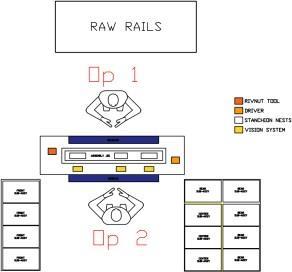

Figure4showsthe2stationassemblycellandfigure5shows the2stationassemblycell.This2stationassemblycellhas onlyonetablewith2jigfixturesemploying2operatorsonly. This also eliminates the time consumed by the turn table. Operator1takestherawroofrailfromthestandandfixeson the jig fixture to install a screw to support the stanchions whichisthesametaskinvolvedinthe3stationassemblycell. Then, operator 2 fixes the stanchions and installed the rivnutswitharivnutgun.
Thetimestudyiscarriedoutonthesetwodifferentassembly cells and compared them effectively, the structured procedure that is mentioned above is followed. This methodicalprocesswillensurethatthecomparisonyields valuableinsightsintotheefficiencyandproductivityofeach design layout, ultimately guiding decisions to optimize operationsandenhanceoverallperformance.
Thetimestudyisperformedusingastopwatchforboth layouts.Theefficiencyoftheproductionrateisdetermined bycomparingthetimetakentocompleteeachtaskateach station.
Table -1: Timeandmotionstudyon3stationassembly (beforeimplementationofmethod×tudy)
S.N o Description of activity Operator Average timing calculated in seconds
1 Obtainthe rawrailfrom therackand 1 6.43
Table -2: Timeandmotionstudyon2stationassembly (afterimplementationofmethod×tudy) S.
Description of activity
The time recorded in table 1 and 2 is an average of 10 recordingsofeachtaskwiththesameoperatorsperforming
From the comparison between 3 station and 2 station assemblycells,theaveragetimetakentorotatethetableand theoperationperformedbyrobotwaseliminated.Now,the productivityofeachassemblycelliscalculated.
Productivityisameasuretodeterminetheefficiencyofwork employedonatask,product,goods,serviceetc.
Theaverage timetaken on 3stationassemblycell (before implementationofmethodandtimestudy)=60.27seconds
The total time taken on 2 station assembly cell (after implementationofmethodandtimestudy)=41.67seconds
The total time taken on 3 station assembly cell (before implementationofmethodandtimestudy)-totaltimetaken on2stationassemblycell(afterimplementationofmethod andtimestudy)=60.27-41.67=18.6seconds
International Research Journal of Engineering and Technology (IRJET) e-ISSN: 2395-0056 p-ISSN: 2395-0072
Volume: 11 Issue:10 | Oct 2024 www.irjet.net
In general, time and method study on any manufacturing process increases productivity and reduces the time consumed to complete an action. Through this study, it is evidentthatthecomparisonofthepreviousprocessandthe currentprocesshasmadeahugedifferenceinproductivity. Theaveragetimeconsumed wasreducedby18.6seconds andproductivityincreasedby30.86%.
On the other hand, cooperation among the operators, training, comfort, manual & power tool facility, and communication are a few essential factors that indirectly drivetoachievethedesiredtarget.
[1] W.Charles,TheoryandPracticeofTimeStudy.Century, 1966.
[2] Womack,JamesP.,DanielT.JonesandDanielRoos.The Machine That Changed the World: The Story of Lean Production-Toyota’sSecretWeaponintheGlobalCar WarsthatIsNowRevolutionizingWorldIndustry.New York:FreePress,2007.
[3] Krafcik, John F. (1998). “The Japanese Style ManufacturingProcess:PioneeredbyToyota.”
[4] Niebel, Benjamin W. (1988). Motion and Time Study. Homewood,IL:RichardD.Irwin,Inc.
[5] Alsyouf, Imad. (2007). The role of maintenance in improving companies productivity and profitability. InternationalJournalofProductionEconomics.105.7078.10.1016/j.jipe.2004.06.057.
[6] [Atkinson,A.A.,R.D.Banker,R.S.Kalpan,&S.M.Young. (1995).ManagementAccounting.PrenticeHall,England. (p.514)
[7] Vijay’sKumar,S.,etal.(2014).“ProductionPlanningand Process Improvement in an Impeller Manufacturing Using Scheduling and OEE Techniques.” Procedia MaterialsScience,Vol.5,pp.1710-1715.
[8] Odior, Oyawale. (2011). “Application of Time Study Model in Rice Milling Firm: A Case Study.” Journal of AppliedScienceandEnvironmental Management,Vol. 15(3),pp.501-505.
[9] Prajapati,D.R.(2014).“ProductivityImprovementofa ForgingIndustryUsingTimeStudyTechnique-ACase Study.” International Journal of Management, IT and Engineering,Volume4,Issue12,pp.72-84.
[10] Braglia,M.,Frosolini,M.,&Zammori,F.(2009).“Overall Equipment Effectiveness of a Manufacturing Line (OEEML): An Integrated Approach to Assess Systems Performance.” Journal of Manufacturing Technology Management,Vol.20,No.1,pp.8-29.
[11] Rahmani, K., Bonab, M.P., & Naghadeh, M.K. (2011). “Evaluating the Overall Effectiveness of Production
Equipment and Machinery.” American Journal of ScientificResearch,Vol.31,pp.59-68.
[12] Rajput,H.S.,&Jayaswal,P.(2012).“ATotalProductive Maintenance (TPM) Approach to Improve Overall
Equipment Efficiency.” International Journal of ModernEngineeringResearch,Vol.2(6),pp.4383-4386.
[13] Siddheshwar, Parshetty. (2020). “Paper on Timeand Method Study Productivity Improvement in Machining Industry by using Time Study and Method Study Techniques.” International Research Journal ofEngineeringandTechnology,Vol.7,Issue7.
[14] Bon,A.T.&Daim,D.(2010).“TimeMotionStudyin Determination of Time Standard in Manpower Process.”Proceedings of Engineering Conference on Advancementin Mechanical and Manufacturing for Sustainable Environment, Kuching, Sarawak, Malaysia,pp.1-6.
[15] Hendrich,A.,etal.(2008).“A36-HospitalTimeand Motion Study: How Do Medical - Surgical Nurses SpendTheir Time?” The Permanent Journal, Vol. 12 (3),pp.25-34.
[16] Rehman, A., Ramzan, M., Shafiq, M., Rasheed, A., Naeem, S., & Savino, M. (2019). “Productivity Improvement Through Time Study Approach: A Case Study from an Apparel Manufacturing Industry of Pakistan.” ProcediaManufacturing, 39, 1447-1454.doi:10.1016/j.promfg.2020.01.306.
[17] International Labor Office. (1979). Introduction to WorkStudy.InternationalLabourOffice.