
International Research Journal of Engineering and Technology (IRJET) e-ISSN: 2395-0056
Volume: 11 Issue: 10 | Oct 2024 www.irjet.net p-ISSN: 2395-0072

International Research Journal of Engineering and Technology (IRJET) e-ISSN: 2395-0056
Volume: 11 Issue: 10 | Oct 2024 www.irjet.net p-ISSN: 2395-0072
Shraddha Jadhav1 , Bushra Bagwan2 , Shrikant Bhosale3
1 Shraddha Shivaji Jadhav Department of Technology, Shivaji University, Kolhapur
2 Bushra Asif Bagwan Department of Technology, Shivaji University, Kolhapur
3 Shrikant Bhosale Department of Technology, Shivaji University, Kolhapur
Abstract - Noise pollution is the term for unwanted sound, and it needs to be minimized to provide a comfortable working atmosphere. This chapter does a mathematical examination of noise and examines the effects of several sources. When two noises are joined and have the exact same intensity, the combined noise level can be 3 dB greater than the separate values.
Two strategic transportation system locations were chosen for this study in order to assess the interior and outside areas. Twelve hours of the day, the noise level was measured every five minutes using the Lutron company Electronics Digital Sound Meter Model SL-4010 to assess the noise (the central Bus Stand Inside and the central Bus Stand Outside).
Thequantityofnoisepollutioncausedbyvehiculartraffic flowwascalculatedbymeasuringthesoundlevelsindBA everyfiveminutes.Afterthat,datawereanalysedevery45 minutestoevaluatethenoiselevelsateachoftheselected locations.Thevolumeoftrafficandtheintensityofthenoise arestudied.EvaluationisdoneonthesoundlevelfactorsL max,Lmin,L10,L50,L90,andLeq.
Key Words: Noise Pollution, Central Bus Stand, traffic noise, SL-4010
1.INTRODUCTION
The impact of noise pollution on human health and wellbeing has gained recognition in recent times, leading to further research into its levels and detrimental effects by scientistsandinterestedglobalorganizationsliketheWorld HealthOrganization(WHO).Environmentalnoiseisaterm used to describe one of the most common contaminants foundincommunity noise. Accordingtothe WorldHealth Organization,itisnoiseproducedbyallcommunityactivities excludingindustrialareas.Theseactivitiesinclude,butare not limited to, transport, air traffic, learning, building, governmentwork,recreation,andcommunity.
Trafficnoiseisoneofamongthemostsignificanttypes of noise in comparison to other noises. The four main categories of traffic noise are noise from roads, airports, trains, and buses. Road traffic noise pollution causes physiologicalandpsychologicalharmtopeopleinaddition to irritation, loss of concentration, and decreased productivityatwork.Theintensityofroadtrafficnoisealso rises geometrically in proportion to advancements in technologyandtheeconomy.
Recently, it has been determined that one of the main environmentalfactorsaffectinglivingstandardsworldwide, especiallyincities,isenvironmentalnoisepollution.
When human activities like transportation, industry, & urbanizationincreasesignificantly,environmentallevelsof noisepollutionrisequicklyovertime.Themajorityofurban populationisforcedtoshifttoquietersecondaryroadways awayfromnoisygeneratorsduetothenegativeeffectson humanwellnessandcomfort.Noiseis"unwantedsound"or "soundthatisloud,unpleasant,orunexpected."Theword noisecomesfromtheLatinword"nausea."
Thedetrimentalimpactsofnoisepollutionaffectmillionsof people.Studieshaveindicatedadirectlinkbetweensound pollution and health problems. Disorders connected to stress,highbloodpressure,speechdifficulties,hearingloss, restless nights, and reduced productivity are among the problemscausedbynoise.Noiselevelsgreaterthan55DB cancauseconditionssuchasheartFailureandhypertension. Formorethan50years,CirrusResearchhasbeensupplying user-friendlyacousticmonitoringdevicestoorganizations allaroundtheworldinanefforttoprotectpeopleandthe environment from noise. "Noise monitoring" is the methodicalprocessofmeasuring,recording,andassessing sound levels in various contexts to ascertain the level of noise pollution and its potential consequences on the ecosystemandpublichealth.
According to the tribunal, sound is far more than just a nuisance because it can lead to serious psychological distress.Still,thereisalackofapplicationofthelegislation. Noisefromtheenvironmentisamajorproblemthesedays, especiallyintowns,andthemainsourceofnoiseintownsis transportation noise. Because there are so many cars and otherinternalcombustionenginevehiclesontheroad,road traffic noise is one of the main causes of noise pollution. Cities often have lower noise levels because electric and hybridcars,whicharegraduallytakingtheplaceofgasolinepoweredcars,typicallyhavequieterengines.Othernoises are also harmful to people and the environment. In this paper, we track and assess various noise sources and provideviablefixesfortheimpactedplaces.
International Research Journal of Engineering and Technology (IRJET) e-ISSN: 2395-0056
Volume: 11 Issue: 10 | Oct 2024 www.irjet.net p-ISSN: 2395-0072
Commonly used instruments for assessing noise pollution include loudspeaker meters and noise dosimeters. These devices provide useful information about noise levels and patternsinaparticularareabymeasuringsoundpressurein dB units. This is the method commonly used to quantify noisepollution.It'simportanttokeepinmindthataccurate measuresofnoisepollutionrequireadheringtoestablished methods and accounting for factors including the type of sound, the time of day, as well as the sensitivity of the receiving environment. Interpreting noise data may also involveassessingpotentialhealthimpactsandthespecifics ofthesoundsource.Inordertoquantifynoisepollution,one mustusespecializedequipmentknownasnoisedosimeters and sound levels to measure the volume of sound in a particularspace.
Inordertoquantifynoisepollution,onemustusespecialized equipmentknownasnoisemetersorsoundlevelmetersto measurethevolumeofsoundinaparticularspace.Thisisan illustrated description of the typical noise pollution monitoring process. Choose the appropriate instrument based on the specific requirements of the measurement. Sound level meters are frequently used for spot measurements,althoughpeoplecanwearsounddosimeters to monitor their exposure over time. Adjustthemeasurementdevice'scalibrationasinstructedby themanufacturer.Anessentialstepinensuringtheaccuracy oftheinstrumentiscalibration.Configuretheinstrument's parameters,includingthemeasurementperiod,frequency weighting(usuallyA-weightingtoaccountforbackground sound),andanyotherspecialneeds.
Twoexamplesofmeteorologicalconditionsthatcouldhave animpacton noise measurementsand the propagation of soundwavesaretemperatureandwind.Forexample,wind can carry sound distant from the instrument's location. Differentlocationsmayhavedifferentpoliciesandpractices fordocumentingandreportingloudness.Investinginhighquality sound testing equipment could be expensive. Thorough noise investigations could also require a lot of resources, like sophisticated tools and knowledgeable personnel.
It is essential to use appropriate and calibrated measurement tools, consider the context of the measurements,andadheretorelevantstandards.Busnoise is the noise produced by buses if they aremoving. Apart from external factors such as roadways and congestion, thereexistseveralsourcesofnoiseassociatedtobuses.
These guidelines provide acceptable thresholds for air pollutionlevelsandnoiselevelsincertainland-usezones.
Theyaredesignedtoshieldtheecosystemandthehealthof thebroaderpublicfromthe damagingeffectsofpollution. ForthemostupdatedinformationonCPCBstandards,see theofficialpublicationsofthecentralpollutioncontrolbody ormakedirectcontactwiththem.Recallthatguidelinescan alterinreactiontofreshscientificdiscoveriesandevolving environmental conditions. The noise monitoring data provided by CPCB, India, over the odd-even rules implementation,thefestivalofDiwali,andSundaysarealso reviewedandcontrastedwithbusiness-as-usualdays.
Table -1: NoisestandardsbytheCentralPollutionControl Board,India(CPCB,1998)
Preparation of Manuscript
They may have important resources or information about Kolhapur-specific noise pollution standards. Additionally, keepinmindthatnoisepollutionguidelinestypicallyspecify permissible noise levels for specific times of both day and night,aswellasvariationsbetweenvariousland-useareas, suchasthecommercial,residential,andindustrialsectors.
Anyfluctuatingnoisecanberepresentedbythestatistical valueofthesoundpressurelevel.Therefore,itisdefinedasa constantnoiselevelthatexpandsenergyoveracertaintime similartothatwhichisproducedbyvariationsinitoverthe sametime.Equivalentnoiselevelisameasurementofthe constantequivalentsoundlevelthroughoutaspecifictime period. It provides an approach to represent a varying sound level in perspective of a single, constant level that wouldrepresentthesamequantityoftotalnoiseenergyall over the same duration of time. When a detailed representation of noise exposure is needed, like in workplacenoiseexposureassessmentsandenvironmental noiseassessments,Leqiscommonlyused.Thefollowingare importantdetailsaboutEquivalentNoiseLevel:Thesquare of the root of the end product is obtained by adding the squares of the A-weighted sound pressure over a specific timeperiodtogettheLeq.Inmathematicalterms,itcanbe expressedastheaveragerootoftherootsquarewiththeAweightedsoundpressureleveloveragivenduration

International Research Journal of Engineering and Technology (IRJET) e-ISSN: 2395-0056
Volume: 11 Issue: 10 | Oct 2024 www.irjet.net p-ISSN: 2395-0072
where,
n=representstheoverallamountofsoundsamples.
Li=Anyithsample'snoiselevel
Ti=theithsample'stimelengthstatedasapercentageofthe sample'soverallduration.
Theproject'soutcomeisdependentonvarioustypesofdata. Determine the variables influencing noise pollution. gathering of information about traffic parameters like volume,noiselevel,andcomposition.
1.Selectedregionsurvey.
2.Measureandresearchnoiselevels.
3. An analysis of the frequency of buses and trains in the researchregion.
4.Howthelocalpopulaceperceivesthenoise.
5.Asurveywithquestions.
A manual monitoring system is employed for the traffic sound level study. The noise level was measured, and in addition,thetrafficvolumethatarewascounted.Thefirst vehicletrafficfromthestationswasthecauseofthenoisein allfouroccasions.
1.Choosingatransportationhub.
2.Themonitoringandevaluationofnoiseindices1.10,150, and 190 as well as comparable noise levels at various environmental areas,includingtheinteriorandoutside of Kolhapur City's central bus stand and train station.
3. Gathering traffic data during holidays and celebrations.
4. Create a framework based on the field of research.
5.Examinetheresearcharea'smitigatingstrategies.
1.Setthenoiselevelmeterfarenoughawayfromany reflectionsorobstructions.
2.Setthesoundlevelmeter'smicrophonebetween1.3 and1.5metersabovetheground.
3.Pointthesoundlevelmeter'smicrophoneinthesame directionofthesoundssource.
2.4
ConnectionstomanyareasinsideKolhapurcityaswellasto neighbouring towns and cities are available from the Kolhapur Central Bus Stand, or CBS. Buses from Kolhapur Central Bus Stand often go to Pune, Mumbai, Belgaum (Karnataka),Ratnagiri,Goa,Sangli,Satara,Solapur,andPune.
Theseareonlyafewofthelocations;manymoremightbe availabledependingontheroutesandamenitiesofferedby differentbusoperators.
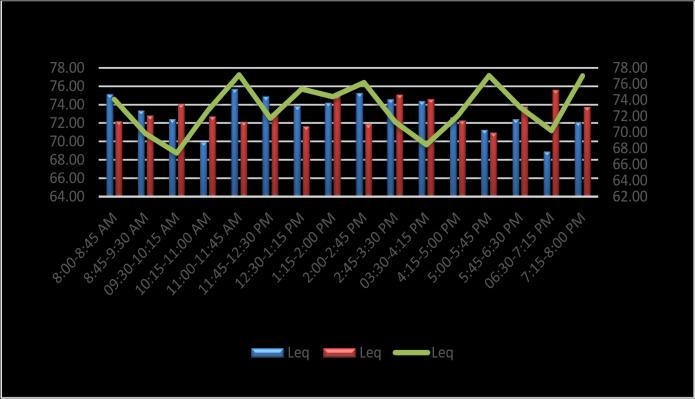
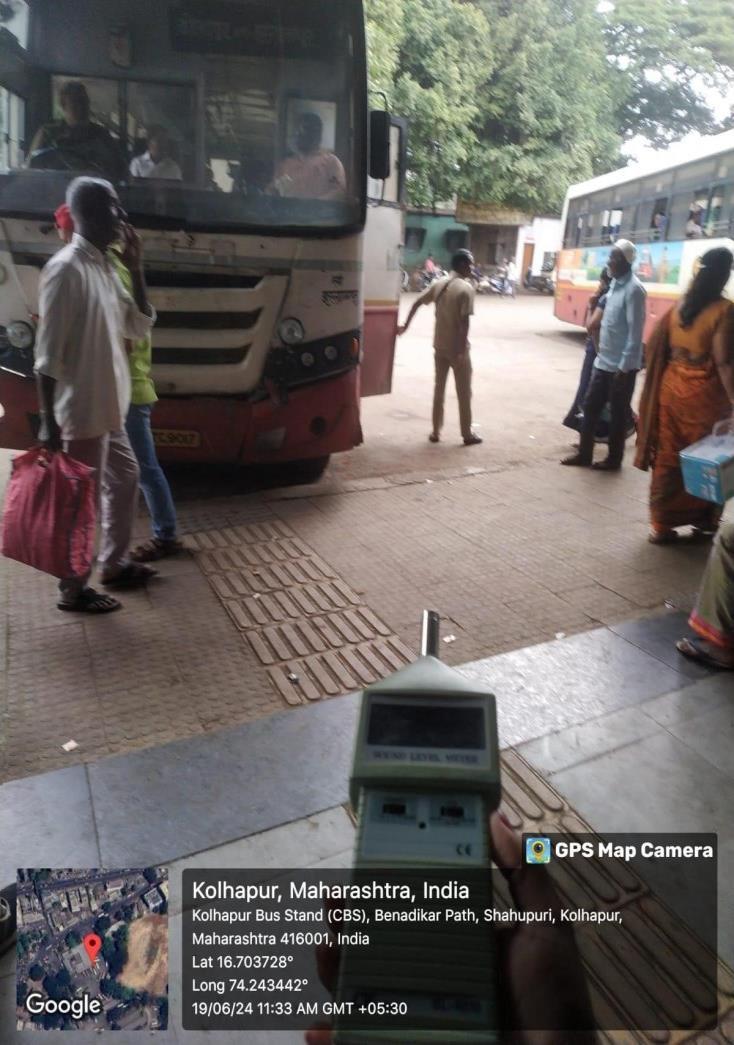
The main causes of the increased noise are the bus conditions; other sources include speakers, abrupt stops, announcements,passengers'chatter,andyellingvendorsat thecentralbusstoparea.Thenoiselevelisfirstreducedin the morning and then raised. At 11:00 and 11:45a.m., the highestleqis77.14dBA,anditrisesduringpeakhours.There is78.79dBAofnoise.Itthengrewoncemoretill between 7:15and8:00p.m.Thereis77.03dBAofnoise.Anditdrops until8:00p.m.oncemore.Aminimumnasallevelof77.61 dBAisalsorequired.
International Research Journal of Engineering and Technology (IRJET) e-ISSN: 2395-0056
Volume: 11 Issue: 10 | Oct 2024 www.irjet.net p-ISSN: 2395-0072
Busstandsaretypicallysurroundedbybusy,noisyareasdue to the continuous movement of traffic, pedestrians, and suppliers.ThelevelofnoiseoutsidetheCBSmaybehigher throughoutpeaktimes,suchasearlymorningsandatnight, while people are moving to and from work or when bus departuresandarrivalsarecommon.Additionalfactorsthat maycontributetohighernoiselevelsincludethetimeofthe day,trafficvolume,thepresenceofnearbybusinesses,and eventsthataretakingplaceinthearea.
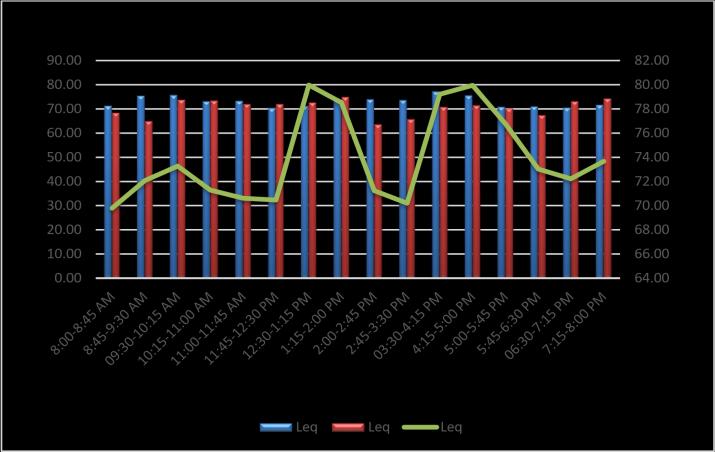
Chart -2:Noiselevelv/sTimeatKolhapurcentralbus standexteriorregion
Consider taking preventative measures, such as soundproofing your house or place of business, donning earplugsornoise-cancellingheadphones,orcontactingthe localgovernmenttolearnaboutanyeffortsthattheymaybe conductingtoreducetheenvironmentaldamagecausedby trafficnoise,ifyou'reconcernedaboutnoisefromvehiclesin theKolhapurCBSarea.elevatesthevolumeofnoise.Inthe afternoon,therearemorecarsonthemad,andthereismore noise.At12:30p.m.,thehighestleqis79.98dBA.Thenoise levelat1:15p.m.is79.96dBA.Itthenraisedonceagaintill3 p.m.Thereis73.66dBAofnoise.Anditdropsuntil8:00p.m. oncemore.Furthermore,thelowestnasalintensityis63.52 dBA.
Effectivenoisebarriersreducethelevelofsoundby10–15 dB,whichcancutthevolumeofroadnoiseinhalf.Barriers canbeconstructedfromhigh,highwallsortheearthberms, which are the earthen mounds that run along the roads. Earth berms are a visually pleasing noise barrier because they produce an organic appearance while blocking vibrations from the road directly into nearby homes and businesses. They don't totally eliminate noise; they only minimizeit.Regardingreceptorimpact,anoisebarriermust be at least five dB quieter than the surrounding environment.
Bamboo panel is a kind of the large genus Bamboo that belongs to the clumping bamboo tribe Bamboo. It usually growsintropicalandsubtropicalregionsofAsia,especially in the wet tropics. When bamboo grows closer to one another,thenoisecontroleffectsarebetter.Thisfeasibility study shows that the noise-reducing impact of a bamboo noisebarrier,measuring5metersinheightand6metersin thickness, is roughly equivalent to that of a solid noise barrier,measuringthreemetersinheight.Becausebamboo naturallyabsorbssound,itcouldbeahelpfulresourceinthis area. The natural characteristics of bamboo allow it to absorb some sound, however not as much as added specializedacousticmaterialslikefiberglassorfoampanels insulation. Because of the porosity in its structure, sound waves
The low cost of Bamboopanels stems from its all-banana construction, which is one of their key features. Waste materialisrecycledandutilizedtomakescrapmaterial,like bamboopoles.Itreducesnoisebyabout5to10%intests that are done indoors. Due to the lack of machinery, the panel requires very little maintenance. It is possible to effectivelyabsorbhigh-frequencysoundbyusingbamboo's hollowstructuretoreflectincomingsoundwaves.Bamboo makesgreatscreensandhedges,butitsdensefoliagealso functionswellasanoisebarrier,windbreak,andhedge.This featureisbecomingmoreandmorecommoninareaswhere organic bushland is disappearing and highway traffic is increasing.
Table -1: TestfindingsforthepanelofBamboo
International Research Journal of Engineering and Technology (IRJET) e-ISSN: 2395-0056
Volume: 11 Issue: 10 | Oct 2024 www.irjet.net p-ISSN: 2395-0072
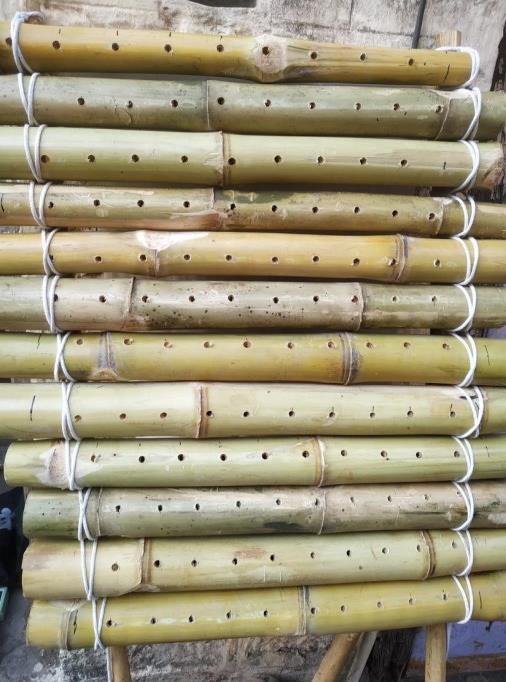

Inalab,theaforementionedtestwasconducted.Thetest's findingsshowthatBambusavulgarisreducesnoiselevelsby about5.7dB.Thisvalueistheaverageofthefourtestresults given before. This proves that Bamboomakes noise perceptiblebyreducingitby6%to10%.
Graphicalrepresentationoftestdata:
-2:LEQv/sLeqsourcedBandLeqreceiverdB
3. CONCLUSIONS
InordertocreateasoundabsorptionmodelforKolhapur City's central bus stand and to provide possible noise mitigation techniques for the impacted area by utilizing sound equivalents, this study will track and evaluate the
noise level within and outside of both platforms. Additionally,itwilldetectsoundlevelsduringholidaysand celebratory days. The primary bus terminal in Kolhapur providesinformationonallthetrafficandnoisewithinand beyondthecity.
1.Buildbarrierscomposedofbrick,concrete,orspecifically designedacousticpanelsaroundthebusstandtostopnoise fromechoingintothesurroundingregions.
2. Use sound-absorbing materials when constructing or remodellingthebusstand.Thesecouldincludewallpanels, ceilings,andflooringthathavebeencarefullyconstructedto reducenoisetransmission.
3. Plantdensegreeneryalongthebusstop'sperimeter.The naturalabsorptionanddeflectionabilitiesofplantsandtrees canbeusedtoreducenoiselevelsinanenvironment.
4. To minimize the number of vehicles that are idle or operating simultaneously, bus arrivals and departures shouldbespacedapart.Thiswillreducenoiselevelsoverall.
5. Graduallyconverttoelectricorhybridbuses,whichare considerably quieter than diesel-powered buses. Examine the use of sound waves in conjunction with active sound control technology to eliminate unwanted sounds in particularareas.
6. Whenelectricbusesreplacedieselonesinthecity,there is less noise. The overall public's well-being and pollution levels are improved by electric buses because they don't produceanyexhaustemissions.
7.Overtime,fuelandmaintenancecostsforelectricbuses can be reduced in comparison to diesel buses. The town's carbon footprint is reduced and sustainable growth objectivesarefulfilledbyutilizingelectricbuses.
8. Within the bus stand, lower speed limits must to be introduced and maintained in order to reduce noise from enginesandbraking.
[1] “Christensen_et_al2004”.
[2] “ijes-3-5-044”.
[3] D.PalandD.Bhattacharya,“Effectofroadtrafficnoise pollution on human work efficiency in government offices,privateorganizations,andcommercialbusiness centres in Agartala City using fuzzy expert system: A case study,” Advances in Fuzzy Systems, 2012, doi: 10.1155/2012/828593.
[4] R. Singh and G. Pandey, “Govind Pandey and Renesha Singh,”2013.[Online].Available:www.ijscer.com
International Research Journal of Engineering and Technology (IRJET) e-ISSN: 2395-0056
Volume: 11 Issue: 10 | Oct 2024 www.irjet.net p-ISSN: 2395-0072
[5] P.E.Oguntunde,H.I.Okagbue,O.A.Oguntunde,andO. O. Odetunmibi, “A study of noise pollution measurementsandpossibleeffectsonpublichealthin otametropolis,Nigeria,” Open Access Maced J Med Sci, vol. 7, no. 8, pp. 1391–1395, Apr. 2019, doi: 10.3889/oamjms.2019.234.
[6] C. Lavanya, R. Dhankar, and S. Chhikara, “‘NOISE POLLUTION’:ANOVERVIEW,”2014.[Online].Available: http://www.journalcra.com
[7] M.Yadav,R.K.Patel,A.Yadav,G.Sharma,andG.Pandey, “Assessment of noise pollution at various locations of Gorakhpur,” International Journal of Engineering, Science and Technology, vol. 13, no. 1, pp. 131–137, Jul. 2021, doi:10.4314/ijest.v13i1.20s.
[8] L.Manea,S.Gilbody,andD.McMillan,“Optimalcut-off scorefordiagnosingdepressionwiththePatientHealth Questionnaire (PHQ-9): A meta-analysis,” CMAJ. Canadian Medical Association Journal, vol. 184, no. 3, Feb.2012,doi:10.1503/cmaj.110829.
[9] A.Mishra,S.Das,D.Singh,andA.KumarMaurya,“Effect of COVID-19 lockdown on noise pollution levels in an Indian city: a case study of Kanpur”, doi: 10.1007/s11356-021-13872-z/Published.
[10] M.UsikaluandO.AkinkunmiKolawole,“Assessmentof noise pollution in selected locations in Ota, Nigeria,” 2018. [Online]. Available: https://www.researchgate.net/publication/328393125
[11] N. Singhvi, “2013; 1(3):154-168 An Analysis of noise pollution in Tirupur city,” SJET. [Online]. Available: www.saspublisher.com
[12] R. B. Ranpise, B. N. Tandel, and V. A. Singh, “Development of traffic noise prediction model for majorarterialroadsoftier-IIcityofIndia(Surat)using artificialneuralnetwork,” Noise Mapping,vol.8,no.1, pp.172–184,Jan.2021,doi:10.1515/noise-2021-0013.
[13] H.M.Elmehdi,“Usingmathematicalmodelstopredict annoyancefromcombined noisesourcesinthecityof Dubai.”
[14] N.Garg,S.Dhruw,andL.Gandhi,“PredictionofSound Insulation of Sandwich Partition Panels by Means of ArtificialNeuralNetworks,” Archives of Acoustics,vol.42, no.4,pp.643–651,Dec.2017,doi:10.1515/aoa-20170068.
[15] B.Tandel,S.Vallabhbhai,R.B.Ranpise,B.N.Tandel,and C. Darjee, “Assessment and MLR modeling of traffic noise at major urban roads of residential and commercial areas of Surat city Chandanmal Darjee AssessmentandMLRmodelingoftrafficnoiseatmajor urban roads of residential and commercial areas of
Surat city,” 2020. [Online]. Available: https://www.researchgate.net/publication/339044493


1 Shraddha Jadhav Department of Technology, Shivaji University, Kolhapur
2 Bushra Bagwan Department of Technology, Shivaji University, Kolhapur
3 Shrikant Bhosale Department of Technology, Shivaji University, Kolhapur