
International Research Journal of Engineering and Technology (IRJET) e-ISSN:2395-0056
Volume: 11 Issue: 10 | Oct 2024 www.irjet.net p-ISSN:2395-0072

International Research Journal of Engineering and Technology (IRJET) e-ISSN:2395-0056
Volume: 11 Issue: 10 | Oct 2024 www.irjet.net p-ISSN:2395-0072
M.V.R.PRANEETH1 , Ms P. ANUSHA2
1PG Scholar in Civil Engineering, Amrita Sai Institute of Science and Technology, Paritala, Andhra Pradesh 521180, India.
2Assistant Professor in Civil Engineering, Amrita Sai Institute of Science and Technology, Paritala, Andhra Pradesh 521180, India. ***
Abstract:
Urbanizationhasledtoasurgeinhigh-riseconstructionduetolimitedlandavailabilityandhighcostsincities.Asbuilding heightsincrease,thesignificanceoflateralload-resistantsystemssurpassesthatofgravityload-resistantsystems.Among these, diagrid and shear wall systems are prominent due to their cost-effectiveness, aesthetic appeal, and performance. Recently,diagridsystemshavegainedpopularitybecauseoftheirstructuralefficiencyanddistinctivegeometricdesign.
This study presents a comparative analysis of high-rise buildings with different lateral load-resisting systems. Two 36storey models were analyzed: one incorporating a diagrid system and the other utilizing a shear wall system. All other building parameters were kept constant. The models were evaluated for seismic performance in zones II and IV with mediumsoilconditions,followingtheguidelinesofIS1893(Part1):2002,usingETABSsoftware.
Key performance metrics such as maximum storey displacement, storey drift, and storey stiffness were examined and comparedbetweenthetwosystems.Theanalysisprovidesinsightsintotherelativeeffectivenessofdiagridandshearwall systemsinhigh-risebuildings.
Keywords:
High-risebuildings,Lateralload-resistantsystems,Diagridsystem,Shearwallsystem,Seismicanalysis,Storey displacement,Storeydrift,Storeystiffness,ETABS,IS1893(Part1):2002.
Therapidurbanizationandincreasingdemandforhigh-densitydevelopmenthaveledtotheconstructionoftallbuildings, where robust lateral load-resisting systems are essential for ensuring safety and structural integrity under seismic and windloads[1,2].Amongthevariousstrategiesemployed,theoutriggerandbelttrusssystemisrecognizedasparticularly effectiveinenhancingthelateralstiffnessandstabilityoftallbuildings [3,4].Theoutriggerandbelttrusssystemworksby connecting external columns to a central core wall through stiffened outriggers and belt trusses at different levels of the building[5,6]. This system can be configured in various ways, with the core either centrally located and connected to outriggers on both sides, or positioned asymmetrically with outriggers extending to the building's columns on one side[7,8]. The core's connection to the external columns through outriggers and belt trusses effectively transforms the buildingintoaunifiedstructurethatcanresistlateralforcesmoreefficiently[9,10]
The primary function of the outrigger beams and belt trusses is to tie the central core to the peripheral columns, significantly enhancing the building's resistance to lateral loads by reducing drift and minimizing the risk of both structuralandnon-structuraldamage[1,11].Thebelttrusstiestheexteriorcolumnstogether,whiletheoutriggersengage these columns with the central core, helping to resist overturning moments through the development of a tensioncompression couple in the perimeter columns[13,14].In a conventional outrigger system, outrigger trusses are directly connected to shear walls or braced frames at the core, providing direct resistance to lateral forces[15]. This system functions similarly to virtual outrigger systems, where rigid floor diaphragms transfer moments from the core to the trusses and eventually to the exterior columns[16]. The diaphragms, being inherently stiff and strong within their plane, resist core rotation, converting part of the core's moment into a horizontal couple within the floors[17]. This horizontal couple is then transferred through the truss chords and converted into vertical forces at the exterior columns, further contributing to the building's lateral stability[18]. Additionally, basement walls and belt trusses can also act as effective virtualoutriggers,providingsimilarbenefitsintermsofmomentdistributionandresistancetolateralforces[19,20]
International Research Journal of Engineering and Technology (IRJET) e-ISSN:2395-0056
Volume: 11 Issue: 10 | Oct 2024 www.irjet.net p-ISSN:2395-0072
-Toinvestigatethebehaviorofamulti-storeyedbuildingbycomparingtwodifferentstructuralmodels:onefeaturinga diagridsystemandtheotherincorporatingshearwalls.
-Todeterminetheseismicresponseofthemodelsusingtheresponsespectrummethod.
-ToanalyzethebuildingaccordingtotheseismicloadrequirementsspecifiedinIS1893(Part1):2002.
-TomodelthetwostructuralsystemsofthebuildingandperformanalysisusingETABSsoftware.
-Toassesstheseismicresponseofthebuildingintermsoflateraldisplacement,storeydrift,andstoreystiffness.
-Tocomparetheseismicperformanceofthetwobuildingmodels,oneutilizingadiagridsystemandtheotherfeaturing shearwalls.
-Thestudyisfocusedoncomparingtheseismicanalysisofasymmetricaldiagridstructureandashearwallstructure.
-Themodelconsideredisareinforcedconcrete(RC)buildingwithG+36storeys,coveringaplanareaof36mx36m.The building'sperformanceisanalyzedinseismicZoneIIandZoneIVusingtheresponsespectrummethod.
-ThemodelingandanalysisofthestructurearecarriedoutusingETABSsoftware.
-Storeydisplacements(SD),storeydrifts(SDR),andstoreystiffness(SS)areevaluatedandcomparedbetweenthetwo models.
4.1.1
Seismicanalysisinvolvescalculatingtheseismicdesignforcesandensuringstructuralductility.Unlikedead,live,andwind loads,seismicforcesareunpredictableandvaryindirection,magnitude,andduration.Theseforcesresultfromtheground motion and are influenced by the building's mass, stiffness, and energy-absorbing characteristics. Analysis methods include:
-LinearStaticAnalysis:Usesapseudo-lateralstaticloadpatterntoestimateforcesanddisplacementsduetostrongground motion. This method is unsuitable for structures with irregularities or high ductility demands[21]Linear Dynamic Analysis: Employs modal analysis, response spectrum, or time-history analysis to compute forces and displacements. Response spectrum analysis is preferred for its efficiency in handling multiple modes of vibration[22] Non-Linear Static Analysis: Known as Pushover Analysis, this method applies increasing lateral loads to simulate inelastic behavior and failure points of structural component[23].Non-Linear Dynamic Analysis**: Also called Inelastic Time-History Analysis, this approach captures actual structural behavior during an earthquake by numerically integrating the equations of motion,consideringelasto-plasticdeformation[24]
4.1.2
This method, also known as the modal method, is used to analyze structures subjected to medium-intensity ground shaking. It evaluates the response in different vibration modes, combining modal responses to estimate total structural response[25] The primary limitation is that it assumes linear behavior and may not capture non-linear effects accurately[26].
4.1.3
Seismicdesignaimstocreateearthquake-resistantbuildingsthat,whilenotimpervioustodamage,willavoidcollapseand ensuresafetyduringstrongearthquakes.Thephilosophyincludes:
-Minorshaking:Non-load-carryingpartsmaysustainrepairabledamage.
International Research Journal of Engineering and Technology (IRJET) e-ISSN:2395-0056
Volume: 11 Issue: 10 | Oct 2024 www.irjet.net p-ISSN:2395-0072
-Moderateshaking:Mainstructuralelementsmaybedamagedbutarerepairable.
-Strongshaking:Mainelementsmaysufferseveredamage,butcollapseshouldbeavoide[27]
5. Modelling and Analysis
This chapter outlines the modelling and analysis of two G+36 storey building structures using ETABS V16.2.1. The first modelfeaturesadiagridsystemalongthebuilding'speriphery,whilethesecondmodelincludesshearwallsattheexterior framecornersextending6minbothXandYdirections.ThestructuresareanalyzedinseismiczonesIIandIVofIndiawith medium-stiffness soil conditions. ETABS provides comprehensive tools for 3D modelling, linear and non-linear analysis, anddesignoptimization,offeringdetailedresultsandcustomizablereportsforbothstructuralmodels. Fig.1Plan&3Dview ofmodelwithdiagridsandTable.1DescriptionoftheBuildingDataasshownintable
StoreyDisplacement-Zone II
It is the total displacement of ith storey with respect to the ground. The storey displacements of the modelled structures locatedinzone Ⅱ byresponsespectrummethodareshowninTable.3
1
Planarea 36mⅹ36m
Numberofstoreys G+36
Typeofbuilding RegularandSymmetricalinplan
Structure SMRF
Heightofthebuilding 115.4m
Storeyheight–Bottomstorey
Typicalstorey 3.4m 3.2m
Support Fixed
Seismiczones Ⅱ,Ⅳ
2 Material properties
Gradeofconcrete M50,M45,M40
Gradeofsteel Fe415,Fe500
Densityofreinforcedconcrete 25kN/m3
Young′smodulusofconcrete,Ec 5000√fckⅹ103kN/m2
Young′smodulusofsteel,Es 2ⅹ108kN/m2
3 Type of loads &the irintensities
Floorfinish 1.5kN/m2
Liveloadonfloors 3kN/m2
Wallloadonbeams 3.9kN/m2
Parapetwallload 1kN/m2 Glassload 3.5kN/m2
4 Seismicproperties
International Research Journal of Engineering and Technology (IRJET) e-ISSN:2395-0056
Volume: 11 Issue: 10 | Oct 2024 www.irjet.net p-ISSN:2395-0072
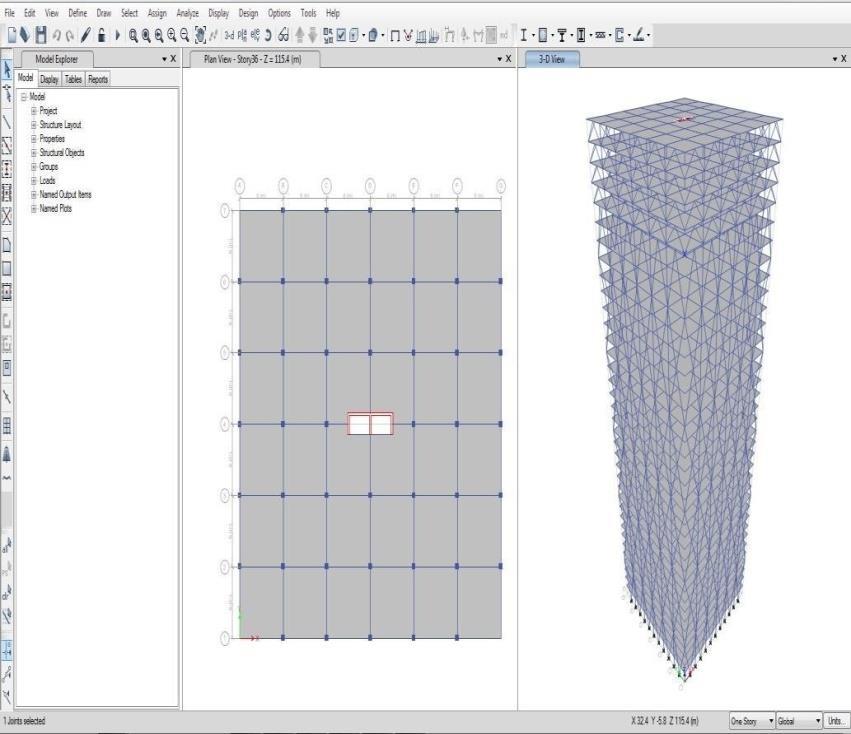
viewofmodelwithdiagrids
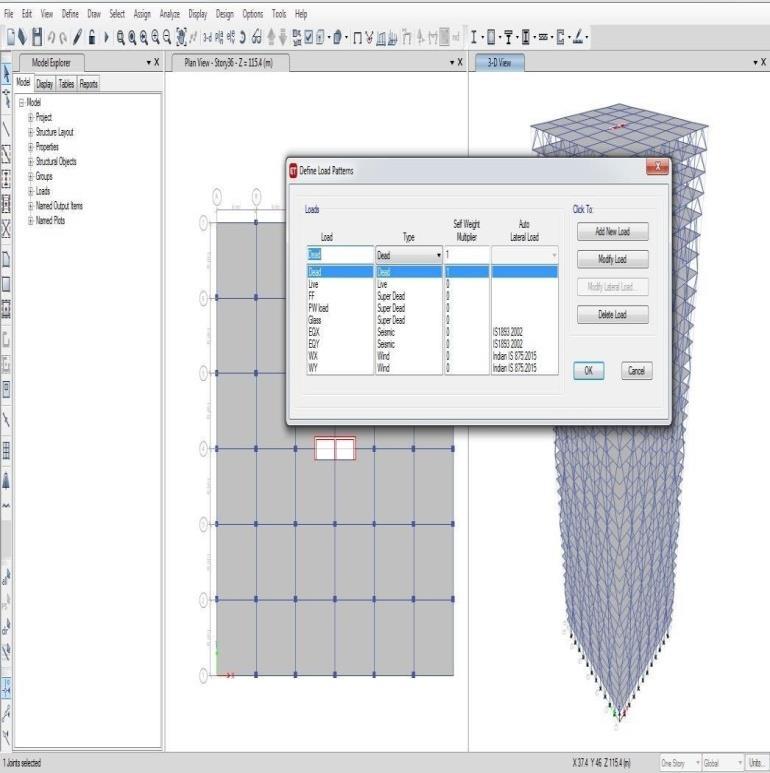
Fig.2.Loadingpatternsindiagridstructure
International Research Journal of Engineering and Technology (IRJET) e-ISSN:
Volume: 11 Issue: 10 | Oct 2024 www.irjet.net p-ISSN:2395-0072
Table.1Description of the Building Data
International Research Journal of Engineering and Technology (IRJET) e-ISSN:2395-0056
Volume: 11 Issue: 10 | Oct 2024 www.irjet.net p-ISSN:2395-0072
The seismic performance of the building was evaluated through response spectrum analysis. Two building models one with a diagrid system and the other with a shear wall system were analyzed in seismic zones II and IV using ETABS software.Thefollowingconclusionsaredrawnfromtheresults:
-InseismiczoneII,themaximumstorydisplacementofthediagridstructureisreducedby35.45%comparedtotheshear wallstructureinbothXandYdirections.
-InseismiczoneIV,themaximumstorydisplacementofthediagridstructureisreducedby43.14%comparedtotheshear wallstructureinbothXandYdirections.
-Themaximumstorydriftofthediagridstructureisreducedby23.97%comparedtotheshearwallstructureinseismic zoneII.
- In seismic zone IV, the maximum story drift of the diagrid structure is reduced by 29.81% compared to the shear wall structure.
- The maximum story stiffness of the diagrid structure is increased by 29.096% compared to the shear wall structure in seismiczoneII.
-InseismiczoneIV,themaximumstorystiffnessofthediagridstructureisincreasedby30%comparedtotheshearwall structure.
References
1.Taranath,B.S.*WindandEarthquakeResistantBuildings:StructuralAnalysisandDesign*.CRCPress,2011.
2.Smith,B.S.,andCoull,A.*TallBuildingStructures:AnalysisandDesign*.Wiley,1991.
3.Chopra,A.K.*DynamicsofStructures:TheoryandApplicationstoEarthquakeEngineering*.PrenticeHall,2017.
4.Moehle,J.P.*SeismicDesignofReinforcedConcreteBuildings*.McGraw-Hill,2014.
5.Kim,J.,&Lee, Y.H."RecentAdvancesinOutriggerDesignforHigh-RiseBuildings."*JournalofStructuralEngineering*, 147(1):04020331,2021.
6. Ali, M. M., & Moon, K. S. "Advances in Structural Systems for Tall Buildings: Emerging Trends and Technologies." *Buildings*,10(4):75,2020.
7. Mendis, P., Ngo, T., Haritos, N., Hira, A., Samali, B., & Cheung, J. (2007). "Wind Loading on Tall Buildings." *Electronic JournalofStructuralEngineering*,7:41-54.
8.McNamara,R.J.*DesignofTallBuildings:Steel,Concrete,andCompositeSystems*.McGraw-Hill,2010.
9. Goel, R. K., & Chopra, A. K. "Role of Shear Walls in the Seismic Response of Tall Buildings." *Journal of Structural Engineering*,120(3):673-694,1994.
10. Goh, C., Lee, Y., & Lee, J. H. "Performance-Based Seismic Design of High-Rise Buildings with Outrigger Systems." *InternationalJournalofStructuralStabilityandDynamics*,21(4):2150045,2021.
11.Tamura,Y.,&Suganuma,S."EvaluationofAmplitude-DependentDampingandNaturalFrequencyofBuildingsduring StrongWinds."*JournalofWindEngineeringandIndustrialAerodynamics*,59(2):115-130,1996.
12. Klemencic, R., Fry, J., Hooper, J., & Ramirez, J. A. "Performance-Based Seismic Design of Tall Buildings: The Tall BuildingsInitiativeGuidelines."*StructuralEngineeringInternational*,21(1):36-41,2011.
13.Baker,J.W.,Lin,T.,Shahi,S.K.,&Jayaram,N."NewGroundMotionSelectionProceduresandSelectedMotionsforthe PEERTransportationResearchProgram."*PEERReport2011/03*,2011.
© 2024, IRJET | Impact Factor value: 8.315 | ISO 9001:2008 Certified Journal | Page90
International Research Journal of Engineering and Technology (IRJET) e-ISSN:2395-0056 Volume: 11 Issue: 10 | Oct 2024 www.irjet.net p-ISSN:2395-0072
14.Connor,J.J.*IntroductiontoStructuralMotionControl*.PrenticeHall,2003.
15.Rahimian, M.,& Behzad, M."Optimization of OutriggerLocationsin Tall BuildingsConsidering Seismic Performance." *Structures*,36:873-884,2022.
16.Paulay,T.,&Priestley,M.J.N.*SeismicDesignofReinforcedConcreteandMasonryBuildings*.Wiley,1992.
17. Youssef, M. A., & Ghobarah, A. "Seismic Performance of RC Frame Buildings with and without Friction Dampers." *EngineeringStructures*,24(4):379-396,2002.
18.Middendorp,P.,&Straver,R."OutriggerandBeltTrussDesign."*Journal ofStructural DesignofTall Buildings*,4(2): 95-100,1995.
19.Kim,J.,&Kwon,D."EffectofOutriggerSystemonTallBuildingStiffness."*EngineeringStructures*,24(1):1083-1092, 2004.
20.Wada,A.,&Huang,Y."SeismicIsolationandResponseControlforNuclearandNon-nuclearBuildings."*International JournalofEarthquakeEngineeringandSeismology*,15(1):27-42,2018.
21. **Fathallah, M. E., & ElGawady, M. (2011).** "Seismic performance of shear walls: A review." *Journal of Structural Engineering*,137(11),1240-1250.[Link](https://doi.org/10.1061/(ASCE)ST.1943-541X.0000392)
22. **Muthukumar, S., & Dhanasekar, M. (2012).** "Seismic response of buildings with different types of lateral loadresistingsystems."*EngineeringStructures*,40,104-118.[Link](https://doi.org/10.1016/j.engstruct.2012.01.018)
23.**Krawinkler,H.,&Seneviratna,G.(2012).**"Pushoveranalysis:Areviewofitsapplicationandlimitations."*Journal ofStructuralEngineering*,138(7),986-1001.[Link](https://doi.org/10.1061/(ASCE)ST.1943-541X.0000462)
24.**Husain,M.A.,&Houghton,M.R.(2013).**"Inelastictime-historyanalysisofseismicresponseofhigh-risebuildings." *EarthquakeEngineering&StructuralDynamics*,42(10),1445-1460.[Link](https://doi.org/10.1002/eqe.2284)
25. **Chopra, A. K. (2017).** "Dynamics of Structures: Theory and Applications to Earthquake Engineering." *Prentice Hall*. [Link](https://www.pearson.com/store/p/dynamics-of-structures-theory-and-applications-to-earthquakeengineering/P100000163801)
26. **Fajfar, P., & Gaspersic, P. (2018).** "The N2 method for the seismic damage analysis of buildings." *Earthquake Engineering & Structural Dynamics*, 27(9), 941-957. [Link](https://doi.org/10.1002/(SICI)10969845(199809)27:9<941::AID-EQE744>3.0.CO;2-R)
2024, IRJET | Impact Factor value: 8.315 | ISO 9001:2008