
International Research Journal of Engineering and Technology (IRJET) e-ISSN:2395-0056
Volume: 11 Issue: 10 | Oct 2024 www.irjet.net p-ISSN:2395-0072

International Research Journal of Engineering and Technology (IRJET) e-ISSN:2395-0056
Volume: 11 Issue: 10 | Oct 2024 www.irjet.net p-ISSN:2395-0072
Rahul
Raj1 , P. Parimalam2
1Scientific officer C , Indira Gandhi Centre for Atomic Research, Kalpakkam, Tamil Nadu, India
2Scientific officer G , Head- DDCSS, Indira Gandhi Centre for Atomic Research, Kalpakkam, Tamil Nadu, India
Abstract - The reactivity of nuclear power plants (NPPs) is a critical parameter, essential for ensuring the safe and secure operation of these systems. In Pressurized Heavy Water Reactors (PHWRs), reactivity measurement typically relies on the Inverse Point Kinetics Equation (IPKE), a deterministic approach based on predefined mathematical formulations, which can be rigid in practice. This paper presents an alternative methodology using Machine Learning (ML), a subset of Artificial Intelligence (AI). ML models offer a data-driven approach for reactivity estimation, providing greater flexibility by learning from historical data. Several ML models are explored, including Linear Regression, Regression Trees, Random Forest, Support Vector Regression (SVR), and Recurrent Neural Networks (RNNs), particularly Long Short-Term Memory (LSTM) networks. Simulated datasets of reactivity versus neutron concentration, generated using Point Kinetics Equations (PKEs), are employed to train the ML models. Aftertraining,the modelsareevaluatedontestingdatasets, and their performance is assessed using Mean Squared Error (MSE), which quantifies the squared deviation between predicted and actual values. A comparative performance analysis based on MSE values identifies the mostoptimalMLmodelforaccuratereactivityestimation.
Key Words: Artificial intelligence (AI), Reactivity estimation, Machine Learning (ML), LSTM, Point Kinetics Equation (PKE), Nuclear Power Plants (NPPs)
Fast Breeder Reactors (FBRs) are a class of nuclear reactors that produce more fissile material than they consume,makingthemacriticalcomponentofsustainable nuclear energy production. However, the inherently dynamicbehaviorofFBRsposessignificantchallengesfor reactor control and safety management, necessitating preciseandtimelyreactivityestimationtoensuresafeand efficientoperation.
Traditionally, reactivity in FBRs is estimated by monitoringpowerchangesthroughthesolutionofInverse Point Kinetics Equations (IPKE), which account for six groups of delayed neutrons. This deterministic approach relies on predefined mathematical models, limiting adaptability in dynamic conditions. In contrast, Machine Learning (ML) models provide a data-driven alternative, offeringgreaterflexibilitybylearningfromhistorical data trends.
Among ML techniques, Deep Neural Networks (DNNs), particularly Long Short-Term Memory (LSTM) networks, have demonstrated superior performance with lower prediction errors compared to traditional methods. To train these models, simulated datasets of neutron concentration versus reactivity are generated using input reactivity values ranging from +20 pcm to -20 pcm. The datasetsincorporatethreetypesofreactivityinputs:step, ramp,andsinusoidalreactivity.
The generated datasets are used to train multiple ML models, and their performance is evaluated through comparative analysis using random test datasets. This study aims to assess the feasibility of ML-based reactivity estimationasacomplementaryoralternativeapproachto theconventionalIPKEmethod,providinginsightsintothe potential of ML models for enhancing the safety and controlofFBRoperations.
AI/ML as an Alternative to Conventional Methods.
Conventional models like IPKE offer a deterministic, physics-based approach to reactivity estimation but are limited by their assumptions, rigidity, and sensitivity to input parameter inaccuracies. They are reliable within well-defined conditions but struggle with dynamic and complex scenarios. AI/ML models such as LSTMs provide a flexible, data-driven alternative that excels in handling time-dependent, non-linear, and noisy data. They learn directly from historical patterns, are more adaptable to changing conditions, and offer robust performance in scenarioswhereconventionalmodelsmayfallshort.
Ma and Bao [1] document a project by Idaho National LaboratoryfortheNuclearRegulatoryCommission(NRC), investigating the use of advanced computational tools, including artificial intelligence (AI) and machine learning (ML), in nuclear plant operations. The report establishes connections between statistics and AI/ML, highlights commonly used supervised and unsupervised learning algorithms, and explores their applications in enhancing the safety and efficiency of nuclear plants and advanced reactors.Saurabh[2]presentsresearchonapplyingLSTMRNN models for stock price prediction, focusing on identifyingthemosteffectiveoptimizersforthesemodels. Suman [3] discusses the complexities of nuclear reactors and the challenges of developing real-time AI models, primarily due to the lack of reliable datasets and the
International Research Journal of Engineering and Technology (IRJET) e-ISSN:2395-0056
Volume: 11 Issue: 10 | Oct 2024 www.irjet.net p-ISSN:2395-0072
absenceofconsensusonoptimalAItechniquesforspecific applications. Mousavi Balgehshiri, Paydar, and Zohuri [4] emphasize that nuclear power plants involve multiple nonlinear systems and propose that integrating AI can improve operator performance, ensuring safer operations and enhancing resilience against natural and man-made disruptions.
AnefficientsolutionofthePointKineticsEquations(PKE) wasdevelopedtogenerateneutronconcentrationprofiles forvariousreactivityinsertions,includingstep,ramp,and sinusoidal signals. The process involved pre-processing and feature engineering of the power series data to enhancethequalityofinputsfortrainingmachinelearning (ML)models.Thegeneratedneutronconcentrationversus reactivity data was used to train multiple ML models, which were subsequently tested with random samples from the datasets to assess their performance. A comparative analysis of the models' effectiveness was conducted to identify the optimal approach for accurate reactivityestimation.
The primary requirement for training ML systems is the availability of suitable datasets. In this study, simulated datasets of neutron concentration versus reactivity were generated,asrealplantdatawasnotused.Thesesynthetic datasets served as labelled data, enabling the use of supervised ML models. The selection of appropriate supervised models plays a critical role in achieving reliable predictions. In this work, the following models were employed: Linear Regression, Regression Tree, RandomForest,andSupportVectorRegression(SVR)[1]. Additionally, a Recurrent Neural Network (RNN) with Long Short-Term Memory (LSTM) layers [2] was implemented as part of the deep learning approach. The ADAM optimizer [2] was used to optimize the performanceoftheRNN-LSTMmodel.
The Point Kinetics Equation (PKE) [6] is employed to generateneutronconcentrationversusreactivitydatasets, which serve as the foundation for training machine learning models. These datasets are produced by implementing custom Python code. The PKE comprises a system of differential equations. To numerically solve these equations, the odeint function from the scipy.integrate libraryisutilized.Thefollowingdifferential equations,whichconstitute thePKEmodel,areapplied to simulateneutronconcentrationasafunctionofreactivity:
where:
n(t)istheneutronpopulation.
ρ(t)isthereactivity.
βisthedelayedneutronfraction.
kisneutronmultiplicationfactor.
ispromptneutronlifetime
λi is the decay constant for the i-th group of delayedneutronprecursors.
Ci(t)isthepopulationofthei-thgroupofdelayed neutronprecursors.
βi is the delayed neutron fraction for the i-th groupofprecursors.
The datasets are generated with neutron concentration versus reactivity values, sampled at 10 ms intervals. Due to the time-dependent nature of the Point Kinetics Equation (PKE), it is utilized for generating these training datasets.Thesedatasetsaresubsequentlyusedtotrainthe system with various Machine Learning (ML) models, facilitatingdata-drivenreactivityestimation.
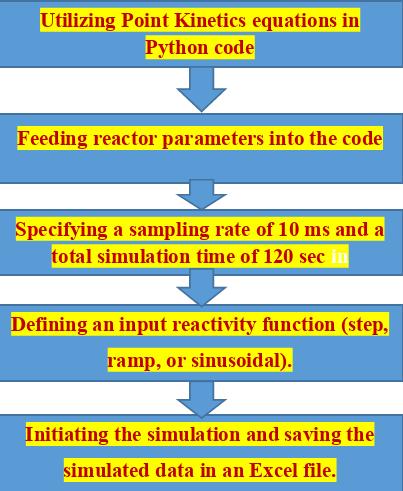
Figure 1. Flowchartrepresentsdatasetgeneration process
Figure 1 illustrates the steps involved in the process of generating the training datasets. The types of synthetic reactivity inputs employed are ramp reactivity with varying slopes, step reactivity with different step values andsinusoidalreactivitywithvaryingtimeperiods.
International Research Journal of Engineering and Technology (IRJET) e-ISSN:2395-0056
Volume: 11 Issue: 10 | Oct 2024 www.irjet.net p-ISSN:2395-0072
Reason for using the synthetic input signals:
Step Reactivity: Sudden changes in reactivity, simulating abruptdisturbancesorcontrolrodmovements.
Ramp Reactivity:Gradualchangesinreactivityovertime, simulating slow control rod adjustments or changes in moderatortemperature.
Sinusoidal Reactivity: Periodic changes in reactivity, simulating oscillations in reactor conditions or coolant flowvariations.
Figure 2 provides a glimpse of the generated neutron concentration vs. reactivity data sets. It contains data corresponding to sinusoidal input reactivity only, with similardatasetsgenerated forstepandrampreactivity as well.The reactivityvalues are fixed for thestep reactivity casebutvaryfortherampandsinusoidalreactivitycases. Inthisfigurethereactivityisthetargetvariablepredicted in the study and neutron population, also called neutron concentration acts as the primary feature in the dataset thatmodelsthetime-dependentresponseofthereactorto changesinreactivity.
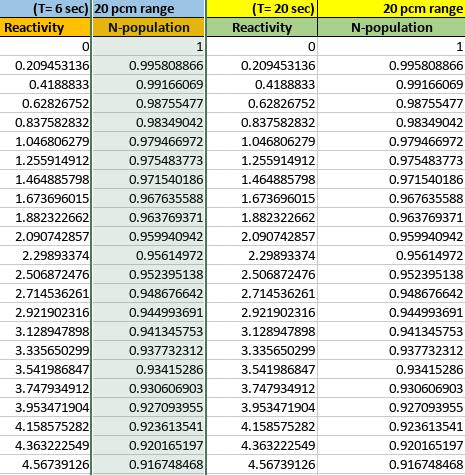
Several fixed neutronics parameter values are used for generatingthetrainingdatasets,aslistedbelow:
Delayed Neutron Fraction (β): Thisvalueisusedwithin the Point Kinetics Equation to model how the delayed neutronscontributetotheoverallneutronpopulation.
Prompt Neutron Lifetime (l): This parameter is part of the differential equations used to generate the synthetic neutronconcentration
Decay Constants of Delayed Neutron Precursors (λi): The decay constants are utilized in the Point Kinetics Equation to model the time-dependent behaviour of delayed neutron precursors, affecting the neutron population.
Population of Delayed Neutron Precursors (Ci(t)): This is also part of the Point Kinetics Equation that helps generatethesyntheticdataset.
TheexperimentswereconductedonaCPUwithanIntel® Xeon®processoroperatingataclockfrequencyof2.5GHz and4GBofRAM.Thesystemranona64-bitWindows10 Pro operating system. The project was implemented in Spyder (version 5) using Python 3.11. Both the dataset generationandthetrainingofML modelswereperformed withintheSpyderenvironmentusingPython.
The generated datasets were sampled at 10 ms intervals foratotaldurationoftwominutes,resultingin12,000data points for each type of reactivity input. The experiment included step reactivity with 40 different values (ranging from -20 pcm to +20 pcm, excluding 0 pcm), ramp reactivity with three slopes (0.5, 1.0, and 2 pcm/sec), and sinusoidal reactivity with two time periods (20 seconds and 60 seconds). In total, the datasets contained 300,000 datapoints.
Thedatasetswerestructuredsuchthatevery100neutron concentration values corresponded to a single reactivity value,withthereactivityvaluematchingthe100thneutron concentration point. This arrangement facilitated efficient mapping between input and output for model training. Table 1 illustrates the input-output relationship between the neutron concentration and reactivity values in the dataset.
International Research Journal of Engineering and Technology (IRJET) e-ISSN:2395-0056
Volume: 11 Issue: 10 | Oct 2024 www.irjet.net p-ISSN:2395-0072
Machine Learning (ML), a branch of artificial intelligence [5], leverages datasets to develop algorithms that identify underlying patterns. These algorithms can make predictions on new, similar data without the need for explicit programming for each task. In this study, various ML models are employed for training, including Linear Regression, Regression Tree, Support Vector Regressor (SVR), and Random Forest. Additionally, the Long ShortTerm Memory (LSTM) model, a type of deep neural network,isusedtoenhanceperformance.Theselectionof these models is informed by a literature review of prior researchstudies.
The ML models are implemented using Python programming. Upon completing the training, the Mean Squared Error (MSE) metric is used to evaluate the system’s performance. The MSE measures the deviation between predicted and actual values, with higher MSE values indicating lower prediction accuracy, thereby deeming the model unsuitable for practical use. An 80:20 split is applied to the dataset, where 80% is allocated for trainingand20%fortesting.
After training, the system undergoes testing with random datasets of normalized neutron flux. These datasets serve asinputtothetrainedmodelstopredictreactivityvalues. The predicted reactivity values are then compared with the actual reactivity values (the corresponding values of theinputneutronflux)toassessthemodel'saccuracy.
Once training is complete, the trained system undergoes testingusingrandomdatasetsofnormalizedneutronflux. Thesedatasetsareinputtedintothesystemtopredictthe output, known as predicted reactivity values. The reactivity values corresponding to the input normalized neutron flux, used for testing, are referred to as actual reactivity values. For testing purposes, random data sets are selected from the sinusoidal column of the generated data sets, where the time period is 20 seconds. The sinusoidal signal is chosen due to its curved path, which differsfromthefixedpathofstepsignalsorthefixedslope pathoframpsignals.
The performance of the trained ML models is analyzed based on the results from the test datasets and the MSE values. Figure 3 presents a graph illustrating the deviations between predicted and actual reactivity values for the different ML models.In Figure 3 blue line is for actual value of reactivity with respect to time and rest other line are of predicted values trained at different ML models. Only LSTM (purple line) and Regression Tree (Yellowline)tracestheactualvaluelineproperly
Overall Comparision among all ML models
Figure 3. TestoutputofdifferentMLmodelsunderno noiseconditions
Table 2 summarizes the overall MSE values for each ML model, with a corresponding graphical representation providedinFigure4.Inallthefivemodels,onlyLSTMhas theminimumMSEvaluewhichis0.665.
Table 2. MSEvaluesofdifferentMLmodels
Comparision of overall Mean Sq. Error values among different ML Techniques
Different ML models
Figure 4. BargraphofMSEvaluesofdifferentMLmodels
BoththeLSTMandRegressionTreemodelscloselyfollow the actual values (as shown in Figure 3). However, when considering MSE values, the LSTM model demonstrates superior accuracy, achieving an MSE of 0.665 (Table 2). The Regression Tree model comes in second, but with a
International Research Journal of Engineering and Technology (IRJET) e-ISSN:2395-0056
Volume: 11 Issue: 10 | Oct 2024 www.irjet.net p-ISSN:2395-0072
significantly higher MSE of 17.215 (Table 2). Since Figure 3 is based on a few data points, whereas the MSE is calculated from 20% of the training dataset, the results from Table 2 (or Figure 4) are deemed more reliable. Therefore, the LSTM model emerges as the more dependablechoiceforpredictingreactivity.
LSTMs arecapableoflearningcomplextemporalpatterns due to their architecture, which includes mechanisms to retain relevant information and forget irrelevant details over time. This capability is essential for accurately estimating reactivity, which can be influenced by various factorslikesuddenchangesinneutronflux.
Linear Regression(LR) assumes a linear relationship between the input features and the target variable (reactivity).
Regression Trees(RT), make predictions by dividing the dataintobranchesbasedonfeaturevalues.However,they are prone to over fitting on training data and fail to effectively model time-dependent or sequential data like changesinreactivitybutmoreflexiblethanLR.
Random Forest(RF) aggregates the predictions of multiple regression trees, improving accuracy and reducing over fitting. However RF treats each input instance independently and does not consider sequential relationships, which results in poorer performance for time-dependentproblemslikereactivityestimation.
SVR is primarily designed to find a hyper plane that best fits the data points. However, it lacks mechanisms to understand or remember sequential patterns and dependenciesthatarecrucialintime-seriesproblemsand it is very sensitivity to noise and is effective for many regression problems. Reactivity estimation involves subtle, time-dependent variations that SVR finds hard to modeleffectively.
Although traditional RNNs can model sequences, they havelimitationsin rememberinglong-termdependencies, which is crucial in modeling reactivity changes over time. LSTM networks, on the other hand, overcome this with specialized units (gates) designed to retain relevant information over extended periods and LSTMs have a well-suited architecture for time-series data, enabling them to capture long-term dependencies and effectively modelnon-linearpatternsindynamicsystemslikenuclear reactors.
[1] Z. Ma, H. Bao “Exploring Advanced Computational ToolsandTechniqueswith Artificial Intelligenceand MachineLearningin OperatingNuclearPlants”.Idaho
National Lab. (INL), Idaho Falls, ID (United States), 2022.
[2] Nikitha Saurabh“LSTM -RNN Model toPredictFuture Stock Prices using an Efficient Optimizer.” International Research Journal of Engineering and Technology(IRJET) 2020,pno.672-677.
[3] Siddharth Suman “Artificial intelligence in nuclear industry: Chimera or solution?”. Journal of Cleaner Production,2021.
[4] Seyed Kamal Mousavi Balgehshiri, Ali Zamani Paydar and Bahman Zohuri “Artificial Intelligence Driven Nuclear Power Reactors ”, Journal of Energy and Power Engineering16(2022).
[5] Textbook, “Introduction to Machine learning with Python” - 1st Edition (Author- Andreas C. Müller & SarahGuido)
[6] Textbook,“NuclearReactorEngineering”-4thEdition (Author-SamuelGlasstone&AlexanderSesonske)