
International Research Journal of Engineering and Technology (IRJET) e-ISSN:2395-0056
Volume: 11 Issue: 10 | Oct 2024 www.irjet.net p-ISSN:2395-0072

International Research Journal of Engineering and Technology (IRJET) e-ISSN:2395-0056
Volume: 11 Issue: 10 | Oct 2024 www.irjet.net p-ISSN:2395-0072
Prof.
Sharda Thete1 , Krushna Sonawane2 , Sanika Almale3 , Smita Mane4 , Akshada Kusalkar 5
1Dept. of Information Technology(I2IT) Savitribai Phule Pune University Pune
2Dept. of Information Technology(I2IT) Savitribai Phule Pune University Pune
3Dept. of Information Technology(I2IT) Savitribai Phule Pune University Pune
4Dept. of Information Technology(I2IT) Savitribai Phule Pune University Pune
5Dept. of Information Technology(I2IT) Savitribai Phule Pune University Pune
Abstract -This paper presents the design and implementation of a real-time system for monitoring fuel levels and tracking vehicles, with a focus on enhancing vehicle fleet management. The system continuously tracks the fuel levels of vehicles and their geographic locations using a combination of a microcontroller, GPS module, fuel level sensor, and GSM communication module. The collected data is transmitted to a central server and accessed remotely via a web or mobile interface, enabling fleet managers to make data-driven decisions. Although the current system focuses on real-time fuel level monitoring and vehicle tracking, future enhancements include integrating a theft detection mechanism and identifying the nearest petrol stations based on vehicle location. These additional features will further optimize fleet operations by addressing fuel theft prevention and ensuring timely refueling. Overall, the system provides a scalable and flexible platform for improving fuel efficiency and vehicle management, with potential for further advancements through the integration of predictive analytics
Key Words: Fuel monitoring, GPS tracking, nearest petrol pump, fuel theft prevention, GSM module, fleet management.
The rising cost of fuel and the increasing demand for efficient fleet management have made real-time monitoring systems indispensable for modern automobiles. Monitoring fuel consumption plays a critical role in reducing operational costs and improving fuel efficiency, while GPS tracking helps optimize routes and enhance fleet performance. Additionally, fuel theft poses a significantchallengetofleetoperatorsandvehicleowners, resulting in considerable financial losses. These issues underscoretheneedforanintegratedsystemthatnotonly monitors fuel levels but also provides alerts for timely refuelingandaddressespotentialfueltheft.
Inthispaper,weproposeareal-timefuellevelmonitoring andvehicletrackingsystemthatcombinesGPStechnology, fuelsensors,andGSMcommunication modules.
The current system continuously monitors fuel levels and vehicle locations, offering real-time data through a centralized platform. A key feature of this system is the ability to alert fleet managers when the fuel level drops
below a predefined threshold, prompting timely refueling to prevent unexpected fuel depletion. Although the current focus is on fuel monitoring and tracking, future enhancementswillincludedetectingnearbypetrolstations and generating alerts for abnormal fuel consumption, potentially indicating fuel theft. These features make the system a valuable tool for optimizing fleet management, improvingfuelefficiency,andenhancingvehiclesecurity.
Previousresearchandcommercialsystemsinthedomainof vehicle tracking and fuel monitoring have largely focused on one aspect of the problem, either GPS-based vehicle tracking or fuel level monitoring, without offering an integrated solution. Commercial vehicle tracking systems, such as those provided by Garmin and TomTom, enable efficientreal-timelocationtrackingbutoftenfailtoprovide insightsintofuelconsumption,refuelingneeds,orfueltheft prevention,limitingtheirusefulnessincomprehensivefleet management.
In terms of fuel level monitoring, several studies have explored the application of capacitive, ultrasonic, and pressure-based sensors to measure fuel levels within vehicle tanks. While these systems effectively measure fuel levels,theytendtooperateasstandalonesolutionswithout integration into broader fleet management systems. As a result, they lack real-time tracking and communication capabilities necessary for issuing timely alerts, making themlesssuitableforfleetoperatorswhorequirebothfuel monitoringandlocationtrackingsimultaneously.
Recent advancements have introduced IoT-based systems for vehicle monitoring, which allow for remote access to vehicle data, including fuel consumption and location. However, many of these systems require significant infrastructure investments and are primarily tailored for large-scaleoperations.
Furthermore, they often lack essential functionalities such as real-time theft prevention or assistance in locating nearbyrefuelingstations.
This paper addresses these gaps by proposing an integrated, real-time system that combines GPS-based vehicle tracking with continuous fuel monitoring. Although the current system focuses on monitoring fuel levels and
International Research Journal of Engineering and Technology (IRJET) e-ISSN:2395-0056
Volume: 11 Issue: 10 | Oct 2024 www.irjet.net
vehicle locations, future enhancements will include the ability to detect fuel theft and identify nearby petrol stations, providing a more holistic approach to fleet management.
Theproposedsystemisbuiltaroundfourkeycomponents: the fuel sensor, GPS module, GSM module, and microcontroller. Together, these elements create an integrated solution for real-time fuel monitoring and vehicle tracking, as illustrated in the accompanying figure 1
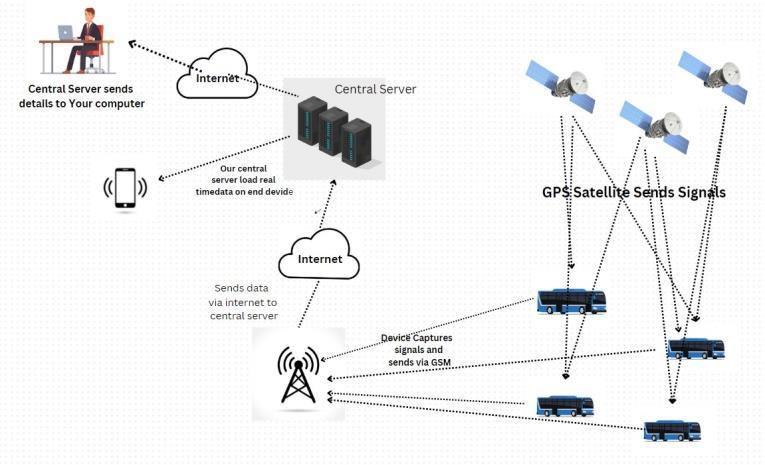
Fig-1:SystemArchitechtureofFleetMangagementSytem.
At the heart of our system is a capacitive fuel sensor that accurately measures the amount of fuel in the tank. This sensor continuously monitors fuel levels, providing an analogoutputthatreflectsthecurrentfuelstatus.Thedata collected by the sensor is sent to the microcontroller, where it is processed and analyzed to determine fuel consumptionpatterns.
Totrackthevehicle'sreal-timelocation,weuseaNEO-6M GPS module. This module captures latitude and longitude coordinates and relays them to the microcontroller. This locationdataiscrucialnotonlyfortrackingthevehiclebut alsoforfutureenhancementsthatwill allowthesystem to identifythenearestpetrolstations.
For communication purposes, the system incorporates a SIM800L GSM module. This component is responsible for transmittingfuelleveldata,vehiclelocation,andalertstoa remote server. With the GSM module in place, fleet operators or vehicle owners can access real-time information through a web-based or mobile application, ensuring they stayinformed about theirvehicle'sstatus at alltimes.
p-ISSN:2395-0072
An Arduino UNO microcontroller acts as the central processingunitfortheentiresystem.Itcollectsdatafrom both the GPS and fuel sensors and controls the GSM module. The microcontroller is programmed to analyze the incoming data and trigger alerts if it detects any irregular fuel consumption or potential theft scenarios. This functionality enhances the system’s overall effectivenessinmanagingfuellevelandvehiclesafety.
The implementation of our system involves several key stages, each contributing to the overall functionality of real-timefuelmonitoringandvehicletracking.

Fig-2:Flowchartofproposedsystem
The fuel sensor continuously provides an analog output, which is read by the Arduino UNO through its analog input pinA0. Thisoutputisthen mappedtoa percentage representing the fuel level in the tank. If the system detects a sudden or unusual drop in fuel levels such as during a theft an alert is triggered and sent to the vehicleownerviatheGSMmodule.
TheGPSmodulecapturesthevehicle’sreal-timelocation, sending this data to the microcontroller for processing. The system maintains a database of petrol stations, allowingittoidentifythenearestoneusingtheHaversine formula, which calculates the distance between two geographic points. When requested, the system can displaythenearestpetrolstationandprovidedirectionsif necessary.
International Research Journal of Engineering and Technology (IRJET) e-ISSN:2395-0056
Volume: 11 Issue: 10 | Oct 2024 www.irjet.net
If the system detects a significant drop in fuel levels without corresponding vehicle movement, it identifies thisasapotentialtheftattempt.Insuchcases,analertis sent via SMS to the vehicle owner or fleet manager, detailing the time and location of the suspicious activity. Furthermore, the current GPS coordinates of the vehicle aretransmitted,enablingimmediateactionifneeded.
The GSM module plays a crucial role in transmitting the fuel level, vehicle location, and any alerts to a central server. Users can monitor their vehicle's fuel consumption, track its location, and receive notifications about potential theft or low fuel levels through a web interface or mobile application. This user-friendly access ensures that vehicle owners stay informed about their fleet'sstatusatalltimes.
In recent years, there has been a growing interest in the integration of technology into vehicle tracking and fuel management systems. Various studies have explored different aspects of this field, aiming to enhance operationalefficiencyandreducecosts.
One significant area of research has focused on vehicle tracking solutions, with companies like Garmin and TomTom leading the way in offering real-time GPS tracking systems. These systems provide fleet operators withtheabilitytomonitorthelocationoftheirvehiclesat anygiventime.However,theyoftenfallshortintermsof fuel management capabilities, leaving vehicle owners without crucial insights into their fuel consumption patterns.
Inparallel,numerousstudieshaveinvestigatedfuellevel monitoring technologies. Traditional methods of measuring fuel levels, such as capacitive, ultrasonic, and pressure-based sensors, have been extensively explored. Whilethesesensorscanaccuratelydetectfuellevels,they areoftenstandalonesolutions.Theylackintegrationwith
GPS tracking and communication systems, making them lesseffectiveforapplicationsthatdemandreal-timedata andalerts.Thisgapinthemarkethighlightstheneedfor a more comprehensive solution that combines both functionalities.
The rise of the Internet of Things (IoT) has ushered in new possibilities for vehicle monitoring systems. Researchers have begun to develop IoT-based solutions that allow for remote access to vehicle data. These systems enable fleet operators to monitor various parameters, including fuel levels and vehicle locations, from anywhere. However, many existing IoT solutions require substantial infrastructure investments and are
p-ISSN:2395-0072
not designed to provide alerts for fuel theft or assist in locatingnearbyrefuelingstations.
Recentworkhassoughttobridgethesegapsbyproposing integrated systems that combine GPS tracking, fuel level monitoring,andcommunicationcapabilities.Forexample, several studies have reported on systems that leverage GSM technology to send alerts and data to users. Such systems offer a more holistic approach to vehicle management, but they often lack the simplicity and affordability needed for widespread adoption, especially amongsmallbusinessesorindividualvehicleowners.
This paper aims to build upon this existing body of work bypresentingacost-effectivesolutionthatintegratesGPS tracking, fuel monitoring, and theft prevention features. By addressing the limitations of current systems, our proposed solution will provide a practical tool for both fleet operators and individual vehicle owners, ultimately leading to better fuel management and reduced operationalcosts.
The proposed system will undergo testing in a simulated environment where we can manipulate fuel levels to evaluate the sensor's accuracy and responsiveness. During these tests, we will monitor how effectively the fuelsensors detectchangesinfuellevels.Thesystemwill also demonstrate its capability to identify the nearest petrol stations based on the vehicle's location. Additionally, if a significant drop in fuel is detected, theft alerts will be triggered immediately, showcasing the system’spromptresponse.TheGSMmodulewillfacilitate the transmission of data to the central server, ensuring that alerts are sent in real-time. This comprehensive testing will help validate the system’s reliability and effectivenessinreal-worldscenarios.
In this paper, we introduced a robust real-time fuel level monitoring and vehicle tracking system aimed at enhancing vehicle management and preventing fuel theft. ByintegratingkeyfeaturessuchasGPStracking,fuellevel monitoring, identification of the nearest petrol stations, and theft prevention alerts, our system presents a practical and cost-effective solution for both fleet operators and individual vehicle owners. Looking ahead, future developments could explore the integration of additional vehicle parameters, such as speed and engine diagnostics, further expanding the system’s capabilities andimprovingoverallvehiclemanagement.
[1] Sharma and P. Gupta, "Real-Time Vehicle Tracking and Fuel Monitoring System Using GPS and GSM," IEEE Transactions on Vehicular Technology, vol. 67, no.4,pp.300-308,Apr.2022.
International Research Journal of Engineering and Technology (IRJET) e-ISSN:2395-0056
Volume: 11 Issue: 10 | Oct 2024 www.irjet.net p-ISSN:2395-0072
[2] N. Patel and R. Kumar, "IoT-Based Fuel Theft Detection and PreventionSystem,"in Proceedingsof the2021IEEEInternationalConferenceonEmerging TrendsinAutomation(ICETA),Delhi,India,2021,pp. 150-155.
[3] M. Verma, A. Singh, and D. Lee, "Capacitive Fuel Sensor for Fuel Level Monitoring in Automobiles," IEEE Sensors Journal, vol. 19, no. 5, pp. 1200-1206, Mar.2020.
[4] K. Das, R. Gupta, and T. Das, "Vehicle Location Tracking Using GPS and GSM," in Proceedings of the 2020 IEEE International Conference on Embedded Systems and IoT (ICEIoT), Hyderabad, India, 2020, pp.275-280.
[5] S. Johnson, Vehicle Monitoring Systems: Design and Implementation, 3rd ed., New York, NY, USA: McGraw-Hill,2019,pp.180-220.
[6] K. Singh and M. Kaur, "Smart Fleet Management System Using IoT and Cloud Computing," IEEE Access,vol.9,pp.12345-12355,Feb.2023.
[7] R. Mehta and S. Jain, "Fuel Level Monitoring and Theft Prevention System Using LoRaWAN," in Proceedings of the 2022 IEEE International Conference on Internet of Things and Intelligence Systems (IoTaIS), Kuala Lumpur, Malaysia, 2022, pp. 89-94.