
International Research Journal of Engineering and Technology (IRJET) e-ISSN:2395-0056
Volume:11Issue:10|October2024 www.irjet.net p-ISSN:2395-0072

International Research Journal of Engineering and Technology (IRJET) e-ISSN:2395-0056
Volume:11Issue:10|October2024 www.irjet.net p-ISSN:2395-0072
Kunal Chhatlani, Sakshi Nanda
1Kunal Chhatlani, Independent Affiliation, New Jersey, USA
2Sakshi Nanda, Independent Affiliation, Oregon, USA
Abstract - Urban design is starting to apply Artificial Intelligence (AI) and Machine Learning (ML) in an attempt to optimize complex challenges with regard to pedestrian flow. This paper provides a comprehensive analysis of the existing literature on predictive modeling of pedestrian movement, with particular focus on integrating data-driven approaches and agent-based modeling. This paper highlights the prospect of improving urban planning by using the potential of data-driven pedestrian dynamics models supported by multi-source data for building evacuation coupled with research on agent-based modeling of pedestrian movements. The given analysis underlinestheimportanceofutilizingmulti-sourcedataand advanced modeling techniques in a proper way to give accurate predictions of pedestrian behavior for making the urbanenvironmentmorelivableandefficient.
Key Words: Urban Design, Artificial Intelligence (AI), Pedestrian Flow Optimization, Data Integration, Agent-Based Modeling, Data-Driven Modeling, Urban Mobility,MachineLearning(ML).
1.INTRODUCTION
The rapid growth of urban populations has increased the necessity for efficient management of pedestrian flow in cities around the globe. Crowded pathways, ineffective public areas, and insufficient evacuation protocols have a negative impact on safety, accessibility, and the general quality of urban life. Conventional approaches to modeling pedestrian movement frequently fail to accurately represent the intricate and ever-changing behaviorofpeopleinurbanenvironments.
Progress in AI and ML field offers encouraging opportunities in improving predictive models of pedestrian flow. Through the utilization of large quantities of data and advanced algorithms, these tools offer more in-depth understanding of pedestrian behaviors, allowing city planners to create environments thatarebothmoreeffectiveandadaptable.
This paper offers a detailed analysis of existing research on predictive modeling for pedestrian flow optimization, with a specific emphasis on combining data-driven methods withagent-basedmodels.Bycombininginsights from studies on data-driven pedestrian dynamics using multi-source data and research on agent-based modeling
ofpedestrianmovements,weaimtoenhancetheprecision andrelevanceofpredictingpedestrianflow
Pedestrian flow modeling has progressed from basic mathematical depictions to more intricate simulations. Initial models, such as the social force model proposed in themid-1990s,providedamacroscopicviewofpedestrian dynamics but lacked the granularity to capture individual behaviors and interactions (Helbing & Molnár, 1995). These models frequently viewed pedestrians as particles impacted by social forces, a perspective beneficial for analyzing overall crowd movement but lacking considerationforindividualdecision-makingprocesses.
Agent-based models (ABMs) simulate how individual pedestrians,actingautonomously,interactandimpactthe overall system. Research in this area has highlighted the potentialofABMsinsimulatingpedestrianmovementsby modeling pedestrians with specific characteristics and behaviors (Kerridge et al., 2001). Key aspects of this methodologyinclude:
Individual Agent Representation: Each pedestrianismodeledasanindividualagentwith parameters such as walking speed, desired destinations,andpersonalpreferences.
BehavioralRules:Agentsfollowpredefinedrules that dictate their movement and interactions, including speed preferences, route choices, and avoidanceofobstaclesandotherpedestrians.
Environment Interaction: Agents interact with the environment, encompassing physical infrastructure,spatiallayouts,andotheragents. Critical questions addressed in this modeling approach include:
How do the actions of individuals impact group behavioronalargerscale?
What are the appropriate behavioral rules for agents?
International Research Journal of Engineering and Technology (IRJET) e-ISSN:2395-0056
Volume:11Issue:10|October2024 www.irjet.net p-ISSN:2395-0072
What impact does the spatial environment have onhowagentsbehave?
Addressing these questions is essential for developing accurateandreliableABMsforpedestrianflow.
Data-driven approaches to modeling pedestrian dynamics involve utilizing various data sources to inform models, particularly for scenarios such as building evacuations (Zhangetal.,2011).Thismethodologyencompasses:
Data Analysis and Pattern Recognition: Utilizingstatisticalandmachinelearningmethods to recognize patterns and trends in pedestrian behavior.
Multi-Source Data Collection: Collecting data from various sources such as video surveillance, sensor networks, and manual observations to trackpedestrianmovementinreal-time.
Model Development and Calibration: Developing models based on empirical data and calibrating them to ensure accuracy in representingactualpedestrianmovements.
Incorporating geometry and analysis: Using 3dimensional and 2- dimensional geometry for spaceplanningandtransportationplanning.
Bybasingmodelsonactualdatafromtherealworld,datadrivenmethodsimproveaccuracyinpredictions.Utilizing variousdatasourceshelpsincapturingacompleteviewof pedestrian behavior, taking into account differences caused by environmental conditions and individual actions.
Combining data-driven methods with agent-based models offers the potential to combine the strengths of both approaches:
Data-Driven Insights for Agent Behaviors: ABMs benefit from empirical data guiding behavioral rules and parameters, resulting in simulationsthataremoretrue-to-life.
Enhanced Model Calibration: Data-driven methods calibrate and validate ABMs, ensuring that simulated behaviors align with observed behaviors.
Adaptive Modeling: Integrating these methods enables models to adjust to fresh data and evolvingcircumstances,enhancingtheirrelevance indynamiccitysettings
This integration addresses some limitations of standalone ABMs, such as reliance on assumptions about agent
behaviors, and enhances the practicality of data-driven modelsbyincorporatingbehavioraldynamics.
Table-1: KeyFactorsInfluencingPedestrianBehavior
Factor Addressed in AgentBased Modeling Addressed in DataDriven Modeling WalkingSpeed Setasanattribute basedon assumptions Derivedfrom observeddata distributions
RouteChoice Modeledthrough decision-making algorithms Inferredfrom trajectorydata
Interactions withOthers Simulatedthrough predefinedinteraction rules Reflectedindensity andflowpatterns
Environmental Familiarity Assignedbasedon agentprofiles Maynotbeexplicitly modeled Responseto Events Programmed behaviorsforspecific scenarios Observedresponses analyzedifdatais available
Thissection provides a detailed analysis of methodologies from existing research, investigating their potential integration for improving predictive modeling in optimizingpedestrianflow.
Key considerations in developing ABMs for pedestrian movementinclude:
1. Factors Influencing Pedestrian Behavior: Understanding factors such as trip purpose, environmentalfamiliarity,andsocialinteractions.
2. Decision-Making Processes: Modeling how pedestrians make decisions about route choice and movement, involving shortest paths, preferred environments, and congestion avoidance based on studies of human anthropology.
3. Interactions and Collective Dynamics: Examining how interactions between pedestrians affect overall flow dynamics, such as lane formationandcrowding.
Data-driven modeling approaches utilize multi-source datatoinformpedestriandynamicsmodels:
Data Collection: Collecting data from video surveillance, sensors, and environmental conditions to capture real-time pedestrian movement.
Data Processing and Analysis: Cleaning and organizing data, extracting key features influencing pedestrian movement (e.g., speed,
International Research Journal of Engineering and Technology (IRJET) e-ISSN:2395-0056
Volume:11Issue:10|October2024 www.irjet.net p-ISSN:2395-0072
density, flow rates), and employing statistical methodstoanalyzepatterns.
Model Development: Developing mathematical models representing pedestrian dynamics based on analyzed data, simulating scenarios, and calibrating models using additional data for validation.
The integration of data-driven approaches with agentbased modeling offers a complete framework for accurately simulating pedestrian flow in urban settings. This approach uses empirical data to inform agent behaviors within simulations, enhancing both the realism andpredictivecapabilitiesofthemodels:
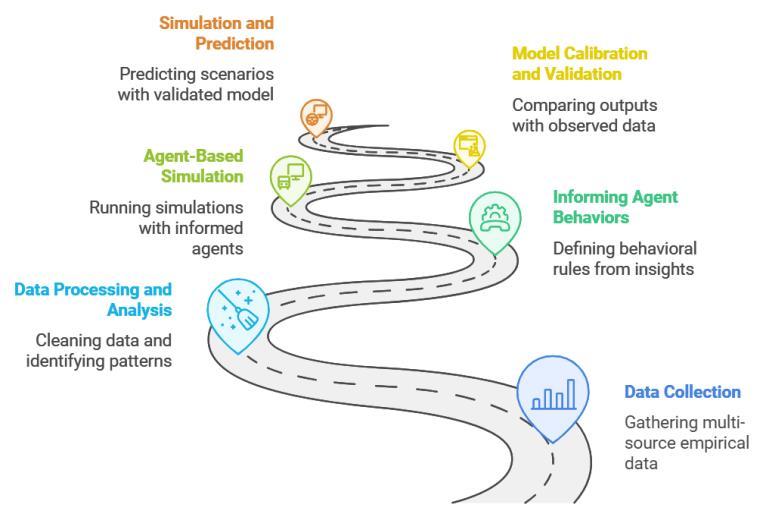
Fig-1:IntegrationFrameworkofData-DrivenMethods withAgent-BasedModels
3.3.1
A critical step in integrating data-driven methods with agent-based models (ABMs) is defining agent behaviors basedonempirical data.Thisprocessinvolvesseveralkey components:
EmpiricalDataUtilization
Behavioral Parameter Extraction: Analyze data from various sources to identify parameters that define pedestrian behaviors conceptually. These factors could consist of desired walking speeds, rates of acceleration and deceleration, personal spacepreferences,routeselections,andresponses toenvironmentaltriggers.
Statistical Analysis: Employ statistical methods theoretically to identify distributions and correlations within the data. For example, determine probability distributions of walking speeds or the likelihood of pedestrians choosing certainroutesunderspecificconditions.
Cluster Analysis: Utilize clustering algorithms within a theoretical framework to classify
pedestrians into separate groups according to their actions. This may include identifying commuters, tourists, shoppers, or event attendees, each displaying distinct movement patterns and preferences. By theoretically incorporating these empirical insights, the agent behaviors within the ABM can be defined more accurately. Thisapproachallows for the modeling of realistic pedestrian dynamics without necessitating the actual execution of data analysis ormodelsimulations.Itensuresthattheagentsin the model reflect the diversity and complexity of real-world pedestrian behaviors, enhancing the model's applicability for urban design and planning.

Model calibration and validation are essential steps in ensuringthattheintegratedmodelaccuratelyreflectsrealworld pedestrian dynamics. Even without running the models, it's important to understand how these processes contributetomodeldevelopment.
ConceptualApproachtoModelCalibration
Parameter Alignment: The theoretical framework involves adjusting model parameters toalignwithobserveddatapatterns.Thisincludes ensuring that agent behaviors, interaction rules, and environmental representations correspond withempiricalobservations.
Calibration Techniques: Methods such as sensitivity analysis can be conceptually discussed to highlight how different parameters influence model outcomes. The goal is to identify which parameters have the most significant impact on pedestrianflowpredictions.
Data Utilization: Emphasize the importance of using empirical data to inform calibration. This ensures that the model remains grounded, enhancingitsreliability.
International Research Journal of Engineering and Technology (IRJET) e-ISSN:2395-0056
Volume:11Issue:10|October2024 www.irjet.net p-ISSN:2395-0072
Validation Principles: Discuss the principles of model validation, which involve comparing the model's outputs with real-world data to assess accuracy. This comparison helps in identifying discrepanciesandareasforimprovement.
Validation Methods: Without executing the model, you can explain methods such as crossvalidation and holdout validation conceptually. Thesemethodsassessthemodel'sgeneralizability androbustness.
StatisticalMeasures:Introducestatisticalmetrics like Mean Absolute Error (MAE), Root Mean Square Error (RMSE), and the coefficient of determination(R²)astoolsthataretypicallyused to evaluate model performance. Explain their significanceinassessingpredictiveaccuracy.
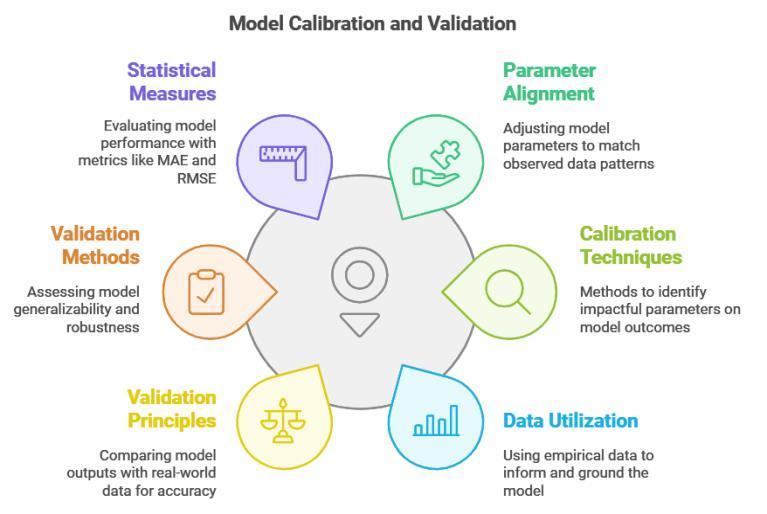
Fig-3:Conceptualapproachformodelcalibrationand validation.
TheoreticalImplications
Iterative Refinement: Highlight that calibration and validation are iterativeprocesses. Theoretical models are refined continuously based on new data and insights, improving their accuracy over time.
ReliabilityandCredibility:Stresstheimportance of these processes in establishing the model's credibility, making it a valuable tool for urban plannersanddecision-makers.
Even without running simulations, discussing how simulation and scenario analysis contribute to understandingpedestrianflowisvaluable.
Baseline Scenario: Describe the concept of establishing a baseline scenario that represents current conditions. This serves as a reference
point for evaluating the impact of any proposed changesorinterventions.
Intervention Scenarios: Theoretically explore variousscenariosthatcouldbesimulated,suchas:
o Infrastructure Changes: Adding or removing walkways, modifying street layouts,oralteringpublicspacedesigns.
o Policy Implementations: Introducing pedestrian-only zones, adjusting traffic signal timings, or implementing crowd controlmeasures.
o Event Simulations: Modeling pedestrian flow during special events, festivals, or emergencysituations.
Flow Patterns and Behaviors: Discuss how simulations can reveal patterns in pedestrian movement, identify potential congestion points, and assess the effectiveness of different urban designs.
ComparativeAnalysis:Explaintheimportanceof comparingdifferentscenariostodeterminewhich interventions might lead to optimal pedestrian flowandsafety.
Decision Support: Emphasize that, in theory, simulation and scenario analysis provide valuable insights that support urban planning decisions without the need for costly or disruptive realworldexperiments.
Risk Assessment: The conceptual use of simulations allows planners to assess potential risks and outcomes associated with different urbandesignstrategies.
Level of Service: Level of Service (LOS) is a measureofagents(people)inadefinedspace.Itis based on the average speed of the agent and the area.Animportantmetrictoanalyzepedestrianas wellastrafficflows.
While actual model implementation involves practical steps, discussing the considerations theoretically is essential to understanding the challenges and requirements of integrating data-driven approaches with agent-basedmodeling.
Conceptual Requirements: Acknowledge that complexmodelsrequiresignificantcomputational power. Theoretically, this involves understanding the limitations and ensuring that models are designedefficiently.
International Research Journal of Engineering and Technology (IRJET) e-ISSN:2395-0056
Volume:11Issue:10|October2024 www.irjet.net p-ISSN:2395-0072
Scalability: Discuss the importance of designing models that are scalable, allowing them to be adapted to different urban environments or expandedincomplexityasneeded.
SoftwareandTools
Differentsoftwaresandtoolscansupportvariedscenarios andscalesofprojects.Thefollowingtoolsareusedbymost planners in North America. These tools help in data analytics,visualization,andrealtimemetricsevaluation.
Replica
Streetlight
OasysMassMotion
INRIX
Locus
CATTLab
ApplicationsinDesignIndustry
Theagentbasedmodelingcanhelpintestingscenariosfor a wide scale of project types ranging from Transit, Performing Center, Healthcare Facilities, Stadiums, SidewalksandPublicopenspaces.
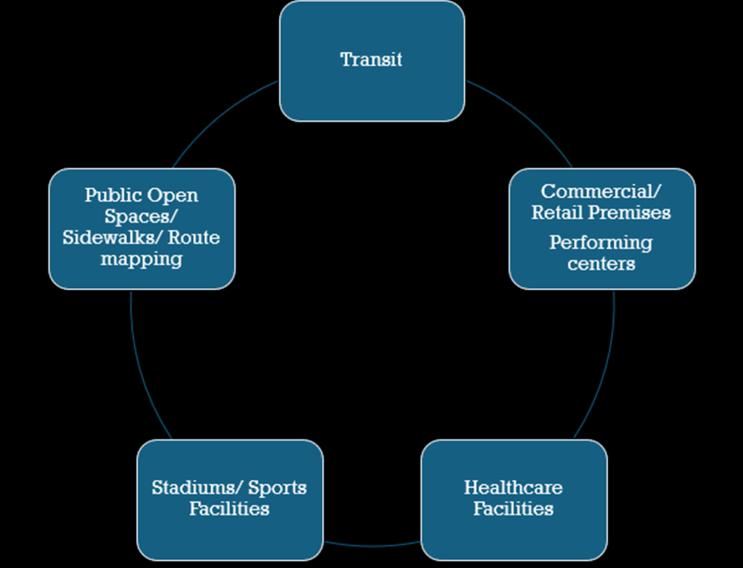
Fig-4:ApplicationsinDesignIndustry
EthicalandPrivacyConsiderations
Data Privacy: Emphasize the importance of adhering to ethical standards and regulations when collecting and using data, even in a theoreticalcontext.
AnonymizationTechniques:Discussmethodsfor ensuringthatindividualprivacyisprotected,such as data aggregation or anonymization, which are crucialconsiderationsinmodeldevelopment.
InterdisciplinaryCollaboration
Collaborative Approach: Highlight the need for collaboration among urban planners, data scientists, sociologists, and other stakeholders to
ensure that the model is comprehensive and accountsforvariousperspectives.
Knowledge Integration: Theoretically, integrating knowledge from different disciplines enhancesthemodel'srobustnessandapplicability.
ChallengesandMitigationStrategies
Theoretical Challenges: Acknowledge potential challenges such as data quality issues, computational limitations, or the complexity of accuratelymodelinghumanbehavior.
Mitigation Approaches: Discuss strategies for addressing these challenges, such as simplifying models where appropriate, using representative data samples, or focusing on key behavioral factors that have the most significant impact on pedestrianflow.
Strengths:
Agent-based modeling is highly effective for simulating how pedestrians move in urban areas. A key benefit is its capacity to simulate specific individual actions and engagements with precision. ABM captures the unique qualities and interactions of pedestrians by portraying them as independent agents with distinct traits and decision-making abilities. This detailed method enables a precisecomprehensionofhowindividualbehaviorsplaya partinlargergroupbehaviorslikecrowdformations,lane formation, and congestion patterns. Moreover, ABM is extremely versatile and can be easily adjusted, allowing for simulations in different situations and circumstances. This is beneficial for urban planners who are evaluating variousdesignoptionsorstrategiesformanagingcrowds.
Limitations:
Despiteitsstrengths,ABMalsohassignificant limitations. Itsdependencyontheoreticalassumptionstodefineagent behaviors and interactions is a notable issue. Lack of empirical data may result in inaccurate modeling of pedestrian dynamics, leading to less dependable predictions. Furthermore, ABM may require significant computational resources, particularly when modeling numerous agents with intricate relationships in vast settings. Computational complexity can restrict the scalabilityofmodelsandtheirutilityinreal-timeorlargescale simulations. Moreover, the absence of empirical validation in certain ABMs brings up concerns regarding their precision and usefulness in guiding urban design choices.
International Research Journal of Engineering and Technology (IRJET) e-ISSN:2395-0056
Volume:11Issue:10|October2024 www.irjet.net
Strengths:
Data-driven modeling approaches offer the benefit of usingempiricalevidenceinsimulationsofpedestrianflow. Through the utilization of data obtained from sensors, cameras,andobservationsintherealworld,thesemodels are able to reach a high level of predictive accuracy and dependability. Utilizing various data sources allows for a thorough insight into pedestrian actions, capturing movement paths, changes in speed, and crowd levels. These data-driven models have an empirical basis that enables them to accurately represent pedestrian dynamics, making them useful for real-world situations like building evacuations and urban space management. Moreover,data-centricmodelshavetheabilitytoadjustto fresh data inputs, improving their ability to respond to fluctuatingconditionsinurbansettingsthatareconstantly changing.
Limitations:
However, data-driven modeling has limitations that may affectitsefficiency.Asignificantobstacleistherelianceon comprehensive, quality data sets, which may not be accessible at all times due to limitations in resources or privacyissues.Gatheringandanalyzingextensiveamounts of data may take a lot of time and money, which could restrict the model's flexibility and usefulness in various scenarios.Moreover,despitebeingeffectiveinrecognizing patterns in data, data-driven models may not completely grasp the underlying decision-making processes of individuals, including their motivations and preferences thatimpactbehavior.Themodel'spredictionofbehaviors in new or unfamiliar situations may be restricted by the absence of understanding of individual cognitive processes.Finally,modelscreatedforparticularsituations may not perform effectively in different settings without considerableadjustmentsandvalidation.
Table-1: ComparativeAnalysisofModelingApproaches
Aspect Agent-Based Modeling
DataSources Theoretical assumptions;limited empiricaldata
Agent Representation Explicitmodelingof individualagentswith specificbehaviors
Behavioral Rules Predefinedbasedon theoretical considerations
Application Focus Simulatinggeneral pedestrian movementsinurban settings
Strengths Capturesindividual behaviorsand interactions;flexible andadaptable
Limitations Computationally intensive;relieson assumptions
Data-Driven Modeling
Multi-source empiricaldata (sensors,cameras, observations)
Implicit representation throughdata patterns
Derivedfrom observeddata patterns
Modelingspecific scenarios(e.g., building evacuations)
p-ISSN:2395-0072
Highpredictive accuracy;grounded inreal-worlddata
Datadependency; maynotcapture decision-making processesfully
Data Quality and Availability: High-quality, granular data is necessary to inform agent behaviorsaccurately.
Computational Demands: Combining datadriven methods with ABMs increases computationalrequirements.
Complexity of Model Development: Integrating different methodologies requires expertise in bothdataanalysisandsimulationmodeling.
5.1
Integrating data-driven approaches with agent-based modelinghassignificantimplicationsforurbandesign:
Improved Planning: Accurate predictions of pedestrian flow enable better visioning of the design of public spaces, infrastructure, and evacuationroutes.
Dynamic Management: Models inform real-time management strategies during events or emergencies.
Enhanced Safety: Understanding pedestrian behaviors leads to safer design strategies that reduce accidents, overcrowding and improve comfortandsafety.
Data Privacy: Collecting detailed movement data raises privacy concerns addressed through anonymizationandregulatorycompliance.
Bias and Representation: Ensuring models do not inadvertently introduce biases affecting certainpopulationsdisproportionately.
Transparency: Maintaining transparency in data useandmodeldevelopmenttobuildpublictrust.
Real-Time Modeling:Developingmodelscapable of processing live data feeds for immediate predictionsandrecommendations.
Scalability: Enhancing models to handle larger urban areas and more complex environments withoutsacrificingaccuracy.
International Research Journal of Engineering and Technology (IRJET) e-ISSN:2395-0056
Volume:11Issue:10|October2024 www.irjet.net p-ISSN:2395-0072
Interdisciplinary Collaboration: Bringing together experts from urban planning, computer science, sociology, and ethics to develop efficient models.
Combining data-driven methods with agent-based modeling creates great potential to improve urban design and optimize pedestrian flow. From the theoretical analysis and possible integration methods discussed in this study, various recommendations are put forward for researchers,urbanplanners,andpolicymakers.
ForResearchers,itiscrucialtostriveformethodological innovation through the exploration of new methods to successfully combine data-driven techniques with agentbased models. Advancing this integration will contribute tothedevelopmentofmore accurateandrealistic models of pedestrian behavior. Researchers need to prioritize developing strong validation frameworks to guarantee that these models accurately represent real-world behaviors. This involves using rigorous testing methods and comparing simulation outputs with empirical data to establishcredibility.Additionally,itisessentialtosupport open data projects. By promoting policies that facilitate accesstonecessarydatawhileensuringethicalstandards, researchers can enhance model development and encouragecollaborationwithinthescientificcommunity.
Urban Designers and Planners are encouraged toadopt advancedmodelingtechniquesandintegratethemintothe planningprocesstoenhancedecision-making.Byutilizing AI and ML tools, urban designers can obtain a better understanding ofpedestrian behaviors,resultingin urban areas that are more effective and pleasant to live in. Investingindatainfrastructureisessential;supportingthe deployment of sensors and data collection systems will provide the necessary inputs for these advanced models. Additionally, it is essential to offer training and educational resources for planners in order to guarantee they possess the necessary skills and knowledge to efficientlyusethesetechnologies.
PolicyMakers playapivotalroleinenablingtheeffective incorporation of these methodologies. Establishing regulatory frameworks that balance data utilization with privacy protection is essential. Policies should safeguard individual privacy rights while allowing for the collection and use of data necessary for model development. Also crucial is the involvement of the public, discussing data collection and model deployment with communities promotes transparency and trust. Policymakers can guarantee that progress in urban design is socially responsible and well received by addressing public worries and emphasizing the advantages of these technologies.
This paper provided a detailed analysis of predictive modelingmethodologiesforpedestrianflowoptimization, focusingontheintegrationofdata-drivenapproacheswith agent-based models. Combining these methodologies offers a promising path forward in urban design and planning,mergingtheaccuracyofempirical data with the depthofbehavioralsimulationinputsandanalyses. Byaddressingchallengesassociatedwithintegration,such as data requirements and computational demands, urban plannersandresearcherscandevelopmodelssignificantly enhancing the efficiency and livability of urban environments. Collaborative efforts across disciplines and sectors are essential to realize the full potential of these methodologies, ultimately contributing to safer, more responsive,andsustainablecities.
[1] Helbing,D.,&Molnár,P.(1995).Socialforcemodelfor pedestrian dynamics. Physical Review E, 51(5), 4282–4286.https://doi.org/10.1103/PhysRevE.51.4282
[2] Kerridge, J., Hine, J., & Wigan, M. (2001). Agent-based modelling of pedestrian movements: The questions thatneedtobeaskedandanswered. Environment and Planning B: Planning and Design, 28(3), 327–341. https://doi.org/10.1068/b2697
[3] Zhang, J., Klingsch, W., Schadschneider, A., & Seyfried, A. (2011). Data-driven pedestrian dynamics modeling with multi-source data for building evacuation. Automation in Construction, 20(5), 616–628. https://doi.org/10.1016/j.autcon.2010.12.001
1 Kunal Chhatlaniisa practicingDesign TechnologyLead in the United States. He holds a Bachelor of Architecture from D.Y. Patil College of Architecture under the University of Mumbai and a Master’s in Architectural Design from Georgia Tech, where he advanced his expertise in digital tools and BIM management. With extensive experience in construction and design technology,KunalhasledprojectsinvolvingcomplexMEP systemsandadvancedBIMapplications.
2 Sakshi Nanda is a practicing Urban Designer in the United States. She holds a Bachelor of Architecture from the University of Mumbai and is a licensed architect in India. Additionally, she earned a Master of Science in Urban Design from the Georgia Institute of Technology, where she deepened her expertise in creating equitable, sustainable,andinnovativeurbanenvironments.