
International Research Journal of Engineering and Technology (IRJET) e-ISSN: 2395-0056
Volume: 11 Issue: 10 | Oct 2024 www.irjet.net p-ISSN: 2395-0072

International Research Journal of Engineering and Technology (IRJET) e-ISSN: 2395-0056
Volume: 11 Issue: 10 | Oct 2024 www.irjet.net p-ISSN: 2395-0072
Akash Bhagat1 , Bhoj Ram Sahu2
1Research Scholar, M. Tech. (Structural Engg.)
2Assistant Professor, Department of Civil Engineering, Bharti Vishwavidyalaya Durg, Chhattisgarh India.
Abstract - The use of nanotechnology has resulted in substantial advances in the concrete industry, ushering in novel construction methods. Concrete's application in buildings is due to its low cost, strength, and moldability. However, environmental concerns drive research into alternatives. Adding ultra-fine additives, such as nano-silica, can improve cementitious system performance, reduce maintenanceandlifecyclecosts,andenhancethepropertiesof plastic and hardened materials, resulting in a more sustainable construction process. The most recent breakthroughsinnanotechnologyprovidehopefulsolutionsto thesedifficulties.Thisstudyinvestigatesthesimultaneoususe of nano silica (NS) and nano-titanium dioxide (NTiO2) to improve the mechanical qualities and sustainability of concrete. This study investigates the influence of nano-silica and nano-titanium dioxide (nano-TiO₂) on the mechanical characteristics of concrete. As a result, combining nanoparticles is more helpful than using them alone. Many studiessupportthe inclusionofnanoparticlestooptimizethe use of concrete in building structures, both alone and in combinationtostudythefreshandhardenpropertiesofnano silica and nano titanium dioxide with partial replacement of cementindifferentpercentagesuchas0%,1%1.5%,3%, and 3% 2.5%, 1% are evaluated.
Key Words: conventional concrete, Concrete mix with nano material (Nano-silica and Nano-titanium dioxide, Workability,Compressive-strength,Tensile-strength,and Flexural-strength.
Concreteisthemost-commonbuilding-materialbecauseof its strength, durability, and low cost. Civil engineering constructionsfrequentlyemployit,anditsversatilitymakes itidealforawiderangeofconstructionprojects.However, worries about the an environmental-impact of cement manufacturing have prompted continued research into alternatives. The goal is to create more durable and ecologicallyfriendlyconcretewhileloweringmaintenance andlife-cycleexpenses.Theuseofultra-fineadditivessuch asnano-silicaandnanotitaniumdioxidecanincreasethe properties of plastic and hardened materials, making concreteapreferredalternativeforconstructionprojects.
1.1 Nanotechnologies in concrete:
Since its first examination in the late 1980s, the use of nanoparticles to improve the mechanical behavior of cementitious composites has been the topic of ongoing research for nearly two decades. Nanomaterials offer incrediblefeaturesandcapacitiesthatcanimproveconcrete behavior. Nano-SiO2, made up of pozzolanic components thatreactwithcementhydrationproducts,isoneofthemost widely used nanomaterials. The inclusion of nano-SiO2 improvedcementqualitiessuchascompressiveandflexural strength, resistance to water penetration, sulfate defense, and reduced calcium leaching. Nanotechnology remains a rapidlygrowingsectorinwhichresearchersfromavariety of industries, including construction, continue to seek breakthroughs.Nonetheless, the -concrete is the world's mostusedbuildingmaterialduetoitslowcostandstrength. With rising demand each year, over 4.2 billion tons of cementweremanufacturedin2019.Itisvitaltonotethat the identical materials at the nanoscale have different properties than those at the microscale. This study investigatesof-thesimultaneoususeof-nanosilica(NS)and nano titanium oxide (NTO) to improve the mechanical qualitiesandsustainabilityofconcrete.Thepercentagesof nano silica are 1%, 1.5%, and 3%, respectively, whereas nanotitaniumdioxideis3%,2.5%,and1%.Followingthe experimentalinvestigation,thestrengthsofthemechanical propertiesgrewastheamountofnano-silicaintheconcreteincreased,whiletheconcrete'sworkabilitydecreased.
This research aims to investigate how nanoparticles affectthemechanical-propertiesofconcretematerial.
Thestudyaimstotestthefreshandhardeningqualities of nano silica and nano titanium dioxide with varying percentagesofcementsubstitution,including0%,1%, 1.5%,3%,2.5%,and1%.
Nano-TiO2 hardness increases proportionally with nanofillerconcentration.
Praveen Kumar et al. (2019) soughttoassessthe performancefeaturesofricehuskash(RHA)based self-compacting concretes including micro TiO2. Theconcreteshadawater-to-binderratioof0.41,
International Research Journal of Engineering and Technology (IRJET) e-ISSN: 2395-0056
Volume: 10 Issue: 03 | Mar 2024 www.irjet.net p-ISSN: 2395-0072
with10%RHAreplacingcement.Thenanoparticle additionsrangedfrom1%to5%,respectively.The results showed that adding 3% nano-TiO2 increased compressive strength by 8.5% when comparedtocontrolconcrete,splittensilestrength by 18%, and flexure strength by 13%. The durabilitycharacteristicsstatethatat3%ofnanoTiO2,thechloridepenetrationisless,asevaluated usingRCPTtest,andthepercentageofweightlossis reducedfollowingthehydrochloricacidassault.
Mukherjee and Barai (2014) the compressive strengthandpropertiesoftheInterfacialTransition Zone (ITZ) of concrete using recycled aggregates and nano-silica. The addition of nano-silica improved concrete's compressive strength and microstructure.
Mostafa Jalal et al. (2013) Usingflyashandnano titanium oxide, we sought to examine the performance characteristics in both fresh and hardenedconditions.Thecementwassubstituted with15%flyash,andnanoTiO2levelsrangedfrom 1%to5%.Thedeclineinfreshstatepropertieswas offset by the incorporation of fly ash into the composite. However, the permeability properties drasticallyreducedwiththeadditionofnano-TiO2. The results showed that at 4% nano-TiO2, the compressive strength, split tensile strength, and flexure strength rose to their maximum when compared to control concrete. The durability characteristics show that at 4% nano-TiO2, the percentage of water absorption is lower, and the chloride penetration depth is reduced due to the densified microstructure. In an attempt to assess durabilityattributesofSCCcontainingfourdifferent typesofnanoparticles(NanoTio2,NanoZro2,Nano Al2o3andNanoFe2o3)A.H.Shekarietal.(2011) reportedthatthechloridepenetrabilityinconcrete can be reduced up to 80% in comparison to conventionalconcretewitha1.5%additionofnano particles.
4.1 Nano silica and nano titanium dioxide: We bought powdered nano-silica from various manufacturers and investigate the effects of nano-silica penetration on to the fresh characteristics of concrete after lab testing-we discovered95%ofnano-silicaparticlesare12nminsizeand haveaspecificgravityof2.4.NTiO2isavailableforpurchase, with particle sizes-ranging from 15-30nm. The photocatalyticpropertiesofnano-titaniumoxidearehighly valued,asisitsabilitytoimprovesthecompressivestrength and lifespan-of-concrete, especially under hard environmental conditions. The combined impact of nanotitaniumdioxideandnano-silica.Althoughtherehasn'tbeen
muchresearchonthemtogether,earlystudiesshowthatthe freshandhardenedcharacteristicsofconcretehavegreatly enhanced.
4.2 Cement: The main component/or leading material in cementcompositionislime,isbindingmedium60-65%of the composition, and the remaining components are combined inthe right ratio toform cement;cement isthe propertiesforcohesionwhichaccountsthematerialsother thanlimearesilica,alumina,magnesia,ironoxide,sulphur trioxide, and alkali. The specific-gravity and a fineness ofcementare3.070and8%,respectively.
4.3 Fine Aggregate: Theaggregate,forthemostpart,passes through the 4.75 mm IS filter and contains no coarser particlesthanthestandardallows.Accordingtothesource, fine aggregate can be defined as: The current study's fine aggregatewasriversand,whichwaseasilyavailablelocally andmetIS383:1970'sGradingZoneII.Severaltestswere doneontherawsampletodeterminethequalityofthefine aggregates;alltestingwascarriedoutinalaboratorysetting in accordance with Indian laws. It should be absolutely inactive.Thegrainshouldbecrisp,powerful,andangular.It shouldbewell-graded.Itsspecific-gravity,water-absorption, and fineness-modulus are, respectively, 2.461, 1.121, and 2.571%.
4.4 Coarse aggregate: Coarse particles are the principal componentoftheconcretemix.Aggregatesclassedascoarse rangeinparticlesizefrom4.75mmto20mm.Severaltests wereperformedontherawmaterialtoestablishthequality of the coarse aggregates, and all of the results were discoveredafterthetestwascompletedinthelab.Alltests werecompletedinalaboratoryinaccordancewithIndian standards.Thecoarseaggregatespecific-gravity,finenessmodulus,andwater-absorptionvaluesare2.570,7.29,and 0.79%,respectively.
4.5 Water: Clean,freshwaterdevoidoforganiccomponents, silt,oil,sugar,chloride,andacidicchemicalsisusedtocast and cure the specimens. Cement paste, produced by hydration, binds aggregate particles to form a flexible concretemixture.Whileitisused,ordinarytapwatermight lead to segregation in excess. Water is essential to the creationofcementgel,andbothitsquantityandqualityneed to be carefully considered. Water meeting IS 456-2000 requirementswasutilizedformixingandcuring.
5. MIX DESIGN STEPS FOR M-35 GRADE CONCRETE MIX:
(A) Design Required:
1.Gradeofconcretemix=M-35
2.Typeofcementmaterial=OPC53grade
3.Sizeofaggregate=20mm
International Research Journal of Engineering and Technology (IRJET) e-ISSN: 2395-0056
Volume: 10 Issue: 03 | Mar 2024 www.irjet.net p-ISSN: 2395-0072
3.Degreeofsitecontrol=Goodcondition
4.Exposurecondition=Very-severe
5.Workabilityofconcrete=75mm(assumed)
6.Methodofconcrete-place=manually
7.Minimumcement-content=340.00Kg/m3
(B) Test result for material:
I. Sp.gravityofcement=3.071
II. Sp.gravityofcoarse-aggregate=2.571
III. Sp.gravityoffine-aggregate=2.461
IV. Water-absorptionof(coarse-aggregate)=0.791
V. Waterabsorptionforsand(fine-aggregate)=1.121
VI. Conformingofsand=zone-II
(C) Target mean strength = 43.250N/mm2
(D) Selection of w/c(water-cement) ratio= 0.51
(E) Selection of water-content = 169.904 kg/m3
(F) Selection of Cement content = 375.490 kg/m3
(G) Selection of coarse aggregate = 991.094 kg/ m3
(H) Selection of fine aggregate = 555.310 kg/m3
5.1 Tests on concrete mixture: Slump Cone test for workability of concrete: Constructing a concrete workabilitytestisrequiredsinceconcretecanbemixed, transported,andusedincertainapplications.Theslump test is the common way to determine workability-ofconcrete.Thistestisthemostoftenusedprocedurefor assessingconcreteconsistency,whetheron-siteorina laboratory.Theslump-coneisfilledwiththreelayersof newly mixed concrete, each stamped 25 times with a standard rod. The C:S: A ratio for normal concrete is 1:1.90:3.41, but the ratio for nano-silica concrete is 1.1.99:3.55.
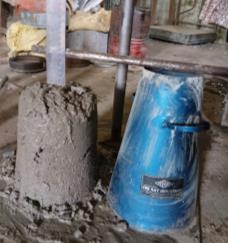
Table-1 SlumpValuesofConventionalConcrete Addition of nano silica and nano titanium dioxide is Inclusiondecreasesworkability.
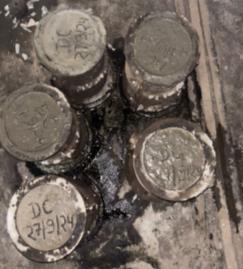
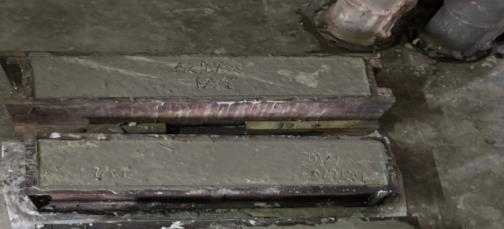
6.1 CASTING OF SPECIMEN: Thespecimenswerecastedin the-cube,cylinder,andbeammouldssampleswerecuredin awaterpondforaperiodofsevenandtwenty-eightdays.At seven and twenty-eight days of age, the nanomaterial concretewascomparedtonormalconcretesamples.
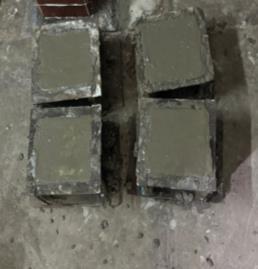
6.2 Compressive Strength test: The size of the concretecubespecimenwas150×150×150mm,and ittestedin7daysand28daysaftercuring.Pisthe load,andAisthecross-sectionalarea,theformula forcompressivestrength=P/��
2024, IRJET | Impact Factor value: 8.226 | ISO 9001:2008
International Research Journal of Engineering and Technology (IRJET) e-ISSN: 2395-0056
Volume: 10 Issue: 03 | Mar 2024 www.irjet.net p-ISSN: 2395-0072
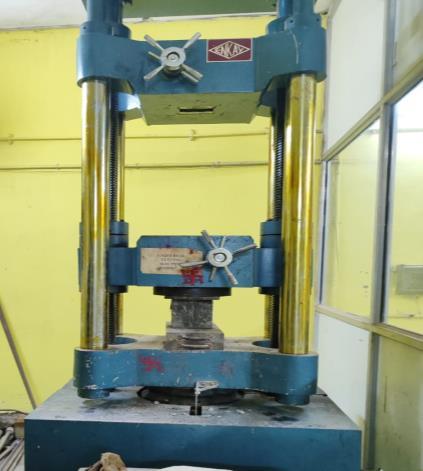
Table-02 CompressiveStrengthresultsforConcrete.
6.3 Split tensile strength: Using cylinders for split tensilestrengthitsdiameterof150mmandaheight of 300mm. It took seven and 28days to pour and test the cylinder. P is the load, D is the cylinder's diameter,andListhecylinder'slength.Thetensile strengthisequalto2P/πDL.
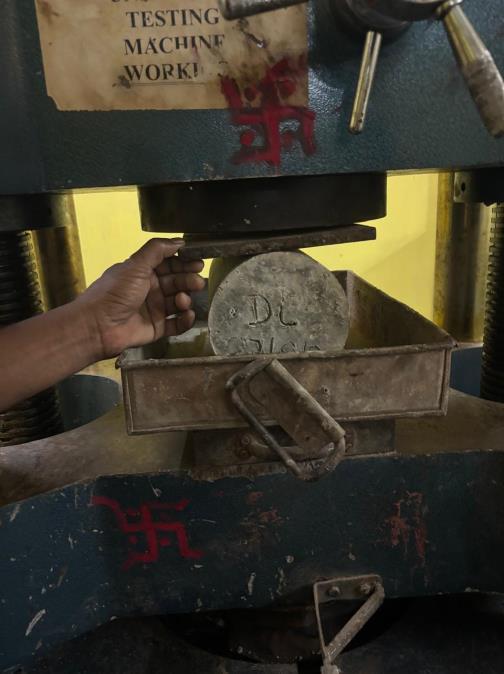
Table-03 Tensile-Strengthresultsforconcretespecimens:

chart-1: Compressivestrengthbehaviourfor conventional-concreteafter07-&-28-daysvsnanosilicate concrete.
International Research Journal of Engineering and Technology (IRJET) e-ISSN: 2395-0056

Chart-2: Tensilestrengthbehaviourofconcreteafter7 and28-daysvsnanosilicateconcretemix.
6.4 Flexural Strength test: the bending is produced a universaltestingapparatusappliedaforceof2000KNtoa specimenofabeamof150x150x700mmsizeobservedthat thestrengthoftheconcretemixhadgrownbetween7and 28days.WL/bd2=fstrength.
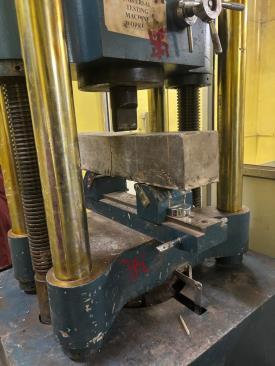
Fig-: flexuralstrengthtestinU.T.M.
Table-4 Flexural-Strengthresultsforconcretespecimen:

Chart-3: Flexuralstrengthbehaviourofconventional concreteafter7and28-daysvsnanosilicateconcretemix.
8. CONCLUSION:
Presentstudy,itwasconcludedthattheadditionof different concentrations of nano silica and nano titaniumsilicate nano particlesenhancedsomeof thematerialproperties.
Increasedhardnessoftheconcretespecimen.
The most optimum enhancement is 1% for this work.
Theaforementionedresultindicatesthatachieves 1% of the mix-35's compressive, and tensile strengthsascomparetoconventionalconcretehave samegrade.
9. SCOPE OF RESEARCH:
Evaluationofthebond,creep,shrinkage,andother engineering parameters of concrete treated with nano-silicaisnecessary.
Thecreationofconcretewithnano-silicainjection that is lightweight and incredibly durable Need shouldbetheprimarysubjectofstudy.
REFERENCES:
1. IS 10262:2009 Recommended Guidelines for ConcreteMixDesignBureauofIndianstandardNew Delhi.
2. BureauofIndianStandardsIS516:1959Methodsof TestsforStrengthofConcrete.
3. Indian Standard code 456:2000 of practice for general structural use of plain and reinforced concrete.
Volume: 10 Issue: 03 | Mar 2024 www.irjet.net p-ISSN: 2395-0072 © 2024, IRJET | Impact Factor value: 8.226 | ISO 9001:2008 Certified Journal | Page780
International Research Journal of Engineering and Technology (IRJET) e-ISSN: 2395-0056
Volume: 10 Issue: 03 | Mar 2024 www.irjet.net p-ISSN: 2395-0072
4. Method of tests for strength of concrete. Specification for 53 grade ordinary Portland cement.
5. MayankNigam,ManvendraVerma“Effectofnanosilica on the fresh and mechanical properties of conventional concrete” Department of Civil Engineering, GLA University, Mathura, Uttar Pradesh,India.
6. DeepikaRana,Dr.G.P.Khare,Mr.DushyantKumar Sahu,“Experimentalstudyofstrengthpropertyof concreteusingnanosilica”.
7. Haneen AlTawaiha, Fadi Alhomaidat and Tamer Eljufout“AReviewoftheEffectofNano-Silicaonthe Mechanical and Durability Properties of CementitiousComposites”.
8. Ms.S.Bharathi,Dr.A.M.Arunmohan,Dr.A.Karthik, Hariharan,ArwinExperimentalStudyonStrength ofConcreteUsingNanosilica”.
9. IS383:1970Codeforfineandcoarseaggregatefor concrete.
10. ConcreteTechnology:TheoryandPracticebyM.S. Shetty.
11. ConcreteTechnology:TheoryandPracticebyM.L Gambhir.
12. ConcreteTechnology:byS.S.Bhavikatti.
13. Ms.S. Bharathi1, Dr.A.M. Arunmohan2, Dr.A. Karthik3, Hariharan A4, Arwin S5 “Experimental StudyonStrengthofConcreteUsingNanosilica”
14. VivekRangnekar“Experimentalanalysisoneffectof nano silica on the compressive strength of concrete”.
15. Petro E Mabeyo1 and Jun Gu2 Coupled Effects of Hydrophilic Nano Silica Oxide and Anatase Nano TitaniumOxideonStrengthsofOilwellCement.
16. Dhuha A. Shakir, BDS and Faiza M. Abdul-Ameer, MSc “Effect of nano-titanium oxide addition on somemechanicalpropertiesofsiliconeelastomers for maxillofacial prostheses” Department of Prosthodontics,CollegeofDentistry,Universityof Baghdad,Baghdad,Iraq.
17. Abhilash P. P. a, ⇑, Dheeresh Kumar Nayak a, BhaskarSangojub,RajeshKumarVeerendraKumar “Effectofnano-silicainconcrete;areview”
18. L.Senffa,b,D.Hotzab,S.Lucasc,V.M.Ferreirac,J.A. Labrinchaa Effect of nano-SiO2 and nano-TiO2 addition on the rheological behaviour and the hardenedpropertiesofcementmortars.
19. T.R. Praveenkumar, M.M. Vijayalakshmi, M.S. Meddah,Strengthsanddurabilityperformancesof blendedcementconcretewithTiO2nanoparticles and rice husk ash, Construction and Building Materials 217 (2019) 343–351, https://doi.org/10.1016/j.conbuildmat.2019.05.04 5.
20. J.Ren,Y.Lai,J.Gao,ExploringtheinfluenceofSiO2 and TiO2 nanoparticles on the mechanical properties of concrete, Constr. Build. Mater. 175 (2018) 277–285, https://doi.org/10.1016/j.conbuildmat.2018.04.18 1
21. A.H. Shekari, M. Razzaghi, S, “Influence of nano particlesondurabilityandmechanicalpropertiesof high-performance concrete, Procedia Eng. 14 (2011) 3036–3041, https://doi.org/10.1016/j.proeng.2011.07.382.
22. Nazari,S.Riahi,“TheeffectsofTiO2nanoparticles onphysical,thermalandmechanicalpropertiesof concreteusinggroundgranulatedblastfurnaceslag asbinder,MaterialsScienceandEngineering:A528 (4–5) (2010) 2085–2092, https://doi.org/10.1016/j.msea.2010.11.070
23. Nazari,S.Riahi,“TheeffectofTiO2nanoparticleson water permeability and thermal and mechanical properties of high strength self-compacting concrete, Mater. Sci. Eng., A 528 (2) (2010) 756–763,https://doi.org/10.1016/j.msea.2010.09.074