
International Research Journal of Engineering and Technology (IRJET) e-ISSN: 2395-0056
Volume: 10 Issue: 03 | Mar 2024 www.irjet.net p-ISSN: 2395-0072

International Research Journal of Engineering and Technology (IRJET) e-ISSN: 2395-0056
Volume: 10 Issue: 03 | Mar 2024 www.irjet.net p-ISSN: 2395-0072
Aiswarya M1 , Chithra K G2
1Student, Department of Civil Engineering, JCET, Kerala, India
2Assistant Professor, Department of Civil Engineering,JCET ,Kerala, India
Abstract - Ice Pigging is an innovative pipeline cleaning method that utilizes a slurry of ice and water to effectively remove accumulated deposits from pipes. This semi-solid slurry, known as the “ice pig,” is formed by a dense suspension of small ice crystals that behaves like a plug, efficiently scrubbing the interior walls as it moves through the pipeline under pressure. Originally developed for applications like sewer and wastewater systems, Ice Pigging has recently gained traction in drinking water distribution systems due to its ability to remove sediment, biofilm, and other residues without using harsh chemicals or requiring extensive downtime. Despite its benefits, Ice Pigging has raised concerns regarding its impact on bulk water quality, sparking debate within the industry. Critics argue that as the ice melts and mingles with residual sediments or organic materials, there may be an increased risk of contaminant release into the water supply. Conversely, proponents claim that the process, if conducted properly, minimizes contamination risk and can even improve water quality by removing potential contamination sources. While studies have shown that Ice Pigging is effective in removing deposits, more research is needed to fully understand its potential effects on water quality, especially in drinking water systems, where purity is paramount.
Key Words: Ice Pigging, Ice Slurry, Bulk Water Quality, DrinkingWaterDistributionSystem,BulkWaterQuality
1.INTRODUCTION
Public health is strongly linked to the safety of drinking water. The quality of drinking water often declines when distributed through water distribution systems. The concept of using ice for pipeline cleaning emerged as an innovative response to the limitations of conventional cleaning methods like mechanical pigging, air scouring, and chemical flushing Traditional methods frequently need large amounts of water, are abrasive, or use chemicals that might pose risks to the environment and health. In contrast,ice pigging offers a gentle yet effective cleaning approach that leverages the unique properties of ice–primarilyitssemi-solidstateanditsabilitytoconform todifferentpipegeometries
Ensuring the safety and quality of drinking water is a crucial priority for water utilities. However, challenges within drinking water distribution system (DWDSs) can
compromise water quality. Drinking water distribution can be affected by the release of pipe materials, biofilm detachment, and the resuspension of loose deposits. Additionally, sediments and microorganisms in DWDSs are responsible for discoloration, metal ion release, and bacterial level increases.Watercompany’s clean pipelines toremovesediments and microorganisms inDWDSs fora continuous,safe,andreliablewatersupply.
IcePiggingisa pipe-cleaningprocessthatusesa slurryof ice crystals and water to remove sediments, biofilms, and otherresiduesfromtheinteriorofpipelines.Knownasthe "ice pig," this semi-solid, flowable plug moves through pipes under pressure, scrubbing their surfaces more effectively than traditional methods. Initially developed for wastewater and sewer systems, Ice Pigging is now used in drinking water distribution systems due to its ability to clean without chemicals or heavy equipment. While effective, concerns remain about its potential impact on water quality, as melting ice may release residualcontaminantsintothewatersystem.
Ice pigging operates on the principle of using a highly viscousiceslurrytoscourandcleantheinteriorsurfacesof pipes.Theiceslurryiscreatedbymixingfinelyground ice withwatertoformadense,flowablemixture.Theslurryis then introduced into the pipeline, where it moves under hydraulicpressure.
The preparation of an ice slurry is a critical step in Ice Pigging, as the composition and consistency of the ice determine the effectiveness of the cleaning process. The delicate balance requires technical expertise and specialized equipment to produce an effective, stable slurrythatcanperformindiversepipelineenvironments.
Thefirststepinpreparingiceslurryistoproducetheice, whichformsthebasisof theslurry.Commercial-grade ice makersaretypicallyusedtoproducethenecessaryice,as
International Research Journal of Engineering and Technology (IRJET) e-ISSN: 2395-0056
Volume: 10 Issue: 03 | Mar 2024 www.irjet.net p-ISSN: 2395-0072
these machines can quickly and consistently generate large quantities. The preferred types of ice for slurry productionareflakeiceandcrushedice,bothofwhichmix effectivelywithwater.
Flake ice, often favored for its thin, flat shape, provides a large surface area, enhancing its ability to combine with water. Flake ice machines achieve this by freezing a thin layerofwaterontheinnersurfaceofarefrigerateddrum, which is then scraped off as flakes by a rotating blade. Crushed ice, on the other hand, is made by grinding or crushing larger blocks of ice into smaller, manageable piecesusingicecrushers.Theirregularshapesandvaried sizes of crushed ice make it highly effective for slurry production by increasing the abrasive action during the pipelinecleaningprocess.
Theice-to-waterratiodependsonthedesiredconsistency of the slurry and the specific application. Common ratios rangefrom1:1to2:1(icetowaterbyvolume).Thequality and temperature of the water are crucial to ensure effectiveandsafepipelinecleaning.Thewaterusedshould be clean and free of contaminants, especially in potable water systems, where it must meet drinking water standards to avoid introducing any impurities into the pipeline during the cleaning process. Additionally, the water temperature should be at or just above freezing typically around 0°C to prevent the ice from melting prematurely. Cooling the water before mixing it with the icehelpsmaintaintheconsistencyandeffectivenessofthe slurry.
The final step in preparing the ice slurry is to adjust its consistency to ensure it meets pipeline cleaning requirements.Thisconsistencyisprimarilydeterminedby viscosity,whichmeasurestheslurry'sresistancetoflow.It should be thick enough for abrasive action but fluid enoughtofloweasily.Aftermixing,viscosityistestedwith aviscometer.Iftheslurryistoothin,moreiceisadded;if toothick,additionalwaterisincorporated.Temperatureis also monitored and adjusted to prevent ice melting or freezingsolidly.Continuousmonitoringensurestheslurry maintains the ideal consistency for immediate use in cleaningpipelines.
4.1
The first and critical step in the ice pigging process is isolatingthesectionofthepipelinetobecleaned,ensuring the operation is confined to the targeted area without affectingotherpartsofthewaterdistributionsystem.The
procedure begins by identifying the correct isolation points, typically valves located at the boundaries of the section to be cleaned. The operational status of these valves must be verified and well-documented. Once identified,theisolationvalvesareclosedtodisconnectthe section from the rest of the system, preventing the ice slurryfromenteringotherareas.
After closing the valves, a leakage check is performed to confirm that the isolation is complete, involving monitoring pressure and flow within the isolated section to detect any unexpected water movement that might indicate a leak. Additionally, appropriate safety precautions are implemented to prevent accidental reopeningofthevalvesduringthecleaningprocess,which mayincludelockingoutthevalvesandmarkingthemwith warningsigns.
The step of inserting the ice slurry involves introducing the semi-solid mixture into the isolated section of the pipeline, which scours the walls to remove accumulated debris such as sediments, biofilm, and rust. This process begins with the preparation of the ice slurry, which is carefully monitored to maintain the correct ice-to-water ratio,ensuringitisneithertoothicknortoothin.
Next, injection equipment, including pumps and hoses, is setupatthedesignatedentrypoint,creatingasecureand leak-proofconnectionbetweentheslurrystoragetankand thepipeline. The slurryisthenslowlyintroduced into the pipelineatalowflowratetoavoidhydraulicshock,which coulddamagethepipeorcausetheslurrytofreezeinside. During this insertion, pressure within the pipeline is continuously monitored to ensure the slurry moves uniformly without blockages. Once the slurry is flowing smoothly, the flow rate is gradually increased to enhance the cleaning effectiveness. Finally, the ice slurry is introduced into the pipe through a fire hydrant or similar fitting, with downstream pressure regulated at the outlet, creatinganicepigthataidsinthecleaningprocess.
Opening the upstream valve allows the ice slurry to be pushed through the pipeline section by the normal water flow from the system, ensuring that the slurry travels the full length of the isolated section for thorough cleaning. The procedure begins with a controlled opening of the upstream valve, located at the beginning of the isolated section, which is done gradually to prevent subjecting the slurry to sudden high pressures that could cause it to breakupormelttooquickly.
As the upstream valve opens, the flow rate of the water entering the pipeline is carefully controlled to match the desired speed of the slurry movement, maintaining the
International Research Journal of Engineering and Technology (IRJET) e-ISSN: 2395-0056
Volume: 10 Issue: 03 | Mar 2024 www.irjet.net p-ISSN: 2395-0072
integrity of the ice pig and ensuring consistent cleaning action throughout the pipeline section. The movement of the slurry is continuously monitored using flow meters and pressure sensors, allowing operators to verify that it is traveling at the correct speed and effectively cleaning the pipe walls. Additionally, maintaining continuous communication between personnel controlling the upstreamvalveandthosemonitoringthedownstreamexit point is essential for coordinating the process and ensuringtheicepigreachestheendofthepipelinesection effectively.
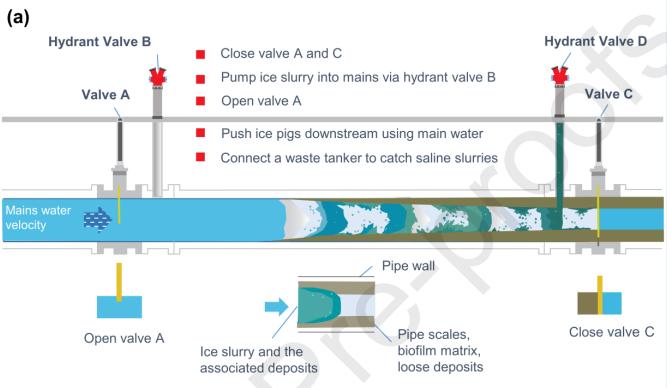
Thepreparationofthedownstreamexitpointiscrucialfor collectingtheicepig, which involvesconnectinga hose or pipe to direct the expelled slurry into a holding tank or sewer system, ensuring the connection is secure to preventleakageorspillage. Astheicepigreachestheexit point,itisexpelledfromthepipelinealongwithdislodged debris,andthemixtureisdirectedintotheholdingtankor disposal system, where the ice melts quickly, leaving behind solid debris. Continuous monitoring of the exit flow is essential to ensure that all slurry and debris are effectivelycollected.
To prevent the expelled slurry from re-entering the clean water system, measures are implemented to isolate the collection point from the rest of the water distribution network. The collected debris is then analyzed for its compositionandquantitybeforedisposal,whichiscarried outinaccordancewithlocalregulations.Thismayinvolve transportingthedebristoatreatmentfacilityorlandfillto ensureproperwastemanagement.
The cleaning process concludes with flushing the pipeline section using clean water to remove any remaining ice particles and debris. This is achieved by gradually fully opening the upstream valve to allow a steady flow of water through the pipeline until the expelled water runs clear, indicating successful debris removal. Throughout the flushing, water quality is closely monitored, checking parameters such as turbidity, chlorine levels, and microbial content to ensure the pipeline remains safe for drinkingwaterdistribution.Followingtheflushing,afinal inspection is performed using CCTV cameras or other diagnostic tools to confirm that the pipeline is free of debrisandingoodcondition.
Once the inspection is complete, the isolation valves are reopened carefully to reconnect the cleaned section with the rest of the water distribution system, taking care to avoid pressure surges or disturbances in water flow. The pipeline is then gradually brought back into normal operation by slowly increasing the flow rate to match system demand, with ongoing water quality monitoring to address any potential issues. Final water quality tests are conducted to ensure compliance with regulatory standards for drinking water. Finally, customers are informed that the cleaning process is complete and their water service has been fully restored, along with any necessary advisories, such as flushing hometapstoeliminateanyresidualsediment.
Icepiggingoffersseveraladvantagesforcleaningdrinking water distribution networks, making it an increasingly popular choice among water utilities. Firstly, this method utilizes a semi-solid mixture of ice and water, which effectivelyscrubstheinteriorsurfacesofpipeswithoutthe needforharshchemicals.Thisisparticularlyimportantin drinkingwatersystems,asithelpsmaintainwaterquality andsafetywhileensuringthatnoharmfulresiduesareleft behindafterthecleaningprocess.
Another significant benefit is the ability of ice pigging to remove a variety of contaminants, including sediments, biofilms, and rust, which can accumulate in pipes over time. By efficiently dislodging these materials, ice pigging helps to improve water flow and pressure within the distribution system, ultimately enhancing the overall efficiency of water delivery. Additionally, the process can beconductedwithminimaldisruptiontothewatersupply, as it often requires only localized isolation of sections of thepipeline,allowingforcontinuedservicetocustomers.
Icepiggingisalsoenvironmentallyfriendly;itreducesthe needforextensiveexcavationorreplacementofpipelines, minimizing the environmental footprint associated with
International Research Journal of Engineering and Technology (IRJET) e-ISSN: 2395-0056
Volume: 10 Issue: 03 | Mar 2024 www.irjet.net p-ISSN: 2395-0072
traditional cleaning methods. Moreover, the process is quick and effective, often requiring less time than conventional cleaning techniques. Finally, the use of ice pigging can lead to longer-lasting infrastructure by reducing corrosion and buildup within pipes, ultimately resulting in lower maintenance costs and improved reliability of the water distribution network. Overall, ice pigging presents a modern, efficient solution for maintaining the integrity and safety of drinking water systems.
Ice pigging represents a highly effective and innovative approach to cleaning drinking water distribution networks. By utilizing a semi-solid ice slurry, this method not only removes accumulated sediments, biofilms, and rust but also enhances water quality without introducing harmful chemicals. The ability to conduct the cleaning process with minimal disruption to service ensures that customers receive continuous access to safe drinking water while maintaining the efficiency of the distribution system.
Moreover, ice pigging is environmentally friendly, reducing the need for extensive excavation and pipeline replacement, which lessens the overall impact on surrounding ecosystems. The quick execution of this technique contributes to lower operational downtime, making it a practical solution for water utilities. Additionally, by prolonging the lifespan of infrastructure and minimizing maintenance costs, ice pigging ultimately supports the sustainability and reliability of drinking water systems. As water quality standards become increasingly stringent, ice pigging stands out as the integrity and safety of drinking water a modern, efficient, and responsible choice for maintaining distribution networks.
[1] YujingHuang,ZhiweiChen,GuilinHe,YuShao,Shuang Song, Feilong Dong, Tuqiao Zhang, “Application of Ice Pigging in a Drinking Water Distribution System: ImpactsonPipesandBulkWaterQuality”(2024)
[2] YujingHuang,FeilongDong,GuilinHe,QiufengLin,Da Wang, Yu Shao, Shuang Song and Tuqiao Zhang, “Review of Ice Slurry Pigging Techniques for the Water Supply Industry: Engineering Design and Application”(2022)
[3] JiaminHu,DavidFernandesdelPozo,IngmarNopens,Ji ayingWang,HexiangYan,KunlunXin,TaoTao “Ice slurry pigging technology in drinking water distribution system: From flow mechanisms to pipelinescleaningapplication”(2024)
[4] BeataNiezgodaZelasko“Transportoficeslurryinthe pipelinesofcentralairconditioningsystemsinmining plants(2023)
[5] K Ervin, M Friedman, R Moore “The New Ice Age: Pigging Effectively Cleans Water and Wastewater Pipelines”(2014)
*© 2024, IRJET | Impact Factor value: 8.315 | ISO 9001:2008 Certified
|