
International Research Journal of Engineering and Technology (IRJET) e-ISSN:2395-0056
Volume: 11 Issue: 10 | Oct 2024 www.irjet.net p-ISSN:2395-0072

International Research Journal of Engineering and Technology (IRJET) e-ISSN:2395-0056
Volume: 11 Issue: 10 | Oct 2024 www.irjet.net p-ISSN:2395-0072
Prof. Miruna JoeAmali1 , Roshni Sri KA2,Priyadharshini T2 , Rithika R2
1Professor and Head of the Dept.ofComputerScienceandEngineering,KLNCollegeofEngineering,Pottapalayam, Sivagangai, Tamil Nadu, India
2B. E Student, Dept. of Computer Science and Engineering, K L N College of Engineering, Pottapalayam ,Sivagangai, Tamil Nadu, India
Abstract - The proposed model presents a comprehensive system for detecting and assessing stress in employees based on text messages, using machine learning techniques. The system utilizes the Naive Bayes algorithm to classify text inputs as stress-related or non-stress-related, and it calculates a stress percentage using both a machine learning model and a keyword-based approach. The analysis is further refined by asking employees to input their weekly working hours and daily sleep duration. These additional factors, coupled with the text analysis, provide a holistic picture of the employee's stress levels. By incorporating machine learning and personal input data, the system ensures a highly accurate and context-sensitive assessment ofstress.
The system evaluates stress at three different levels: low, moderate, and high. If stress is detected in the text, but the working hours remain within the company's set average and the sleep duration is 6 hours or more, the system classifies the stress level as low. In such cases, employees are regarded as managing stress effectively, and the system offers general suggestions to maintain balance based on their working hours. When stress is identified in the text and either the working hours exceed the average or sleep is insufficient (less than 6 hours), the system flags a moderate stress level. In this case, it provides personalized suggestions, helping the employee manage their workload or improve sleep patterns. Finally, if the text indicates stress and both factors excessive working hours and insufficient sleep are present, the stress level is labeledhigh, requiring immediate attention and more focused intervention. If no stress is detected in the text, the system offers suggestions based on working hours alone to promote well-being and maintain a healthy worklife balance. This stress detection system aims to enhance workplace well-being by providing tailored, real-time recommendations that help employees manage stress effectively
KEYWORDS: Machine Learning, Naive Bayes Algorithm, Stress Detection, Text Analysis, Employee Well-being
1.INTRODUCTION
In today's fast-paced work environment, employee wellbeing has become a critical factor for both individual
productivity and organizational success. Stress, if left unaddressed, can significantly impact an employee's performance,mentalhealth,andoveralljobsatisfaction.To tackle this issue, a comprehensive stress detection and assessmentmodel hasbeen developed,leveragingmachine learning to analyze employee text inputs alongside their working hours and sleep patterns. By integrating these factors, the model offers a highly accurate, personalized approach to identifying and managing stress. The core of this system utilizes the Naïve Bayes algorithm to classify text messages as either stress-related or non-stressrelated.Thisclassificationisfurtherrefinedbycalculatinga stress percentage through a combination of machine learning and a keyword-based analysis. However, the system goes beyond simple text analysis by incorporating additional key factors employees’ weekly working hours and daily sleep duration. By considering these objective metrics alongside the subjective text input, the model provides a holistic picture of each employee’s stress level. The system evaluates stress across three levels: low, moderate, and high. When stress is detected through text but is mitigated by balanced working hours and sufficient sleep,thesystemflagsalowstresslevel,indicatingthatthe employee is managing well.If either working hours exceed the company’s set average or sleep falls below 6 hours, moderate stress is identified, and personalized recommendations are provided. In cases where both excessive working hours and poor sleep patterns are present, the stress level is classified as high, triggering immediate attention and intervention. By combining machine learning with real-time data input, this model ensuresacontext-sensitiveanddynamicapproachtostress management,aimedatenhancingemployeewell-beingand promotingahealthierwork-lifebalance.
[1] Analyzing Perceived Psychological and Social Stress of UniversityStudents:AMachineLearningApproach-Ishrak Jahan Ratul, Mirza Muntasir Nishat, Fahim Faisal, Sadia Sultana,AshikAhmed,MdAbdullahAlMamun.Theconcept of the study revolves around using machine learning techniquestobetterunderstandthefactorscontributingto stress among university students. Traditional methods of stress assessment often rely on self-reported surveys,
International Research Journal of Engineering and Technology (IRJET) e-ISSN:2395-0056
Volume: 11 Issue: 10 | Oct 2024 www.irjet.net p-ISSN:2395-0072
which may not fully capture the complexity of stress experiences. This study leverages machine learning algorithms to analyze diverse data points, such as academic performance, social relationships, and demographic factors, to identify key predictors of psychological and social stress. By using both supervised and unsupervised learning, the study uncovers patterns andtrendsthatofferamorenuancedunderstandingofthe stressorsaffectinguniversitystudents.
[2]Early Mental Stress Detection Using Q-Learning Embedded StarlingMurmuration Optimiser-BasedDeep LearningModel-S.K.R.Moosavi,M.H.Zafar,F.Sanfilippo, M.N.AkhterandS.F.Hadi. This system integratesQ-learning with a Starling murmuration-inspired optimization technique within a deep learning model for early mental stress detection. Q-learning helps the model adapt in realtime, while the murmuration technique optimizes performance. Deep learning identifies complex stress patterns from physiological data. This approach enables proactive, real-time stress monitoring and can be integratedintowearabletechnologyforcontinuousmental healthsupport.
[3]Ensemble Hybrid Learning Methods for Automated Depression Detection -M. N. Ali,M. AmerandM. Elsisi. This system examines hybrid and ensemble methods for automated depression detection using text data from sources like social media. Hybrid models combine classifiers to better capture depressive patterns, while ensemble methods enhance accuracy. Key challenges include symptom variability, privacy concerns, and potential biases in training data. Performance is evaluated using metrics such as accuracy, precision, and recall to assessdepressiondetectioneffectiveness.
[4]CalibrationofTransformer-BasedModelsforIdentifying StressandDepressioninSocialMedia-L.Ilias,S.Mouzakitis and D. Askounis. This study leverages advanced natural language processing (NLP) techniques, particularly transformermodels,todetectmentalhealthconditionslike stress and depression through social media data. By finetuningpre-trainedmodelsonaccuratedataset,theauthors enhance the model's ability to identify subtle linguistic cuesindicativeofemotionaldistress.
Theresearchdemonstratesthattransformer-basedmodels outperform traditional machine learning methods in predictive accuracy, offering valuable insights for early mental health intervention. The paper also addresses ethicalconcerns,suchasprivacyandresponsibleAIusein mentalhealthdiagnostics.
The existing system for identifying stress in text messages primarily utilizes the Support Vector Machine (SVM) algorithm as its core classification method, known for its
effectiveness in high-dimensional spaces. It analyzes various forms of written communication, such as social media posts and chat messages, to classify them as indicative of stress or not. The system begins with data collection, followed by an extensive preprocessing phase that includes tokenization, normalization, and stop word removal.Afterpreprocessing,featureextractiontechniques like Term Frequency-Inverse Document Frequency (TFIDF) are employed to convert text into a numerical format suitable for SVM input. The SVM model is then trained on labeled datasets to identify the optimal hyperplane separating stress and non- stress messages. While the approach demonstrates a systematic methodology, it faces significant challenges, including high computational costs, dependency on effective feature extraction, and a lack of transparencyindecision-making.
The complexity of the SVM algorithm can result in difficulties in interpreting classifications, particularly critical in mental health contexts. Additionally, the system risks over fitting due to high dimensionality and has limitations in handling non-linear relationships. Overall, whileeffectiveindetectingstress,thesystemhighlightsthe need for ongoing research to address its limitations and improveperformance.
The proposed system is a comprehensive tool designed to monitorandassessemployeestressusingacombinationof textanalysisandpersonaldatainputs,primarilyemploying theNaïveBayesalgorithmfortextclassification.Itanalyzes written communication, such as emails and messages, to detect stress- related indicators while incorporating a keyword-baseddetectionapproachforenhancedaccuracy.
Alongside text analysis, employees provide personal metricslikeweeklyworkinghoursanddailysleepduration, allowing for a nuanced evaluation of stress contributors. The system categorizes stress into three levels low, moderate, and high based on text analysis and personal data, facilitating targeted interventions. Employees receive tailored recommendations for managing stress, which include general well-being tips and specific strategies for workloadandsleepimprovement.Thisproactiveapproach helps identify early signs of stress, enabling timely interventions to prevent burnout. Moreover, the system promotes a healthy work-life balance by offering suggestionsevenwhennostressisdetected,fosteringlongtermwell-being.
By integrating psychological and lifestyle factors, the system provides a holistic understanding of employee stress, ultimately enhancing workplace well-being and productivity.
International Research Journal of Engineering and Technology (IRJET) e-ISSN:2395-0056
Volume: 11 Issue: 10 | Oct 2024 www.irjet.net
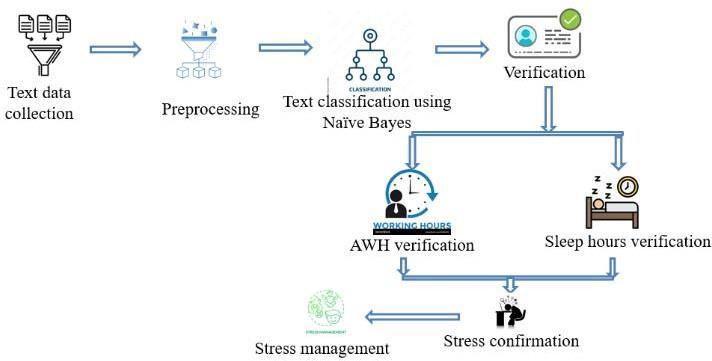
Fig 1-Architecture of the system
A system designed for stress detection and management throughtextanalysisandlifestylemonitoring.Itbeginswith text data collection, where user inputs, such as text messages, provide insights into mental states. The preprocessingstagecleansandformatsthedataforanalysis, removing irrelevant information and handling missing values.
The system employs a Naive Bayes classifier to analyze the text and detect stress levels based on linguistic patterns. Verification follows, checking lifestyle factors like average working hours and sleep hours to identify potential stress triggers. If stress is confirmed, the system recommends management techniques such as time management and relaxation exercises. This integrated approach combines emotional analysis with lifestyle monitoring, offering personalizedfeedbackforeffectivestressmanagement.
5.1 Text data collection
TextDataCollectionandProcessinginvolvesgatheringtext messages from various sources. Sources include SMS, social media platforms, and messaging apps like Whats App and Facebook. API integration and automated data collection tools facilitate efficient data gathering. Collected data must ensure accuracy, completeness, and sufficient volume. Data quality assurance checks are performed to validate data integrity. Machine learning algorithms, specifically Natural Language Processing (NLP), extract relevant features. Text classification and language modeling tasks benefit from this processed data. Scikitlearn and NLTK libraries provide essential tools for NLP tasks. Effective text analysis enables applications like sentiment analysis and topic modeling. By leveraging large-scale text data businesses can gain valuable insights intocustomeropinionsandbehaviors
5.2Text classification using Naive Bayes
Text preprocessing phase aimed at enhancing model accuracy by removing noise from the input data. This involvesconvertingalltexttolowercase,tokenizingwords intomanageableunits,andeliminatingstopwordsthat do not add significant meaning to the analysis. The cleaned
p-ISSN:2395-0072
and processed text is then used to define two class labels: “Stress”and“NoStress,”allowingthesystemtoclassifytext messagesaccordingly.Thecoreoftheclassificationprocess integrates a keyword detection approach with a Naive Bayes training model, which effectively categorizes the messages into either "Stress" or "No Stress" based on the presenceofstress-relatedtermsandpatterns.Additionally, the system calculates a stress percentage by applying a stress probability function, providing a more nuanced understanding of the detected stress levels. To ensure the effectiveness of stress detection, the performance of the Naive Bayes model is evaluated using various metrics, including accuracy, precision, and recall. This evaluation helps identify the model's strengths and weaknesses in detecting stress. Furthermore, the system assigns points based on the stress level: five points are given if stress is detected,whiletwopointsareassignedifnostressisfound. Thisscoringmechanismservesasanintuitivewaytogauge overall employee stress levels, intuitive way to gauge overall employee stress levels, contributing to a more comprehensive assessment of mental well-being in the workplace.
Themoduleassessesemployeestressbycomparingweekly working hours to a set average threshold. If hours exceed this threshold, two stress points are assigned, while sleep entries under six hours also receive two stress points. The total stress level points are calculated by adding these points to those derived from text analysis. Employees are notified when their working hours or sleep falls short, accompanied by reminders and suggestions for improvement.Additionally,repeatedinstancesoflowsleep are tracked for further review, allowing for targeted interventions. Based on the total points accumulated, the module recommends personalized stress-relieving techniques,promotingproactivemanagementofstressand encouraginghealthierlifestylechoices.
Stress analysis is based on a comprehensive analysis of several key factors, including text messages classified as "Stress" or "No stress," along with the employee's working hours and sleep duration. The module aggregates points fromthesefactors,providinganumericalrepresentationof stress levels. If the total points amount to 2, it indicates effective stress management, suggesting that the employee is maintaining a healthy balance. A score of 5 signifies low stress, which may warrant attention to ensure it does not escalate.With7points,theresultiscategorizedasmoderate stress,indicatinganeedforproactivemeasures.
A score of 9 reflects high stress, signaling an urgent requirement for intervention. Based on the total points accumulated, tailored suggestions are provided to help employees manage their stress effectively, enhancing their overallwell-beingandproductivity.
International Research Journal of Engineering and Technology (IRJET)
Volume: 11 Issue: 10 | Oct 2024 www.irjet.net
Stress management is facilitated by offering personalized suggestions tailored to the individual employee's needs, basedonthepointscollectedfromtheirstressanalysis.By evaluating the number of working hours and other contributing factors, the system can provide specific recommendations to help alleviate stress. For instance, employees may be encouraged to listen to calming music, whichcanenhancerelaxationandimprovemood.
Additionally, suggestion may include engaging in meditation and yoga, both of which are effective practices for reducing anxiety and promoting mental clarity. Going on a vacation or taking short breaks can also be recommended to help employees recharge and disconnect from work-related pressures. These personalized strategies aim to empower employees to take proactive stepsinmanagingtheirstresslevels,ultimatelyfosteringa healthier work environment. By implementing such tailored interventions, the organization demonstrates its commitmenttoemployeewell-beingandproductivity.
p-ISSN:2395-0072
The system can be transformed into a website that helps more corporate employees manage their stress and wellbeing.Byintegratinghealthmetricslikeheartrate,physical activity, and sleep quality, alongside work-related factors suchasworkloadanddeadlines,theplatformwouldoffera more accurate and comprehensive understanding of stress triggers. Expanding the model to detect a broader range of emotions, including frustration, anxiety, and burnout, wouldprovidedeeperinsightsintoemployeewell-being.
This approach allows for more personalized interventions and solutions, promoting better emotional and mental health management across the workforce, ultimately improvingproductivityandjobsatisfaction.
The system effectively detects employee stress by integrating Naive Bayes text analysis with real-world data, such as working hours and sleep patterns. This hybrid approach enhances accuracy in stress identification through machine learning and empirical metrics. Upon confirming stress, data-driven interventions like workload reduction are implemented to alleviate pressure and improve employee well-being. By continuously analyzing sentiment and behavioral data, the system provides a comprehensive view of mental health, helping employees avoid burnout and maintain focus. This innovative AIdriven model fosters a healthier work environment, benefitingbothemployeesandorganizations.
[1] M. Milyavskaya, M. Saffran, N. Hope, and R. Koestner, ‘‘Fear of missing out: Prevalence, dynamics, and consequencesofexperiencingFOMO,’’Motivat.Emotion,vol. 42,no.5,pp.725–737,Oct.2018.
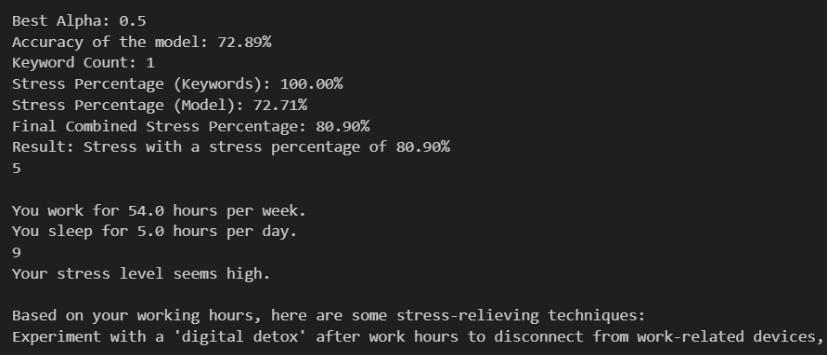
This analysis implements a stress detection and management system using a data set of text messages labeledforstresslevels.Initially,itpreprocessesthetextby cleaning it and removing noise, applying stemming, and filtering out stop words. The code uses a Naïve Bayes classifier trained on TF-IDF features derived from the cleaned text to classify user input as "Stress" or "No Stress."After predictingstresslevels,thecodecalculatesa stress level score based on user input regarding working hours and sleep duration, with points assigned for excessiveworkhoursorinadequatesleep.Thescorehelps categorize stress into four levels: great management, low, moderate, or high stress. Personalized suggestions for Stressmanagementtechniquesaregeneratedbasedonthe number of working hours. The final output provides the user with their stress classification,stress percentage,and tailored techniques to manage their stress effectively, promotingoverallwell-being.
[2] L. Tomczyk and E. Selmanagic-Lizde, ‘‘Fear of missing out (FOMO)Among us in Bosnia and Herzegovina Scale and selected mechanisms,’’ Children Youth ServicesRev., vol.88,pp.541–549,May2018.
[3] S. Mahmud, S. Hossain, A. Muyeed, M. M. Islam, and M. Mohsin,‘‘The global prevalence of depression, anxiety, stress, and, insomnia and its changes among health professionals during COVID-19 pandemic: A rapid systematic review and meta-analysis,’’ Heliyon,vol. 7, no. 7, Jul.2021,Art.no.e07393.
[4] M.H.Akhand,‘‘Factors contributing to mental health problems in Kazakhstan: Literature review,’’ B.S. thesis, Dept.Appl.Sci.,TurkuUniv.,Turku,Finland,2019.
[5] P.W.Corrigan and A.C.Watson, ‘‘Understanding the impact of stigma on people with mental illness,’’Proc.Comput.Sci.,vol.1,pp.16–20,2022.
International Research Journal of Engineering and Technology (IRJET) e-ISSN:2395-0056
Volume: 11 Issue: 10 | Oct 2024 www.irjet.net p-ISSN:2395-0072
[6] H.J.Lim,L.Moxham,C.Patterson,D.Perlman,V.Lopez,andY. S. Goh, ‘‘Students’ mental health clinical placements, clinical confidence and stigma surrounding mental illness: A correlational study,’’ Nurse Educ. Today, vol. 84, Jan. 2020,Art.no.104219.
[7] K. Masood, B. Ahmed, J. Choi, and R. Gutierrez-Osuna, ‘‘Consistency and validity of self-reporting scores in stress measurement surveys,’’ in Proc. Annu. Int.Conf. IEEEEng. Med.Biol.Soc.,Aug.2012,pp.4895–4898
[8] T. W. Wong, Y. Gao, and W. W. S. Tam, ‘‘Anxiety among university students during the SARS epidemic in Hong Kong,’’StressHealth,vol.23,no.1,pp.31–35,Feb.2007.
[9] K. Shamsuddin, F. Fadzil, W. S. W. Ismail, S. A. Shah, K. Omar,N. A. Muhammad, A.Jaffar, A.Ismail, andR.Mahadevan,”Correlates of depression,anxiety and stress among Malaysian University students”,Asian J.Psychiatry,vol.6,no.4,pp-318–323,Aug.2013.
[10]M.M.Al-Shahrani,B.S.Alasmri,R.M.Al-Shahrani,N.M.AlMoalwi,A.A.AlQahtani,andA.F.Siddiqui,‘‘Theprevalenceand associated factors of academic stress among medical students of King Khalid University: An analyticalcrosssectionalstudy,’’Healthcare,vol.11,no.14,p.2029,Jul.2023.
[11] T.McCloud, S.Kamenov, C.Callender, G.Lewis,and G. Lewis, ‘‘The association between higher education attendance and common mental health problems among young people inengland: Evidence from two populationbased cohorts,’’ Lancet Public Health, vol. 8, no. 10, pp. e811–e819,Oct.2023.
[12] J. Friedrich, A. Bareis, M. Bross, Z. Bürger, Á. Cortés Rodríguez, N.Effenberger, M. Kleinhansl, F. Kremer, and C. Schröder, ‘“How is your thesis going?’ Ph.D. students’ perspectives on mental health and stress in academia,’’ PLoSONE,vol.18,Jul.2023,Art.no.e0288103.
[13]H.Almerekhi,H.Kwak,andB.J.Jansen,‘‘Investigating toxicity changes of cross-community redditors from 2 billion posts and comments,’’ PeerJComput. Sci., vol. 8, p. e1059,Aug.2022,doi:10.7717/peerj-cs.1059.
[14]M.M.Tadesse,H.Lin,B.Xu,andL.Yang,‘‘Detectionof depression-related posts in Reddit social media forum,’’ IEEEAccess,vol.7,pp.44883–44893,2019.
[15] R. Shounak, S. Roy, V. Kumar, and V. Tiwari, ‘‘Reddit comment toxicity score prediction through BERT via transformer based architecture,’’ in Proc. IEEE 13th Annu. Inf. Technol., Electron. MobileCommun. Conf.(IEMCON), Oct.2022, pp.0353–0358.
[16] M.Chauhan,S. V. Vora, andD.Dabhi,‘‘Effectivestress detection using physiological parameters,’’ in Proc. International Conference on Innovations in Information, Embedded and Communication Systems, vol. 2017, pp-014-018.