
International Research Journal of Engineering and Technology (IRJET) e-ISSN: 2395-0056
Volume: 11 Issue: 10 | Oct 2024 www.irjet.net p-ISSN: 2395-0072

International Research Journal of Engineering and Technology (IRJET) e-ISSN: 2395-0056
Volume: 11 Issue: 10 | Oct 2024 www.irjet.net p-ISSN: 2395-0072
Shahina K H1 , Chandni P K Divakaran2
1Student , Department of Civil Engineering, JCET, Kerala, India
2Assistant Professor, Department of Civil Engineering , JCET, Kerala , India
Abstract – Air pollution caused by industrial processes, vehicle emissions, and other anthropogenic activities presents significant health and environmental risks. Biofiltration is a sustainable andcost-effective methodused for the purification of air contaminated with volatile organic compounds (VOCs), hydrogen sulfide (H2S), and other pollutants. This process leverages microbial activity within a biofilter, where pollutants are absorbed into a moist biofilm and subsequently degraded by microorganisms. The biofilter typically consists of a packed bed of organic or inorganic materials that support the microbial community. As air passes through the filter, contaminants are metabolized into harmless byproducts likecarbondioxideandwater.Thisexploresthemechanisms ofbiofiltration, the designof biofilters, types of filter media, andthekeyfactorsinfluencingtheefficiencyofbiofiltration, such as pH, temperature, and moisture content. Additionally, advancements in biofiltration technology and its applications in industrial air treatment and indoor air quality management are discussed, demonstrating its potential as an environmentally friendly solution for air pollutioncontrol.
Key Words: Biofiltration , Air pollution, Microorganisms, VOCs,Airquality
1.INTRODUCTION
Air pollution has become a pressing environmental issue, with increasing concerns over the health and ecological impacts of gaseous emissions from industrial activities, vehicularexhaust,andurbandevelopment.Traditionalair pollutioncontroltechnologies,suchaschemicalscrubbers and catalytic converters, although effective, often entail high operational costs and energy consumption. In response to the growing demand for sustainable, costeffective solutions, biofiltration has emerged as a promising alternative for the treatment of contaminated airstreams.
Biofiltration is a biological air treatment process that leverages the metabolic activity of microorganisms to degrade pollutants. Contaminated air is passed through a packed bed filter containing a biofilm of microbial communitiesthatmetabolizeandconvertharmfulorganic and inorganic compounds into harmless end products, suchascarbondioxide,water,andbiomass.Theprocessis particularly effective for removing volatile organic
compounds(VOCs),ammonia,hydrogensulfide,andother malodorousorhazardousgasesfromindustrialemissions.
The microorganisms live in a thin layer of moisture, the “biofilm”, which surrounds the particles that make up the filtermedia.Duringthebio filtrationprocess,thepolluted airstreamisslowlypumpedthroughthebiofilterandthe pollutants are absorbed into the filter media. The contaminatedgasisdiffusedinthebiofilterandadsorbed onto the biofilm. This gives microorganisms the opportunity to degrade the pollutants and to produce energy and metabolic byproducts in the form of CO2 and H2O.
The biological degradation process occurs by oxidation,canbewrittenasfollows
Organicpollutant+O2=CO2+H2O+Heat+Biomass
In comparison to conventional methods, biofiltration offers several advantages, including lower operational costs, minimal energy requirements, and reduced environmental impact. Additionally, biofilters can handle fluctuating concentrations of pollutants and do not produce secondary pollutants, making them an environmentallyfriendlysolution.However,thesuccessful application of biofiltration depends on the careful selectionofmicrobialspecies,filtermedia,andoperational parameters to ensure efficient pollutant removal and systemstability.
This paper provides a comprehensive review of biofiltration technology, focusing on the principles, mechanisms, and applications of biofilters in various industrialsectors.
Air pollution is one of the quickly rising issues of today’s world. Contaminants are ejected from various origins directlyorIndirectlytotheenvironment.Oneornumerous contaminantalsoexistwithintheairforextendedperiods, whichmayhavefewdetrimentaleffectsonhumans,cattle, and plants. This also influences the international economy and environmental transitions for long periods. Air pollutants are categorized into the following different types.
International Research Journal of Engineering and Technology (IRJET) e-ISSN: 2395-0056
Volume: 11 Issue: 10 | Oct 2024 www.irjet.net p-ISSN: 2395-0072
Primary air pollutants are directly emitted into the atmospherefromnaturalandanthropogenicsources.They include gases like carbon monoxide, sulphur dioxide, and nitrogen oxides, as well as particulate matter and volatile organic compounds. These pollutants can have serious impactsonhumanhealth,ecosystems,andclimate,making their regulation and reduction critical in addressing air qualityandenvironmentalchallenges.
Belowarethemajortypesofprimaryairpollutants:
2.1.1.Carbon Monoxide (CO)
Carbon Monoxide is released in to the air mainly from incomplete combustion of fossil fuels (e.g., from vehicles, industrial processes, residential heating), wildfires, and biomass burning. Carbon monoxide is a colourless, odourless gas that can cause harmful health effects by reducing the amount of oxygen that can be transported in thebloodstreamtocriticalpartsofthebody.
2.1.2.Sulphur Dioxide (SO2)
Sulphurdioxideisagasthatcanbefoundintheairaround us.Itisproducedfromburningfossilfuelslikecoalandoil. Factories and power plants are significant sources of sulphur doxide emissions. Sulphur dioxide can cause respiratoryproblemsandisaprecursortoacidrain,which damagesecosystems,buildings,andcrops.
2.1.3
Nitrogenoxidesformedfromthecombustionoffossilfuels in vehicles, power plants, and industrial processes and natural sources include lightning and microbial activity in soils. NOx can irritate the respiratory system, cause lung diseases,andreducevisibilityintheatmosphere.
2.1.4.Volatile Organic Compounds (VOCs)
It is emitted from vehicle exhaust, industrial processes (suchaspetrochemical productionand painting),solvents, and natural sources (like trees). VOCs contribute to the formationofground-levelozoneandsmogwhentheyreact with nitrogen oxides in the presence of sunlight. Many VOCs, such as benzene and formaldehyde, are harmful to humanhealthandcancancer,respiratoryissues,andorgan damage.
2.1.5.Particulate Matter (PM)
Particulate matter is emitted directly from combustion processes (e.g., vehicles, industrial facilities, residential wood burning), construction activities, dust storms, and It is classified basedased on size, with PM10 (particles less than 10 microns in diameter) and PM2.5 (particles less than2.5micronsindiameter)beingthemostharmful.
2.1.6.
Methane formed from natural gas extraction and transportation, agriculture (livestock emissions, rice paddies),landfills,andwastewatertreatment.Methaneisa potent greenhouse gas that contributes significantly to globalwarming.
2.1.7.
Ammonia contributes to the formation of secondary pollutants,suchasammoniumsaltsandparticulatematter (PM), when it reacts with other chemicals in the atmosphere. It can also cause respiratory irritation and contribute to nitrogen deposition, which harms ecosystems.
2.2.Secondary Air Pollutants
Secondary air pollutants are not emitted directly into the atmosphere but form when primary pollutants undergo chemical reactions in the atmosphere, often involving sunlight (photochemical reactions), water, or other natural compounds. These secondary pollutants are often more harmful than primary pollutants, contributing to issueslikesmog,acidrain,andrespiratorydiseases.
Belowarethemajortypesofsecondaryairpollutants:
2.2.1.Ground-Level Ozone (O₃)
Ground-levelozoneisformedwhennitrogenoxides(NOx) and volatile organic compounds (VOCs) react in the presenceofsunlight,aprocesscalledphotochemicalsmog formation. Ozone at ground level is a harmful pollutant that can cause respiratory problems, exacerbate asthma, andreducelungfunction.
2.2.2.Peroxyacyl Nitrates (PANs)
PANs are formed from the reaction between nitrogen oxides (NOx) and volatile organic compounds (VOCs) in the presence of sunlight. They are a component of photochemicalsmog PANsaretoxictoplants,causingleaf damage and inhibiting growth. They also irritate the eyes andrespiratorysysteminhumans.
2.2.3.
Nitric acid forms when nitrogen oxides (NOx) react with hydroxyl radicals (OH) in the atmosphere. Nitric acid contributestoacidrain,leadingtotheacidificationofsoils and water bodies. It can damage vegetation and aquatic ecosystems and cause the corrosion of buildings and infrastructure
International Research Journal of Engineering and Technology (IRJET) e-ISSN: 2395-0056
Volume: 11 Issue: 10 | Oct 2024 www.irjet.net p-ISSN: 2395-0072
Sulfuricacidisproducedwhensulfurdioxide(SO₂)reacts withwaterandoxygenintheatmosphere,oftencatalyzed by sunlight. Sulfuric acid is a major component of acid rain, which leads to soil acidification, forest damage, and the deterioration of buildings and monuments. Sulfuric acid aerosols play a role in cloud formation and can influence weather patterns by increasing cloud reflectivity,contributingtoglobalcoolingeffects.
Biofiltration has evolved significantly over the centuries, transitioning from basic filtration techniques used by ancient civilizations to sophisticated environmental management technologies. Its origins trace back to early methods such as sand and gravel filtration used by the Egyptians. However, these early systems relied solely on physicalprocesses,lackingthebiologicalmechanismsthat characterizecontemporarybiofiltration.
Scientificexplorationofbiofiltrationbeganinthe19th century, driven by the demands of sanitation in rapidly industrializing cities. In 1829, John Snow demonstrated the efficacy of sand filtration for water treatment, leading toitsintegrationintomunicipalsystems,suchasthewater supply infrastructure in Lawrence, Massachusetts, by the late 1800s. By the early 20th century, biofiltration expanded to wastewater treatment with the development of trickling filters, which utilized microbial activity to degrade organic matter. This period also witnessed the advent of activated sludge systems, further enhancing the biologicaltreatmentofwastewater.
The mid-20th century marked a turning point for biofiltration, as it was adapted for air pollution control. Biofilters began utilizing organic media to support microbial communities capable of degrading volatile organic compounds (VOCs) and other pollutants. In 1923, German scientist Bach introduced the biofilter concept, andbythe1950s,RichardPomeroyhadpatentedsoilbed systems in California, which were among the first to successfully address odor control in waste gases. This innovation underscored biofiltration’s potential in mitigatingindustrialemissions.
During the 1960s and 1970s, biofiltration was further refined, particularly in West Germany, where it was employedtomanageodorsfromsewagetreatmentplants, food processing facilities, and livestock operations. Researchinthiserafocusedonimprovingairflowdesigns and filter media, with municipal solid waste compost being tested as a filter material. These advancements, combined with gas humidification, optimized microbial activityandfilterperformance.
The 1980s saw significant advancements in biofiltration, particularly in Europe. Germany and the Netherlands led the implementation of biofiltration for VOC control in industries such as biochemical plants and printing workshops, as well as for odor management at wastewater treatment facilities. By this time, biofiltration was recognized as a Best Available Control Technology (BACT)forair pollution,offeringa sustainablealternative to traditional methods like incineration and chemical adsorption.
In recent decades, biofiltration technology has continued to progress. Modern biofilters are now capable of treating complex mixtures of contaminants, ranging from single compounds like methanol to hazardous mixtures such as BTEX (benzene, toluene, ethylbenzene, and xylene). The development of bio-trickling filters and hybrid systems has further expanded the efficiency and scope of biofiltration, making it an integral part of sustainable environmental management. Today, biofiltration is a globally recognized solution for the treatment of water, air, and stormwater, valued for its cost-effectiveness, environmental sustainability, and versatilityinaddressingdiversepollutants.
Biofiltration of air is an environmentally friendly method for removing air pollutants, particularly organic compounds, odorous gases, and volatile organic compounds(VOCs).Thisprocessreliesonmicroorganisms that live on a biofilter medium, breaking down contaminants into harmless byproducts. To operate effectively, biofiltration systems require several key components, each playing an important role in the process.
Below is a detailed explanation of the primary components
4.1.Biofilter Media
The biofilter media serves as the substrate for microorganisms and provides the surface area where the biological processes occur. The media is porous, allowing air to flow through while offering ample space for microbial colonization. The characteristics of the media directly affect the efficiency and longevity of the biofilter. Severaltypesofmediaarecommonlyused,including:
Compost:Richinnutrientsandorganicmatter,compostis often used because it promotes the growth of microorganisms.
Peat Moss: Lightweight and naturally abundant, it providesagoodenvironmentformicrobialactivity.
International Research Journal of Engineering and Technology (IRJET) e-ISSN: 2395-0056
Volume: 11 Issue: 10 | Oct 2024 www.irjet.net p-ISSN: 2395-0072
Wood Chips: These provide excellent airflow due to their sizeandshape,makingthemidealforbiofiltration.
The real work of biofiltration is carried out by the microorganisms that grow on the biofilter media. These include bacteria, fungi, and protozoa, which break down contaminants into simpler, non-toxic compounds such as water, carbon dioxide, and biomass. These microorganisms thrive in environments where they have accesstopollutantsasafoodsource,aswellasoxygenand moisture.
Bacteria: The most commonly active microorganisms In biofiltration,bacteria,degradeawiderangeofpollutants.
Fungi:Fungiareeffectiveinbreakingdownmorecomplex, hydrophobic compounds, such as certain volatile organic compounds(VOCs)andodour-causingsulfurcompounds.
Protozoa: Though less common, protozoa can also play a roleindegradingspecificpollutantsOrfeedingonbacteria tocontrolbacterialpopulations.
Thehealthandactivityofthesemicroorganismsare vital for the biofiltration process. Regular maintenance and monitoring of thesystem help to ensure that the microbial community remains active and balanced. The degrading classes In biofilters are typically between 1% and15%oftheall-outbacterial growth.Asignificantpart of the biofiltration investigation has been focused on microorganisms, although fungi have also been studied. Manure has been described to utilize microbes such as Proteobacteria, Actinobacteria, Bacteroidetes, and Firmicutes.Althoughcontrolleddataareaccessibleonthe bacterial networks associated with biofiltration, novel machinery, for example, denaturing gradient gel electrophoresis (DGGE), Temperature gradient , Gel electrophoresis (TGGE), and single-Strand conformation polymorphism (SSCP), have perrmitted for a superior consideration of bacterial growth dynamics within open andclosedbiofilterarrangements.
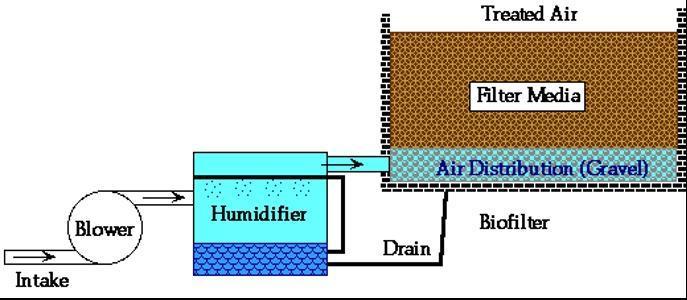
An essential aspect of an air biofiltration system is the proper distribution of air across the biofilter media. The contaminated air must flow evenly through the media to ensureall parts ofthefilter areutilizedandcontaminants are consistently broken down. This is typically achieved throughacombinationof:
Fans:Tomaintainasteadyflowofairintothebiofilter.
Ductwork:Thatchannelstheincomingairtothebiofilter.
Perforated pipes or Diffusers: These are placed within or beneaththebiofiltermediatoensuretheairisdistributed evenlyacrossthesurfaceofthemedia.
Proper air distribution prevents “channeling,” where air flows through certain sections of the biofilter while by passingothers,reducingoveralltreatmentefficiency.
4.4.Humidification
The effectiveness of biofiltration depends heavily on maintainingtherightmoisturelevelinthebiofiltermedia. Microorganisms require a humid environment to metabolize pollutants efficiently, and excessively dry air can reduce microbial activity, leading to system failure to prevent this, a humidification system is used to add moisture to the incoming air stream. This is particularly important in cases where the air is too dry, such as in industrial environments or during certain seasons. The system may involve water sprayers, misters, or steam injectors placed before the biofilter to ensure that air enteringthesystemhastherighthumiditylevel.
4.5.Support Structure or Housing
Thebiofiltermediaandtheairdistributionsystemneedto besupportedwithinacontainmentstructure,whichcould takeseveralformsdependingontheapplication:
BiofilterBeds:Horizontalbedswherethebiofiltermediais spread in layers, often used for treating large air volumes atlowpressures.
BiofilterTowers:Verticaltowerswhereairflowsupwards ordownwardsthroughthebiofiltermedia,usedforspacesavingdesigns.
EnclosuresorChambers:Thesemaybeusedtocontainthe media, ensuring controlled airflow and protecting the system from environmental factors like rain, wind, or temperature fluctuations.
The design and construction of the support structure directlyinfluencethebiofilter’s performance.
4.6.Drainage
Biofiltration systems, especially those that use natural or organic media, require moisture to function effectively. However, excess water can accumulate over time, either from the humidification system or from condensation. To prevent waterlogging or flooding of the biofilter, a drainagesystemisimplemented. Thisconsistsof:
GravelorCoarseMaterial:Atthebottomofthebiofilterto allowwatertoflowthroughwithoutobstructingtheair.
PerforatedPipes:Thatcollectanddrainexcesswater.
International Research Journal of Engineering and Technology (IRJET) e-ISSN: 2395-0056
Volume: 11 Issue: 10 | Oct 2024 www.irjet.net p-ISSN: 2395-0072
Drain Ports: Through which the water is safely removed fromthesystem..
4.7.Monitoring and Control System
Toensureoptimalperformanceofthebiofiltrationsystem, certain key parameters need to be regularly monitored andadjusted.Theseinclude:
Temperature: Microorganisms are most active within a specific temperature range.If the biofilter gets too hot or toocold,microbialactivitycandecrease.
Humidity: Maintaining the rightmoisturelevelsiscritical, as both overly dry and waterlogged conditions can affect microbialactivity.
Air Flow Rate: The flow of air through the biofilter needs tobecontrolledtoensureallpollutantsareexposedtothe microbialprocesses.
pH Levels: Certain pollutants can cause the biofilter’s pH to fluctuate, which can inhibit microbial growth. A monitoring system will track pH levels and, if necessary, triggercorrectiveactions(suchasaddingbuffers).
4.8.Exhaust System
Once the air has passed through the biofilter and the pollutants have been removed, the treated air is vented back into the atmosphere. The exhaust system ensures that the air meets environmental standards and does not containanyresidualharmfulcontaminants.
5.MECHANISM OF BIOFILTRATION
Biofiltration is an advanced biological method for air pollution control, involving the use of microorganisms to degrade air pollutants into harmless byproducts such as carbon dioxide and water. This environmentally sustainable process is highly effective for treating industrial emissions, offering a natural solution to reducing harmful airborne contaminants. The mechanism behind biofiltration involves a complex interaction of physical, chemical, and biological processes within the biofilter system, where the transfer of contaminants from thegasphasetoabiologicallyactivefiltermediumoccurs. This paper aims to provide a detailed explanation of the biofiltration mechanism, highlighting the fundamental processesofsorptionand biodegradation,whichformthe basisofairpurification.
In biofiltration, the contaminated air is introduced into the biofilter, typically entering through the lower portionofthefilteringpool,whereitisevenlydistributed across the surface of the filter medium. The air rises upward through a porous filtering material, which serves as a support for the microorganisms responsible for
degradingthepollutants.Thisfiltermediumcanconsistof organic material such as compost, rocks, activated sludge, or synthetic substrates, designed to prevent long-term compaction and ensure sufficient air permeability. The core of the process is the biofilm a thin layer of water and microorganisms attached to the filter media, where mostofthepollutantdegradationoccurs.
The treatment process in biofiltration relies primarily on two fundamental mechanisms: sorption and biodegradation. Sorption is the process by which contaminants from the gaseous phase are transferred to theliquidorsolidphaseonthebiofiltermedium.Oncethe pollutant is sorbed into the biofilm or dissolved in the water layer surrounding it, the microorganisms use the contaminant as a carbon and energy source for growth andmetabolism.
The biodegradation phase begins once the pollutant isadsorbedintothebiofilm.Themicroorganisms,typically bacteria and fungi, metabolize the pollutant in a series of biochemical reactions, converting it into less harmful byproducts. Organic pollutants, such as volatile organic compounds (VOCs), hydrogen sulfide, and other odorous gases, are broken down into simpler compounds like carbon dioxide, water, and microbial biomass. The biodegradation efficiency is influenced by several factors, includingthepollutant’schemicalnature,thecomposition of the biofilter medium, and the operational conditions withinthebiofilter.
Severalphysical,chemical,andbiologicalfactorsare criticaltotheeffectiveoperationofabiofilter.Maintaining high moisture content in the biofilter bed is essential, as themicroorganisms relyon a waterlayerforsurvival and pollutant degradation. Humidity levels must be carefully regulated, typically between 40-60%, to prevent desiccation of the biofilm, which would reduce microbial activity. Temperature is another critical factor; optimal temperatures for biofiltration generally range between 15°C and 43°C, as microbial activity is temperaturedependent. At lower temperatures, microbial metabolism slows down, leading to reduced degradation efficiency, while temperatures exceeding the optimal range can inhibitorkillthemicroorganisms.
Thebiofilterishousedinanopenorenclosedvessel, ranging in size from small tanks to large industrial-scale buildings, dependingonthe volumeof airto betreated. A blower is used to move the contaminated air through the biofilter, while an air dispersion system ensures an even flow of air through the bed, maximizing the contact between the pollutants and the biofilm. The design of the biofilter must accommodate several operational parameters,suchasthesizeofthefiltermediumparticles, air residence time, and the height of the filter bed, all of whichinfluencetheefficiencyofpollutantremoval.
International Research Journal of Engineering and Technology (IRJET) e-ISSN: 2395-0056
Volume: 11 Issue: 10 | Oct 2024 www.irjet.net p-ISSN: 2395-0072
Through a well-managed combination of sorption and biodegradation, biofilters provide an efficient and cost-effective solution for removing airborne contaminantsfromindustrialemissions.Byoptimizingthe design and operation of the biofilter, including selecting appropriate filter media, maintaining moisture and temperaturelevels,andensuringauniformdistributionof air,biofiltrationcanachievehighremovalefficienciesfora widerangeofpollutants.Thisnatural,sustainableprocess is a valuable tool in the ongoing effort to control air pollution, offering a green alternative to traditional chemicalandphysicalfiltrationmethods.
Biofiltration represents a highly effective and sustainable approach for controlling air pollution, particularly for the treatment of industrial emissions. By harnessing the natural metabolic processes of microorganisms, biofilters can degrade a wide range of airborne contaminants, including volatile organic compounds (VOCs), odorous gases,andhazardouschemicals,intoharmlessbyproducts such as carbon dioxide, water, and biomass. The core mechanisms of sorption and biodegradation are influencedbyvariousfactors,includingthecompositionof the biofilter medium, moisture content, temperature, and the chemical nature of the pollutants. Optimizing these parameters is essential to maximizing the efficiency and longevityofthebiofiltrationsystem.
The advantages of biofiltration, including its low energy consumption, minimal chemical usage, and ability to treat low concentrations of pollutants, make it an appealing solution in the quest for greener, more environmentally friendly air pollution control technologies. Despite challenges such as the need for regular maintenance and operational monitoring, biofiltration’s adaptability and cost-effectiveness continue to drive its widespread adoption in industrial settings. Further research and development in biofilter design and operational strategies will enhance its applicability, enabling it to meet increasingly stringent environmental regulationsandtocontributesignificantlytoimprovingair qualityworldwide.
[1] Avneesh Tiwari, Tauqeer Alam, A. Shukla, Control of Odour , Volatile Organic Compounds ( VOCs ) &Toxic Gases through Biofiltration-An Overview, EnvironmentalScience,2019
[2] Kaushal Yadav , Varun Patil, Sidharth Nair , Puiotechnology castries of Gaseous pollutants using BiofiltrationTechnique,2020
[3] KaramveerSheoran,SamarjeetSinghSiwal,Deepanshi Kapoor, Nirankar Singh, Adesh K. Saini, Walaa Fahad Alsanie, and Vijay Kumar Thakur , Air Pollutants RemovalUsingBiofiltrationTechnique:AChallengeat theFrontiersofSustainableEnvironment ,2022
[4] Mehzabeen Mannan and Sami G. Al-Ghamd , Active Botanical Biofiltration in Built Environment to MaintainIndoorAirQuality,2021
[5] P. Márqueza, J.A. Silesa, M.C. Gutiérreza, J. Alhamab, C.Michánb, M.A. Martína , A comparative study between the biofiltration for air contaminated with limonene or butyric acid using a combination of olfactometric, physico-chemical and genomic approaches,2022
[6] Priyanshi Maurya, Maumita Das Mukherjee, Kumar Rakesh Ranjan , Role of nanobiotechnology in maintaining a hygienic environment for the livestock author links open overlay panel , Nanobiotechnology fortheLivestockIndustry,2023
[7] Rasa Vaiškūnaitė , Using Biofilter Packed with Different Wood Waste Charges for Purification of Air ContaminatedwithBenzene,2021
[8] S Aziz , Performance of Biological Filtration Process for Wastewater Treatment: A review , Environmental Science, Biology, ZANCO Journal of Pure and Applied Sciences,2021
[9] Surekha Kolekar, Ashwini Patil, S.P. Shingare, M.B. Mandake , Biofiltration System for Air Pollution Control :AReview, International ResearchJournal of EngineeringandTechnology(IRJET),2019